
Regulations Amending the Atlantic Fishery Regulations, 1985: SOR/2026-199
Canada Gazette, Part II, Volume 160, Number 20
Registration
SOR/2026-199 September 25, 2026
FISHERIES ACT
P.C. 2026-855 September 25, 2026
Her Excellency the Governor General in Council, on the recommendation of the Minister of Fisheries and Oceans, makes the annexed Regulations Amending the Atlantic Fishery Regulations, 1985 under subsection 43(1)footnote a of the Fisheries Act footnote b.
Regulations Amending the Atlantic Fishery Regulations, 1985
Amendments
1 Part V of Schedule XIII to the Atlantic Fishery Regulations, 1985 footnote 1 is replaced by the following:
LOBSTER FISHING AREAS
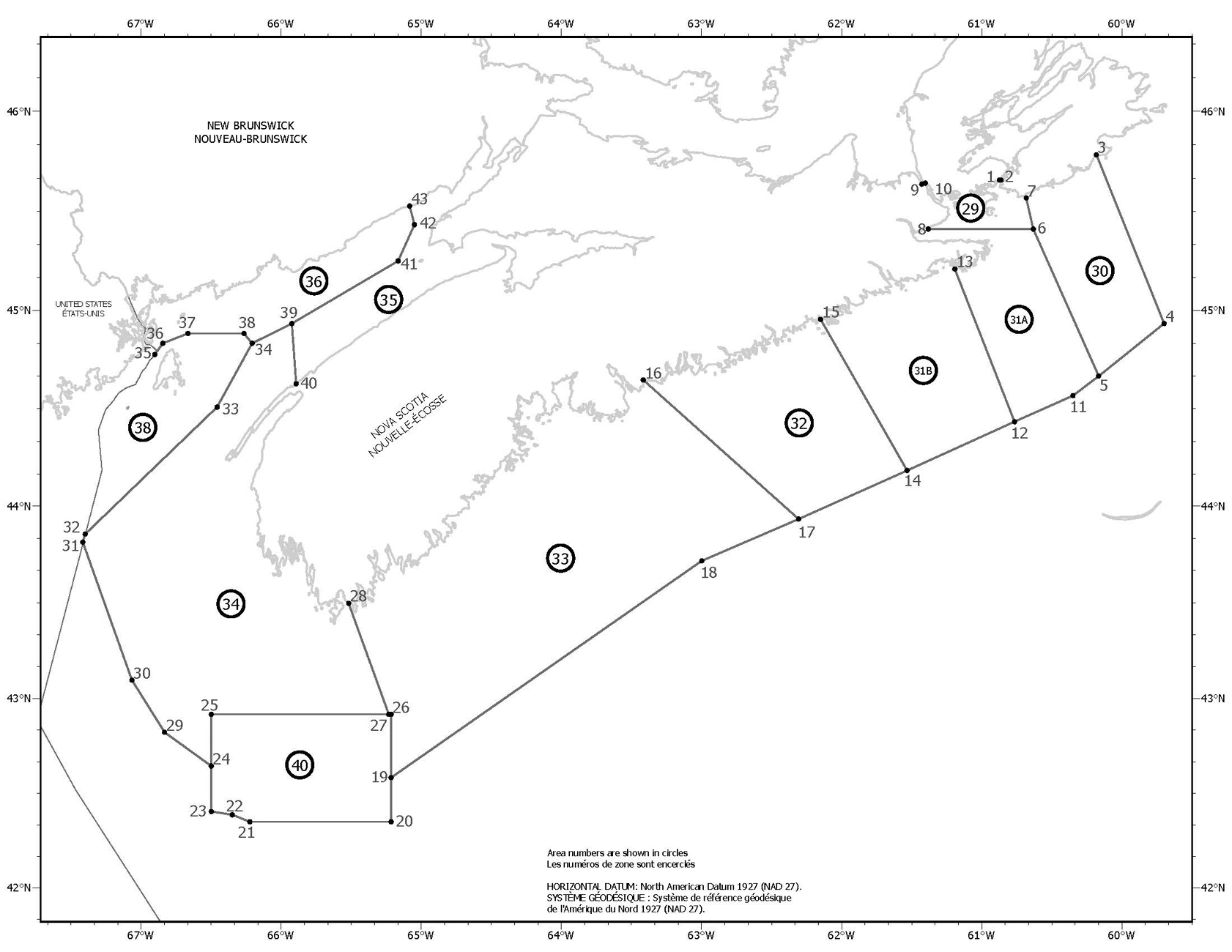
LOBSTER FISHING AREAS - Text version
Map showing Lobster Fishing Areas in the Atlantic Ocean. The area numbers are shown in circles. The longitude and latitude are based on the North American Datum of 1927 (NAD 27
| Point | North Latitude nord | West Longitude ouest |
|---|---|---|
| 1 | 45°39′25″ | 60°52′30″ |
| 2 | 45°39′25″ | 60°51′45″ |
| 3 | 45°47′ | 60°11′ |
| 4 | 44°56′ | 59°42′ |
| 5 | 44°40′ | 60°10′ |
| 6 | 45°24′40″ | 60°38′ |
| 7 | 45°34′ | 60°41′ |
| 8 | 45°24′40″ | 61°23′ |
| 9 | 45°38′10″ | 61°25′45″ |
| 10 | 45°38′30″ | 61°24′15″ |
| 11 | 44°34′ | 60°21′ |
| 12 | 44°26′ | 60°46′ |
| 13 | 45°12′ 36″ | 61°11′36″ |
| 14 | 44°11′ | 61°32′ |
| 15 | 44°57′18″ | 62°09′05″ |
| 16 | 44°38′48″ | 63°25′ |
| 17 | 43°56′ | 62°18′30″ |
| 18 | 43°43′ | 63°00′ |
| 19 | 42°35′ | 65°13′ |
| 20 | 42°21′ | 65°13′ |
| 21 | 42°21′ | 66°13′30″ |
| 22 | 42°23′13″ | 66°21′ |
| 23 | 42°24′15″ | 66°30′ |
| 24 | 42°38′40″ | 66°30′ |
| 25 | 42°55′ | 66°30′ |
| 26 | 42°55′ | 65°13′ |
| 27 | 42°55′ | 65°14′ |
| 28 | 43°29′47.7″ | 65°31′11.1″ |
| 29 | 42°49′20″ | 66°50′ |
| 30 | 43°05′45″ | 67°04′ |
| 31 | 43°48′50″ | 67°25′ |
| 32 | 43°51′20″ | 67°24′ |
| 33 | 44°30′30″ | 66°27′30″ |
| 34 | 44°50′ | 66°12′30″ |
| 35 | 44°46′35.348″ | 66°54′11.253″ |
| 36 | 44°50′ | 66°50′45″ |
| 37 | 44°53′ | 66°40′ |
| 38 | 44°53′ | 66°20′ |
| 39 | 44°56′ | 65°55′30″ |
| 40 | 44°37′39″ | 65°53′40″ |
| 41 | 45°15′ | 65°10′ |
| 42 | 45°26′ | 65°03′ |
| 43 | 45°31′35″ | 65°05′04″ |
2 Item 37 of Schedule XIV to the Regulations is repealed.
Coming into Force
3 These Regulations come into force on the day on which they are registered.
REGULATORY IMPACT ANALYSIS STATEMENT
(This statement is not part of the Regulations.)
Issues
In Atlantic Canada, the Department of Fisheries and Oceans (the Department or DFO) issues authorizations to fish lobster within specific lobster fishing areas (LFA). These LFAs are defined through coordinates and map depictions in Schedules XIII and XIV of the Atlantic Fishery Regulations, 1985 (the Regulations or AFR). When these LFAs were revised in 1985, a small area in the Bay of Fundy — LFA 37 — was formally established as a buffer zone between two adjacent LFAs: LFA 36 and LFA 38. Since the 2022–2023 fishing season, this area has been equitably divided between LFA 36 and LFA 38 on an interim basis using coordinates set out in conditions of licence. As a result of the successful implementation of these interim boundaries and following consultations and engagement, the Department has determined that LFA 37 is now obsolete. Therefore, to increase regulatory certainty, the interim boundaries are being made permanent in Part V of Schedule XIII to the AFR.
Background
The AFR are the regulatory instrument used to govern fishing activities in Nova Scotia (N.S.), New Brunswick (N.B.), Prince Edward Island and adjacent tidal waters (Canadian Atlantic fisheries waters). Part V of Schedule XIII to the AFR illustrates the boundaries of each LFA located in the Canadian fisheries waters of the Bay of Fundy and the portion of the Atlantic Ocean adjacent to the coast of N.S. Parts I to V of Schedule XIII to the AFR prescribe the coordinates for each LFA. Issuing licences to fish lobster within specific LFA as defined by the AFR simplifies the language used by DFO to describe fishing areas in fishing authorizations, such as commercial licences issued under the AFR and communal commercial (CC) licences issued under the Aboriginal Communal Fishing Licence Regulations (ACFLR).
LFA 37 is a small area in the Bay of Fundy, between the shores of N.B. and N.S., that is bordered by LFA 36 and LFA 38. It was initially created in 1980 as a buffer zone in response to long-standing disputes regarding the location of the traditional boundary line separating LFA 36 and LFA 38. When the AFR were made in 1985, it was established as a shared fishing area: licence holders from both LFA 36 and LFA 38 commercial and CC fleets were authorized to fish in LFA 37. There are no dedicated lobster fishing licences for LFA 37: LFA 36 and LFA 38 commercial and CC licence holders are authorized to fish within LFA 37 as well as within their respective LFA. Food, social and ceremonial (FSC) fisheries licence holders are authorized to fish in various areas as set out in their respective conditions of licence.
LFA 36 encompasses the water adjacent to Saint John and Charlotte counties (N.B.). The area has 177 Vessel Based Limited Entry licences, of which 15 are CC licences (a total of 50 940 authorized traps). The Fundy North Fishermen’s Association (FNFA) represents the majority of commercial LFA 36 licence holders. There are 4 FSC licences issued to Wolastoqey Nation in New Brunswick (WNNB) communities that authorize lobster fishing in LFA 36. LFA 38 encompasses water surrounding Grand Manan Island. There are 136 Vessel Based Limited Entry licences, of which 16 are CC licences (a total of 45 694 authorized traps). The Grand Manan Fishermen’s Association (GMFA) and the LFA 38 Lobster Board represent the majority of LFA 38 commercial licence holders. There are 4 FSC licences issued to WNNB communities that authorize access to LFA 38.
The shared LFA 37 fishing grounds have been a point of contention between LFA 36 and LFA 38 licence holders. Following several years of discord, DFO commissioned an independent review to determine how best to address this issue. The ensuing recommendation, obtained in 2022, was to divide LFA 37 fishing grounds equitably between LFA 36 and LFA 38, thereby creating two independent fishing areas. The location of the new boundary line between LFA 36 and LFA 38 was determined based on relative productive capacity, ensuring that LFA 37 was divided equitably. DFO implemented this recommended division on an interim basis through conditions of licence for commercial harvesters beginning in the 2022–2023 fishing season. Since its implementation, the interim boundary has resolved conflicts between commercial fleets.
During the 2022–2023 and 2023–2024 fishing seasons, while the Department continued to engage with Indigenous groups regarding LFA 37, the interim boundary change did not apply to CC fisheries. During both commercial and Indigenous consultations, concern for the safety of harvesters linked to inconsistent application of LFA boundaries between commercial and CC licences were raised. Following discussions with Indigenous groups, in the 2024–2025 and the 2025–2026 fishing seasons, DFO applied the interim boundary to CC fisheries through conditions of licence. Since then, reports of conflict between licence holders pertaining to LFA 37 have been greatly reduced.
Objective
The objective of these administrative amendments is to remove references and depictions of the obsolete LFA 37 from the AFR and divide the area equitably between LFA 36 and LFA 38 along the same interim boundaries that have been in place through conditions of licence since the 2022–2023 fishing season. The intended outcome is to have the updated LFA 36 and LFA 38 boundaries codified in the Regulations, promoting clarity and long-term predictability.
Description
The Regulations Amending the Atlantic Fishery Regulations, 1985 (the amendments) update the Regulations by removing references and depictions of the now-obsolete LFA 37. The modernized LFA 36 and LFA 38 boundaries are identical to the interim boundaries that have been in effect through conditions of licence since the 2022–2023 fishing season. The map and coordinates in Part V of Schedule XIII to the AFR are replaced to codify the redistribution of LFA 37 fishing grounds between LFA 36 and LFA 38 by creating a permanent boundary line between LFA 36 and LFA 38. The maps in Part V of Schedule XIII to the AFR are updated accordingly and the lobster close times and minimum lengths for AFR 37 in Part V of Schedule XIV are repealed.
Regulatory development
Consultation
The Department has been in varying degrees of discussions surrounding the management of LFA 37 with LFA 36 and LFA 38 commercial licence holders since 1977. Consultation and engagement with commercial licence holders and with Indigenous partners intensified in 2018 as conflicts increased (see next section for detailed Indigenous engagement). The Department also consulted with the province of New Brunswick through the Department of Agriculture Aquaculture and Fisheries (DAAF) and confirmed their support for the amendments.
In 2021–2022, increased engagement and consultations took place as part of identifying the best solution to resolve ongoing conflicts. Targeted consultations on the interim boundaries and the proposed regulatory amendments have been ongoing since 2022. Meetings were held with stakeholders in 2022 and a summary document was circulated detailing the proposed implementation of interim boundaries through conditions of licence. Letters were also sent to all impacted stakeholders confirming that the interim boundaries would be implemented through licence conditions in the 2022–2023 fishing season.
Each year, following the initial implementation of interim boundaries through conditions of licence, the Department continued to seek feedback on the impacts of the interim boundaries. These discussions include annual engagement with the commercial fleet prior to each fishing season. Commercial licence holders consistently noted that the interim application of the boundary line for commercial licences has reduced tensions between commercial harvesters.
In 2023, the GMFA challenged the decision to divide LFA 37 through an application for judicial review of the decision. In October 2023, the Court dismissed the application, finding that the decision demonstrated transparency, intelligibility and the required justifications to demonstrate reasonableness. The Department further consulted with the GMFA and the LFA 38 Lobster Board and it was identified that open and close times in the AFR for the portion of LFA 37 that was attributed to LFA 38 were not in alignment with open and close times for LFA 38. This misalignment complicated the exploitation of the area by fishers who could not access portions of their fishing grounds during the LFA 38 season. The Department subsequently implemented an alignment of fishing seasons (open and close times) through variation orders for the portion of LFA 37 allocated to LFA 38. This season’s alignment supported simplified and predictable management and administration of the newly defined LFA 38 and since open and closed times for LFA 37 are repealed as part of the amendments, the alignment is permanent. GMFA and LFA 38 representatives support the regulatory amendment with a continued season alignment commitment.
In 2025, the FNFA informed DFO that the proposed division of LFA 37 is acceptable and that they support the regulatory amendments. All impacted groups recommend prioritizing resource conservation and ensuring compliance and enforcement.
Indigenous engagement, consultation and modern treaty obligations
Rights-based fishing activities will not be impacted by this regulatory amendment. The decision to change the boundaries between LFA 36 and LFA 38 does not affect the Minister’s discretion to issue licences that accommodate the rights and interests of Indigenous fishers. DFO has consulted on the implementation of the change to boundaries prior to implementing the change in CC licences issued under the ACFLR. DFO will continue to engage with Indigenous groups, including as part of annual consultations ahead of issuing FSC licences, to ensure FSC fishing activity and community needs are accommodated, and will consider any necessary adjustments through conditions of licence.
An internal assessment was conducted as per the United Nations Declaration on the Rights of Indigenous Peoples Act to determine if there are potential intersections with Canada’s responsibilities pursuant to Indigenous rights or interests set out in the United Nations Declaration. The assessment concluded that the amendments are unlikely to impact the rights and interests of First Nations. The amendments are exclusively an administrative change to align an interim boundary in conditions of licence with the boundary and map in the AFR.
The Indigenous organizations that hold CC and/or FSC licences, and/or represent the interests of these licence holders are The Wolastoqey Nation in New Brunswick (WNNB), which represents six Maliseet nations: Matawaskiyak (Madawaska), Neqtokuk (Tobique), Wotsak (Woodstock), Bilijk (Kingsclear), Sitansisk (St. Mary’s), and Welamukotuk (Oromocto); the Peskotomuhkati Nation at Skutik (PNS); and the New Brunswick Aboriginal Peoples Council (NBAPC).
CC licences are issued in part to support the exercise of the treaty right to fish in pursuit of a moderate livelihood. The WNNB’s position is that there should be more flexibility to accommodate the exercise of the treaty right to fish in pursuit of a moderate livelihood. CC licences refer to the same LFA as commercial licences, which is illustrated in Part V of Schedule XIII to the AFR, and defined in Part V of Schedule XIV.
Consultation with Indigenous groups regarding the ongoing conflict between the commercial fishing fleets (including CC fleets) in LFA 36, LFA 37 and LFA 38 began in 2018. Discussions and meetings took place and letters were exchanged on a yearly basis until the Department determined that it would pilot an equitable division of LFA 37 that would be implemented on an interim basis through conditions of commercial licences. At that time, DFO began targeted consultation and engagement with Indigenous groups on the eventual application of the interim boundaries between LFA 36 and LFA 38 to CC licences. As of 2022, the Department indicated its intent to apply the interim boundaries to CC licences starting in the 2024–2025 fishing season.
In October 2024, the Department sent letters to all impacted Indigenous groups to advise them that the Minister had made the decision to apply the LFA 36 and LFA 38 interim boundaries to CC fisheries through conditions of licence starting in the 2024–2025 fishing season. The letters stipulated that this approach would not impact FSC fisheries. The letters also highlighted that the Department did not anticipate that there would be any significant reduction in CC or FSC landings as a result of the interim boundaries.
Following this decision, the PNS applied to the federal court for judicial review of the proposed interim boundaries on the grounds that DFO had failed to adequately consult, particularly with regard to the two Passamaquoddy communities in Maine, and in relation to their interest in designating LFA 37 as a protected area. This application was withdrawn in favour of further engagement with the PNS on the proposed boundaries for the 2025–2026 fishing season. Although no new information (mitigating factors) were raised, the PNS filed a second application for judicial review, this time seeking to challenge the decision to renew the LFA 37 division for the 2025–2026 season. Since the application was filed past the prescribed deadline, it was dismissed. DFO consulted with the PNS on January 23, 2026, regarding their conservation concerns and the perceived infringement on Indigenous fishing rights. At that time, DFO also clarified that the Minister’s discretion to accommodate Indigenous fishing rights remains unchanged and clarified its understanding that CC and FSC needs will not be impacted by the proposed amendment. The Department will continue to consult with the PNS and all other impacted Indigenous groups to assess impacts and consider adjustments to authorized access to support changes to future community needs.
During consultation on the proposed amendments, the WNNB voiced concerns regarding the loss of available fishing area resulting from the division of LFA 37 (approximately 4.5% for LFA 36 and 5% for LFA 38). They indicated that this loss of access to fishing grounds constitutes an infringement on their Aboriginal and treaty rights. In 2025, the WNNB further indicated that there was insufficient information to ascertain the impact the interim boundary may have had on CC landings for the 2024–2025 fishing season and that further analysis would be required and reiterated that the loss of available fishing area was an infringement on Aboriginal and treaty rights. DFO shared information to support this analysis; however, impacts have not yet been identified.
Based on landing data collected during the 2025–2026 lobster fishing season, DFO has not observed any impact linked to the implementation of the new boundary in CC licences on Indigenous partners. The Department therefore maintains that the marginal loss of fishing area represents a negligible change to anticipated landings and that the decreased area is expected to be offset by decreased congestion. However, if there is an indication that the decreased area could have a more than negligible impact on the ability of the WNNB to fish in accordance with their rights and interests, DFO will work with the WNNB to explore appropriate accommodation.
Engagement with the WNNB and the PNS in early 2026 continues to highlight their opposition to permanently redefining the boundaries of LFA 36 and 38 to divide LFA 37. However, both the WNNB and the PNS recognize the reduction in conflicts between commercial and CC licence holders, since the interim boundaries have been applied to all commercial fisheries, including CC, starting in the 2024–2025 fishing season.
In 2026, the Sitansisk (St Mary’s) First Nation noted that the division of LFA 37 meaningfully improved harvester safety, contributed to a more flexible preseason weather assessment and facilitated safer and more predictable season openings for the full LFA 36 fleet, including CC licence holders. However, Sitansisk representatives identified that the interim boundary reduced the overall LFA 36 fishing area and disproportionately benefited LFA 38 licence holders, with higher catch per unit effort in LFA 38 compared to LFA 36 and that this was not reflected in the initial assessment.
The NBAPC generally supports the division for the purpose of resolving conflict.
Food, social and ceremonial (FSC) fisheries
When the interim boundaries were applied to CC licences, concerns were raised by both WNNB and PNS surrounding whether CC licenced vessels could carry and set FSC traps in the entirety of LFA 37, not just in the portion of LFA 37 that had been added to their respective LFA 36 or LFA 38 licence. The Department agreed that the decision to constrain CC licensed fishing to either LFA 36 or LFA 38 does not constrain vessels carrying FSC traps. CC licenced vessels continue to be allowed to access the entirety of the former LFA 37 to set FSC traps throughout the area, as authorized in accordance with FSC licence conditions, even with LFA 36 or LFA 38 CC traps on board.
Modern treaty obligations
As per the 2015 Cabinet Directive on the Federal Approach to Modern Treaty Implementation, a preliminary assessment of modern treaty implications was conducted on these amendments. The preliminary assessment concluded that implementation of the amendments will likely not have an impact on the rights, interests and/or self-government provisions of treaty partners in Atlantic Canada, as the proposed LFA does not overlap with any modern treaties.
Instrument choice
Since the 2022–2023 fishing season, conditions of licence have been used to define interim boundaries for LFA 36 and LFA 38. However, the AFR are the instrument intended to govern fishing activities in the Canadian fisheries waters of the Atlantic Ocean. Therefore, codifying the changes to LFA 36, LFA 37 and LFA 38 for the purposes of governing lobster fisheries is appropriate and will streamline regulatory management of the fishery.
Regulatory analysis
Benefits and costs
Analytical framework
The incremental impacts (benefits and costs) are assessed as a difference between the baseline scenario and the regulatory scenario. The baseline scenario depicts what is likely to happen in the future in the absence of the amendments to the AFR. The regulatory scenario is the amendments to the AFR, which remove the reference to LFA 37 from the Regulations and modify geographical coordinates to allocate fishing in the area to LFA 36 and LFA 38. The resulting fishing boundary and corresponding allocations align with the baseline scenario interim requirements established through licence conditions by DFO since the 2022–2023 fishing season in commercial fisheries, and since the 2024–2025 fishing season in CC fisheries. Under the regulatory scenario, no changes to baseline scenario fishing practices or allocations are expected; therefore, only minimal impacts are anticipated, and a qualitative analysis is presented below.
Incremental costs and benefits to Canadians and Canadian businesses
The amendments are not expected to result in incremental costs or benefits to businesses, consumers, or Canadians.
Close times and minimum length requirements
Under the regulatory scenario, the LFA 37 close times and minimum lengths specified in Part V of Schedule XIV are repealed. The baseline scenario close times and minimum lengths already specified in the Regulations for LFA 36 and LFA 38 will apply within their respective portions of the former LFA 37 fishing area. As the close times and minimum length requirements currently specified in the regulations for LFA 36 are identical to LFA 37, no incremental impacts are expected for LFA 36 licence holders. The minimum length requirements for LFA 38 and LFA 37 are also identical, but winter close times differ. However, in the baseline scenario, LFA 38 variation orders specify that the LFA 37 winter close times do not apply to that portion of the expanded LFA 38. Consequently, there will be no incremental impacts on LFA 38 licence holders, and this specific variation order will no longer need to be relied upon in the regulatory scenario.
Geographic coordinates of the fishing boundary
Under the regulatory scenario, a map in Part V of the Regulations is amended to remove the graphic representation of LFA 37. In addition, the geographical coordinates on the map are amended to equitably allocate fishing in the area to LFA 36 and LFA 38. The resulting fishing boundary and associated allocations for LFA 36 and LFA 38 remain consistent with the baseline scenario requirements set out in existing licence conditions for commercial and CC harvesters. Therefore, no incremental impacts are expected.
Under the baseline scenario, the interim boundary line implemented through commercial and CC licence conditions did not apply to FSC fisheries. Under the regulatory scenario, the expanded boundaries for LFA 36 and LFA 38 will apply to FSC licences referencing these LFAs. FSC fishing activities for licences that allowed fishing in all three LFAs (i.e. LFA 36, LFA 37 and LFA 38) will not be impacted by the amendments. For others with current access to LFA 37 but not to both LFA 36 and LFA 38, DFO will consult and adjust the authorized fishing area to reflect community needs to ensure they are not impacted by the amendments.
Incremental costs and benefits to the Government
Following the coming into force of the amendments, the Department is expected to incur negligible one-time incremental administrative costs associated with updating licence conditions and issuing annual licences according to DFO’s regular schedule to remove references to LFA 37 and its boundaries from licence conditions. DFO will also incur negligible costs associated with issuing a notice to affected licence holders (Notice to Fish Harvesters). These government costs will be absorbed through existing resources and no new funding will be sought.
The amendments could result in minor administrative efficiencies for the Department, as annual licence conditions and variation orders will no longer need to be relied upon to implement the interim LFA 37 boundary, allocations and close times. No incremental enforcement and compliance activities are expected to be undertaken.
Small business lens
The amendments dissolve the boundaries of LFA 37 and reallocate its fishing grounds to LFA 36 and LFA 38, respectively, in accordance with current conditions of licence. Thus, the amendments are not anticipated to result in any incremental impacts on Canadian small businesses.
One-for-one rule
The one-for-one rule does not apply to these amendments, as there is no change in administrative costs or burden to businesses.
Regulatory cooperation and alignment
The regulatory initiative is not related to a work plan or commitment under a formal regulatory cooperation forum. Part V of Schedule XIII to the AFR illustrates the boundaries of each LFA located in the Canadian fisheries waters of the Bay of Fundy and the portion of the Atlantic Ocean adjacent to the coast of Nova Scotia. As described in the “Consultation” section, DFO consulted with relevant Atlantic Canada provinces on the amendments and confirmed their support, or lack of objection, for the amendments.
International obligations
The amendments are not related to any international obligations.
Effects on the environment
A preliminary analysis of the environmental impacts of the amendments has been conducted. Dissolving LFA 37 and dividing it equitably between LFA 36 and LFA 38 are not expected to have any environmental or economic effects. Fishery management decisions will continue to be made with the same goal of sustainably managing fisheries, working with fishers, coastal and Indigenous communities to enable their continued prosperity from fish and seafood and ensuring that Canada’s oceans and other aquatic ecosystems are protected from negative impacts.
Gender-based analysis plus
A preliminary assessment was conducted and concluded that the amendments have no potential benefits, differential outcomes, or adverse outcomes for Canadians based on factors such as gender, age, education, language, geography, culture and income.
Implementation, compliance and enforcement, and service standards
Upon coming into force, the amendments will result in the interim boundaries between LFA 36 and LFA 38 becoming enshrined in the Regulations; they will no longer be included in conditions of licence. Existing conditions of licences that refer to LFA 36, LFA 37 or LFA 38 — such as some crab, sea cucumber and urchin harvest licences — will be reissued according to the Department’s regular licensing schedule to refer to areas only by geographic coordinates. A Notice to Fish Harvesters will be sent to all licence holders in fisheries that currently include the LFA 37 boundaries in their conditions of licence to advise them to refer only to the coordinates associated with their fishing area until licences are reissued.
No new government programs or stakeholder actions are needed to implement the changes related to removing LFA 37 and dividing the area equitably between LFA 36 and LFA 38. The licences issued in lobster fishing season 2026–2027 will refer only to the one LFA (either LFA 36 or LFA 38) the fisher is authorized to operate in. Enforcement activities will continue as they have been. No incremental enforcement effort is expected to be required.
Contact
Megan Folkins
Area Director
Fisheries and Oceans Canada
Email: DFO.MARRMSWNB-SONBGRMAR@dfo-mpo.gc.ca