
Regulations Amending Certain Regulations Made Under the Transportation of Dangerous Goods Act, 1992 (Part 12 and International Harmonization Update): SOR/2026-112
Canada Gazette, Part II, Volume 160, Number 12
Registration
SOR/2026-112 June 4, 2026
TRANSPORTATION OF DANGEROUS GOODS ACT, 1992
P.C. 2026-552 June 4, 2026
Her Excellency the Governor General in Council, on the recommendation of the Minister of Transport, makes the annexed Regulations Amending Certain Regulations Made Under the Transportation of Dangerous Goods Act, 1992 (Part 12 and International Harmonization Update) under section 27footnote a of the Transportation of Dangerous Goods Act, 1992 footnote b.
Regulations Amending Certain Regulations Made Under the Transportation of Dangerous Goods Act, 1992 (Part 12 and International Harmonization Update)
Transportation of Dangerous Goods Regulations
1 (1) Paragraph 1.3(2)(b) of the Transportation of Dangerous Goods Regulations footnote 1 is replaced by the following:
- (b) the words “on”, “on board”, “in” or “by” are synonymous when they are associated with the defined terms aircraft, railway vehicle, road vehicle or vessel;
(2) Paragraph 1.3(2)(d) of the Regulations is repealed.
(3) Paragraph 1.3(2)(f) of the Regulations is replaced by the following:
- (f) the words “placard” and “label” refer, respectively, to any placard or label required by Part 4 and illustrated in the appendix to that Part or in Chapter 5.2 or 5.3 of the UN Recommendations;
(4) Subsection 1.3(2) of the Regulations is amended by striking out “and” at the end of paragraph (k), by adding “and” at the end of paragraph (l) and by adding the following after paragraph (l):
- (m) if text, other than a shipping name, must, in accordance with these Regulations, be included on a document or displayed, the elements of that text may be written in upper or lower case letters, spelled or punctuated as those elements appear in 49 CFR, the UN Recommendations, the ICAO Technical Instructions or the IMDG Code.
(5) Section 1.3 of the Regulations is amended by adding the following after subsection (2):
(3) For the purposes of interpreting the provisions of a document that is incorporated by reference in these Regulations, in the French version of such a document, a reference to “numéro ONU” is to be read as a reference to “numéro UN”.
2 (1) The definitions ASTM F 852, CGSB-32.301, CGSB-43.126, MIL-D-23119G, MIL-T-52983G and TP 14850 in section 1.3.1 of the Regulations are repealed.
(2) The definitions CGSB-43.125 and Manual of Tests and Criteria in section 1.3.1 of the Regulations are replaced by the following:
- CGSB-43.125
- means the National Standard of Canada CAN/CGSB-43.125, Packaging of Category A and Category B infectious substances (Class 6, Division 6.2) and clinical, (bio) medical or regulated medical waste, published by the Canadian General Standards Board (CGSB), as amended from time to time. (CGSB-43.125)
- Manual of Tests and Criteria
- means the Manual of Tests and Criteria, published by the United Nations (UN), as amended from time to time. (Manuel d’épreuves et de critères)
(3) Section 1.3.1 of the Regulations is amended by adding the following in alphabetical order:
- ANSI/WSC PST
- means the ANSI/WSC PST 2000/2016, Pressurized Water Storage Tank Standard, February 2016, published by the Water Systems Council. (ANSI/WSC PST)
- CGA C-7
- means the CGA Standard C-7, Guide to Classification and Labeling of Compressed Gases, published by the Compressed Gas Association, Inc. (CGA), as amended from time to time. (CGA C-7)
- CGSB-43.145
- means the National Standard of Canada CAN/CGSB-43.145, Design, manufacture and use of large packagings for the transportation of dangerous goods, classes 3, 4, 5, 6.1, 8, and 9, published by the Canadian General Standards Board (CGSB), as amended from time to time. (CGSB-43.145)
- CGSB-43.150
- means the National Standard of Canada CAN/CGSB-43.150, Design, manufacture and use of UN standardized drums, jerricans, boxes, bags, combination packaging, composite packaging and other packagings for the transport of dangerous goods, classes 3, 4, 5, 6.1, 8, and 9, published by the Canadian General Standards Board (CGSB), as amended from time to time. (CGSB-43.150)
- ISO 7225
- means the International Standard ISO 7225:2005(E), Gas cylinders — Precautionary labels, Second Edition, July 15, 2005, published by the International Organization for Standardization (ISO). (ISO 7225)
- ISO 8115
- means the International Standard ISO 8115:1986(E), Cotton bales — Dimensions and density, First Edition, November 15, 1986, published by the International Organization for Standardization (ISO). (ISO 8115)
3 (1) The portion of section 1.3.2 of the Regulations before paragraph (b) is replaced by the following:
1.3.2 If any of the following documents is amended after the day on which this section comes into force, instead of the current version of the document, the previous version of the document may be complied with for a period that ends on the last day of the sixth month after the month in which the current version is published:
- (a) CGA C-7;
- (a.1) CGSB-43.123;
(2) Paragraph 1.3.2(c) of the Regulations is replaced by the following:
- (c) CGSB-43.145;
(3) Section 1.3.2 of the Regulations is amended by adding the following after paragraph (d):
- (d.1) CGSB-43.150;
4 The Regulations are amended by adding the following after section 1.3.3:
Interpretation of CGSB-43.150
1.3.4 For the purposes of these Regulations, clause 10.4.10 of CGSB-43.150 must be read as “Starting on July 1, 2029, the requirements of 7.1.3 apply.”
5 (1) The definitions cargo aircraft and passenger carrying aircraft in section 1.4 of the Regulations are repealed.
(2) The definitions aircraft, carrier and shipping name in section 1.4 of the Regulations are replaced by the following:
- aircraft
- has the same meaning as in subsection 3(1) of the Aeronautics Act. (aéronef)
- carrier
- means a person who has or will have possession of dangerous goods while they are in transport. (transporteur)
- shipping name
- means an entry in upper case letters in column 2 of Schedule 1 and includes any qualifying word added in accordance with section 1.6.2 and any of the following elements if they form an integral part of the entry:
- (a) a number;
- (b) a Greek letter written in Latin characters;
- (c) the letter “m”, “n”, “o” or “p”;
- (d) the prefix “tert”. (appellation réglementaire)
(3) The definition offer for transport in section 1.4 of the English version of the Regulations is replaced by the following:
- offer for transport
- means, for dangerous goods not in transport, to select or allow the selection of a carrier to transport the dangerous goods, to prepare or allow the preparation of the dangerous goods so that a carrier can take possession of them for transport or to allow a carrier to take possession of the dangerous goods for transport. (demande de transport or présentation au transport)
(4) Paragraph (a) of the definition consignor in section 1.4 of the Regulations is replaced by the following:
- (a) is identified in a shipping document or transport document as the consignor;
(5) Paragraphs (a) and (b) of the definition gas in section 1.4 of the Regulations are replaced by the following:
- (a) compressed, other than in solution, so that when it is packaged under pressure for transport it remains entirely gaseous at −50°C;
- (b) liquefied so that when it is packaged for transport it is partially liquid at −50°C;
(6) Paragraph (a) of the definition liquid in section 1.4 of the Regulations is replaced by the following:
- (a) at 50°C has a vapour pressure of 300 kPa or less, is not completely gaseous at 20°C at a pressure of 101.3 kPa and has a melting point or initial melting point of 20°C or less at a pressure of 101.3 kPa; or
(7) Section 1.4 of the Regulations is amended by adding the following in alphabetical order:
- cargo transport unit
- means a highway tank, road vehicle used to transport freight, tank car, railway vehicle used to transport freight, intermodal container, portable tank or multiple-element gas container. (engin de transport)
- descriptive text
- means the lower case text after the shipping name in column 2 of Schedule 1. (texte descriptif)
- IBC
- has the same meaning as intermediate bulk container or IBC in section 3 of CGSB-43.146. (GRV)
- large packaging
- means a means of containment that contains articles or inner packagings, is designed for mechanical handling, has a net mass of more than 400 kg and has a volume of 3 m3 or less. (grand emballage)
- marine pollutant
- means a substance
- (a) for which the letter “P” is set out in column 4 of Schedule 3;
- (b) that meets the criteria to be considered as an “environmentally hazardous substance (aquatic environment)” under section 2.9.3 of the IMDG Code; or
- (c) is a marine pollutant as defined in Chapter 2.10 of the IMDG Code. (polluant marin)
- transport document
- means, unless the context otherwise requires, the document referred to in the ICAO Technical Instructions that relates to dangerous goods that are imported, offered for transport, handled or transported in accordance with the requirements of Part 12. (document de transport)
6 Section 1.5 of the Regulations and the heading “Applicability of the Regulations” before it are repealed.
7 Section 1.5.2 of the Regulations is replaced by the following:
1.5.2 (1) If the word “Forbidden” is set out in column 3 of Schedule 1 or column 2 of Schedule 3 for dangerous goods, a person must not import, offer for transport, handle or transport those dangerous goods.
(2) If the word “Forbidden” is set out in column 8 or 9 of Schedule 1 for dangerous goods, a person must not import, offer for transport, handle or transport those dangerous goods by the means of transport set out in the heading of that column.
8 The Regulations are amended by adding the following after section 1.6:
Shipping Names — General Requirements
1.6.1 (1) If a person is required or permitted, by these Regulations, to indicate a shipping name with respect to dangerous goods, the shipping name may be
- (a) written in the singular or the plural;
- (b) written with or without punctuation marks;
- (c) written with any descriptive text;
- (d) spelled as it is spelled in 49 CFR, the UN Recommendations, the ICAO Technical Instructions or the IMDG Code;
- (e) written in upper or lower case letters; or
- (f) written in a different word order, if the word order does not change the meaning of the shipping name.
(2) If the person writes the shipping name with its descriptive text and the descriptive text includes a concentration range, the person may write, instead of the concentration range, the actual concentration of the dangerous goods.
Shipping Names — Qualifying Words
1.6.2 (1) If a person is required or permitted, by these Regulations, to indicate a shipping name with respect to a substance that is dangerous goods — except for a self-reactive substance or organic peroxide — and the substance, without stabilization, is liable to react dangerously under normal conditions of transport, the person must add the following qualifying words as part of the shipping name, if they are not already part of it:
- (a) the word “STABILIZED” or “STABILISÉ”; or
- (b) the words “TEMPERATURE CONTROLLED” or “AVEC RÉGULATION DE TEMPÉRATURE”, if the substance is stabilized by temperature control.
(2) In the case of dangerous goods in the form of a solid that are offered for transport or transported in a molten state, the person must add the qualifying word “MOLTEN” or “FONDU” as part of the shipping name, if it is not already part of it.
(3) In the case of dangerous goods in the form of a solution or mixture, the person may add the following qualifying words as part of the shipping name, if they are not already part of it:
- (a) the word “SOLUTION”, “MIXTURE” or “MÉLANGE”, as applicable; or
- (b) the applicable word referred to in paragraph (a) and the concentration of the solution or mixture.
9 Section 1.8 of the Regulations and the heading before it are repealed.
10 Section 1.10 of the Regulations is replaced by the following:
1.10 (1) The requirements of these Regulations respecting the transportation of dangerous goods, other than those included in Class 1, on board a passenger carrying vessel apply to a passenger carrying vessel transporting more than 25 passengers or more than one passenger for each 3 m of the length of the vessel.
(2) The requirements of these Regulations respecting the transportation of dangerous goods included in Class 1 on board a passenger carrying vessel apply to a passenger carrying vessel transporting more than 12 passengers.
11 Section 1.11 of the Regulations is replaced by the following:
1.11 If a substance is regulated in the United States by 49 CFR but is not regulated in Canada by these Regulations, a person may transport the substance from Canada to the United States or vice versa by road vehicle or railway vehicle in accordance with all or part of 49 CFR.
Evidence — Marks and Prescribed Documents
1.12 As provided for in section 42 of the Act, in any prosecution for an offence, evidence that a means of containment or a means of transport bore a dangerous goods mark — or another mark likely to be mistaken for a dangerous goods mark — or was accompanied by a shipping record is, in the absence of evidence to the contrary, proof of the presence and identification of the dangerous goods indicated by the dangerous goods mark, or other mark, or the shipping record.
Defence — Due Diligence
1.13 As provided for in section 40 of the Act, a person is not to be found guilty of an offence if it is established that the person took all reasonable measures to comply with the Act or to prevent the commission of the offence.
12 (1) The portion of subsection 1.15(1) of the Regulations before paragraph (a) is replaced by the following:
1.15 (1) Parts 3 to 6 and 8 do not apply to the offering for transport, handling or transporting of dangerous goods on a road vehicle, a railway vehicle or a vessel on a domestic voyage if
(2) Subparagraphs 1.15(1)(c)(i) and (ii) of the Regulations are replaced by the following:
- (i) is less than or equal to 150 kg, in the case of dangerous goods transported on a road vehicle or railway vehicle, or
- (ii) is less than or equal to 150 kg, in the case of dangerous goods transported on a vessel on a domestic voyage, excluding dangerous goods on a road vehicle or railway vehicle transported on the vessel;
13 (1) The portion of subsection 1.16(1) of the Regulations before paragraph (a) is replaced by the following:
1.16 (1) Parts 3 to 5 do not apply to the offering for transport, handling or transporting of dangerous goods on a road vehicle, a railway vehicle or a vessel on a domestic voyage if
(2) Subparagraphs 1.16(1)(b)(i) and (ii) of the Regulations are replaced by the following:
- (i) is less than or equal to 500 kg, in the case of dangerous goods transported on a road vehicle or railway vehicle, or
- (ii) is less than or equal to 500 kg, in the case of dangerous goods transported on a vessel on a domestic voyage, excluding dangerous goods on a road vehicle or railway vehicle transported on the vessel;
(3) Subparagraph 1.16(1)(e)(i) of the Regulations is replaced by the following:
- (i) the primary class of the dangerous goods, after the word “Class”, “Classe” or “Division”, and
(4) Subparagraph 1.16(2)(c)(i) of the Regulations is replaced by the following:
- (i) explosives included in Class 1.4 and in compatibility group S, or
14 (1) Paragraph 1.17(1)(a) of the Regulations is replaced by the following:
- (a) the dangerous goods are in one or more means of containment designed, constructed, filled, closed, secured and maintained so that under normal conditions of transport, including handling, there is no release of the dangerous goods that could endanger public safety; and
(2) Subsection 1.17(2) of the Regulations is replaced by the following:
(2) Parts 3 to 8 do not apply to the offering for transport, handling or transporting of limited quantities of dangerous goods if each means of containment is legibly and durably marked on one side, other than a side on which it is intended to rest or be stacked during transport, with the mark illustrated in subsection (5).
(3) The portion of subsection 1.17(4) of the Regulations before paragraph (b) is replaced by the following:
(4) If a limited quantity of dangerous goods is in a means of containment that is inside an overpack, the following information must be displayed on the overpack unless the marks on the means of containment are visible through the overpack:
- (a) the word “Overpack” or “Suremballage”, in characters at least 12 mm high on a contrasting background; and
(4) Subsections 1.17(6) and (7) of the Regulations are repealed.
15 (1) Paragraph 1.17.1(1)(a) of the English version of the Regulations is replaced by the following:
- (a) the dangerous goods are in an inner means of containment and outer means of containment that are designed, constructed, filled, closed, secured and maintained so that under normal conditions of transport, including handling, there is no release of the dangerous goods that could endanger public safety;
(2) Paragraph 1.17.1(4)(a) of the Regulations is replaced by the following:
- (a) the word “Overpack” or “Suremballage”, in characters at least 12 mm high on a contrasting background; and
16 The portion of section 1.18 of the Regulations before paragraph (a) is replaced by the following:
1.18 These Regulations do not apply to the transport of
17 Paragraph 1.19.2(e) of the Regulations is replaced by the following:
- (e) the samples are not transported in a passenger carrying road vehicle, passenger carrying railway vehicle or passenger carrying vessel other than a passenger carrying vessel that operates over the most direct water route between two points that are not more than 5 km apart;
18 (1) The portion of paragraph 1.21(1)(e) before subparagraph (i) of the English version of the Regulations is replaced by the following:
- (e) the dangerous goods are not included in
(2) Subparagraphs 1.21(1)(e)(i) to (v) of the Regulations are replaced by the following:
- (i) Class 1, unless they are included in Class 1.4 and in compatibility group S,
- (ii) Class 2.1, if they are in a cylinder with a capacity greater than 46 L,
- (iii) Class 2.3,
- (iv) Class 6.2, or
- (v) Class 7.
19 (1) The portion of paragraph 1.22(1)(e) before subparagraph (i) of the English version of the Regulations is replaced by the following:
- (e) the dangerous goods are not included in
(2) Subparagraphs 1.22(1)(e)(i) to (v) of the Regulations are replaced by the following:
- (i) Class 1, unless they are included in Class 1.4 and in compatibility group S,
- (ii) Class 2.1, if they are in a cylinder with a capacity greater than 46 L,
- (iii) Class 2.3,
- (iv) Class 6.2, or
- (v) Class 7.
20 Paragraph 1.24(a) of the English version of the Regulations is replaced by the following:
- (a) in transport on a road vehicle solely on land and the distance on public roads is less than or equal to 100 km; and
21 Section 1.26 of the Regulations is replaced by the following:
1.26 These Regulations do not apply to dangerous goods that are in quantities necessary to respond to an emergency that endangers public safety and that are in transport in a means of transport dedicated to emergency response, unless the dangerous goods are forbidden for transport in Schedule 1 or 3.
22 Section 1.30 of the Regulations is replaced by the following:
1.30 Paragraph 3.5(1)(f), subsection 4.16(3) and paragraph 4.16.1(2)(d) do not apply to dangerous goods in transport on a road vehicle or railway vehicle that is being transported on board a vessel operating over the most direct water route between two points that are not more than 5 km apart.
23 The portion of section 1.30.1 of the Regulations before paragraph (a) is replaced by the following:
1.30.1 Subsection 1.6(1) and paragraph 3.5(1)(f) do not apply to dangerous goods that are UN1203, GASOLINE or MOTOR SPIRIT or PETROL or UN1978, PROPANE, and are in a highway tank that is being transported by a tank truck on a passenger carrying vessel operating over the most direct water route between two points that are not more than 5 km apart if the following conditions are met:
24 Section 1.32.2 of the Regulations and the heading before it are replaced by the following:
Class 2.2, Non-flammable, Non-toxic Gases, Absolute Pressure less than 280 kPa
1.32.2 (1) Gases that are non-flammable and non-toxic transported at an absolute pressure of less than 280 kPa at 20°C that are not liquefied or refrigerated gases may be offered for transport, handled or transported as if they were included in Class 2.2. In that case, the requirements of these Regulations that relate to gases included in Class 2.2 must be complied with.
(2) For greater certainty, a dangerous goods mark displayed in accordance with the requirements of subsection (1) is not misleading as to the presence or nature of any danger.
25 The portion of section 1.33 of the Regulations before paragraph (a) is replaced by the following:
1.33 Parts 3 to 7, 9 and 10 do not apply to the offering for transport, handling or transporting of dangerous goods included in Class 3 if they
26 Section 1.34 of the Regulations is replaced by the following:
1.34 (1) Substances that have a flash point greater than 60°C but less than or equal to 93°C may be transported as if they were included in Class 3 and Packing Group III. In that case, the requirements of these Regulations that relate to flammable liquids included in Class 3 must be met, except the requirement set out in paragraph 7.2(1)(f).
(2) For greater certainty, a dangerous goods mark displayed in accordance with the requirements of subsection (1) is not misleading as to the presence or nature of any danger.
27 The portion of section 1.36 of the Regulations before paragraph (a) is replaced by the following:
1.36 Parts 3 to 10 do not apply to the offering for transport, handling or transporting of
28 Section 1.38 of the Regulations and the heading before it are repealed.
29 Subsection 1.42(1) of the Regulations is replaced by the following:
1.42 (1) Parts 3 to 8 and 17 do not apply to the importing, offering for transport, handling or transporting of human or animal specimens for which a competent professional has determined that there is minimal likelihood that infectious substances are present.
(1.1) In making the determination, the professional must take into account the medical history, symptoms and relevant circumstances of the human or animal and the endemic local conditions applicable to the human or animal.
30 The portion of section 1.43 of the Regulations before paragraph (a) is replaced by the following:
1.43 Parts 3 to 7, 9 to 11 and 17 do not apply to the offering for transport, handling or transporting of dangerous goods included in Class 7 if the dangerous goods
31 The portion of section 1.44 of the Regulations before paragraph (a) is replaced by the following:
1.44 Parts 2 to 4 and 7 do not apply to a residue of dangerous goods contained in a drum in transport, except for dangerous goods included in Packing Group I or contained in a drum that would otherwise require a label for Class 1, 4.3, 6.2 or 7, if
32 Section 1.45 of the Regulations and the heading before it are replaced by the following:
Fumigation of Cargo Transport Unit
1.45 (1) These Regulations, except for Part 1, sections 3.1 and 3.2, subsection 3.4(1) and section 4.21, do not apply in respect of a cargo transport unit, or the contents of a cargo transport unit, being fumigated with dangerous goods if the fumigant is the only dangerous goods in the cargo transport unit and the cargo transport unit and its contents are accompanied by a document that includes the following information:
- (a) the shipping name “FUMIGATED CARGO TRANSPORT UNIT” or “ENGIN DE TRANSPORT SOUS FUMIGATION”;
- (b) the class, Class 9;
- (c) the UN number, UN3359;
- (d) the quantity and type of the fumigant;
- (e) the date and time of fumigation; and
- (f) instructions for the disposal of residues of the fumigant and, if applicable, for the disposal of any fumigation devices used.
(2) For the purposes of this section, a reference to “shipping document” in sections 3.1 and 3.2 and subsection 3.4(1) is to be read as a reference to the document referred to in subsection (1).
33 Section 1.45.1 of the Regulations is replaced by the following:
1.45.1 Parts 3 and 4 do not apply to a substance included in Class 9 under subparagraph 2.43(b)(ii) if it is in transport on a road vehicle or railway vehicle solely on land. However, the substance may be identified as a marine pollutant on a shipping document and the required dangerous goods marks may be displayed when the substance is in transport on a road vehicle or railway vehicle.
34 (1) Paragraph 1.46(b) of the Regulations is repealed.
(2) Paragraph 1.46(d) of the Regulations is repealed.
(3) Paragraph 1.46(j) of the Regulations is repealed.
(4) Section 1.46 of the Regulations is amended by adding “or” at the end of paragraph (k) and by repealing paragraphs (n) and (o).
35 (1) The portion of section 1.47 of the Regulations before paragraph (a) is replaced by the following:
1.47 Subsection 5.10(1) and Part 17 do not apply to the offering for transport, handling or transporting of UN1044, FIRE EXTINGUISHERS if the fire extinguishers
(2) Paragraph 1.47(a) of the English version of the Regulations is replaced by the following:
- (a) do not contain dangerous goods included in Class 2.3, 6.1 or 8;
36 Section 1.48 of the Regulations and the heading before it are repealed.
37 (1) Paragraph 1.49(1)(c) of the Regulations is replaced by the following:
- (c) the cylinder is accompanied by a shipping document or transport document that includes the words “Cylinder in transport for purpose of refilling, exchanging or requalification in compliance with section 1.49 of the TDGR” or “Bouteille à gaz en transport aux fins de remplissage, d’échange ou de requalification en conformité avec l’article 1.49 du RTMD”;
(2) Paragraph 1.49(1)(g) of the Regulations is replaced by the following:
- (g) in the case of a cylinder from or for an aircraft, the cylinder serves an aeronautical purpose, including a life-saving or emergency purpose.
38 The portion of subsection 1.50(1) of the Regulations before paragraph (a) is replaced by the following:
1.50 (1) Sections 5.1.1, 5.2 and 5.5 and subsection 5.10(1) do not apply to the offering for transport, handling or transporting of UN1978, PROPANE in a cylinder if
39 The Regulations are amended by adding the following after section 1.50:
Water Pump System Tank
1.51 Parts 3 to 6 and 8 do not apply to the importing, offering for transport, handling or transporting of dangerous goods that are UN1002, AIR, COMPRESSED, UN1046, HELIUM, COMPRESSED or UN1066, NITROGEN, COMPRESSED if
- (a) the dangerous goods are contained in and are not intended to be discharged from a water pump system tank that
- (i) is designed, manufactured, tested and marked in accordance with ANSI/WSC PST,
- (ii) is filled, closed, secured and maintained so that under normal conditions of transport, including handling, there is no release of the dangerous goods that could endanger public safety, and
- (iii) is made of steel or composite material, has ends concave to pressure and has a maximum outside diameter of 660.4 mm;
- (b) the pressure in the tank when filled for transport with the dangerous goods is less than or equal to 280 kPa at 20°C; and
- (c) the tank is packed in a strong outer packaging.
Engines and Machinery
1.52 (1) These Regulations, except for Parts 1, 2 and 4, do not apply to the importing, offering for transport, handling or transporting of dangerous goods that are an engine or piece of machinery and that meet the conditions set out in special provision 154 under which the dangerous goods are to be transported under any UN number to which that provision applies if, despite Part 4, the following is displayed on two opposite sides of each engine or piece of machinery:
- (a) the UN number of the dangerous goods and a placard for its primary class, or
- (b) the UN number and shipping name of the dangerous goods and a label for its primary class.
(2) These Regulations, except for Parts 1 and 2, do not apply to the importing, offering for transport, handling or transporting of dangerous goods, other than fuel, that are contained in an engine or piece of machinery referred to in subsection (1) and that are required for the functioning or safe operation of the engine or piece of machinery or for the safety of its operator if the dangerous goods are securely installed in the engine or piece of machinery and the engine or piece of machinery is on a road vehicle, railway vehicle or vessel.
(3) Despite subsection (2), the condition set out in paragraph 2.43.1(2)(a) does not apply to lithium cells and batteries that
- (a) are pre-production prototypes transported for the purpose of testing; and
- (b) are of a production run of 100 or fewer cells or batteries.
40 Paragraph 2.2(3)(b) of the Regulations is replaced by the following:
- (b) for radioactive materials, the classification determined in accordance with the Packaging and Transport of Nuclear Substances Regulations, 2015.
41 Section 2.2.1 of the Regulations is amended by adding the following after subsection (3):
(4) Despite subsections (2) and (3), in the case of lithium cells and batteries manufactured after June 30, 2003, other than button cells installed in equipment, the proof of classification is the test summary referred to in subsection 38.3.5 of Part III of the Manual of Tests and Criteria.
42 Section 2.7 of the Regulations and the heading before it are repealed.
43 Paragraph 2.8(1)(a) of the Regulations is replaced by the following:
- (a) Class 1, Explosives;
44 The Regulations are amended by adding the following after section 2.8:
Articles Containing Dangerous Goods N.O.S.
2.8.1 (1) Any article that contains one or more dangerous goods that are necessary for its functioning and that cannot be removed for the purpose of transport may be classified in accordance with this section instead of sections 2.3 to 2.6 and 2.8, except in the following cases:
- (a) the article is dangerous goods and its name is a shipping name set out in column 2 of Schedule 1;
- (b) a shipping name exists in Schedule 1 that more precisely describes the article than any shipping name assigned to the article under this section; or
- (c) the article contains dangerous goods that are radioactive or are included in Class 1, 6.2 or 7.
(2) If the article contains a single substance that is dangerous goods, even if the substance is contained more than once in the article, its primary class and subsidiary classes, if any, are determined in accordance with sections 2.3 to 2.6 and 2.8.
(3) If the article contains multiple dangerous goods,
- (a) the primary class of each of the dangerous goods is determined in accordance with sections 2.3 to 2.6 and 2.8;
- (b) the primary class of the article is determined by ranking the classes that were determined under paragraph (a) in order of precedence in accordance with section 2.8 and by placing Class 9, if applicable, at the lowest rank; and
- (c) the remaining classes that were determined under paragraph (a) are the article’s subsidiary classes.
(4) The article must be imported, offered for transport, handled or transported with one of UN numbers UN3537 to UN3548 and the shipping name, set out in columns 1 and 2, respectively, of Schedule 1, that correspond to the primary class in which it is included in accordance with subsections (2) or (3).
45 Paragraph 2.21.1(a) of the Regulations is replaced by the following:
- (a) a polymerizing substance that is in a small means of containment prescribed by CGSB-43.150 or Chapter 6.1 of the UN Recommendations or in an IBC and whose self-accelerating polymerization temperature (SAPT) is 50°C or less in the small means of containment or IBC; and
46 Section 2.37 of the Regulations is replaced by the following:
2.37 Radioactive material, as defined in subsection 1(1) of the Packaging and Transport of Nuclear Substances Regulations, 2015, is included in Class 7.
47 Subparagraph 2.43(b)(ii) of the Regulations is replaced by the following:
- (ii) is a marine pollutant, or
48 (1) The portion of subsection 2.43.1(1) of the Regulations before paragraph (a) is replaced by the following:
2.43.1 (1) A person must not offer for transport, handle or transport lithium cells and batteries under any of the following shipping names unless the cells and batteries meet the conditions set out in subsection (2) or (3), as applicable:
(2) The portion of subsection 2.43.1(2) of the Regulations before paragraph (b) is replaced by the following:
(2) Except in the case of a battery referred to in subsection (3), the conditions are as follows:
- (a) the cell or battery type meets the applicable test requirements set out in subsection 38.3 of Part III of the Manual of Tests and Criteria;
(3) Section 2.43.1 of the Regulations is amended by adding the following after subsection (2):
(3) In the case of a battery that is not designed to be externally charged and that contains both primary lithium metal cells and rechargeable lithium ion cells, the conditions are those set out in paragraphs (2)(b) to (d) with respect to the battery, in addition to the following:
- (a) the battery meets the applicable test requirements for primary lithium batteries set out in subsection 38.3 of Part III of the Manual of Tests and Criteria;
- (b) the battery is designed in a manner that prevents overcharging of its rechargeable lithium ion cells;
- (c) the cells contained in the battery meet the applicable test requirements set out in subsection 38.3 of Part III of the Manual of Tests and Criteria; and
- (d) the rechargeable lithium ion cells contained in the battery can be charged only from its primary lithium metal cells.
49 The Regulations are amended by adding the following after section 2.43.1:
Marine pollutants
2.43.2 A marine pollutant included in Class 9 under subparagraph 2.43(b)(ii) must be imported, offered for transport, handled or transported under the following UN number and shipping name:
- (a) for a solid, UN3077, ENVIRONMENTALLY HAZARDOUS SUBSTANCE, SOLID, N.O.S; or
- (b) for a liquid, UN3082, ENVIRONMENTALLY HAZARDOUS SUBSTANCE, LIQUID, N.O.S.
50 Sections 3.5 and 3.6 of the Regulations are replaced by the following:
3.5 (1) The following information must be included on a shipping document:
- (a) the name and address of the place of business in Canada of the consignor;
- (b) the date on which the shipping document or an electronic copy of it was prepared or was first given to a carrier;
- (c) a description of each of the dangerous goods to which the shipping document relates that includes the following elements in the following order, without any additional information interspersed unless otherwise provided in these Regulations:
- (i) the UN number,
- (ii) the shipping name and, unless it is already part of the shipping name,
- (A) the word “WASTE” before the shipping name or the word “DÉCHET” before or after the shipping name, if the dangerous goods are waste,
- (B) the word “HOT” before the shipping name or the words “À HAUTE TEMPÉRATURE” after the shipping name, if the dangerous goods are transported in a liquid state at a temperature greater than or equal to 100°C or in a solid state at a temperature greater than or equal to 240°C and if the shipping name does not include words that convey the elevated temperature of the dangerous goods, such as “MOLTEN”, “ELEVATED TEMPERATURE”, “FONDU” or “TEMPÉRATURE ÉLEVÉE”, and
- (C) the words “NON-ODOURIZED”, “NONODORIZED”, “NOT ODOURIZED” or “SANS ODORISANT” before or after the shipping name, if the dangerous goods are a liquified petroleum gas that has not been odorized,
- (iii) the number of the primary class in which the dangerous goods are included after or under the word “Class”, “Classe” or “Division”,
- (iv) the compatibility group letter, if the dangerous goods are included in Class 1,
- (v) any subsidiary class numbers, between parentheses after or under the words “subsidiary class”, “classe subsidiaire”, “Class”, “Classe” or “Division”, and
- (vi) the packing group Roman numeral after or under the letters “PG” or “GE” or the words “Packing Group” or “Groupe d’emballage”;
- (d) for each shipping name, the quantity of dangerous goods and the unit of measure used to express the quantity which, if the shipping document prepared in Canada, must
- (i) be included in the International System of Units or acceptable for use under that system,
- (ii) expressed in net explosives quantity, in the case of dangerous goods in Class 1, and
- (iii) expressed in number of articles or net explosives quantity, in the case of explosives with UN numbers subject to special provision 85 or 86;
- (e) for dangerous goods in one or more small means of containment that requires a label to be displayed on it in accordance with Part 4, the number of small means of containment for each shipping name;
- (f) for dangerous goods in transport by vessel,
- (i) in the case of dangerous goods included in Class 3, the flash point, and
- (ii) in the case of dangerous goods that are marine pollutants, the words “marine pollutant” or “polluant marin” and, if the marine pollutants are pesticides, the technical name and concentration of the most active substance in each pesticide between parentheses;
- (g) the control and emergency temperatures, for any of the following dangerous goods that are stabilized by temperature control:
- (i) self-reactive substances and polymerizing substances included in Class 4.1,
- (ii) organic peroxides included in Class 5.2,
- (iii) dangerous goods that include the word “STABILIZED” or “STABILISÉ” as part of the shipping name;
- (h) for dangerous goods included in Class 7, the information that a consignor must include in the transport documents under section 29 of the Packaging and Transport of Nuclear Substances Regulations, 2015;
- (i) for dangerous goods for which an approved ERAP is required under subsection 7(1) of the Act,
- (i) the ERAP reference number issued by Transport Canada, preceded or followed by the letters “ERAP” or “PIU”, and
- (ii) the ERAP telephone number required under paragraph 7.3(2)(f) of these Regulations, preceded or followed by the letters “ERAP” or “PIU”; and
- (j) the words “24-Hour Number” or “Numéro 24 heures”, an abbreviation of these words or words with an equivalent meaning, followed by a telephone number, including the area code, at which the consignor can be reached immediately for technical information about the dangerous goods that are being handled or are in transport without breaking the telephone connection made by the caller.
(2) The telephone number referred to in paragraph (1)(j) may, instead of being a telephone number at which the consignor can be reached, be the telephone number of an organization or agency, such as CANUTEC, that is capable of providing the technical information, in English or French, required by that paragraph without breaking the telephone connection made by the caller, if
- (a) in the case of CANUTEC, the consignor receives permission, in writing, from CANUTEC; and
- (b) in the case of an organization or agency other than CANUTEC, the consignor ensures that the organization or agency has current and accurate information about the dangerous goods that the consignor offers for transport and, if the organization or agency is located outside Canada, the consignor includes the country code and the area code.
(3) In the case of a means of containment containing a residue of dangerous goods, other than a residue of dangerous goods included in Class 2 contained in a small means of containment or a residue of dangerous goods included in Class 7, paragraph (1)(d) does not apply and the words “Residue – Last Contained” or “Résidu – dernier contenu” may be added before or after the description of the dangerous goods.
(4) If the quantity of dangerous goods included on the shipping document under paragraph (1)(d) or the number of small means of containment included on the shipping document under paragraph (1)(e) changes during transport, the carrier must write those changes on the shipping document or on a document attached to the shipping document.
51 Paragraph 3.11(3)(b) of the Regulations is replaced by the following:
- (b) entirely outside Canada, on board a vessel.
52 Section 4.1 of the Regulations and the headings before it are replaced by the following:
PART 4
Dangerous Goods Marks
Requirements for Dangerous Goods Marks
4.1 A person must not import, offer for transport, handle or transport a means of containment that contains dangerous goods unless each dangerous goods mark required by this Part and illustrated in the appendix to this Part or in Chapter 5.2 or 5.3 of the English or French version of the UN Recommendations is displayed on the means of containment in accordance with this Part.
53 (1) Paragraph 4.1.1(b) of the Regulations is replaced by the following:
- (b) section 4.6;
- (b.1) section 4.8;
(2) Paragraph 4.1.1(e) of the Regulations is replaced by the following:
- (e) paragraphs 4.15.3(1)(a) and (b); and
54 (1) Section 4.5 of the Regulations is amended by striking out “and” at the end of paragraph (b) and by replacing paragraph (c) with the following:
- (c) provide and display, or completely cover or remove, the dangerous goods marks, if the conditions requiring the display of dangerous goods marks change while the dangerous goods are in transport; and
- (d) in the case of a means of containment in transport that does not contain dangerous goods but that displays any dangerous goods marks,
- (i) completely cover those dangerous goods marks,
- (ii) remove those dangerous goods marks, or
- (iii) flatten the means of containment, if the means of containment is a fibreboard large packaging, fibreboard box, bag, fibreboard IBC or flexible IBC.
(2) Section 4.5 of the Regulations is renumbered as subsection 4.5(1) and is amended by adding the following:
(2) For the purposes of paragraph (1)(c) and subparagraph (1)(d)(i), the material used to cover the dangerous goods marks must be durable and weather-resistant and withstand the conditions to which the material is exposed while the means of containment is in transport without substantial detachment or deterioration.
(3) For greater certainty, a dangerous goods mark is not misleading as to the presence of danger or the nature of any danger if the carrier complies with this section.
55 The portion of section 4.6 of the Regulations before paragraph (b) is replaced by the following:
4.6 Dangerous goods marks must be
- (a) visible, legible and displayed either against a background of contrasting colour or within a border that is a solid or dotted line;
56 The heading before section 4.7 and sections 4.7 and 4.8 of the Regulations are replaced by the following:
Labels — Size, Orientation and Text
4.7 (1) A label must be square and must be displayed on a means of containment in the same orientation as it appears in the appendix to this Part, relative to the bottom of the means of containment, so that the square is on point if the means of containment is upright.
(2) Each side of a label must be at least 100 mm in length and have a line running approximately 5 mm inside the edge.
(3) Despite subsection (2), except for a Class 7 label,
- (a) each side of a label may be reduced in length by the same amount but must not be reduced to less than 30 mm, if
- (i) the label is displayed on the shoulder of a cylinder, or
- (ii) the label would not be visible, because of the shape or size of the means of containment, from the same viewpoint as the other dangerous goods marks required to be displayed on the means of containment by this Part; and
- (b) each side of a label that must be displayed on a non-refillable UN pressure receptacle may be reduced in length in accordance with ISO 7225, if
- (i) the label would not be visible from the same viewpoint as all the other dangerous goods marks required to be displayed on the means of containment by this Part, even if the sides of the label were reduced to 30 mm, and
- (ii) the label would not be visible from that viewpoint because of the shape or size of the receptacle or the mechanisms for securing the receptacle during transport.
(4) If each side of a label is reduced in length under subsection (3), every element required on that label must be reduced proportionally.
(5) Except for a Class 7 label and for the Class 9 label specific to lithium batteries, a person may include text on a label that describes the danger that the dangerous goods pose and that is illustrated on that label if
- (a) the text is located under the symbol or, in the case of a label for Class 1.4, 1.5 or 1.6, under the class number illustrated in the top corner;
- (b) the text, if it is in a language other than English or French, includes a translation in English or French; and
- (c) the text and the translation, if any, does not obscure any symbol or other text on the label.
Placards — Size, Orientation and Text
4.8 (1) A placard must be square and must be displayed on a means of containment, in the same orientation as it appears in the appendix to this Part, relative to the bottom of the means of containment, so that the square is on point if the means of containment is upright.
(2) Each side of a placard must be at least 250 mm in length and, except for the DANGER placard and a Class 7 placard, have a line running approximately 12.5 mm inside the edge.
(3) Each side of a Class 7 placard must have a line running approximately 5 mm inside the edge.
(4) Despite subsection (2), except for a Class 7 placard, each side of a placard may be reduced in length to not less than 100 mm if the placard would not be visible, because of the shape or size of the means of containment, from the same viewpoint as the other dangerous goods marks required to be displayed on the means of containment by this Part.
(5) If each side of a placard is reduced in length under subsection (4), every element required on that placard must be reduced proportionally.
(6) Except for a Class 7 placard, a person may include text on a placard that describes the danger that the dangerous goods pose and that is illustrated on that placard if
- (a) the text is located under the symbol or, in the case of a placard for Class 1.4, 1.5 or 1.6, under the class number illustrated in the top corner;
- (b) the text, if it is in a language other than English or French, includes a translation in English or French; and
- (c) the text and the translation, if any, does not obscure any symbol or other text on the placard.
57 (1) Subsection 4.9(1) of the Regulations is replaced by the following:
4.9 (1) If the conditions that require the display of a dangerous goods mark change, the person having the charge, management or control of the means of containment must determine, as a result of the new conditions, whether the dangerous goods mark must be changed, covered or removed.
(2) Section 4.9 of the Regulations is amended by adding the following after subsection (2):
(2.1) For the purposes of subsections (1) and (2), the material used to cover the dangerous goods mark must be durable and weather-resistant and withstand the conditions to which the material is exposed without substantial detachment or deterioration.
(2.2) Despite subsections (1) and (2), if the means of containment no longer contains dangerous goods, the person may flatten the means of containment, if the means of containment is a fibreboard large packaging, fibreboard box, bag, fibreboard IBC or flexible IBC, instead of changing, covering or removing the dangerous goods mark displayed on it.
(2.3) For greater certainty, a dangerous goods mark is not misleading as to the presence or nature of any danger if the person complies with this section.
58 Section 4.10 of the Regulations is replaced by the following:
4.10 (1) Subject to subsections (2) to (8), for each of the dangerous goods in transport in a small means of containment, one label must be displayed on the small means of containment for the primary class and one for each subsidiary class, if any.
(2) A label is not required to be displayed on the small means of containment if the small means of containment is inside another small means of containment that displays the label and that is not opened during loading or unloading or while the dangerous goods are in transport.
(3) Instead of the labels referred to in subsection (1), the oxidizing gas label may be displayed on the small means of containment if the small means of containment contains any of the following dangerous goods:
- (a) UN1072, OXYGEN, COMPRESSED;
- (b) UN1073, OXYGEN, REFRIGERATED LIQUID;
- (c) UN3156, COMPRESSED GAS, OXIDIZING, N.O.S.;
- (d) UN3157, LIQUEFIED GAS, OXIDIZING, N.O.S.
(4) If the small means of containment contains dangerous goods included in Class 7, the applicable label for Class 7 must be displayed on two opposite sides of the small means of containment, in addition to any subsidiary class labels required under subsection (1).
(5) If the dangerous goods are included in Class 2 and are contained in a combination of cylinders, each cylinder having a capacity greater than 225 L, that are a single unit as a result of being interconnected through a piping arrangement and are permanently mounted on a structural frame for transport, the combination of cylinders may be placarded as one large means of containment, instead of displaying the labels required under subsection (1).
(6) If the dangerous goods are included in Class 2 and are contained in a cylinder, the cylinder may be marked in accordance with Appendix A of CGA C-7 instead of displaying the labels required under subsection (1).
(7) If the dangerous goods are contained in a non-specification container referred to in section 5.5.4 or 5.5.5 of CSA B340, no labels are required to be displayed on the container.
(8) Despite subsection (4), a Class 7 label is not required to be displayed on a small means of containment that contains radioactive material if the shipping name and UN number of the radioactive material are displayed on the small means of containment and
- (a) the radioactive material is contained in an exposure device, as defined in section 1 of the Nuclear Substances and Radiation Devices Regulations, and the small means of containment is marked in accordance with paragraph 28(2)(a) of the Packaging and Transport of Nuclear Substances Regulations, 2015; or
- (b) the radioactive material is LSA-I material, within the meaning of subsection 5(1) of the Packaging and Transport of Nuclear Substances Regulations, 2015, and does not have any subsidiary classes and the small means of containment is marked in accordance with subparagraphs 28(2)(c)(iii) and (iv) of those Regulations.
(9) For the purposes of subsection (1), the primary class label that must be displayed on a small means of containment that contains any of the following dangerous goods is the Class 9 label specific to lithium batteries:
- (a) UN3090, LITHIUM METAL BATTERIES;
- (b) UN3091, LITHIUM METAL BATTERIES CONTAINED IN EQUIPMENT or LITHIUM METAL BATTERIES PACKED WITH EQUIPMENT;
- (c) UN3480, LITHIUM ION BATTERIES;
- (d) UN3481, LITHIUM ION BATTERIES CONTAINED IN EQUIPMENT or LITHIUM ION BATTERIES PACKED WITH EQUIPMENT.
(10) A label required by this Part must be displayed
- (a) on any side of the outer surface of the small means of containment, other than the side on which the small means of containment is intended to rest or to be stacked during transport, as long as the label and all other dangerous goods marks required to be displayed on the small means of containment under this Part are visible from the same viewpoint;
- (b) on or near the shoulder of a cylinder containing dangerous goods; or
- (c) in the case of a label for dangerous goods included in Class 7, on two opposite sides of the outer surface of the small means of containment but not on the side on which the small means of containment is intended to rest or to be stacked during transport.
(11) Despite subsection (10), a label with sides that are reduced in length to not less than 30 mm in length under subsection 4.7(3) may be displayed on a tag that is securely attached to the small means of containment.
59 Subsections 4.10.1(2) and (3) of the Regulations are replaced by the following:
(2) Subsection (1) does not apply if the information described in subsection (3) is visible through the overpack.
(3) The information referred to in paragraphs (1)(b) and (c) is the following:
- (a) the shipping name and UN number of each of the dangerous goods contained in the overpack; and
- (b) any other dangerous goods marks required to be displayed on the small means of containment by this Part with respect to each of the dangerous goods contained in the overpack.
(3.1) For greater certainty, if any of the dangerous goods marks referred to in paragraph (3)(b) applies to two or more of the dangerous goods contained in the overpack, the mark is required to be displayed, for the purposes of paragraph (1)(b), only once on one side of the overpack and, for the purposes of paragraph (1)(c), only once on each of the two opposite sides of the overpack.
60 Section 4.11 of the Regulations and the heading before it are replaced by the following:
Shipping Name on Small Means of Containment or Tag
4.11 If dangerous goods are in a small means of containment on which the primary class label for the dangerous goods is displayed, the shipping name of the dangerous goods must be displayed next to the label or, if the label is displayed on a tag, on the tag.
61 Section 4.12 of the Regulations is replaced by the following:
4.12 (1) If dangerous goods are in a small means of containment on which the primary class label is displayed, the UN number for the dangerous goods must be displayed
- (a) next to the label; or
- (b) within a white rectangle located on the label without the prefix “UN”, if the white rectangle does not obscure any symbol or text on the label.
(2) If the label is displayed on a tag, the UN number must be displayed on the tag in accordance with paragraph (1)(a) or (b).
(3) For the purposes of paragraph (1)(a), the UN number must be written
- (a) for a means of containment with a capacity of 5 L or less or with a net mass of 5 kg or less, in characters that are visible, legible and sized appropriately for the size of the means of containment;
- (b) for a cylinder with a capacity of 60 L or less and for any other means of containment with a capacity of 30 L or less but more than 5 L or with a net mass of 30 kg or less but more than 5 kg, in characters at least 6 mm high; or
- (c) for all other small means of containment, in characters at least 12 mm high.
62 The portion of subsection 4.14(2) of the Regulations before paragraph (a) is replaced by the following:
(2) For dangerous goods included in Class 7, the following information must be determined in accordance with the Packaging and Transport of Nuclear Substances Regulations, 2015 and must be displayed on the Class 7 label for those dangerous goods:
63 (1) Subsection 4.15(1) of the Regulations is replaced by the following:
4.15 (1) The primary class placard for each of the dangerous goods contained in a large means of containment, other than any part of a vessel, must be displayed on each side and on each end of the large means of containment.
(2) Subsection 4.15(2) of the French version of the Regulations is replaced by the following:
(2) Lorsque deux ou plusieurs marchandises dangereuses ont des numéros UN différents mais sont identifiées par la ou les mêmes plaques, un seul exemplaire de cette plaque ou de ces plaques est exigé sur chaque côté et à chaque extrémité du grand contenant.
64 Section 4.15.1 of the Regulations is replaced by the following:
4.15.1 The following placards must be displayed next to the primary class placard for dangerous goods, on each side and on each end of a large means of containment that contains the dangerous goods, if the dangerous goods require an ERAP:
- (a) the placard for Class 4.3, if the dangerous goods have a subsidiary class of 4.3;
- (b) either of the placards for Class 6.1, if the dangerous goods have a subsidiary class of 6.1 and, due to inhalation toxicity, are included in Packing Group I; and
- (c) the applicable placard for Class 6.1 and the placard for Class 8, if the dangerous goods are UN2977, RADIOACTIVE MATERIAL, URANIUM HEXAFLUORIDE, FISSILE or UN2978, RADIOACTIVE MATERIAL, URANIUM HEXAFLUORIDE.
65 (1) The portion of section 4.15.2 of the Regulations before paragraph (a) is replaced by the following:
4.15.2 (1) The UN number for each of the dangerous goods in a large means of containment, other than dangerous goods included in Class 1, must be displayed on the large means of containment if the dangerous goods
(2) Section 4.15.2 of the Regulations is amended by adding the following after subsection (1):
(2) Subject to subsection 4.15.3(2), the UN number must be written without the prefix “UN” in black characters at least 65 mm high and displayed
- (a) on an orange panel next to the primary class placard for the dangerous goods or next to the oxidizing gas placard, in the case of dangerous goods that are referred to in section 4.18.1; or
- (b) within a white rectangle located on the primary class placard for the dangerous goods — or on the oxidizing gas placard, in the case of dangerous goods that are referred to in section 4.18.1 — if the white rectangle does not obscure any symbol or text on the placard.
66 (1) Paragraph 4.15.3(c) of the Regulations is replaced by the following:
- (c) in the case of a large means of containment with a capacity less than or equal to 3 000 L that is an IBC or large packaging, the following may be displayed on two opposite sides of the means of containment:
- (i) the placard and UN number for each of the dangerous goods in the means of containment, or
- (ii) the label for the primary class and the label for each subsidiary class, if any, as well as the UN number and shipping name for each of the dangerous goods in the means of containment.
(2) Section 4.15.3 of the Regulations is renumbered as subsection 4.15.3(1) and is amended by adding the following:
(2) In the case of an IBC or large packaging that has a label, UN number and shipping name displayed on it in accordance with subparagraph (1)(c)(ii), the following conditions apply:
- (a) the shipping name and UN number must be displayed next to the label or, in the case of the UN number, within a white rectangle located on the label without the prefix “UN”, if the white rectangle does not obscure any symbol or any text on the label;
- (b) if the UN number is displayed next to the label, the UN number must be written in black characters at least 25 mm high; and
- (c) if the dangerous goods are subject to special provision 16, the technical name must be determined in accordance with that provision and, subject to subsections (2) to (4) of that provision, displayed in parentheses after the shipping name.
67 Subsection 4.16(3) of the Regulations is replaced by the following:
(3) If a road vehicle or railway vehicle to be transported by vessel contains a flammable gas, the placard for Class 2.1 must be displayed on the road vehicle or railway vehicle.
68 Paragraph 4.17(1)(b) of the Regulations is replaced by the following:
- (b) Class 1.4 and compatibility group S.
69 (1) The portion of section 4.18.1 of the Regulations before paragraph (a) is replaced by the following:
4.18.1 If any of the following dangerous goods are contained in a large means of containment, the means of containment must have displayed on it either the placard for Class 5.1 next to the placard for Class 2.2 or the oxidizing gas placard:
(2) Paragraph 4.18.1(c) of the English version of the Regulations is replaced by the following:
- (c) UN3156, COMPRESSED GAS, OXIDIZING, N.O.S.;
70 Section 4.21 of the Regulations is replaced by the following:
4.21 (1) If the fumigation of a cargo transport unit is done using dangerous goods, the consignor must ensure that the fumigation sign
- (a) is displayed at or immediately next to each entryway through which a person can enter into the cargo transport unit; and
- (b) displays the name of the fumigant, the date and time the fumigant was applied and the date of ventilation.
(2) The fumigation sign must continue to be displayed on a cargo transport unit that has been fumigated until
- (a) the cargo transport unit has been ventilated to remove harmful concentrations of the fumigant; and
- (b) the dangerous goods that were in the cargo transport unit during the fumigation have been unloaded.
71 (1) The portion of subsection 4.22(1) of the Regulations before paragraph (a) is replaced by the following:
4.22 (1) For dangerous goods that are marine pollutants and are in transport by vessel, the marine pollutant mark must be displayed in the following locations:
(2) Section 4.22 of the Regulations is amended by adding the following after subsection (1):
(1.1) If the shape or size of the means of containment so requires, each side of the mark may be reduced in length by the same amount, provided that the mark remains legible and that every element required on the mark is reduced proportionally.
(3) Clause 4.22(2)(b)(ii)(C) of the Regulations is replaced by the following:
- (C) the large means of containment does not contain dangerous goods included in Class 1 — other than Class 1.4 — or in Class 5.2, 6.1 or 7.
(4) Subsection 4.22(3) of the Regulations is replaced by the following:
(3) The placard and UN number for substances included in Class 9 under subparagraph 2.43(b)(ii) are not required to be displayed if the marine pollutant mark is not required to be displayed under subsection (2).
72 Section 4.22.1 of the Regulations is replaced by the following:
4.22.1 The Category B mark must be displayed, instead of the Class 6.2 label, on a small means of containment that contains infectious substances that are UN3373, BIOLOGICAL SUBSTANCE, CATEGORY B.
73 Section 4.23 of the Regulations is replaced by the following:
4.23 A person must not import, offer for transport, handle or transport dangerous goods that are toxic by inhalation and are included in Class 2.3 or 6.1 unless, in addition to any other dangerous goods marks required by this Part, the following is displayed on the means of containment:
- (a) in the case of a small means of containment, the words “inhalation hazard” or “dangereux par inhalation” in characters at least 12 mm high next to the shipping name, unless those words are already part of the shipping name or already displayed on one of the dangerous goods marks displayed on the means of containment; or
- (b) in the case of a large means of containment,
- (i) either of the placards for Class 2.3 or either of the placards for Class 6.1, as applicable, and
- (ii) if the displayed placard is not the placard specific to toxic-by-inhalation gases or the placard specific to toxic-by-inhalation substances the words “inhalation hazard” or “dangereux par inhalation” — unless those words already appear on one of the dangerous goods marks displayed on the means of containment — on two opposite sides of the means of containment in characters at least
- (A) 6 mm wide and 100 mm high, in the case of a tank car,
- (B) 4 mm wide and 25 mm high, in the case of a portable tank or an IBC, or
- (C) 6 mm wide and 50 mm high, in the case of all other large means of containment.
74 (1) The portion of subsection 4.24(1) of the Regulations before paragraph (a) is replaced by the following:
4.24 (1) For the purposes of special provision 34, the lithium battery mark must indicate
(2) Subsections 4.24(3) and (4) of the Regulations are replaced by the following:
(3) The mark must be a square or rectangle that is at least 100 mm wide and 100 mm high and have a hatching that is at least 5 mm wide.
(4) If the mark and all other dangerous goods marks required by this Part cannot be displayed on the means of containment such that they are all visible from the same viewpoint because of the shape or size of the means of containment, each side of the mark may be reduced in length, despite subsection (3), provided that
- (a) the mark is at least 100 mm wide and 70 mm high; and
- (b) every symbol, letter and number required on the mark is reduced proportionally.
75 The Regulations are amended by adding the following after section 4.24:
Non-odorized Liquefied Petroleum Gases
4.25 (1) A person must not import, offer for transport, handle or transport any of the following dangerous goods if they are non-odorized unless the words “NON-ODOURIZED”, “NONODORIZED”, “NOT ODOURIZED” or “SANS ODORISANT” are displayed on the means of containment in which the dangerous goods are contained:
- (a) UN1011, BUTANE;
- (b) UN1012, BUTYLENE;
- (c) UN1055, ISOBUTYLENE;
- (d) UN1075, LIQUEFIED PETROLEUM GASES or PETROLIUM GASSES, LIQUIFIED;
- (e) UN1077, PROPYLENE;
- (f) UN1969, ISOBUTANE;
- (g) UN1978, PROPANE.
(2) The words must be displayed
- (a) in the case of a small means of containment, in characters at least 6.3 mm high next to the shipping name; or
- (b) in the case of a large means of containment, on two opposite sides of the large means of containment in characters at least
- (i) 6 mm wide and 100 mm high, in the case of a tank car,
- (ii) 4 mm wide and 12 mm high, in the case of a portable tank that has a capacity of less than 3 785 L, or
- (iii) 6 mm wide and 50 mm high, in the case of all other large means of containment.
76 (1) The portion of the appendix to Part 4 of the Regulations before the heading “Other Placards” is replaced by the following:
APPENDIX
Illustration of Dangerous Goods Marks
Labels and Placards
Class 1, Explosives
Classes 1.1, 1.2 and 1.3
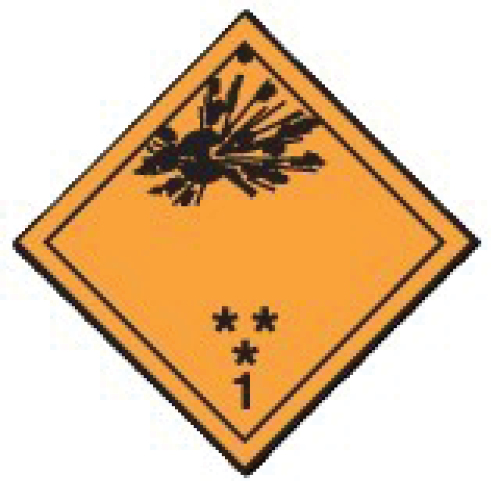
Classes 1.1, 1.2 and 1.3 - Text version
Orange square on point with, in black: a line inside running parallel to the edge, the exploding bomb symbol in the top corner and the number “1” in the bottom corner underneath two horizontally centred asterisks above one horizontally centred asterisk.
Label and Placard
- Black: Symbol, numbers, letter and line inside edge
- Orange: Background
Symbol: exploding bomb
** place for division – to be left blank if label or placard is required to be displayed for dangerous goods not included in Class 1
* place for the compatibility group letter – to be left blank if label or placard is required to be displayed for dangerous goods not included in Class 1
Class 1.4

Class 1.4 - Text version
Orange square on point with, in black: a line inside running parallel to the edge, the number “1.4” in the top corner, and the number “1” in the bottom corner under a horizontally centred asterisk.
Class 1.5

Class 1.5 - Text version
Orange square on point with, in black: a line inside running parallel to the edge, the number “1.5” in the top corner, and the number “1” in the bottom corner under a horizontally centred asterisk.
Class 1.6

Class 1.6 - Text version
Orange square on point with, in black: a line inside running parallel to the edge, the number “1.6” in the top corner, and the number “1” in the bottom corner under a horizontally centred asterisk.
Label and Placard
- Black: Numbers, letter and line inside edge
- Orange: Background
* place for the compatibility group letter
Class 2, Gases
Class 2.1, Flammable Gases

Class 2.1 - Text version
Red square on point with, in white: a line inside running parallel to the edge, the flame symbol in the top corner and the number “2” in the bottom corner.
Label and Placard
- Black or White: Symbol, number and line inside edge
- Red: Background
Symbol: Flame
Class 2.2, Non-flammable, Non-toxic Gases

Class 2.2 - Text version
Green square on point with, in black or in white: a line inside running parallel to the edge, the gas-cylinder symbol in the top corner and the number “2” in the bottom corner.
Label and Placard
- Black or White: Symbol, number and line inside edge
- Green: Background
Symbol: Gas cylinder
Class 2.3, Toxic Gases
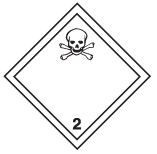
Class 2.3, Toxic Gases - Text version
White square on point with, in black: a line inside running parallel to the edge, the skull-and-crossbones symbol in the top corner and the number “2” in the bottom corner.
Label and Placard
- Black: Symbol, number and line inside edge
- White: Background
Symbol: Skull and crossbones
Class 2.3, Toxic-by-Inhalation Gases
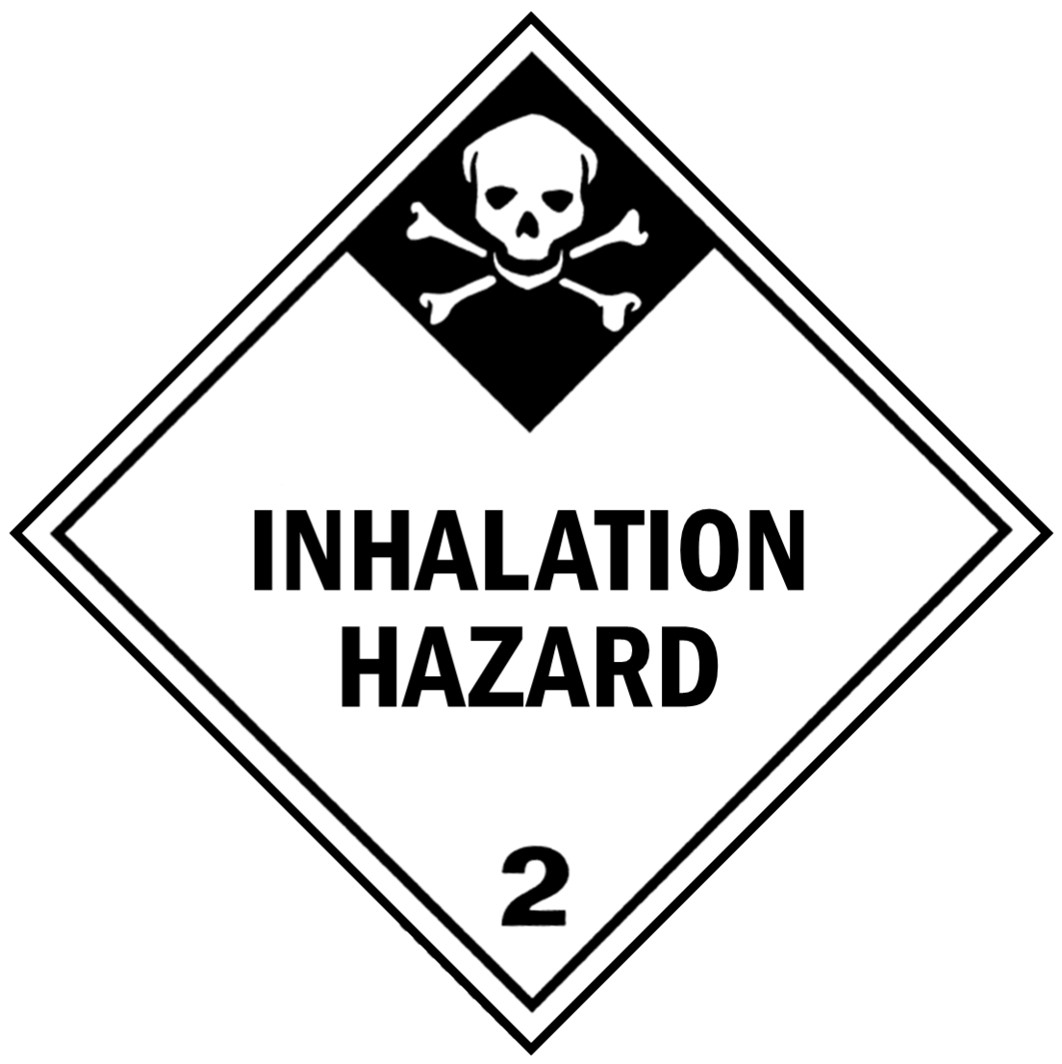
Class 2.3, Toxic-by-Inhalation Gases - Text version
White square on point with, in black: a line inside running parallel to the edge, a square on point in the top corner the words “INHALATION HAZARD” in the centre and the number “2” in the bottom corner. In white, the skull-and-crossbones symbol in the black square on point.
Label and Placard
- Black: Number, text, line inside edge and a square on point in the top corner
- White: Symbol and background
Symbol: Skull and crossbones
Text: “INHALATION HAZARD”
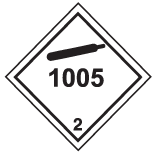
Placard for UN1005 - Text version
White square on point with, in black: a line inside running parallel to the edge, the gas-cylinder symbol in the top corner, the number “1005” in the centre of the square and the number “2” in the bottom corner.
Placard for UN1005, ANHYDROUS AMMONIA
- Black: Numbers, symbol and line inside edge
- White: Background
Symbol: Gas cylinder
Oxidizing Gases

Oxidizing Gases - Text version
Yellow square on point with, in black: a line inside running parallel to the edge, the symbol of a flame over a circle (underlined flaming letter “o”) in the top corner and the number “2” in the bottom corner.
Label and Placard
- Black: Symbol, number and line inside edge
- Yellow: Background
Symbol: Flame over a circle (underlined flaming letter “o”)
Class 3, Flammable Liquids
Class 3, Flammable Liquids

Class 3, Flammable Liquids - Text version
Red square on point with, in black or white: a line inside running parallel to the edge, the flame symbol in the top corner and the number “3” in the bottom corner running parallel to the edge, the flame symbol in the top corner and the number “4” in the bottom corner.
Label and Placard
- Black or White: Symbol, number and line inside edge
- Red: Background
Symbol: Flame
Class 4, Flammable Solids; Substances Liable to Spontaneous Combustion; Substances That on Contact with Water Emit Flammable Gases (Water-reactive Substances)
Class 4.1, Flammable Solids

Symbol: Class 4.1, Flammable Solids - Text version
White square on point with seven red vertical stripes, resulting in 13 red and white stripes of equal width. In black: a line inside.
Label and Placard
- Black: Symbol, number and line inside edge
- Red: Seven vertical stripes
- White: Background
Symbol: Flame
Class 4.2, Substances Liable to Spontaneous Combustion

Symbol: Class 4.2, Substances Liable to Spontaneous Combustion - Text version
Square on point with the upper half in white and the lower half in red. In black: a line inside running parallel to the edge, the flame symbol in the top corner and the number “4” in the bottom corner.
Label and Placard
- Black: Symbol, number and line inside edge
- Red: Lower half of background
- White: Upper half of background
Symbol: Flame
Class 4.3, Water-reactive Substances

Symbol: Class 4.3, Water-reactive Substances - Text version
Blue square on point with, in black or white: a line inside running parallel to the edge, the flame symbol in the top corner and the number “4” in the bottom corner.
Label and Placard
- Black or White: Symbol, number and line inside edge
- Blue: Background
Symbol: Flame
Class 5, Oxidizing Substances and Organic Peroxides
Class 5.1, Oxidizing Substances
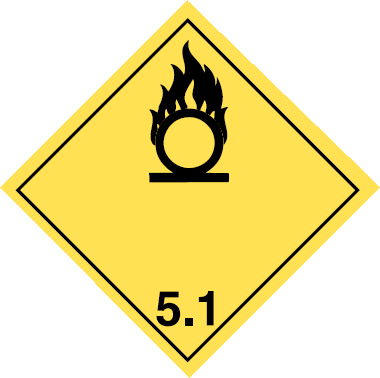
Symbol: Class 5.1, Oxidizing Substances - Text version
Yellow square on point with, in black: a line inside running parallel to the edge, the symbol of a flame over a circle (underlined flaming letter “o”) in the top corner and the number “5.1” in the bottom corner.
Label and Placard
- Black: Symbol, number and line inside edge
- Yellow: Background
- Symbol: Flame over a circle (underlined flaming letter “o”)
Class 5.2, Organic Peroxides
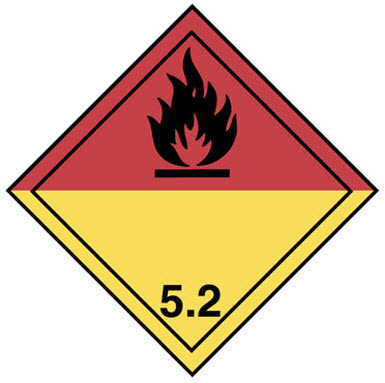
Symbol: Class 5.2, Organic Peroxides - Text version
Square on point with the upper half in red and the lower half in yellow. In black: a line inside running parallel to the edge and the number “5.2” in the bottom corner. In black or white: the flame symbol on the upper half.
Label and Placard
- Black: Number and line inside edge
- Black or White: Symbol
- Yellow: Lower half of background
- Red: Upper half of background
Symbol: Flame
Class 6, Toxic and Infectious Substances
Class 6.1, Toxic Substances
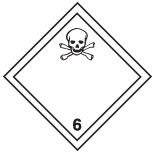
Class 6.1, Toxic Substances - Text version
White square on point with, in black: a line inside running parallel to the edge, the-skull-and-crossbones symbol in the top corner and the number “6” in the bottom corner.
Label and Placard
- Black: Symbol, number and line inside edge
- White: Background
Symbol: Skull and crossbones
Class 6.1, Toxic-by-Inhalation Substances
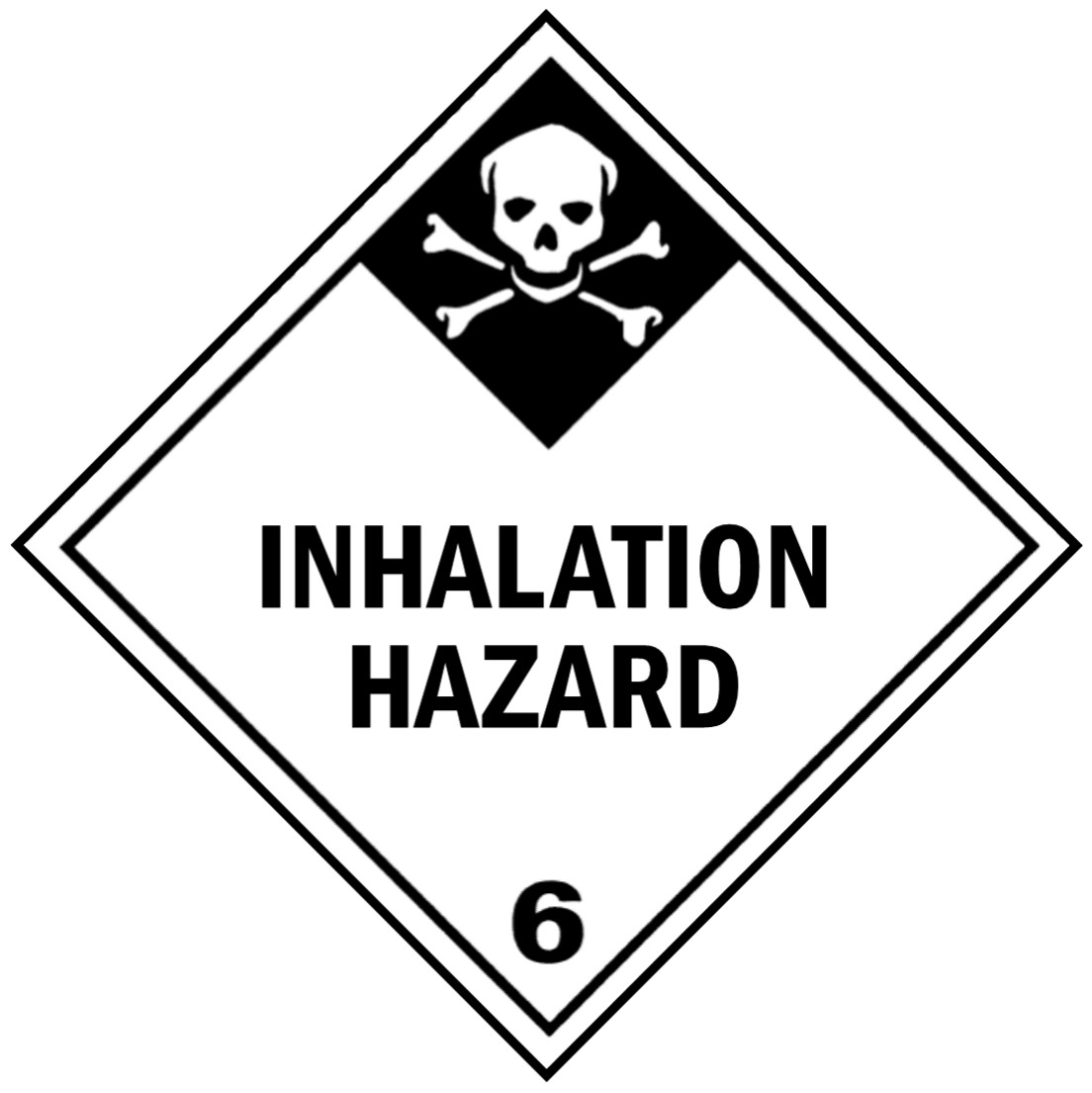
Class 6.1, Toxic-by-Inhalation Substances - Text version
White square on point with, in black: a line inside running parallel to the edge, a square on point in the top corner, the words “INHALATION HAZARD” in the centre and the number “6” in the bottom corner. In white: the skull-and-crossbones-symbol in the black square on point.
Label and Placard
- Black: Number, text, line inside edge and square on point in the top corner
- White: Symbol and background
Symbol: Skull and crossbones
Text: “INHALATION HAZARD”
Class 6.2, Infectious Substances

Class 6.2, Infectious Substances - Text version
White square on point with, in black: a line inside running parallel to the edge, the biohazard symbol (three crescents superimposed on a circle) in the top corner and the number “6” in the bottom corner underneath bilingual text that reads as follows: “INFECTIOUS IN CASE OF DAMAGE OR LEAKAGE IMMEDIATELY NOTIFY LOCAL AUTHORITIES AND CANUTEC 613‑996‑6666 / INFECTIEUX EN CAS DE DOMMAGE OU DE FUITE COMMUNIQUER IMMÉDIATEMENT AVEC LES AUTORITÉS LOCALES ET CANUTEC 613‑996‑6666”.
Label
- Black: Symbol, number, text and line inside edge
- White: Background
Symbol: Three crescents superimposed on a circle
Text:
- INFECTIOUS INFECTIEUX
- IN CASE OF DAMAGE EN CAS DE DOMMAGE
- OR LEAKAGE OU DE FUITE
- IMMEDIATELY COMMUNIQUER
- NOTIFY IMMÉDIATEMENT
- LOCAL AUTHORITIES AVEC LES AUTORITÉS
- AND LOCALES ET
- CANUTEC
- 613‑996‑6666
Class 6.2, Infectious Substances

Class 6.2, Infectious Substances - Text version
White square on point with, in black: a line inside running parallel to the edge, the biohazard symbol (three crescents superimposed on a circle) in the top corner and the number “6” in the bottom corner.
Placard
- Black: Symbol, number and line inside edge
- White: Background
Symbol: Three crescents superimposed on a circle
Class 7, Radioactive Material
Class 7, Radioactive Material
Category I – White
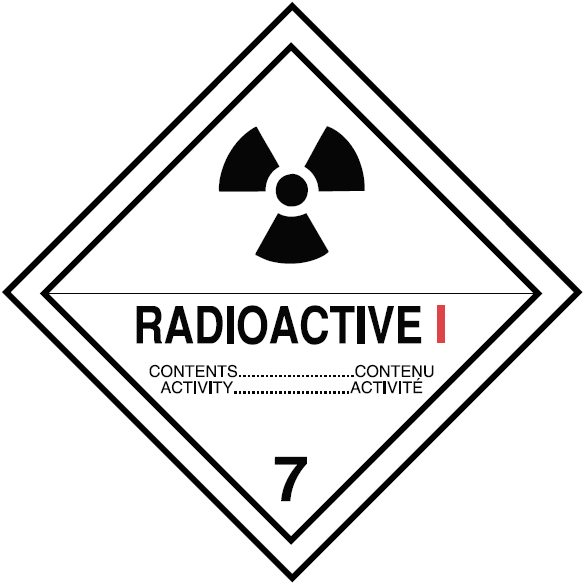
Class 7, Radioactive Material Category I – White - Text version
White square on point with, in black: a line inside running parallel to the edge, a horizontal line dividing the square (excluding the border) in half, the radioactivity (trefoil) symbol in the upper half and text in the lower half. In the lower half, the word “RADIOACTIVE” in the upper part followed by a red vertical bar and, underneath, bilingual text that reads as follows: “CONTENTS — CONTENU; ACTIVITY — ACTIVITÉ”. The number “7” in the bottom corner.
Label and Optional Placard
- Black: Symbol, number, text, line inside edge and horizontal line dividing the square (excluding the border) in half
- Red: One vertical bar after the word “RADIOACTIVE”
- White: Background
Symbol: Radioactive trefoil
Text under the word “RADIOACTIVE”:
- CONTENTS CONTENU
- ACTIVITY ACTIVITÉ
Class 7, Radioactive Material
Category II – Yellow
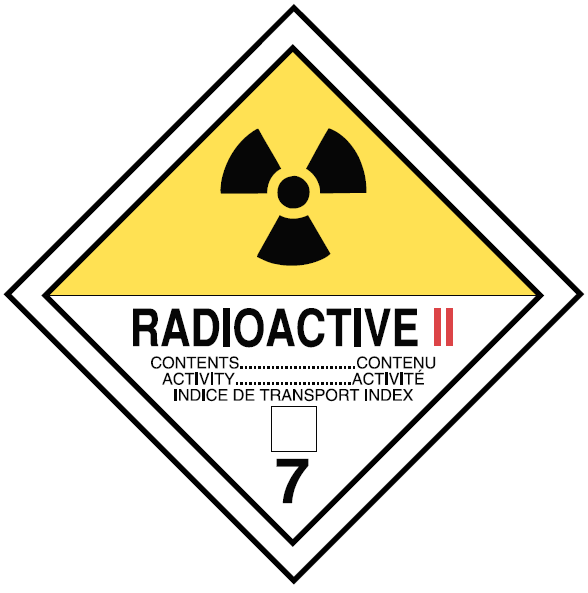
Class 7, Radioactive Material Category II – Yellow - Text version
White square on point with, in black: a line inside running parallel to the edge, a horizontal line dividing the square (excluding the border) in half, the radioactivity (trefoil) symbol in the upper half and text in the lower half. In the lower half, the word “RADIOACTIVE” in the upper part followed by two red vertical bars and, underneath, bilingual text that reads as follows: “CONTENTS — CONTENU, ACTIVITY — ACTIVITÉ — INDICE DE TRANSPORT INDEX”. In the lower half, the number “7” in the bottom corner and an empty square above the number “7”. Yellow upper half (excluding the border).
Label and Optional Placard
- Black: Symbol, number, text, line inside edge and horizontal line dividing the square (excluding the border) in half
- Red: Two vertical bars after the word “RADIOACTIVE”
- Yellow: Upper half (excluding the border)
- White: Lower half and border
Symbol: Radioactive trefoil
The text and shape under the word “RADIOACTIVE”:
- CONTENTS CONTENU
- ACTIVITY ACTIVITÉ
- INDICE DE TRANSPORT INDEX

Class 7, Radioactive Material
Category III – Yellow
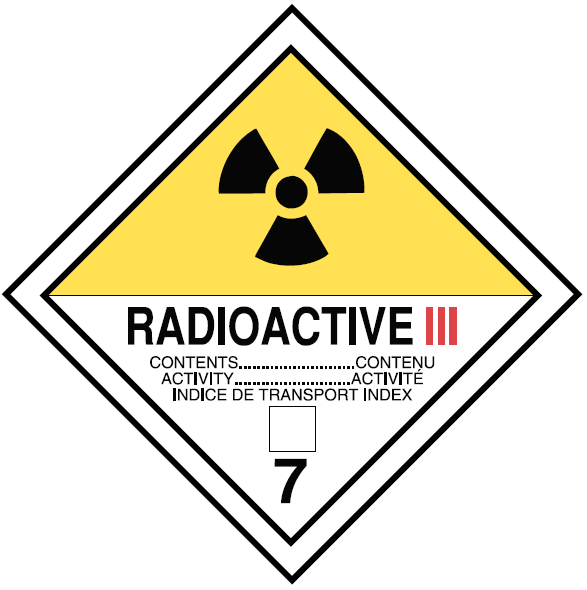
Class 7, Radioactive Material Category III – Yellow - Text version
White square on point with, in black: a line inside running parallel to the edge, a horizontal line dividing the square (excluding the border) in half, the radioactivity (trefoil) symbol in the upper half and text in the lower half. In the lower half, the word “RADIOACTIVE” in the upper part followed by three red vertical bars and, underneath, bilingual text that reads as follows: “CONTENTS — CONTENU, ACTIVITY — ACTIVITÉ — INDICE DE TRANSPORT INDEX”. In the lower half, the number “7” in the bottom corner and an empty square above the number “7”. Yellow upper half (excluding the border).
Label and Optional Placard
- Black: Symbol, number, text, line inside edge and horizontal line dividing the square (excluding the border) in half
- Red: Three vertical bars after the word “RADIOACTIVE”
- Yellow: Upper half (excluding the border)
- White: Lower half and border
Symbol: Radioactive trefoil
The text and shape under the word “RADIOACTIVE”:
- CONTENTS CONTENU
- ACTIVITY ACTIVITÉ
- INDICE DE TRANSPORT INDEX
Class 7, Radioactive Material
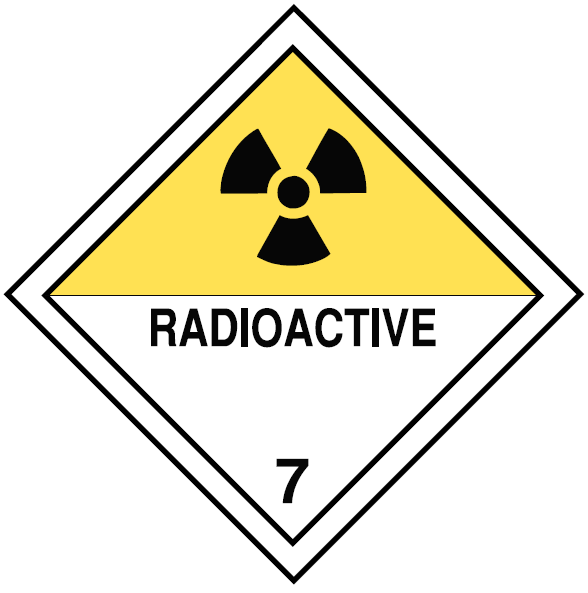
Class 7, Radioactive Material - Text version
White square on point with, in black: a line inside running parallel to the edge, a horizontal line dividing the square (excluding the border) in half, the radioactivity (trefoil) symbol in the upper half. In the lower half, the word “RADIOACTIVE” in the upper part and the number “7” in the bottom corner. Yellow upper half (excluding the border).
Placard
- Black: Symbol, number, text, line inside edge and horizontal line dividing the square (excluding the border) in half
- Yellow: Upper half (excluding the border)
- White: Lower half and border
Symbol: Radioactive trefoil
Optional text: “RADIOACTIVE”
Class 7, Fissile Material
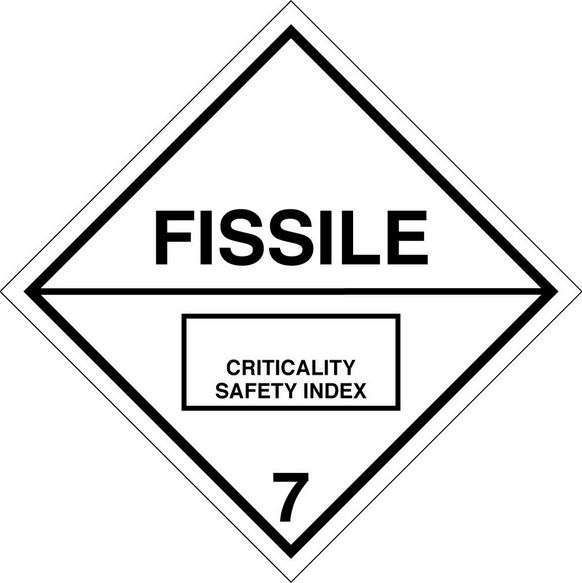
Class 7, Fissile Material - Text version
White square on point with, in black: a line inside running parallel to the edge, a horizontal line dividing the square (excluding the border) in half, the word “FISSILE” in the upper half, the words “CRITICALITY SAFETY INDEX” in a rectangle in the lower half and the number “7” in the bottom corner.
Label
- Black: Number, text, outline of rectangle in lower half, line through centre of label and line inside edge
- White: Background
Text:
- FISSILE
- CRITICALITY
- SAFETY INDEX
Class 8, Corrosives
Class 8, Corrosives

Class 8, Corrosives - Text version
White square on point with, in black: a line inside running parallel to the edge, the lower half (excluding the border) and a symbol consisting of liquid spilling from two transparent test tubes and corroding a hand and metal bar in the upper half. In white: the border and the number “8” in the bottom corner.
Label and Placard
- White: Number, upper half and border
- Black: Symbol, line inside edge and lower half (excluding the border)
Symbol: Liquid spilling from two transparent test tubes and corroding a hand and metal bar
Class 9, Miscellaneous Products, Substances or Organisms
Class 9, Miscellaneous Products, Substances or Organisms

Class 9, Miscellaneous Products, Substances or Organisms - Text version
White square on point with, in black: a line inside the edge, seven vertical stripes in the upper half resulting in 13 black and white stripes of equal width. Also in black: the number “9” in the bottom corner and the underlining of the number.
Label and Placard
- Black: Seven vertical stripes in the upper half, symbol, number, underlining and line inside edge
- White: Background
Number 9 underlined
Class 9, Lithium Batteries
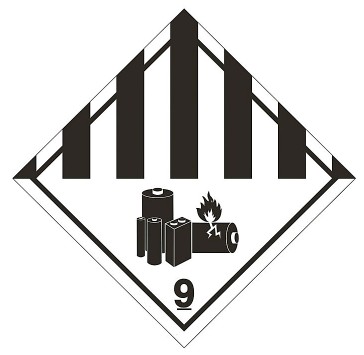
Class 9, Lithium Batteries - Text version
White square on point with seven black vertical stripes in the upper half resulting in 13 black and white stripes of equal width. Also in black: a line inside running parallel to the edge, a group of batteries (one damaged and emitting flame) in the lower half, the number “9” in the bottom corner and the underlining.
Label
- Black: Seven vertical stripes in the upper half, symbol, number, underlining and line inside edge
- White: Background
Symbol: A group of batteries (one broken and emitting flame) in the lower half
Number 9 underlined
(2) The illustration under the title “Lithium Battery Mark” in the appendix to Part 4 of the Regulations is replaced by the following:
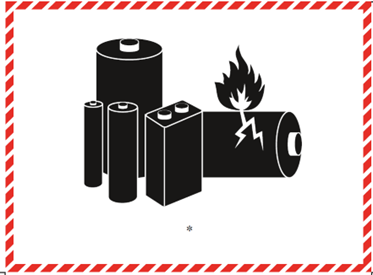
Description of lithium battery mark. White rectangle with red border hatching and, in black: a group of batteries (one damaged and emitting flame) above a horizontally-centred asterisk - Text version
White rectangle with red border hatching and, in black: a group of batteries (one damaged and emitting flame) above a horizontally-centred asterisk.
(3) The description “** Replace with telephone number for additional information” after the illustration under the title “Lithium Battery Mark” in the appendix to Part 4 of the Regulations is repealed.
(4) The description “Size: Rectangle, at least 120 mm wide x 110 mm high” after the illustration under the title “Lithium Battery Mark” in the appendix to Part 4 of the Regulations is replaced by the following:
Size: Rectangle or square, at least 100 mm wide x 100 mm high
77 Section 5.6 of the Regulations is replaced by the following:
5.6 A means of containment is a UN standardized means of containment if it has displayed on it the applicable UN marks illustrated in Chapter 6.1, 6.3, 6.5 or 6.6 of the UN Recommendations and
- (a) it is in compliance with
- (i) sections 2 and 3 and Part I of CGSB-43.125, for a Type P620 means of containment,
- (i.1) sections 2 and 3 and Part I of CGSB-43.145,
- (ii) sections 2 and 3 and Part I of CGSB-43.146, or
- (iii) sections 2 and 3 and Part I of CGSB-43.150; or
- (b) it was manufactured outside Canada in compliance with Chapter 6.1, 6.3, 6.5 or 6.6 of the UN Recommendations and with the national regulations of the country of manufacture.
78 (1) Subparagraph 5.10(1)(a)(iv) of the Regulations is replaced by the following:
- (iv) CSA B622,
(2) Subparagraph 5.10(1)(d)(v) of the Regulations is replaced by the following:
- (v) CSA B622, or
(3) Subsections 5.10(12) and (13) of the Regulations are repealed.
79 Subsections 5.12(1) to (4) of the Regulations are replaced by the following:
5.12 (1) A person must not import, offer for transport, handle or transport dangerous goods included in Class 3, 4, 5, 6.1, 8 or 9 in a small means of containment unless it is selected and used in accordance with sections 2 and 3 and Part II of CGSB-43.146 or selected and used in accordance with sections 2 and 3 and Part II of CGSB-43.150.
(2) The manufacturer or distributor of a small means of containment that is a UN standardized means of containment manufactured in Canada must provide the means of containment information to the initial user in accordance with clause 4.4 of CGSB-43.150.
(3) The manufacturer or distributor of a UN standardized means of containment that is an IBC manufactured in Canada must provide a notice to the initial user in accordance with clause 4.8 of CGSB-43.146.
(4) A person must not reuse an IBC for liquids or solids that is filled or discharged under pressure to offer for transport, handle or transport dangerous goods included in Class 3, 4, 5, 6.1, 8 or 9 unless it has been leak-tested and inspected in accordance with clause 12.6 of CGSB-43.146.
80 (1) Subsection 5.14(1) of the Regulations is replaced by the following:
5.14 (1) A person must not import, offer for transport, handle or transport dangerous goods included in Class 3, 4, 5, 6.1, 8 or 9 in a large means of containment unless it is manufactured, selected and used in accordance with
- (a) for transport by road vehicle,
- (i) Part II of CGSB-43.145,
- (ii) Part II of CGSB-43.146,
- (iii) CSA B621,
- (iv) CSA B625, or
- (v) TP 14877, if the means of containment is a ton container;
- (b) for transport by railway vehicle,
- (i) Part II of CGSB-43.145,
- (ii) Part II of CGSB-43.146,
- (iii) CSA B625, or
- (iv) TP 14877; and
- (c) for transport by vessel,
- (i) Part II of CGSB-43.145,
- (ii) Part II of CGSB-43.146,
- (iii) CSA B621,
- (iv) CSA B625, or
- (v) TP 14877.
(2) The portion of subsection 5.14(2) of the Regulations before paragraph (a) is replaced by the following:
(2) A person who uses a standardized means of containment required by CSA B621 to offer for transport dangerous goods included in Class 3, 4, 5, 6.1, 8 or 9 must use a means of containment that is
81 Subsection 5.16(2) of the Regulations is replaced by the following:
(2) If the means of containment is a packaging made available as a kit, the packaging manufacturer or distributor must provide the packaging information required under clause 4.4 of CGSB-43.125 to the packaging purchaser at the initial purchase and to a packaging user on request.
82 Paragraph 6.2(f) of the Regulations is replaced by the following:
- (f) the compliance marks requirements, safety requirements and safety standards in Part 5;
83 (1) Subparagraphs 7.2(1)(b)(i) to (iv) of the Regulations are replaced by the following:
- (i) Class 3, if they are assigned a subsidiary class of Class 6.1,
- (ii) Class 4,
- (iii) Class 5.2, if they are Type B or Type C,
- (iv) Class 6.1, if they are included in Packing Group I;
(2) Paragraph 7.2(1)(g) of the Regulations is replaced by the following:
- (g) any quantity of dangerous goods that are Risk Group 4 human pathogens within the meaning of the Human Pathogens and Toxins Act, other than dangerous goods that are UN3549, MEDICAL WASTE, CATEGORY A, AFFECTING HUMANS or MEDICAL WASTE, CATEGORY A, AFFECTING ANIMALS.
(3) Subsection 7.2(2) of the Regulations is replaced by the following:
(2) An approved ERAP is required for dangerous goods classified in accordance with the ICAO Technical Instructions, the IMDG Code, the UN Recommendations or 49 CFR, in accordance with subsection 2.2(4) or Parts 9, 10, 11 or 12, as applicable, if the dangerous goods would require an approved ERAP if they were classified in accordance with Part 2 other than subsection 2.2(4).
84 Paragraph 7.7(1)(d) of the Regulations is replaced by the following:
- (d) the person who received approval for the ERAP provides a written authorization to the authorized user before the information referred to in paragraph 3.5(1)(i) is entered on the shipping document or before the information referred to in subsection 12.16(3) is entered on the transport document, as applicable.
85 Paragraphs 8.1(b) to (e) of the Regulations are replaced by the following:
- (b) the loss or theft of dangerous goods;
- (c) unlawful interference with dangerous goods; and
- (d) the implementation of an approved ERAP.
86 The headings before section 8.9 and sections 8.9 to 8.15.2 of the Regulations are repealed.
87 Paragraphs 8.16(2)(b) and (c) of the Regulations are replaced by the following:
- (b) any quantity, in the case of dangerous goods included in any of the following primary or subsidiary classes:
- (i) Class 1.1, 1.2 or 1.3,
- (ii) Class 2.3,
- (iii) Class 5.2, if the dangerous goods are Type B, liquid or solid, temperature controlled,
- (iv) Class 6.1, if the dangerous goods are included in Packing Group I,
- (v) Class 6.2,
- (vi) Class 7; and
- (c) a quantity of 450 kg or more, in the case of dangerous goods included in any of the following primary or subsidiary classes:
- (i) Class 1.4, if the dangerous goods are not included in compatibility group S, or Class 1.5 or 1.6,
- (ii) Class 2.1,
- (iii) Class 3,
- (iv) Class 4.1, if the dangerous goods are desensitized explosives,
- (v) Class 4.2, if the dangerous goods are a pyrophoric substance and are included in Packing Group I or II,
- (vi) Class 4.3, 5.1 or 8, if the dangerous goods are included in Packing Group I or II.
88 The portion of section 8.20 of the Regulations before the table is replaced by the following:
8.20 A person who is required under subsection 18(1) of the Act to report a release or anticipated release of dangerous goods in respect of which an approved ERAP is required under subsection 7(1) of the Act must, as soon as possible after the release or anticipated release, make an ERAP incident report, by telephone, using the ERAP telephone number included on the shipping document in accordance with subparagraph 3.5(1)(i)(ii) or on the transport document in accordance with paragraph 12.16(3)(b), if the dangerous goods are, or could be, in excess of the quantity set out in the table to this section.
89 The heading “Transporting Dangerous Goods from the United States into or through Canada” before section 9.1 of the Regulations is replaced by the following:
Transporting Dangerous Goods from Canada to the United States or from the United States to Canada or through Canada
90 (1) The portion of subsection 9.1(1) of the Regulations before paragraph (a) is replaced by the following:
9.1 (1) Despite the requirements set out in Parts 2 to 4, a person may import, offer for transport, handle or transport dangerous goods by road vehicle from a place in Canada to a place in the United States, from a place in the United States to a place in Canada or from a place in the United States through Canada to a place outside Canada in accordance with the classification, marking, labelling, placarding and documentation requirements of 49 CFR if
(2) Subparagraph 9.1(1)(a)(i) of the Regulations is replaced by the following:
- (i) when dangerous goods are transported to or from a place in Canada, the name and address of the place of business in Canada of the consignor,
(3) Subsection 9.1(1) of the Regulations is amended by striking out “and” at the end of paragraph (b), by adding “and” at the end of paragraph (a) and by repealing paragraph (c).
(4) Subsection 9.1(3) of the Regulations is replaced by the following:
(3) A person who imports, offers for transport, handles or transports dangerous goods by road vehicle in accordance with an exemption issued under Subpart B of Part 107 of 49 CFR may do so if the exemption number appears on the shipping document and the dangerous goods are transported
- (a) from a place in Canada to a place in the United States, if the means of containment contains a residue of dangerous goods;
- (b) from a place in the United States to a place in Canada; or
- (c) from a place in the United States through Canada to a place outside Canada.
91 Subsection 9.2(1) of the Regulations is replaced by the following:
9.2 (1) Despite the requirements set out in Parts 2 to 5, a person may also handle or transport dangerous goods by road vehicle to or from an aircraft, aerodrome or air cargo facility in accordance with the classification, marking, labelling, documentation and packing requirements set out in Part 12, if transport has been or is to be by aircraft and the person complies with
- (a) paragraph 3.5(1)(j) and, if applicable, subsection 3.5(2);
- (b) section 3.7; and
- (c) section 3.10.
(1.1) For the purposes of subsection (1), a reference to “shipping document” in sections 3.5, 3.7 and 3.10 is to be read as a reference to “transport document”.
92 Paragraph 9.5(b) of the Regulations is replaced by the following:
- (b) 2 000 kg, if any of the explosives are included in Class 1.1 and in compatibility group A; and
93 The heading “Transporting Dangerous Goods from the United States into or through Canada” before section 10.1 of the Regulations is replaced by the following:
Transporting Dangerous Goods from Canada to the United States or from the United States to Canada or through Canada
94 (1) The portion of subsection 10.1(1) of the Regulations before paragraph (a) is replaced by the following:
10.1 (1) Despite the requirements set out in Parts 2 to 4, a person may import, offer for transport, handle or transport dangerous goods by railway vehicle from a place in Canada to a place in the United States, from a place in the United States to a place in Canada or from a place in the United States through Canada to a place outside Canada in accordance with the classification, marking, labelling, placarding and documentation requirements of 49 CFR if
(2) Subparagraph 10.1(1)(a)(i) of the Regulations is replaced by the following:
- (i) when dangerous goods are transported to or from a place in Canada, the name and address of the place of business in Canada of the consignor,
(3) Subsection 10.1(1) of the Regulations is amended by striking out “and” at the end of paragraph (b), by adding “and” at the end of paragraph (a) and by repealing paragraph (c).
(4) Subsection 10.1(3) of the Regulations is replaced by the following:
(3) A person who imports, offers for transport, handles or transports dangerous goods by railway vehicle in accordance with an exemption issued under Subpart B of Part 107 of 49 CFR may do so if the exemption number appears on the shipping document and the dangerous goods are transported
- (a) from a place in Canada to a place in the United States, if the means of containment contains a residue of dangerous goods;
- (b) from a place in the United States to a place in Canada; or
- (c) from a place in the United States through Canada to a place outside Canada.
95 Section 10.1.1 of the Regulations is replaced by the following:
10.1.1 Despite the requirements set out in Part 5, a person may import, offer for transport, handle or transport dangerous goods by railway vehicle in accordance with the requirements of Parts 172, 173, 174, 179 and 180 of 49 CFR, except by tank car, if the dangerous goods are included in Class 3, and are referred to in section 10.5.6 of TP 14877, as follows:
- (a) from a place in Canada to a place in the United States, if the means of containment contains a residue of dangerous goods;
- (b) from a place in the United States to a place in Canada; or
- (c) from a place in the United States through Canada to a place outside Canada.
96 Subsection 10.2(1) of the Regulations is replaced by the following:
10.2 (1) Despite the requirements set out in Parts 2 to 5, a person may also handle or transport dangerous goods by railway vehicle to or from an aircraft, aerodrome or air cargo facility in accordance with the classification, marking, labelling, documentation and packing requirements set out in Part 12, if transport has been or is to be by aircraft and the person complies with
- (a) paragraph 3.5(1)(j) and, if applicable, subsection 3.5(2);
- (b) section 3.8; and
- (c) section 3.10.
(1.1) For the purposes of subsection (1), a reference to “shipping document” in sections 3.5, 3.8 and 3.10 is to be read as a reference to “transport document”.
97 (1) Subparagraph 11.1(2)(b)(iii) of the Regulations is replaced by the following:
- (iii) section 4.5, Carrier responsibilities, and
(2) Subsection 11.1(2) of the Regulations is amended by striking out “and” at the end of paragraph (c), by adding “and” at the end of paragraph (d) and by adding the following after paragraph (d):
- (e) Part 17 (Site Registration Requirements).
98 Part 12 of the Regulations is replaced by the following:
PART 12
Air
Application and Interpretation
12.1 (1) Unless otherwise provided in this Part, only this Part and the following provisions and Parts apply to the importing, offering for transport, handling or transporting of dangerous goods by aircraft:
- (a) paragraph 1.3(2)(b);
- (b) sections 1.3.1, 1.3.2, 1.4 and 4.2; and
- (c) Parts 7 and 13 to 17.
(2) Section 1.3 of Part 1 of the ICAO Technical Instructions applies to the interpretation of the provisions of those Instructions that are incorporated by reference in this Part, except with respect to terms that are defined in Part 1 of these Regulations.
(3) Despite subsection (2) and section 1.4 of these Regulations, for the purposes of this Part, UN number has the same meaning as in section 3.1.1 of Part 1 of the ICAO Technical Instructions.
(4) For the purpose of interpreting the provisions of the ICAO Technical Instructions that are incorporated by reference in this Part, a reference to “shipper” is to be read as a reference to “consignor”, a reference to “operator” is to be read as a reference to “carrier” and a reference to “packaging” is to be read as a reference to “means of containment”.
(5) The following definitions apply in this Part.
- limited access location
- means a location to which there is no year-round access by a mode of transport other than air. (lieu à accès limité)
- MIL-T-52983G
- means the standard entitled Military Specification: Tanks, Fabric, Collapsible: 3,000, 10,000, 20,000 and 50,000 Gallon, Fuel, May 11, 1994, published by the United States Department of Defense. (MIL-T-52983G)
- remotely piloted aircraft
- has the same meaning as in subsection 101.01(1) of the Canadian Aviation Regulations. (aéronef télépiloté)
- Table 3-1
- means Table 3-1, Dangerous Goods List, of Chapter 2 of Part 3 of the ICAO Technical Instructions. (Tableau 3-1)
(6) The notes that appear with the provisions of the ICAO Technical Instructions that are incorporated by reference in this Part do not form part of these Regulations.
ICAO Technical Instructions — Compliance
General
12.2 (1) Unless otherwise provided in this Part, a person who imports, offers for transport, handles or transports dangerous goods by aircraft must do so in accordance with the requirements of the ICAO Technical Instructions.
(2) Despite subsection (1), a person who imports, offers for transport, handles or transports dangerous goods by aircraft may do so in accordance with section 1.19 or 1.20 of these Regulations.
Documentation
12.3 Any information that must, under this Part, be included on a document must be written in English or French.
ICAO Technical Instructions — Part 1 (General)
Training
12.4 (1) Chapter 4 of Part 1 of the ICAO Technical Instructions applies to the offering for transport, handling or transporting of dangerous goods by aircraft.
(2) Subject to subsection (3), Part 6 of these Regulations applies to the offering for transport, handling or transporting of dangerous goods by aircraft.
(3) Despite section 6.6 of these Regulations, the period of time for which an employer or a self-employed person must keep a record of training or statement of experience, as well as a copy of a training certificate, in electronic or paper form, is 36 months beginning on the first day of the month in which the most recent training and assessment was completed.
Security, Accident and Incident Reporting
12.5 Chapters 5 and 7 of Part 1 of the ICAO Technical Instructions do not apply to the importing, offering for transport, handling or transporting of dangerous goods by aircraft.
Medical Aid Exemption
12.6 (1) Despite paragraph 1.1.5.1(a) of Part 1 of the ICAO Technical Instructions, dangerous goods included in Class 2 must be contained in a means of containment that is manufactured, selected and used in accordance with section 5.10 or 5.11 of these Regulations.
(2) Despite section 1.1.5.4 of Part 1 of the ICAO Technical Instructions, dangerous goods that were transported under paragraph 1.1.5.1(a) of that Part may be transported on a flight made by an aircraft other than the one on which the dangerous goods were transported if
- (a) the conditions set out in paragraph 1.1.5.4(a) to (i) of that Part are met;
- (b) the dangerous goods are transported as soon as possible after the flight on which the dangerous goods were transported; and
- (c) the dangerous goods are transported to the departure aerodrome of the flight on which the dangerous goods were transported.
Exemption — Aerial Work and Fire Suppression
12.7 (1) These Regulations do not apply to the transport by aircraft of
- (a) dangerous goods that are in quantities necessary to carry out the aerial work operations specified in subsection 702.01(1) of the Canadian Aviation Regulations and that are not exempt under paragraph 1.1.5.1(c) of Part 1 of the ICAO Technical Instructions;
- (b) dangerous goods that are being transported to a location for the purpose of being used to suppress fire; or
- (c) dangerous goods that are transported from a location where they were used to suppress fire.
(2) A person must not transport dangerous goods under subsection (1) unless all of the following conditions are met:
- (a) the dangerous goods are classified in accordance with this Part;
- (b) in the case of dangerous goods that are included in Class 2, the dangerous goods are contained in a means of containment that is manufactured, selected and used in accordance with section 5.10 or 5.11;
- (c) in the case of dangerous goods that are not included in Class 2, except those for which “A87” is set out in column 7 of Table 3-1, the dangerous goods are contained in
- (i) a tank, a container or an apparatus that is an integral part of the aircraft or that is attached to the aircraft,
- (ii) a collapsible fabric tank that is transported suspended from a helicopter and is constructed of material and seamed in accordance with MIL-T-52983G, or
- (iii) a small means of containment that is designed, constructed, filled, closed, secured and maintained so that under normal conditions of transport, including handling, there is no release of the dangerous goods that could endanger public safety;
- (d) the means of containment is marked with the UN number and shipping name of the dangerous goods;
- (e) in the case of dangerous goods that are liquid, except dangerous goods referred to in section 1.1.13.1 of Part 4 of the ICAO Technical Instructions, the means of containment is marked with package orientation labels in accordance with the requirements set out in paragraph 3.2.12(b) of Part 5 of those Instructions; and
- (f) if the pilot-in-command of the aircraft did not load or directly supervise the loading of the dangerous goods, the person who loaded and secured the dangerous goods gives the pilot-in-command the following information with respect to the dangerous goods:
- (i) the shipping name, UN number and class,
- (ii) the gross mass of the dangerous goods and, for explosives, the net explosives quantity, and
- (iii) the location of the dangerous goods on board the aircraft.
(3) The air carrier must ensure that
- (a) the person who loads and secures the dangerous goods on board the aircraft is trained, or works under the direct supervision of a person who is trained, in accordance with Part 6 of these Regulations and with Chapter 4 of Part 1 of the ICAO Technical Instructions;
- (b) if the dangerous goods are handled or transported by a person other than an employee of the air carrier, that person is trained in accordance with Part 6 of these Regulations and with Chapter 4 of Part 1 of the ICAO Technical Instructions; and
- (c) the person who loads and secures the dangerous goods or directly supervises the loading and securing of the dangerous goods on board the aircraft
- (i) complies with section 3.1 of Chapter 3 of Part 7 of the ICAO Technical Instructions, and
- (ii) segregates the means of containment that contain dangerous goods that could react dangerously with one another in case of a release, in accordance with Table 7-1 of Chapter 2 of Part 7 of the ICAO Technical Instructions.
Exemption — Operation and Safety of an Aircraft
12.8 (1) These Regulations do not apply to the transport by aircraft of dangerous goods required for the safety of individuals on board the aircraft or for the operation or safety of the aircraft.
(2) If the dangerous goods referred to in subsection (1) are not installed in the aircraft, they must be contained in a means of containment that is
- (a) designed, constructed, filled, closed, secured and maintained so that under normal conditions of transport, including handling, there is no release of the dangerous goods that could endanger public safety;
- (b) marked with the shipping name or common name of the dangerous goods; and
- (c) in the case of dangerous goods that are liquid, except dangerous goods referred to in paragraph 1.1.13.1(a), (b) or (c) of Part 4 of the ICAO Technical Instructions, the means of containment is marked with package orientation labels in accordance with the requirements set out in paragraph 3.2.12(b) of Part 5 of those Instructions.
(3) Subsection (2) does not apply to dangerous goods for which “A87” is set out in column 7 of Table 3-1.
Excepted Packages Exemption
12.9 Subsection 12.4(2) of these Regulations and, despite paragraph 6.1.5.1(a) of Part 1 of the ICAO Technical Instructions, the “Radioactive material, excepted package” handling label requirement under paragraph 3.2.12(e) of Part 5 of those Instructions do not apply to the importing, offering for transport, handling or transporting of
- (a) UN2908, RADIOACTIVE MATERIAL, EXCEPTED PACKAGE - EMPTY PACKAGING;
- (b) UN2909, RADIOACTIVE MATERIAL, EXCEPTED PACKAGE - ARTICLES MANUFACTURED FROM NATURAL URANIUM or DEPLETED URANIUM or NATURAL THORIUM;
- (c) UN2910, RADIOACTIVE MATERIAL, EXCEPTED PACKAGE - LIMITED QUANTITY OF MATERIAL;
- (d) UN2911, RADIOACTIVE MATERIAL, EXCEPTED PACKAGE - INSTRUMENTS or ARTICLES; and
- (e) UN3507, URANIUM HEXAFLUORIDE, RADIOACTIVE MATERIAL, EXCEPTED PACKAGE.
ICAO Technical Instructions — Part 2 (Classification of Dangerous Goods)
Class 1
12.10 (1) Despite the Introductory Chapter and Chapter 1 of Part 2 of the ICAO Technical Instructions, a substance included in Class 1 must be classified in accordance with paragraph 2.2(3)(a) and sections 2.9, 2.10 and 2.11 of these Regulations.
(2) A reference to Chapter 1 of Part 2 of the ICAO Technical Instructions in the provisions of those Instructions that are incorporated by reference in this Part is to be read as a reference to paragraph 2.2(3)(a) and sections 2.9, 2.10 and 2.11 of these Regulations.
Class 7
12.11 Despite Chapter 7 of Part 2 of the ICAO Technical Instructions, dangerous goods that are LSA-I or LSA-II material must be classified in accordance with section 5 of the Packaging and Transport of Nuclear Substances Regulations, 2015.
Class 9
12.12 (1) Despite section 9.1.2 of Part 2 of the ICAO Technical Instructions, genetically modified micro-organisms and genetically modified organisms are not dangerous goods.
(2) Despite the requirements set out in the column entitled “Notes” of Table 2-16 in section 9.2 of Part 2 of the ICAO Technical Instructions for UN3077 and UN3082, substances or mixtures that do not meet the criteria for inclusion in any of Classes 1 to 8 nor in Class 9, other than the criteria specified under section 2.9.3 and Chapter 2.10 of the IMDG Code, must be assigned to Packing Group III and designated as UN3077, ENVIRONMENTALLY HAZARDOUS SUBSTANCE, SOLID, N.O.S. or UN3082, ENVIRONMENTALLY HAZARDOUS SUBSTANCE, LIQUID, N.O.S., as applicable.
ICAO Technical Instructions — Part 3 (Dangerous Goods List, Special Provisions and Limited and Excepted Quantities)
12.13 Despite the word “FORBIDDEN” set out in columns 10 and 11 or 12 and 13 of Table 3-1, a person may offer for transport, handle or transport by aircraft dangerous goods included in Class 1 in accordance with this Part if
- (a) the dangerous goods are transported between two points in Canada, directly to or from a location that is a limited access location;
- (b) the aircraft is not carrying any person other than a flight crew member or a person required to accompany the dangerous goods;
- (c) the dangerous goods are in quantities that do not exceed 75 kg net quantity per means of containment;
- (d) the dangerous goods are packed in accordance with the packing instruction indicated, in respect of those dangerous goods, in column 12 of Table S-3-1 of Part S-3 of the Supplement to the ICAO Technical Instructions; and
- (e) the dangerous goods are transported in accordance with section 2.3 of Part S-7 of the Supplement to the ICAO Technical Instructions.
ICAO Technical Instructions — Part 4 (Packing Instructions)
12.14 Despite section 9.2.5 of Part 4 of the ICAO Technical Instructions, dangerous goods that are LSA material or surface contaminated objects must be packaged in accordance with section 27 of the Packaging and Transport of Nuclear Substances Regulations, 2015.
ICAO Technical Instructions — Part 5 (Shipper’s Responsibilities)
Oxidizing Gas Label
12.15 (1) Despite sections 3.1.1, 3.1.2 and 3.5.1.1 of Part 5 of the ICAO Technical Instructions, the oxidizing gas label illustrated in the appendix to Part 4 of these Regulations may be displayed on a small means of containment that contains any of the following dangerous goods instead of the labels for the primary and subsidiary class assigned to those dangerous goods:
- (a) UN1072, OXYGEN, COMPRESSED;
- (b) UN1073, OXYGEN, REFRIGERATED LIQUID;
- (c) UN3156, COMPRESSED GAS, OXIDIZING, N.O.S.;
- (d) UN3157, LIQUEFIED GAS, OXIDIZING, N.O.S.
(2) For the purpose of interpreting the provisions of the ICAO Technical Instructions referred to in subsection (1), unless the context otherwise requires,
- (a) a reference to “class hazard” or “division” is to be read as a reference to “class”;
- (b) a reference to “primary hazard” is to be read as a reference to “primary class”;
- (c) a reference to “subsidiary hazard” is to be read as a reference to “subsidiary class”; and
- (d) a reference to “danger label” or “danger class label” is to be read as a reference to “class label”.
Transport Document
12.16 (1) Despite section 4.1.1.1 of Part 5 of the ICAO Technical Instructions, a transport document for dangerous goods transported by aircraft must be provided on paper.
(2) Despite section 4.1.2.1 of Part 5 of the ICAO Technical Instructions, the transport document for dangerous goods transported by aircraft must have, in the left and right margins, red hatching oriented to the right or left.
(3) In addition to the information required under section 4.1.4.1 of Part 5 of the ICAO Technical Instructions, the transport document for dangerous goods for which an approved ERAP is required under subsection 7(1) of the Act must include
- (a) the ERAP reference number issued by Transport Canada, preceded or followed by the letters “ERAP” or “PIU”; and
- (b) the ERAP telephone number required under paragraph 7.3(2)(f) of the Regulations, preceded or followed by the letters “ERAP” or “PIU”.
(4) Despite section 4.4.1 of Part 5 of the ICAO Technical Instructions, a consignor must be able to produce a copy of any transport document required under this Part for a period of one year after the day on which it was prepared.
ICAO Technical Instructions — Part 6 (Packaging Nomenclature, Marking, Requirements and Tests)
Class 2
12.17 (1) Chapter 5 of Part 6 of the ICAO Technical Instructions does not apply to the importing, offering for transport, handling or transporting by aircraft of dangerous goods included in Class 2.
(2) The requirements set out in sections 5.10 and 5.11 of these Regulations apply to the importing, offering for transport, handling or transporting by aircraft of dangerous goods included in Class 2.
(3) The exemptions related to fire extinguishers and cylinders set out in sections 1.47 and 1.49 of these Regulations, respectively, apply to the importing, offering for transport, handling or transporting by aircraft of dangerous goods included in Class 2.
Class 7
12.18 (1) Despite section 7.21.2 of Part 6 of the ICAO Technical Instructions, the design of a Type B(U) or Type C package used to transport radioactive material must be certified in accordance with section 10 of the Packaging and Transport of Nuclear Substances Regulations, 2015.
(2) The requirements set out in section 5.17 of these Regulations apply to the importing, offering for transport, handling or transporting by aircraft of dangerous goods included in Class 7.
ICAO Technical Instructions — Part 7 (Operator’s Responsibilities)
Loading on passenger aircraft
12.19 Despite section 2.1.1 of Part 7 of the ICAO Technical Instructions, dangerous goods may be transported in a main deck cargo compartment of a passenger aircraft that does not have a Class B or Class C cargo compartment if the dangerous goods are
- (a) referred to in sections 2.2.2 and 2.2.3 of Part S-7 of the Supplement to the ICAO Technical Instructions; or
- (b) transported in accordance with section 12.30 of these Regulations.
Training
12.20 Despite section 4.10 of Part 7 of the ICAO Technical Instructions, a carrier must ensure that any employee, self-employed person or other person who is acting on behalf of the carrier and offering for transport, handling or transporting dangerous goods by aircraft is trained in accordance with Part 6 of these Regulations and with Chapter 4 of Part 1 of the ICAO Technical Instructions.
Documentation
12.21 (1) Despite section 4.1.6 of Part 7 of the ICAO Technical Instructions, information provided to a pilot-in-command must be presented on a dedicated form.
(2) Despite section 4.11.1 of Part 7 of the ICAO Technical Instructions, a carrier must be able to produce a copy of any transport document required under this Part for a period of one year after the day of the flight on which the dangerous goods were transported.
Reporting of Dangerous Goods Accidents or Incidents
12.22 (1) A carrier must make the report referred to in section 4.4 of Part 7 of the ICAO Technical Instructions as soon as possible after a dangerous goods accident or incident to CANUTEC at 1-888-CANUTEC (1‑888‑226‑8832) or 613‑996‑6666 and, if the accident or incident involved dangerous goods included in Class 7, to the Canadian Nuclear Safety Commission.
(2) The report must include
- (a) the name and contact information of the individual making the report;
- (b) the name of the carrier;
- (c) the date, time and geographic location of the accident or incident;
- (d) the shipping name or UN number of the dangerous goods;
- (e) a description of any means of containment that was involved in the accident or incident;
- (f) in the case of an accident or incident involving a release of dangerous goods from a means of containment,
- (i) the date, time and geographic location of the release,
- (ii) the quantity of dangerous goods that was in the means of containment before the release occurred,
- (iii) the quantity of dangerous goods estimated to have been released, and
- (iv) the type of accident or incident leading to the release;
- (g) in the case of an accident or incident involving damage to a means of containment to the extent that its integrity is compromised,
- (i) the quantity of dangerous goods that was in the means of containment before the damage occurred, and
- (ii) the type of accident or incident leading to the damage;
- (h) if applicable, the number of deaths and the number of persons who sustained injuries; and
- (i) if applicable, an estimate of the number of persons evacuated or sheltered in place.
30-Day Follow-up Report — Dangerous Goods Accidents or Incidents
12.23 (1) A carrier who has made the report referred to in subsection 12.22(1) must make a follow-up report in writing to the Minister within 30 days after the day on which the report was submitted.
(2) The follow-up report must include
- (a) the name and contact information of the individual making the report;
- (b) the names and contact information of the consignor, consignee and carrier;
- (c) the classification of the dangerous goods;
- (d) a description of any means of containment that was involved in the accident or incident;
- (e) in the case of an accident or incident involving a release of dangerous goods from a means of containment,
- (i) the date, time and geographic location of the release,
- (ii) the quantity of dangerous goods that was in the means of containment before the release occurred,
- (iii) the quantity of dangerous goods estimated to have been released, and
- (iv) information about the events leading to the release;
- (f) in the case of an accident or incident involving damage to a means of containment to the extent that its integrity is compromised,
- (i) the date, time and geographic location of the accident or incident that led to the damage,
- (ii) the quantity of dangerous goods that was in the means of containment before the damage occurred, and
- (iii) information about the events leading to the damage;
- (g) if applicable, a description of any failure of or damage to a means of containment;
- (h) information as to whether there was an explosion or fire;
- (i) the name and geographic location of any aerodrome, air cargo facility or runway that was closed, and the duration of the closure;
- (j) if applicable, the number of deaths and the number of persons who sustained injuries;
- (k) if applicable, an estimate of the number of persons evacuated or sheltered in place, and the duration of the evacuation or shelter in place;
- (l) if any, the ERAP reference number;
- (m) the date on which the report referred to in subsection 12.22(1) was made;
- (n) an estimate of any financial loss incurred as a result of the accident or incident and any emergency response costs or remediation costs related to the accident or incident;
- (o) a description of the route by which the dangerous goods were, or were to be, transported, including the names of any aerodromes along the route;
- (p) a description of any serious jeopardy to persons on board any aircraft or to the aircraft itself; and
- (q) a description of any damage to property or to the environment.
(3) The carrier must, as soon as possible, notify the Minister of any change to the information referred to in paragraph (2)(c), (d), (g), (h), (k) or (n) that occurs within one year after the day on which the follow-up report was made.
(4) The carrier must keep a copy of the follow-up report for two years after the day on which it was made.
(5) The carrier must make the follow-up report available to an inspector within 15 days after the day on which the carrier received a written request from the inspector.
Reporting of Undeclared or Misdeclared Dangerous Goods
12.24 (1) A carrier must make the report referred to in section 4.5 of Part 7 of the ICAO Technical Instructions electronically to the Minister
- (a) for dangerous goods discovered in cargo or mail, as soon as possible; and
- (b) for dangerous goods discovered in the baggage or on the person of a passenger or crew member, within 10 days after the last day of the month during which the dangerous goods were discovered.
(2) The report must, in the case of a discovery of dangerous goods referred to in paragraph (1)(a), include
- (a) the name and contact information of the individual making the report;
- (b) the name of the carrier;
- (c) the names and contact information of the consignor and consignee;
- (d) the date of the discovery of the dangerous goods;
- (e) the shipping name and UN number of the dangerous goods;
- (f) a description of the means of containment containing the dangerous goods;
- (g) the number of means of containment and the quantity of dangerous goods per means of containment;
- (h) the names of the departure and destination aerodromes for the flight on which the dangerous goods were, or were to be, transported and the name of the aerodrome at which the dangerous goods were discovered; and
- (i) the air waybill number, if applicable.
(3) The report must, in the case of the discovery of dangerous goods referred to in paragraph (1)(b), include
- (a) the name and contact information of the individual making the report;
- (b) the name of the carrier;
- (c) the date of the discovery of the dangerous goods;
- (d) a description of the dangerous goods; and
- (e) the names of the departure and destination aerodromes for the flight on which the dangerous goods were, or were to be, transported and the name of the aerodrome at which the dangerous goods were discovered.
Reporting of Dangerous Goods Occurrences
12.25 (1) A carrier must make the report referred to in section 4.6 of Part 7 of the ICAO Technical Instructions to the Minister within seven days after the day on which the dangerous goods were discovered.
(2) The report must be in writing and include
- (a) the name and contact information of the individual making the report;
- (b) the name of the carrier;
- (c) the names and contact information of the consignor and consignee;
- (d) the date of the discovery of the occurrence referred to in paragraph 4.6(a) or (b) of Part 7 of the ICAO Technical Instructions;
- (e) the shipping name and UN number of the dangerous goods;
- (f) a description of the means of containment containing the dangerous goods;
- (g) the gross mass or capacity of the means of containment and the number of means of containment;
- (h) a description of the route by which the dangerous goods were, or were to be, transported, including the names of any aerodromes along the route; and
- (i) a detailed description of the circumstances that led to the discovery of the occurrence referred to in paragraph 4.6(a) or (b) of Part 7 of the ICAO Technical Instructions.
Security Reports
12.26 Sections 8.16 to 8.19 apply to the importing, offering for transport, handling or transporting of dangerous goods by aircraft.
ERAP Reports
12.27 Sections 8.20 to 8.23 apply to the importing, offering for transport, handling or transporting of dangerous goods by aircraft.
Explosives, Class 1.4 and compatibility group S
12.28 Parts 4 and 5 and Chapter 1 and section 4.1 of Part 7 of the ICAO Technical Instructions do not apply to the offering for transport, handling or transporting by aircraft of dangerous goods if
- (a) the dangerous goods are
- (i) UN0012, CARTRIDGES FOR WEAPONS, INERT PROJECTILE or CARTRIDGES, SMALL ARMS, if the calibre in respect of the cartridges is
- (A) less than .50 calibres, in the case of cartridges for a rifle or pistol, or
- (B) greater than or equal to 8 gauge, in the case of cartridges for a shotgun,
- (ii) UN0014, CARTRIDGES FOR WEAPONS, BLANK or CARTRIDGES, SMALL ARMS, BLANK or CARTRIDGES FOR TOOLS, BLANK, if the calibre in respect of the cartridges is
- (A) less than .50 calibres, in the case of cartridges for a rifle or pistol, or
- (B) greater than or equal to 8 gauge, in the case of cartridges for a shotgun,
- (iii) UN0044, PRIMERS, CAP TYPE,
- (iv) UN0055, CASES, CARTRIDGE, EMPTY, WITH PRIMER,
- (v) UN0323, CARTRIDGES, POWER DEVICE,
- (vi) UN0373, SIGNAL DEVICES, HAND, or
- (vii) UN0405, CARTRIDGES, SIGNAL;
- (i) UN0012, CARTRIDGES FOR WEAPONS, INERT PROJECTILE or CARTRIDGES, SMALL ARMS, if the calibre in respect of the cartridges is
- (b) the net mass of each means of containment is less than or equal to 25 kg;
- (c) the dangerous goods are placed in metal or plastic clips or in partitions and are placed in an inner means of containment that is a box that fits snugly in an outer means of containment designed, constructed, filled, closed, secured and maintained so that under normal conditions of transport, including handling, there is no release of the dangerous goods that could endanger public safety; and
- (d) the outer means of containment is marked with the net mass in kilograms and the words “Explosives — Excepted” or “Explosifs — Exceptés”, in letters at least 25 mm high and in a colour that contrasts with the background colour of the means of containment.
Medical or Clinical Waste
12.29 Part 7, subsection 12.4(2) and sections 12.20 and 12.22 to 12.27 of these Regulations and Part 4, Chapters 2 to 4 of Part 5, Part 6 and Chapter 1 of Part 7 of the ICAO Technical Instructions do not apply to the offering for transporting, handling or transporting by aircraft of dangerous goods that are UN3291, BIOMEDICAL WASTE N.O.S. or CLINICAL WASTE UNSPECIFIED, N.O.S. or MEDICAL WASTE N.O.S. or REGULATED MEDICAL WASTE, N.O.S. if
- (a) the dangerous goods are in a means of containment that complies with CGSB-43.125; and
- (b) the following information is displayed on the means of containment:
- (i) the biohazard symbol illustrated in Figure 5-19 of Chapter 3 of Part 5 of the ICAO Technical Instructions; and
- (ii) the word “BIOHAZARD” or “BIORISQUE”.
Limited Access Location — General Requirements
12.30 (1) Subject to the requirements of this Part and despite any provisions to the contrary in the ICAO Technical Instructions, a carrier may transport the dangerous goods referred to in any of the following provisions by aircraft, other than a remotely piloted aircraft, directly to or from a limited access location:
- (a) subsections 12.31(1) and (2);
- (b) section 12.32;
- (c) subsection 12.33(1);
- (d) subsection 12.34(1);
- (e) subsection 12.35(1);
- (f) subsection 12.36(1);
- (g) subsection 12.37(1);
- (h) subsection 12.38(1).
(2) If a carrier is transporting dangerous goods under subsection (1), the requirements set out in Part 5 of the ICAO Technical Instructions that apply to the consignor are to be read as applying to the carrier.
(3) The following requirements of Part 5 of the ICAO Technical Instructions do not apply to the transport of dangerous goods under subsection (1) of these Regulations:
- (a) the requirements related to consignor and consignee identification under section 2.4.2 of Chapter 4;
- (b) the requirements related to handling labels under paragraphs 3.2.12(a) and (c) to (g) of Chapter 4; or
- (c) the requirements related to transport documents under Chapter 4.
(4) Despite section 1.3.1 of Part 7 of the ICAO Technical Instructions, before transporting dangerous goods under subsection (1) of these Regulations, the carrier must use a checklist to verify that
- (a) the requirements set out in this Part are met with respect to
- (i) the quantity of the dangerous goods per means of containment and per aircraft,
- (ii) the means of containment, and
- (iii) the display of any marks, labels, words or letters on the means of containment and, if applicable, on the overpack;
- (b) the means of containment or overpack does not contain dangerous goods that must be separated from each other in accordance with Table 7-1 of section 2.2 of Part 7 of the ICAO Technical Instructions; and
- (c) the means of containment, overpack, freight container or unit load device is not leaking and there is no indication that its integrity is compromised.
(5) Despite section 4.11.1 of Part 7 of the ICAO Technical Instructions, the carrier must keep a copy of the information referred to in section 4.1 of Part 7 of the ICAO Technical Instructions for a period of one year after the day of the flight on which the dangerous goods were transported.
Limited Access Location — Class 2.1
12.31 (1) Dangerous goods that have a primary class of Class 2.1, except UN1950, AEROSOLS, may be offered for transport, handled or transported in accordance with section 12.30 if Table 3-1 does not forbid the transport of the dangerous goods.
(2) Despite the word “FORBIDDEN” set out in columns 10 and 11 of Table 3-1, dangerous goods may be offered for transport, handled or transported on board a passenger aircraft in accordance with section 12.30 if
- (a) the dangerous goods are
- (i) UN1001, ACETYLENE, DISSOLVED,
- (ii) UN1011, BUTANE,
- (iii) UN1012, BUTYLENE,
- (iv) UN1049, HYDROGEN, COMPRESSED,
- (v) UN1055, ISOBUTYLENE,
- (vi) UN1060, METHYLACETYLENE AND PROPADIENE MIXTURE, STABILIZED,
- (vii) UN1077, PROPYLENE,
- (viii) UN1954, COMPRESSED GAS, FLAMMABLE, N.O.S.,
- (ix) UN1969, ISOBUTANE,
- (x) UN1971, METHANE, COMPRESSED or NATURAL GAS, COMPRESSED, or
- (xi) UN1978, PROPANE;
- (b) the dangerous goods are contained in a cylinder with a water capacity of less than or equal to 110 L; and
- (c) the total water capacity of all cylinders containing the dangerous goods transported on board the aircraft is less than or equal to 132 L.
(3) The dangerous goods referred to in subparagraphs (2)(a)(ii), (iii), (v), (vii), (ix) and (xi) may be identified by UN1075 and the shipping name PETROLEUM GASES, LIQUEFIED instead of the UN number and shipping name identified for them.
Limited Access Location — Class 2.2
12.32 Dangerous goods that have a primary class of Class 2.2, except UN1950, AEROSOLS, may be offered for transport, handled or transported in accordance with section 12.30 if Table 3-1 does not forbid the transport of the dangerous goods.
Limited Access Location — Class 3
12.33 (1) Any of the following dangerous goods may be offered for transport, handled or transported in accordance with section 12.30:
- (a) UN1170, ETHANOL or ETHANOL SOLUTION or ETHYL ALCOHOL or ETHYL ALCOHOL SOLUTION;
- (b) UN1202, DIESEL FUEL or GAS OIL or HEATING OIL, LIGHT;
- (c) UN1203, GASOLINE or MOTOR SPIRIT or PETROL;
- (d) UN1219, ISOPROPANOL or ISOPROPYL ALCOHOL;
- (e) UN1223, KEROSENE;
- (f) UN1230, METHANOL;
- (g) UN1268, PETROLEUM DISTILLATES, N.O.S., or PETROLEUM PRODUCTS, N.O.S., Packing Groups II and III only;
- (h) UN1863, FUEL, AVIATION, TURBINE ENGINE, Packing Groups II and III only;
- (i) UN1987, ALCOHOLS, N.O.S.
(2) Despite the packing instructions and quantity limits set out in columns 10 to 13 of Table 3-1, the dangerous goods referred to in subsection (1) may be offered for transport, handled or transported by aircraft if they are in a large means of containment — that is a tank, container or apparatus that is an integral part of the aircraft or is attached to the aircraft — or in one of the following means of containment:
- (a) for quantities less than or equal to 25 L, a small means of containment that is
- (i) designed, constructed, filled, closed, secured and maintained so that under normal conditions of transport, including handling, there is no release of the dangerous goods that could endanger public safety, and
- (ii) capable of withstanding, without leakage, a pressure differential of not less than 95 kPa; or
- (b) for quantities greater than 25 L, a UN standardized means of containment that is
- (i) a jerrican with the packaging code UN 3A1, UN 3B1 or UN 3H1 and a capacity of less than or equal to 60 L, or
- (ii) a drum with the packaging code UN 1A1, UN 1B1, UN 1N1 or UN 1H1 and a capacity of less than or equal to 220 L.
(3) If the dangerous goods referred to in subsection (1) are transported on board a passenger aircraft and the total capacity of all the means of containment referred to in paragraphs 2(a) and (b) on board the aircraft is less than or equal to 230 L, one of the following letters must be displayed on the means of containment referred to in paragraph (2)(b):
- (a) in the case of Packing Group I or II, the letter “X”, or
- (b) in the case of Packing Group II, the letter “Y”.
(4) If the dangerous goods referred to in subsection (1) are contained in a large means of containment that is transported suspended from a helicopter, the large means of containment must be a collapsible fabric tank that is constructed of material and seamed in accordance with MIL-T-52983G.
Limited Access Location — UN0312, CARTRIDGES, SIGNAL (Bear Bangers)
12.34 (1) Despite the word “FORBIDDEN” set out in columns 10 and 11 of Table 3-1, bear bangers that are UN0312, CARTRIDGES, SIGNAL may be offered for transport, handled or transported in accordance with section 12.30 if
- (a) the bear bangers are in an outer means of containment designed, constructed, filled, closed, secured and maintained so that under normal conditions of transport, including handling, there is no release of the dangerous goods that could endanger public safety;
- (b) the words “Bear bangers” or “Artifices d’effarouchement d’ours” are displayed on the means of containment; and
- (c) in the case of an aircraft that has a baggage or cargo compartment that is separate from the passenger cabin, the bear bangers are transported in that compartment.
(2) Despite subsection 12.2(1) of these Regulations, Chapter 3 of Part 5 of the ICAO Technical Instructions does not apply if dangerous goods that are bear bangers are transported in accordance with this section.
Limited Access Location — UN1950, AEROSOLS and Bear Sprays
12.35 (1) Dangerous goods that are UN1950, AEROSOLS may be offered for transport, handled or transported in accordance with section 12.30 of these Regulations if Table 3-1 does not forbid the transport of the dangerous goods.
(2) If the dangerous goods referred to in subsection (1) are bear sprays,
- (a) the dangerous goods must be in an outer means of containment designed, constructed, filled, closed, secured and maintained so that under normal conditions of transport, including handling, there is no release of the dangerous goods that could endanger public safety;
- (b) the words “Bear spray” or “Répulsif à ours” must be displayed on the outer means of containment; and
- (c) in the case of an aircraft that has a baggage or cargo compartment that is separate from the passenger cabin, the dangerous goods are transported in that compartment.
(3) Despite subsection 12.2(1) of these Regulations, Chapter 3 of Part 5 of the ICAO Technical Instructions does not apply if dangerous goods that are bear sprays are transported in accordance with this section.
Limited Access Location — UN1263, PAINT or PAINT RELATED MATERIAL
12.36 (1) Dangerous goods that are UN1263, PAINT or PAINT RELATED MATERIAL may be offered for transport, handled or transported in accordance with section 12.30.
(2) Despite the quantity limits set out in Packing Instruction Y341 of section 5.1 of Part 4 of the ICAO Technical Instructions and column 11 of Table 3-1, dangerous goods that are UN1263, PAINT or PAINT RELATED MATERIAL and are included in Packing Group II may be offered for transport, handled or transported under subsection (1) in limited quantities in a metal inner packaging with a capacity of 5 L or less and if the total quantity of dangerous goods per means of containment is less than or equal to 5 L.
Limited Access Location — Wet Batteries
12.37 (1) Dangerous goods that are UN2794, BATTERIES, WET, FILLED WITH ACID, UN2795, BATTERIES, WET, FILLED WITH ALKALI or UN2800, BATTERIES, WET, NON-SPILLABLE may be offered for transport, handled or transported in accordance with section 12.30.
(2) Despite the requirements related to outer packaging in Packing Instruction 870 in section 10.12 of Part 4 of the ICAO Technical Instructions, dangerous goods that are offered for transport, handled or transported in accordance with subsection (1) may be transported in an outer packaging that is not listed in that Packing Instruction and does not meet Packing Group II performance requirements if the outer packaging
- (a) is rigid, is a wooden slatted crate or is a pallet; and
- (b) is designed, constructed, secured and maintained so that under normal conditions of transport, including handling, there is no release of the dangerous goods that could endanger public safety.
(3) Despite the quantity limits set out in Packing Instruction 870 in section 10.12 of Part 4 of the ICAO Technical Instructions and column 11 of Table 3-1, the total quantity per means of containment of dangerous goods that are UN2794, BATTERIES, WET, FILLED WITH ACID or UN2795, BATTERIES, WET, FILLED WITH ALKALI must not exceed 120 kg if these dangerous goods are transported on board a passenger aircraft.
Limited Access Location — Vehicles, Engines and Machinery
12.38 (1) Any of the following dangerous goods may be offered for transport, handled or transported in accordance with section 12.30:
- (a) UN3166, VEHICLE, FLAMMABLE GAS POWERED;
- (b) UN3166, VEHICLE, FLAMMABLE LIQUID POWERED;
- (c) UN3166, VEHICLE, FUEL CELL, FLAMMABLE GAS POWERED;
- (d) UN3166, VEHICLE, FUEL CELL, FLAMMABLE LIQUID POWERED;
- (e) UN3528, ENGINE, INTERNAL COMBUSTION, FLAMMABLE LIQUID POWERED;
- (f) UN3528, ENGINE, FUEL CELL, FLAMMABLE LIQUID POWERED;
- (g) UN3528, MACHINERY, INTERNAL COMBUSTION, FLAMMABLE LIQUID POWERED;
- (h) UN3528, MACHINERY, FUEL CELL, FLAMMABLE LIQUID POWERED;
- (i) UN3529, ENGINE, INTERNAL COMBUSTION, FLAMMABLE GAS POWERED;
- (j) UN3529, ENGINE, FUEL CELL, FLAMMABLE GAS POWERED;
- (k) UN3529, MACHINERY, INTERNAL COMBUSTION, FLAMMABLE GAS POWERED;
- (l) UN3529, MACHINERY, FUEL CELL, FLAMMABLE GAS POWERED;
- (m) UN3530, ENGINE, INTERNAL COMBUSTION;
- (n) UN3530, MACHINERY, INTERNAL COMBUSTION.
(2) Despite the word “FORBIDDEN” set out in columns 10 and 11 of Table 3-1, dangerous goods that are UN3529 may be offered for transport, handled or transported under subsection (1) in accordance with the packing instructions and quantity limits set out in columns 12 and 13 of that Table for those dangerous goods.
Enforcement Officer Exemption
12.39 These Regulations do not apply to the offering for transport, handling or transporting by aircraft of dangerous goods by a federal, provincial or municipal officer if the dangerous goods are in quantities necessary to allow the officer to carry out their duties with respect to the enforcement of federal, provincial or municipal law.
Emergency Response Exemption
12.40 These Regulations do not apply to the offering for transport, handling or transporting by aircraft of dangerous goods in quantities necessary to respond to an emergency that endangers public safety.
99 Schedule 1 to the Regulations is amended by replacing the references after the heading “SCHEDULE 1” with the following:
(Sections 1.4, 1.5.2 and 1.6, paragraphs 1.6.1(1)(c), 1.15(2)(g), 1.16(2)(g), 1.17(1)(b) and 1.17.1(1)(b) and (c), subsection 1.17.1(8), section 1.26, paragraphs 1.31(a) and 2.1(a) and (b), sections 2.3 and 2.4, paragraphs 2.5(c) and (d), section 2.6, paragraphs 2.8.1(1)(a) and (b), subsection 2.8.1(4), paragraphs 2.43(a) and (b), section 2.45, paragraph 6.2(c), paragraphs 7.2(1)(a) to (e), subparagraphs 9.1(1)(a)(iii) and 10.1(1)(a)(iii), special provision 59, subparagraph (1)(a)(i) and clause (1)(a)(ii)(A) of special provision 65, paragraphs (1)(a) and (b) of special provision 75, special provisions 85 to 88, paragraph (2)(a) of special provision 146, paragraphs (2)(a) and (4)(a) of special provision 153, subparagraph (1)(b)(i) and paragraph (1)(d) of special provision 167 and columns 2 and 3 of the legend to Schedule 3)
| Column 2 | Shipping Name and Descriptive Text. This column indicates the shipping names for the dangerous goods. Each shipping name is written in upper case letters. Any descriptive text is written in lower case letters and is used to determine the classification of dangerous goods. A semicolon and the word "or" between shipping names indicate that there is more than one shipping name for the dangerous goods. The abbreviation N.O.S. means "not otherwise specified". |
|---|
| Column 3 | Class. This column indicates the primary class of the dangerous goods. For dangerous goods with a primary class of Class 1, the compatibility group letter appears after the primary class. Any subsidiary classes appear in parentheses under the primary class. There is no priority between or among subsidiary classes. The word "Forbidden" in this column means that the dangerous goods must not be imported, offered for transport, handled or transported. Schedule 3 includes dangerous goods that are forbidden for transport but that do not have a UN number. A person may apply for an equivalency certificate in accordance with Part 14 to import, offer for transport, handle or transport the dangerous goods. |
|---|
| Column 7 | ERAP Index. This column indicates the quantity above which an approved ERAP is required in accordance with section 7.2. |
|---|
103 The heading of column 2 of Schedule 1 to the Regulations is replaced by “Shipping Name and Descriptive Text”.
104 The portion of UN number UN0331 of Schedule 1 to the Regulations in column 5 is repealed.
| Column 1 UN Number |
Column 5 Special Provisions |
|---|---|
| UN0349 | 16, 76, 86, 105 |
| Column 1 UN Number |
Column 5 Special Provisions |
|---|---|
| UN0367 | 86, 105 |
| Column 1 UN Number |
Column 5 Special Provisions |
|---|---|
| UN0384 | 16, 105 |
| Column 1 UN Number |
Column 5 Special Provisions |
|---|---|
| UN0481 | 16, 105 |
| Column 1 UN Number |
Column 2 Shipping Name and Descriptive Text |
Column 3 Class |
Column 4 Packing Group/ Category |
Column 5 Special Provisions |
Column 6 | Column 7 ERAP Index |
Column 8 Passenger Carrying Vessel Index |
Column 9 Passenger Carrying Road Vehicle or Passenger Carrying Railway Vehicle Index |
|
|---|---|---|---|---|---|---|---|---|---|
| 6(a) Explosive Limit and Limited Quantity Index |
6(b) Excepted Quantities |
||||||||
| UN0511 | DETONATORS, ELECTRONIC programmable for blasting | 1.1B | II | 86 | 0 | E0 | 5 000 | ||
| UN0512 | DETONATORS, ELECTRONIC programmable for blasting | 1.4B | II | 76, 86 | 0 | E0 | |||
| UN0513 | DETONATORS, ELECTRONIC programmable for blasting | 1.4S | II | 86, 105 | 0 | E0 | |||
| Column 1 UN Number |
Column 2 Shipping Name and Descriptive Text |
|---|---|
| UN1002 | AIR, COMPRESSED |
| Column 1 UN Number |
Column 5 Special Provisions |
|---|---|
| UN1002 | 173 |
| Column 1 UN Number |
Column 5 Special Provisions |
|---|---|
| UN1012 | 9 |
| Column 1 UN Number |
Column 5 Special Provisions |
|---|---|
| UN1026 | 23 |
| Column 1 UN Number |
Column 2 Shipping Name and Descriptive Text |
|---|---|
| UN1057 | LIGHTERS containing flammable gas; or LIGHTER REFILLS containing flammable gas |
| Column 1 UN Number |
Column 5 Special Provisions |
|---|---|
| UN1143 | 23, 49, 155 |
115 UN number UN1169 of Schedule 1 to the Regulations is repealed.
| Column 1 UN Number |
Column 2 Shipping Name and Descriptive Text |
|---|---|
| UN1197 | EXTRACTS, LIQUID, for flavour or aroma |
| Column 1 UN Number |
Column 5 Special Provisions |
|---|---|
| UN1203 | 88, 98, 150 |
| Column 1 UN Number |
Column 5 Special Provisions |
|---|---|
| UN1267 |
|
| UN1268 |
|
| Column 1 UN Number |
Column 5 Special Provisions |
|---|---|
| UN1288 |
|
| Column 1 UN Number |
Column 2 Shipping Name and Descriptive Text |
|---|---|
| UN1323 | FERROCERIUM |
| Column 1 UN Number |
Column 5 Special Provisions |
|---|---|
| UN1323 | 20 |
121 The portion of UN number UN1327 of Schedule 1 to the Regulations in column 4 is repealed.
| Column 1 UN Number |
Column 2 Shipping Name and Descriptive Text |
|---|---|
| UN1372 |
|
| Column 1 UN Number |
Column 5 Special Provisions |
|---|---|
| UN1374 | 131 |
124 The portion of UN number UN1386 of Schedule 1 to the Regulations in column 5 is repealed.
| Column 1 UN Number |
Column 2 Shipping Name and Descriptive Text |
|---|---|
| UN1387 | WOOL WASTE, WET |
| Column 1 UN Number |
Column 2 Shipping Name and Descriptive Text |
|---|---|
| UN1442 | AMMONIUM PERCHLORATE |
| Column 1 UN Number |
Column 2 Shipping Name and Descriptive Text |
|---|---|
| UN1549 | ANTIMONY COMPOUND, INORGANIC, SOLID, N.O.S. |
| Column 1 UN Number |
Column 5 Special Provisions |
|---|---|
| UN1549 | 16, 52 |
| Column 1 UN Number |
Column 2 Shipping Name and Descriptive Text |
|---|---|
| UN1564 | BARIUM COMPOUND, N.O.S. |
| Column 1 UN Number |
Column 5 Special Provisions |
|---|---|
| UN1564 |
|
| Column 1 UN Number |
Column 2 Shipping Name and Descriptive Text |
|---|---|
| UN1588 | CYANIDES, INORGANIC, SOLID, N.O.S. |
| Column 1 UN Number |
Column 5 Special Provisions |
|---|---|
| UN1588 |
|
| Column 1 UN Number |
Column 5 Special Provisions |
|---|---|
| UN1694 | 46 |
| Column 1 UN Number |
Column 2 Shipping Name and Descriptive Text |
|---|---|
| UN1856 | RAGS, OILY |
| UN1857 | TEXTILE WASTE , WET |
| Column 1 UN Number |
Column 5 Special Provisions |
|---|---|
| UN1863 |
|
| Column 1 UN Number |
Column 5 Special Provisions |
|---|---|
| UN1869 | 42 |
| Column 1 UN Number |
Column 3 Class |
|---|---|
| UN1891 |
|
Column 1 UN Number |
Column 6 | |
|---|---|---|
| 6(a) Explosive Limit and Limited Quantity Index |
6(b) Excepted Quantities |
|
| UN1891 | 1 L | E2 |
| Column 1 UN Number |
Column 5 Special Provisions |
|---|---|
| UN1912 | 6 |
| Column 1 UN Number |
Column 6 6(b) Excepted Quantities |
|---|---|
| UN1992 |
|
| Column 1 UN Number |
Column 2 Shipping Name and Descriptive Text |
|---|---|
| UN2024 | MERCURY COMPOUND, LIQUID, N.O.S. |
| UN2025 | MERCURY COMPOUND, SOLID, N.O.S. |
| Column 1 UN Number |
Column 5 Special Provisions |
|---|---|
| UN2024 |
|
| UN2025 |
|
| Column 1 UN Number |
Column 5 Special Provisions |
|---|---|
| UN2059 |
|
| Column 1 UN Number |
Column 5 Special Provisions |
|---|---|
| UN2067 | 37, 68, 113 |
| UN2071 | 114 |
| Column 1 UN Number |
Column 5 Special Provisions |
|---|---|
| UN2211 | 179 |
| Column 1 UN Number |
Column 5 Special Provisions |
|---|---|
| UN2212 | 16, 139 |
| Column 1 UN Number |
Column 5 Special Provisions |
|---|---|
| UN2291 | 16, 24 |
| Column 1 UN Number |
Column 2 Shipping Name and Descriptive Text |
|---|---|
| UN2315 | POLYCHLORINATED BIPHENYLS, LIQUID |
| Column 1 UN Number |
Column 5 Special Provisions |
|---|---|
| UN2315 | 178 |
144 The portion of UN number UN2383 of Schedule 1 to the Regulations in column 5 is repealed.
| Column 1 UN Number |
Column 2 Shipping Name and Descriptive Text |
|---|---|
| UN2465 |
|
| Column 1 UN Number |
Column 5 Special Provisions |
|---|---|
| UN2465 | 27 |
| Column 1 UN Number |
Column 2 Shipping Name and Descriptive Text |
|---|---|
| UN2522 | 2-DIMETHYLAMINOETHYL METHACRYLATE, STABILIZED |
| Column 1 UN Number |
Column 5 Special Provisions |
|---|---|
| UN2522 | 155 |
| Column 1 UN Number |
Column 5 Special Provisions |
|---|---|
| UN2742 | 16, 166 |
| Column 1 UN Number |
Column 5 Special Provisions |
|---|---|
| UN2794 | 180 |
| UN2795 | 180 |
| Column 1 UN Number |
Column 5 Special Provisions |
|---|---|
| UN2852 | 38, 62 |
| Column 1 UN Number |
Column 5 Special Provisions |
|---|---|
| UN2908 | 75 |
| UN2909 | 75 |
| UN2910 | 75 |
| UN2911 | 75 |
| Column 1 UN Number |
Column 2 Shipping Name and Descriptive Text |
|---|---|
| UN2913 |
|
| Column 1 UN Number |
Column 5 Special Provisions |
|---|---|
| UN2956 | 38, 73 |
| Column 1 UN Number |
Column 5 Special Provisions |
|---|---|
| UN2969 | 176 |
| Column 1 UN Number |
Column 5 Special Provisions |
|---|---|
| UN2984 | 29 |
| Column 1 UN Number |
Column 5 Special Provisions |
|---|---|
| UN3028 | 111, 180 |
| UN3048 | 38, 47 |
| Column 1 UN Number |
Column 5 Special Provisions |
|---|---|
| UN3090 | 15, 34, 123, 137, 138 |
| UN3091 | 13, 15, 34, 123, 137, 138 |
| Column 1 UN Number |
Column 3 Class |
|---|---|
| UN3101 | 5.2 |
| UN3102 | 5.2 |
| Column 1 UN Number |
Column 5 Special Provisions |
|---|---|
| UN3101 | 16, 28, 30, 38 |
| UN3102 | 16, 28, 30, 38 |
| Column 1 UN Number |
Column 5 Special Provisions |
|---|---|
| UN3103 | 16, 28, 38 |
| UN3104 | 16, 28, 38 |
| UN3105 | 16, 28, 38 |
| UN3106 | 16, 28, 38 |
| UN3107 | 16, 28, 38 |
| UN3108 | 16, 28, 38 |
| UN3109 | 16, 28 |
| UN3110 | 16, 28 |
| Column 1 UN Number |
Column 3 Class |
|---|---|
| UN3111 | 5.2 |
| UN3112 | 5.2 |
| Column 1 UN Number |
Column 5 Special Provisions |
|---|---|
| UN3111 | 16, 28, 30, 38 |
| UN3112 | 16, 28, 30, 38 |
| Column 1 UN Number |
Column 5 Special Provisions |
|---|---|
| UN3119 | 16, 28 |
| UN3120 | 16, 28 |
| Column 1 UN Number |
Column 2 Shipping Name and Descriptive Text |
|---|---|
| UN3141 | ANTIMONY COMPOUND, INORGANIC, LIQUID, N.O.S. |
| Column 1 UN Number |
Column 5 Special Provisions |
|---|---|
| UN3141 | 16, 52 |
| Column 1 UN Number |
Column 5 Special Provisions |
|---|---|
| UN3149 | 169 |
| Column 1 UN Number |
Column 2 Shipping Name and Descriptive Text |
|---|---|
| UN3151 |
|
| UN3152 |
|
| Column 1 UN Number |
Column 5 Special Provisions |
|---|---|
| UN3151 | 177, 178 |
| UN3152 | 177, 178 |
| Column 1 UN Number |
Column 5 Special Provisions |
|---|---|
| UN3166 | 11, 97 |
| Column 1 UN Number |
Column 5 Special Provisions |
|---|---|
| UN3171 | 11, 97 |
| Column 1 UN Number |
Column 2 Shipping Name and Descriptive Text |
|---|---|
| UN3172 | TOXINS, EXTRACTED FROM LIVING SOURCES, LIQUID, N.O.S. |
| Column 1 UN Number |
Column 5 Special Provisions |
|---|---|
| UN3172 |
|
| Column 1 UN Number |
Column 6 6(b) Excepted Quantities |
|---|---|
| UN3208 |
|
| UN3209 |
|
| Column 1 UN Number |
Column 5 Special Provisions |
|---|---|
| UN3219 |
|
| Column 1 UN Number |
Column 3 Class |
|---|---|
| UN3221 | 4.1 |
| UN3222 | 4.1 |
| Column 1 UN Number |
Column 5 Special Provisions |
|---|---|
| UN3221 | 16, 30, 38 |
| UN3222 | 16, 30, 38 |
| Column 1 UN Number |
Column 3 Class |
|---|---|
| UN3231 | 4.1 |
| UN3232 | 4.1 |
| Column 1 UN Number |
Column 5 Special Provisions |
|---|---|
| UN3231 | 16, 28, 30, 38 |
| UN3232 | 16, 28, 30, 38 |
| Column 1 UN Number |
Column 2 Shipping Name and Descriptive Text |
|---|---|
| UN3242 | AZODICARBONAMIDE |
| Column 1 UN Number |
Column 5 Special Provisions |
|---|---|
| UN3242 | 60 |
| Column 1 UN Number |
Column 2 Shipping Name and Descriptive Text |
|---|---|
| UN3251 | ISOSORBIDE-5-MONONITRATE |
| Column 1 UN Number |
Column 5 Special Provisions |
|---|---|
| UN3251 | 171 |
| Column 1 UN Number |
Column 5 Special Provisions |
|---|---|
| UN3257 | 16, 172 |
| UN3258 | 16, 172 |
174 The portion of UN number UN3269 of Schedule 1 to the Regulations in column 6 is repealed.
175 The portion of UN number UN3291 of Schedule 1 to the Regulations in column 4 is repealed.
| Column 1 UN Number |
Column 5 Special Provisions |
|---|---|
| UN3292 | 174 |
| Column 1 UN Number |
Column 2 Shipping Name and Descriptive Text |
|---|---|
| UN3302 | 2-DIMETHYLAMINOETHYL ACRYLATE, STABILIZED |
| Column 1 UN Number |
Column 5 Special Provisions |
|---|---|
| UN3302 | 155 |
| Column 1 UN Number |
Column 4 Packing Group/ Category |
Column 5 Special Provisions |
Column 6 | |
|---|---|---|---|---|
| 6(a) Explosive Limit and Limited Quantity Index |
6(b) Excepted Quantities |
|||
| UN3316 | 65 | |||
179 The portion of UN number UN3359 of Schedule 1 to the Regulations in column 5 is repealed.
| Column 1 UN Number |
Column 2 Shipping Name and Descriptive Text |
|---|---|
| UN3360 | FIBRES, VEGETABLE, DRY |
| Column 1 UN Number |
Column 5 Special Provisions |
|---|---|
| UN3360 | 22, 97 |
| Column 1 UN Number |
Column 2 Shipping Name and Descriptive Text |
|---|---|
| UN3363 |
|
| Column 1 UN Number |
Column 2 Shipping Name and Descriptive Text |
|---|---|
| UN3432 | POLYCHLORINATED BIPHENYLS, SOLID |
| Column 1 UN Number |
Column 5 Special Provisions |
|---|---|
| UN3432 | 178 |
| Column 1 UN Number |
Column 2 Shipping Name and Descriptive Text |
|---|---|
| UN3449 | BROMOBENZYL CYANIDES, SOLID |
| Column 1 UN Number |
Column 5 Special Provisions |
|---|---|
| UN3449 | 46 |
| Column 1 UN Number |
Column 2 Shipping Name and Descriptive Text |
|---|---|
| UN3462 | TOXINS, EXTRACTED FROM LIVING SOURCES, SOLID, N.O.S. |
| Column 1 UN Number |
Column 5 Special Provisions |
|---|---|
| UN3462 |
|
| Column 1 UN Number |
Column 5 Special Provisions |
|---|---|
| UN3468 | 7 |
| Column 1 UN Number |
Column 5 Special Provisions |
|---|---|
| UN3473 | 101 |
| Column 1 UN Number |
Column 5 Special Provisions |
|---|---|
| UN3474 | 38 |
| UN3475 | 150, 151 |
| Column 1 UN Number |
Column 5 Special Provisions |
|---|---|
| UN3480 | 15, 34, 123, 137, 138 |
| UN3481 | 13, 15, 34, 123, 137, 138 |
| Column 1 UN Number |
Column 5 Special Provisions |
|---|---|
| UN3494 |
|
| Column 1 UN Number |
Column 5 Special Provisions |
|---|---|
| UN3496 | 35, 97 |
Column 1 UN Number |
Column 5 Special Provisions |
Column 6 | |
|---|---|---|---|
| 6(a) Explosive Limit and Limited Quantity Index |
6(b) Excepted Quantities |
||
| UN3527 |
|
||
| Column 1 UN Number |
Column 2 Shipping Name and Descriptive Text |
Column 3 Class |
Column 4 Packing Group/ Category |
Column 5 Special Provisions |
Column 6 | Column 7 ERAP Index |
Column 8 Passenger Carrying Vessel Index |
Column 9 Passenger Carrying Road Vehicle or Passenger Carrying Railway Vehicle Index |
|
|---|---|---|---|---|---|---|---|---|---|
| 6(a) Explosive Limit and Limited Quantity Index |
6(b) Excepted Quantities |
||||||||
| UN3535 | TOXIC SOLID, FLAMMABLE, INORGANIC, N.O.S. |
|
|
|
|
|
|||
| UN3536 | LITHIUM BATTERIES INSTALLED IN CARGO TRANSPORT UNIT lithium ion batteries or lithium metal batteries | 9 | 14 | 0 | E0 | ||||
| UN3537 | ARTICLES CONTAINING FLAMMABLE GAS, N.O.S. | 2.1 | 16, 170, 181, 182, 183 | 0 | E0 | ||||
| UN3538 | ARTICLES CONTAINING NON-FLAMMABLE, NON TOXIC GAS, N.O.S. | 2.2 | 8, 16, 170, 181, 182, 183 | 0 | E0 | ||||
| UN3539 | ARTICLES CONTAINING TOXIC GAS, N.O.S. | 2.3 | 16, 170, 181, 183 | 0 | E0 | Forbidden | Forbidden | ||
| UN3540 | ARTICLES CONTAINING FLAMMABLE LIQUID, N.O.S. | 3 | 16, 170, 181, 182, 183 | 0 | E0 | ||||
| UN3541 | ARTICLES CONTAINING FLAMMABLE SOLID, N.O.S. | 4.1 | 16, 170, 181, 182, 183 | 0 | E0 | ||||
| UN3542 | ARTICLES CONTAINING A SUBSTANCE LIABLE TO SPONTANEOUS COMBUSTION, N.O.S. | 4.2 | 16, 170, 181, 183 | 0 | E0 | Forbidden | Forbidden | ||
| UN3543 | ARTICLES CONTAINING A SUBSTANCE WHICH IN CONTACT WITH WATER EMITS FLAMMABLE GASES, N.O.S. | 4.3 | 16, 170, 181, 183 | 0 | E0 | Forbidden | Forbidden | ||
| UN3544 | ARTICLES CONTAINING OXIDIZING SUBSTANCE, N.O.S. | 5.1 | 16, 170, 181, 183 | 0 | E0 | Forbidden | Forbidden | ||
| UN3545 | ARTICLES CONTAINING ORGANIC PEROXIDE, N.O.S. | 5.2 | 16, 170, 181, 183 | 0 | E0 | Forbidden | Forbidden | ||
| UN3546 | ARTICLES CONTAINING TOXIC SUBSTANCE, N.O.S. | 6.1 | 16, 170, 181, 182, 183 | 0 | E0 | ||||
| UN3547 | ARTICLES CONTAINING CORROSIVE SUBSTANCE, N.O.S. | 8 | 16, 170, 181, 182, 183 | 0 | E0 | ||||
| UN3548 | ARTICLES CONTAINING MISCELLANEOUS DANGEROUS GOODS, N.O.S. | 9 | 16, 170, 181, 182, 183 | 0 | E0 | ||||
| UN3549 |
|
6.2 | 175 | 0 | E0 | ||||
| UN3550 | COBALT DIHYDROXIDE POWDER, containing not less than 10% respirable particles | 6.1 | I | 23, 51 | 0 | E5 | |||
193 Schedule 2 to the Regulations is amended by replacing the references after the heading “SCHEDULE 2” with the following:
(Sections 1.4 and 1.5.1, paragraph 6.2(c) and column 5 of the legend to Schedule 1)
194 Schedule 2 to the Regulations is amended by adding the following after special provision 5:
6 A mixture of methyl chloride and methylene chloride that does not meet the criteria for inclusion in Class 2.1 must be imported, offered for transport, handled or transported under the UN number and shipping name UN3163, LIQUEFIED GAS, N.O.S.
UN1912
7 A metal hydride storage system that contains hydrogen must not be imported, offered for transport, handled or transported if it is installed or intended to be installed
- (a) in a road vehicle, railway vehicle, vessel, aircraft, engine or piece of machinery; or
- (b) in a completed component of a road vehicle, railway vehicle, vessel, aircraft, engine or piece of machinery.
UN3468
8 (1) Despite subsection 5.1.1(3) and subparagraphs 5.10(1)(a)(ii) and (iii), 5.10(1)(b)(iii) and (iv), 5.10(1)(c)(ii) and (iii) and 5.10(1)(d)(iii) and (iv), large and robust articles that are connected to cylinders with open valves may be transported if
- (a) the cylinders contain dangerous goods assigned any of the following UN numbers and shipping names:
- (i) UN1002, AIR, COMPRESSED,
- (ii) UN1066, NITROGEN, COMPRESSED,
- (iii) UN1956, COMPRESSED GAS, N.O.S.;
- (b) the cylinders are connected to the article through pressure regulators and fixed piping in such a way that the pressure of the gas in the article does not exceed 35 kPa;
- (c) the cylinders are secured so that they cannot move and are fitted with pressure-resistant hoses and pipes; and
- (d) the cylinders, pressure regulators, piping and other components are protected from damage and impacts during transport.
(2) If a cargo transport unit contains an article referred to in subsection (1) that is connected to a cylinder with an open valve containing a gas that presents a risk of asphyxiation, the unit must be well ventilated and marked in accordance with paragraph 5.5.3.6.2 of the English or French version of the UN Recommendations.
UN3538
9 (1) Subject to subsections 1.32.1(1) and (2), butylene mixtures, 1-butylene, cis-2-butylene and trans-2-butylene must be imported, offered for transport, handled or transported under the UN number and shipping name UN1012, BUTYLENE.
(2) Subject to subsections 1.32.1(1) and (2), isobutylene must be imported, offered for transport, handled or transported under the UN number and shipping name UN1055, ISOBUTYLENE.
UN1012
195 Schedule 2 to the Regulations is amended by adding the following after special provision 10:
11 (1) A vehicle powered solely by an internal combustion engine must be imported, offered for transport, handled or transported under the UN number and shipping name UN3166, VEHICLE, FLAMMABLE GAS POWERED or VEHICLE, FLAMMABLE LIQUID POWERED, as applicable.
(2) Despite subsection (1), a vehicle powered solely by an internal combustion engine that runs on both a flammable liquid and flammable gas must be imported, offered for transport, handled or transported under the UN number and shipping name UN3166, VEHICLE, FLAMMABLE GAS POWERED.
(3) A vehicle powered solely by a fuel cell engine must be imported, offered for transport, handled or transported under the UN number and shipping name UN3166, VEHICLE, FUEL CELL, FLAMMABLE GAS POWERED or VEHICLE, FUEL CELL, FLAMMABLE LIQUID POWERED, as applicable.
(4) A vehicle must be imported, offered for transport, handled or transported under the UN number and shipping name UN3171, BATTERY-POWERED VEHICLE, if
- (a) it is powered solely by wet batteries, sodium batteries, lithium metal batteries or lithium ion batteries; and
- (b) the batteries are installed in the vehicle.
(5) A hybrid electric vehicle must be imported, offered for transport, handled or transported under one of the following UN numbers and shipping names:
- (a) UN3166, VEHICLE, FLAMMABLE GAS POWERED or VEHICLE, FLAMMABLE LIQUID POWERED, as applicable, if
- (i) the vehicle is powered both by an internal combustion engine and by wet batteries, sodium batteries, lithium metal batteries or lithium ion batteries, and
- (ii) the batteries are installed in the vehicle; or
- (b) UN3166, VEHICLE, FUEL CELL, FLAMMABLE GAS POWERED or VEHICLE, FUEL CELL, FLAMMABLE LIQUID POWERED, as applicable, if
- (i) the vehicle is powered both by a fuel cell engine and by an internal combustion engine with wet batteries, sodium batteries, lithium metal batteries or lithium ion batteries, and
- (ii) the batteries are installed in the vehicle.
(6) These Regulations, except for Parts 1 and 2, do not apply to dangerous goods that are installed in a vehicle if they are required for its operation or for the safety of its operator or other individuals on board the vehicle.
(7) Despite subsection (6), if the dangerous goods are lithium batteries, they must meet the conditions set out in subsections 2.43.1(2) and (3). However, the condition set out in paragraph 2.43.1(2)(a) does not apply to pre-production prototype lithium batteries transported for the purpose of testing or to lithium batteries of production runs of 100 or fewer batteries.
(8) Equipment that is powered by wet batteries or sodium batteries and in which one or more of those batteries are installed must be imported, offered for transport, handled or transported under the UN number and shipping name UN3171, BATTERY-POWERED EQUIPMENT. However, that UN number and shipping name do not apply to
- (a) equipment powered by lithium metal or lithium ion batteries;
- (b) engines or machinery that contain internal combustion systems or fuel cells that run on and contain fuels that are dangerous goods; and
- (c) lithium metal and lithium ion batteries installed in a cargo transport unit.
(9) For the purposes of this special provision, vehicle means a self-propelled apparatus designed to carry persons or goods, including
- (a) a self-balancing apparatus;
- (b) an apparatus that is not equipped with a seating position; and
- (c) a vehicle transported in a means of containment with some parts detached from its frame so that the vehicle and its detached parts fit into the means of containment.
UN3166, UN3171
196 The reference “15 [Reserved]” before special provision 16 and special provision 16 of Schedule 2 to the Regulations are replaced by the following:
13 (1) If a means of containment contains one or more lithium batteries contained in equipment and one or more lithium batteries packed with equipment, the batteries must be imported, offered for transport, handled or transported under the UN number and shipping name UN3091, LITHIUM METAL BATTERIES PACKED WITH EQUIPMENT or UN3481, LITHIUM ION BATTERIES PACKED WITH EQUIPMENT, as applicable.
(2) If a means of containment contains both lithium metal batteries packed with and contained in equipment and lithium ion batteries packed with and contained in equipment,
- (a) the shipping document must include the UN numbers and shipping names UN3091, LITHIUM METAL BATTERIES PACKED WITH EQUIPMENT and UN3481, LITHIUM ION BATTERIES PACKED WITH EQUIPMENT; and
- (b) the UN numbers and the shipping names referred to in paragraph (a) must be displayed on the means of containment in accordance with Part 4.
(3) Paragraph (2)(b) does not apply to a means of containment that contains lithium metal batteries or lithium ion batteries that are button cell batteries installed in equipment, including circuit boards. to a means of containment that contains
UN3091, UN3481
14 (1) A lithium metal or lithium ion battery installed in a cargo transport unit must be imported, offered for transport, handled or transported under the UN number and shipping name UN3536, LITHIUM BATTERIES INSTALLED IN CARGO TRANSPORT UNIT, if the battery
- (a) is intended to provide power outside of the cargo transport unit;
- (b) is equipped with the necessary systems to prevent overcharge and overdischarge between the batteries;
- (c) meets the conditions set out in subsections 2.43.1(2) and (3); and
- (d) is securely attached to the interior structure of the cargo transport unit so that it is protected from damage, short circuit and accidental activation under normal conditions of transport.
(2) Despite section 4.15.3, this UN number and a placard must be displayed only on two opposite sides of the cargo transport unit, in accordance with Part 4.
(3) These Regulations, except for Parts 1 and 2, do not apply to other dangerous goods contained in the cargo transport unit if they are required for the safe and proper operation of the cargo transport unit.
(4) Dangerous goods, other than those referred to in subsection (1), that are not required for the safe and proper operation of the cargo transport unit must not be transported in the cargo transport unit.
UN3536
15 (1) A lithium battery that contains both a primary lithium metal cell and a rechargeable lithium ion cell, that is not designed to be externally charged and that meets the conditions set out in subsection 2.43.1(3) must be imported, offered for transport, handled or transported under the UN number and shipping name UN3090, LITHIUM METAL BATTERIES or UN3091, LITHIUM METAL BATTERIES CONTAINED IN EQUIPMENT or LITHIUM METAL BATTERIES PACKED WITH EQUIPMENT, as applicable.
(2) If a lithium battery referred to in subsection (1) is imported, offered for transport, handled or transported in accordance with special provision 34,
- (a) the total lithium content of all lithium metal cells contained in the battery must not exceed 1.5 g; and
- (b) the total capacity of all lithium ion cells contained in the battery must not exceed 10 Wh.
UN3090, UN3091, UN3480, UN3481
16 (1) The technical name of at least one of the substances that predominantly contributes to a hazard posed by these dangerous goods must appear in English or French, in parentheses:
- (a) immediately after the shipping name, in the case of a shipping document on which the shipping name is required by these Regulations to be shown; and
- (b) after the shipping name, in the case of a small means of containment or a tag on which the shipping name is required by these Regulations to be displayed.
(2) Despite subsection (1), the technical name of the following dangerous goods may be the shipping name that most accurately describes the substance or the mixture, as long as the shipping name does not include the abbreviation “N.O.S.”:
- (a) UN3077, ENVIRONMENTALLY HAZARDOUS SUBSTANCE, SOLID, N.O.S.; and
- (b) UN3082, ENVIRONMENTALLY HAZARDOUS SUBSTANCE, LIQUID, N.O.S.
(3) Despite subsection (1), the technical name of these dangerous goods does not have to appear if disclosure of the technical name is prohibited under an Act of Parliament or by an international convention to which Canada is a signatory.
(4) Despite subsection (1), for dangerous goods that are UN2814, INFECTIOUS SUBSTANCE, AFFECTING HUMANS or UN2900, INFECTIOUS SUBSTANCE, AFFECTING ANIMALS,
- (a) the technical name is not required to be displayed on a small means of containment or a tag; and
- (b) if the dangerous goods are suspected to be included in Category A but their classification or the exact chemical composition is unknown and cannot be readily determined, the words “suspected Category A infectious substance” must be shown in parentheses in place of the technical name on a shipping document.
UN0020, UN0021, UN0190, UN0248, UN0249, UN0349 to UN0359, UN0382 to UN0384, UN0461 to UN0482, UN0485, UN1078, UN1224, UN1228, UN1325, UN1378, UN1383, UN1409, UN1450, UN1461, UN1462, UN1479, UN1482, UN1544, UN1549, UN1556, UN1557, UN1564, UN1566, UN1583, UN1588, UN1601, UN1602, UN1655, UN1693, UN1707, UN1719, UN1759, UN1760, UN1851, UN1903, UN1935, UN1953 to UN1956, UN1964, UN1965, UN1967, UN1968, UN1986 to UN1989, UN1992, UN1993, UN2006, UN2024 to UN2026, UN2206, UN2212, UN2291, UN2478, UN2570, UN2588, UN2627, UN2630, UN2693, UN2733 to UN2735, UN2742, UN2757 to UN2784, UN2786 to UN2788, UN2801, UN2810, UN2811, UN2813, UN2814, UN2845, UN2846, UN2856, UN2881, UN2900, UN2902, UN2903, UN2920 to UN2930, UN2991 to UN3021, UN3024 to UN3027, UN3071, UN3077, UN3080, UN3082, UN3084 to UN3088, UN3093 to UN3096, UN3098, UN3099, UN3101 to UN3120, UN3122 to UN3126, UN3128 to UN3132, UN3134, UN3135, UN3139 to UN3144, UN3146 to UN3148, UN3156 to UN3158, UN3160 to UN3163, UN3172, UN3175 to UN3210, UN3212 to UN3214, UN3219, UN3221 to UN3240, UN3243, UN3244, UN3248, UN3249, UN3256 to UN3267, UN3271 to UN3290, UN3301, UN3303 to UN3312, UN3334 to UN3336, UN3345 to UN3355, UN3361, UN3362, UN3379 to UN3400, UN3439, UN3440, UN3448, UN3462, UN3464 to UN3467, UN3488 to UN3491, UN3500 to UN3505, UN3510 to UN3518, UN3531 to UN3535, UN3537 to UN3548
197 Special provision 17 of Schedule 2 to the Regulations is repealed.
198 The reference “20 [Reserved]” after special provision 19 of Schedule 2 to the Regulations is replaced by the following:
20 These Regulations, except for Parts 1 and 2, do not apply to ferrocerium, stabilized against corrosion, that contains at least 10% iron.
UN1323
199 (1) Subsection (1) of special provision 21 of Schedule 2 to the Regulations is replaced by the following:
(1) A life-saving appliance may be offered for transport, handled or transported under the UN number and shipping name UN2990, LIFE-SAVING APPLIANCES, SELF-INFLATING or UN3072, LIFE-SAVING APPLIANCES NOT SELF-INFLATING, as applicable, only if the appliance contains one or more of the dangerous goods referred to in subsection (2).
(2) Paragraph (2)(c) of special provision 21 of Schedule 2 to the Regulations is replaced by the following:
- (c) first aid kits or repair kits that contain dangerous goods in quantities that are less than or equal to the quantity limits referred to in paragraphs (1)(a) and (c) of special provision 65;
(3) Paragraph (2)(f) of special provision 21 of Schedule 2 to the Regulations is replaced by the following:
- (f) for UN2990 only, cartridges, power devices, included in Class 1.4 and compatibility group S, to activate the self-inflating appliance, if the net explosive quantity in an appliance is less than or equal to 3 200 mg.
200 The reference “22 [Reserved]” after special provision 21 of Schedule 2 to the Regulations is replaced by the following:
22 (1) These Regulations, except for Parts 1 and 2, do not apply to dry cotton bales that are imported, offered for transport, handled or transported by vessel in a closed cargo transport unit and have a density of 360 kg/m3 or more, as determined in accordance with ISO 8115.
(2) For the purposes of this special provision, closed means a cargo transport unit which totally encloses the contents by permanent structures with complete and rigid surfaces and does not include cargo transport units with fabric sides or tops.
UN3360
201 (1) Paragraph (1)(b) of special provision 23 of Schedule 2 to the Regulations is replaced by the following:
- (b) they are accompanied by a shipping document that includes the words “toxic by inhalation”, “toxic — inhalation hazard”, “poison — inhalation hazard”, “toxique par inhalation” or “toxicité par inhalation” immediately after the information required under subparagraph 3.5(1)(c)(vi).
(2) The italicized text at the end of special provision 23 of Schedule 2 to the Regulations is amended by adding “UN3494” and “UN3550” in numerical order.
202 Special provision 24 of Schedule 2 to the Regulations is renumbered as subsection (1) of special provision 24 and is amended by adding the following before the italicized text:
(2) These Regulations, except for Parts 1 and 2, do not apply to lead compounds considered to be insoluble unless they meet the criteria for inclusion in a class other than Class 6.1.
203 The reference “27 [Reserved]” before special provision 28, special provision 28 and the reference “30 [Reserved]” before special provision 31 of Schedule 2 to the Regulations are replaced by the following:
26 Nitrocellulose solutions containing 20% or less of nitrocellulose may be imported, offered for transport, handled or transported under UN1210, UN1263, UN1266, UN3066, UN3469 or UN3470, as applicable.
UN2059
27 These Regulations, except for Parts 1 and 2, do not apply to the dihydrated sodium salt of dichloroisocyanuric acid unless the salt meets the criteria for inclusion in a class other than Class 5.1.
UN2465
28 These dangerous goods must not be imported, offered for transport, handled or transported unless they are stabilized and their temperature is maintained below the control temperature, if any, set out in the applicable row of the tables to paragraphs 2.4.2.3.2.3 and 2.5.3.2.4 of the UN Recommendations that corresponds to the appropriate organic peroxide formulation.
UN3101 to UN3120, UN3231 to UN3240
29 These Regulations, except for Parts 1 and 2, do not apply to hydrogen peroxide aqueous solutions that contain less than 8% hydrogen peroxide.
UN2984
30 (1) The label or placard for Classes 1.1, 1.2 and 1.3 must be displayed on the means of containment for these dangerous goods in accordance with Part 4.
(2) The subsidiary class of Class 1 must be shown on the shipping document for these dangerous goods in accordance with subparagraph 3.5(1)(c)(v).
UN3101, UN3102, UN3111, UN3112, UN3221, UN3222, UN3231, UN3232
204 Special provision 34, the reference “35 [Reserved]” after special provision 34 and special provision 36 of Schedule 2 to the Regulations are replaced by the following:
34 (1) These Regulations, except for Parts 1 and 2, do not apply to the importing, offering for transport, handling or transporting of lithium cells and batteries if
- (a) for a lithium metal or lithium alloy cells, the lithium content of each cell is 1 g or less, and, for lithium ion cells, the watt-hour rating of each cell is 20 Wh or less;
- (b) for lithium metal or lithium alloy batteries, the aggregate lithium content of each battery is 2 g or less and, for a lithium ion batteries, the watt-hour rating of each battery is 100 Wh or less;
- (c) for lithium ion batteries, except those manufactured before January 1, 2009, they are marked with the watt-hour rating on the outside casing;
- (d) the cells and batteries are protected against damage and short circuit, including protection against contact with electrically conductive materials within the same packaging that could lead to a short circuit;
- (e) the cells and batteries, except those installed in equipment, are packed in an inner means of containment that encloses the cells and batteries and is contained in an outer means of containment capable of withstanding a 1.2 m drop test in any orientation without damage to the cells or batteries, without the contents shifting so as to allow cell-to-cell or battery-to-battery contact and without release of contents;
- (f) for cells and batteries that are not installed in or packed with equipment, the gross mass of the means of containment that contains the cells and batteries is 30 kg or less;
- (g) for cells and batteries installed in equipment,
- (i) they are installed in a manner as to prevent activation, and
- (ii) unless they are afforded equivalent protection by the equipment in which they are installed, the equipment is packed in a means of containment designed, constructed, filled, closed, secured and maintained so that under normal conditions of transport, including handling, there is no release of the dangerous goods that could endanger public safety; and
- (h) each means of containment that contains the cells or batteries, other than the following means of containment, displays the lithium battery mark in accordance with section 4.24 and, in the case of a small means of containment inside an overpack, the small means of containment or the overpack, as the case may be, meets the requirements of section 4.10.1:
- (i) a means of containment that contains button cell batteries installed in equipment, including circuit boards, and
- (ii) a means of containment that contains no more than four cells or two batteries installed in equipment, when there are not more than two means of containment in the consignment.
(2) Subparagraph (1)(g)(i) does not apply to cells and batteries installed in devices that are intentionally active during transport, such as radio frequency identification transmitters, watches and sensors, and that are not capable of generating a dangerous evolution of heat.
(3) Despite subsection 2.43.1(1), cells and batteries that meet the applicable conditions of subsection (1) are not required to meet the conditions set out in paragraphs 2.43.1(2)(c) and (d).
UN3090, UN3091, UN3480, UN3481
35 Despite special provision 97, these Regulations, except for Parts 1 and 2, do not apply to the handling or transporting of the following cells and batteries on a vessel on a domestic voyage:
- (a) nickel-metal hydride button cells;
- (b) nickel-metal hydride cells and batteries packed with or contained in equipment; and
- (c) nickel-metal hydride cells and batteries that are
- (i) protected against short circuit,
- (ii) in a means of containment designed, constructed, filled, closed, secured and maintained so that under normal conditions of transport, including handling, there is no release of the dangerous goods that could endanger public safety, and
- (iii) accompanied by a document that includes the information required by section 3.5, if the total mass of the cells and batteries is 100 kg or more.
UN3496
36 These Regulations, except for Parts 1 and 2, do not apply to the importing, offering for transport, handling or transporting of solvent-extracted soya bean meal by road vehicle or railway vehicle if the soya bean meal
- (a) contains 1.5% or less oil and 11% or less moisture; and
- (b) is substantially free of flammable solvent.
UN2217
205 The portion of subsection (2) of special provision 39 of Schedule 2 to the Regulations before paragraph (a) is replaced by the following:
(2) These Regulations, except for Parts 1 and 2, do not apply to the dangerous goods referred to in subsection (1) if
206 The portion of paragraph (1)(c) of special provision 41 of Schedule 2 to the Regulations before subparagraph (i) is replaced by the following:
- (c) the oxygen generator is transported in a means of containment designed and constructed in such a way that, if the generator is activated,
207 Schedule 2 to the Regulations is amended by adding the following after special provision 41:
42 These Regulations, except for Parts 1 and 2, do not apply to these dangerous goods if they contain 50% or less of magnesium.
UN1869
208 Special provision 43 of Schedule 2 to the Regulations is replaced by the following:
43 Despite section 2.1, this classification is assigned to these dangerous goods based on human experience.
UN1230, UN1547, UN1577, UN1578, UN1590, UN1591, UN1661 to UN1663, UN1671, UN1673, UN1708, UN2023, UN2078, UN2311, UN2432, UN2474, UN2512, UN3409, UN3441, UN3442, UN3451, UN3458, UN3495
209 Special provision 45 and the references “46 [Reserved]”, “47 [Reserved]”, “48 [Reserved]”, “49 [Reserved]” and “54 [Reserved]” after special provision 45 of Schedule 2 to the Regulations are replaced by the following:
45 (1) Maneb or a maneb preparation may be imported, offered for transport, handled or transported under the UN number and shipping name UN2968, MANEB, STABILIZED or MANEB PREPARATION, STABILIZED only if the maneb or the preparation has been stabilized against self-heating within the meaning of subsection (2).
(2) Maneb or a maneb preparation is considered to be stabilized against self-heating if it can be demonstrated that, when a 1 m3 sample of the maneb or the preparation is kept in a storage area maintained at a temperature of not less than 75°C ± 2°C for a period of 24 hours,
- (a) the sample does not self-ignite; and
- (b) the temperature at the centre of the sample does not exceed 200°C.
(3) If the maneb or maneb preparation is not stabilized against self-heating within the meaning of subsection (2), it must be imported, offered for transport, handled or transported under the UN number and shipping name UN2210, MANEB or MANEB PREPARATION.
UN2210
46 These Regulations, except for Parts 1 and 2, do not apply to p-bromobenzyl cyanide.
UN1694, UN3449
47 Aluminum phosphide pesticide must not be imported, offered for transport, handled or transported under this UN number if, when in contact with water,
- (a) it is combustible and shows a likelihood of self-ignition; and
- (b) the gases evolved from it are flammable.
UN3048
48 These Regulations, except for Parts 1 and 2, do not apply to barium sulphate.
UN1564
49 Crotonaldehyde must not be imported, offered for transport, handled or transported if it is in a concentration of 99% or less, unless it is stabilized.
UN1143
50 Toxins extracted from a plant, animal or bacterial source that contain infectious substances, and toxins contained in infectious substances, must be included in Class 6.2.
UN3172, UN3462
51 Despite subsection 5.1.1(1) and sections 5.12 and 5.14, these dangerous goods may be packed in a means of containment referred to in Packing Instruction IBC07 of the UN Recommendations that meets the applicable requirements of that Packing Instruction.
UN3550
52 These Regulations, except for Parts 1 and 2, do not apply to antimony sulphides and oxides that contain 0.5% or less of arsenic, by mass.
UN1549, UN3141
53 These Regulations, except for Parts 1 and 2, do not apply to ferricyanides and ferrocyanides.
UN1588
54 These Regulations, except for Parts 1 and 2, do not apply to cinnabar.
UN2024, UN2025
210 (1) The portion of subsection (1) of special provision 56 of Schedule 2 to the Regulations before paragraph (a) is replaced by the following:
56 (1) A mixture of one or more solids that are not dangerous goods and one or more liquids included only in Class 3 may be imported, offered for transport, handled or transported under this UN number without the tests and criteria for including substances in Class 4.1 first being applied to it if
(2) Subsection (2) of special provision 56 of Schedule 2 to the Regulations, before the italicized text, is replaced by the following:
(1.1) Despite subparagraphs 5.14(1)(a)(ii) and (c)(ii), soils contaminated by a liquid included only in Class 3 may be imported, offered for transport, handled or transported in a flexible IBC of type 13H3 or 13H4, as described in paragraphs 6.5.1.3, 6.5.1.4 and 6.5.5.2 of the UN Recommendations, if
- (a) there is no liquid visible at the time the soils are loaded into the flexible IBC or at the time the flexible IBC is closed; and
- (b) in the case of soils transported on board a vessel on a domestic voyage or in an open road vehicle, the flexible IBC is constructed and closed so that neither rain nor road spray can come into contact with the soils during transport.
(2) These Regulations, except for Parts 1 and 2, do not apply to a sealed packet or article containing less than 10 mL of dangerous goods included only in Class 3, Packing Group II or III, if there is no liquid in the packet or article.
211 The portion of special provision 57 of Schedule 2 to the Regulations before paragraph (a) is replaced by the following:
57 A mixture of one or more solids that are not dangerous goods and one or more liquids included only in Class 6.1 may be imported, offered for transport, handled or transported under this UN number without the tests and criteria for including substances in Class 6.1 first being applied to it if
212 The portion of special provision 58 of Schedule 2 to the Regulations before paragraph (a) is replaced by the following:
58 A mixture of one or more solids that are not dangerous goods and one or more liquids included only in Class 8 may be imported, offered for transport, handled or transported under this UN number without the tests and criteria for including substances in Class 8 first being applied to it if
213 Schedule 2 to the Regulations is amended by adding the following after special provision 59:
60 (1) Azodicarbonamide may be imported, offered for transport, handled or transported under this UN number only if it is a technically pure substance, or a formulation derived from it, that has a self-accelerating decomposition temperature greater than 75°C.
(2) These Regulations, except for Parts 1 and 2, do not apply to a homogeneous azodicarbonamide mixture that contains the following proportions of substances, unless the mixture meets the criteria for inclusion in a class other than Class 4.1:
- (a) 35% or less, by mass, of azodicarbonamide; and
- (b) at least 65% of an inert substance.
UN3242
214 (1) The italicized text at the end of special provision 62 of Schedule 2 to the Regulations is amended by adding “UN2852” in numerical order.
(2) The italicized text at the end of special provision 62 of Schedule 2 to the Regulations is amended by striking out “UN3474”.
215 Special provision 65 of Schedule 2 to the Regulations before the italicized text is replaced by the following:
65 (1) A chemical kit or first aid kit may be imported, offered for transport, handled or transported under this UN number only if
- (a) the quantity of each of the dangerous goods in the kit does not exceed either
- (i) the applicable excepted quantity limits as determined, subject to subsection (2), in accordance with column 6(b) of Schedule 1 and the table to subsection 1.17.1(2), or
- (ii) the lesser of
- (A) the applicable limited quantity limit set out in column 6(a) of Schedule 1, and
- (B) 250 mL or 250 g;
- (b) in the case of a kit that contains two or more dangerous goods, the goods are packed so as to prevent them from reacting with one another in a way that causes
- (i) combustion or the evolution of considerable heat,
- (ii) the evolution of a flammable, toxic or asphyxiant gas,
- (iii) the formation of a corrosive substance, or
- (iv) the formation of an unstable substance; and
- (c) the total quantity of dangerous goods in the kit is less than or equal to 1 L or 1 kg.
(2) In the case of dangerous goods included in Class 5.2, the excepted quantity limits must be determined using the alphanumeric code E2.
(3) The chemical kit or first aid kit may be imported, offered for transport, handled or transported in accordance with the exemptions set out in subsection 1.17(2) if
- (a) the quantity of each of the dangerous goods in the kit does not exceed the limited quantity limit referred to in clause (1)(a)(ii)(A);
- (b) the applicable conditions set out in paragraphs (1)(b) and (c) are met;
- (c) each of the dangerous goods in the kit meets the requirements of paragraph 1.17(1)(a); and
- (d) the kit meets the applicable requirements of subsections 1.17(2) to (5).
(4) The chemical kit or first aid kit may be imported, offered for transport, handled or transported in accordance with the exemptions set out in section 1.17.1 if
- (a) the quantity of each of the dangerous goods in the kit does not exceed the excepted quantity limit referred to in subparagraph (1)(a)(i);
- (b) the applicable conditions set out in paragraphs (1)(b) and (c) are met;
- (c) each of the dangerous goods in the kit meets the requirements of paragraph 1.17.1(1)(a); and
- (d) the kit meets the applicable requirements of subsections 1.17.1(3) to (8).
(5) A chemical kit or first aid kit must be included in the packing group with the lowest Roman numeral of the packing groups assigned to the dangerous goods in the kit.
216 Special provision 67 of Schedule 2 to the Regulations is repealed.
217 The italicized text at the end of special provision 71 of Schedule 2 to the Regulations is amended by adding “UN3219” in numerical order.
218 Special provision 72 of Schedule 2 to the Regulations is repealed.
219 The italicized text at the end of special provision 73 of Schedule 2 to the Regulations is amended by adding “UN2956” in numerical order.
220 Special provision 74 of Schedule 2 to the Regulations is replaced by the following:
74 (1) If these dangerous goods have one or more subsidiary classes, the goods must be included in the packing group with the lowest Roman numeral of the packing groups assigned to those subsidiary classes.
(2) A label or placard for each subsidiary class of these dangerous goods must be displayed on the means of containment in accordance with Part 4.
(3) The information relating to each subsidiary class on the shipping document for these dangerous goods must meet the requirements of subparagraphs 3.5(1)(c)(v) and (vi).
(4) The name of the constituents that predominantly contribute to each subsidiary class must appear in parentheses after the shipping name on the shipping document and on the small means of containment.
UN2912 to UN2919, UN3321 to UN3333
75 (1) If these excepted packages contain dangerous goods that meet the criteria for inclusion in a class other than Class 7, the excepted packages must be classified as
- (a) Class 7, with no subsidiary classes, if the quantity of dangerous goods does not exceed the applicable excepted quantity limits as determined in accordance with column 6(b) of Schedule 1 and the table to subsection 1.17.1(2); or
- (b) if the quantity of dangerous goods exceeds the applicable excepted quantity limits as determined in accordance with column 6(b) of Schedule 1 and the table to subsection 1.17.1(2),
- (i) the class that corresponds to the predominant subsidiary class of the dangerous goods, or
- (ii) Class 7, with no subsidiary classes, if a special provision exempts the other classes from the application of Parts 3 to 8.
(2) For excepted packages classified under subparagraph (1)(b)(i), the shipping document must include the classification for the predominant subsidiary class, followed by the shipping name of the applicable radioactive excepted package.
UN2908 to UN2911
221 The italicized text at the end of special provision 76 of Schedule 2 to the Regulations is amended by adding “UN0512” in numerical order.
222 The italicized text at the end of special provision 86 of Schedule 2 to the Regulations is amended by adding “UN0511”, “UN0512” and “UN0513” in numerical order.
223 The italicized text at the end of special provision 92 of Schedule 2 to the Regulations is amended by adding “UN1288” and “UN3494” in numerical order.
224 Special provision 93 of Schedule 2 to the Regulations is repealed.
225 Special provisions 95 and 96 of Schedule 2 to the Regulations are repealed.
226 The italicized text at the end of special provision 97 of Schedule 2 to the Regulations is amended by adding “UN3166” and “UN3171” in numerical order.
227 Special provision 98 of Schedule 2 to the Regulations before the italicized text is replaced by the following:
98 Gasoline, motor spirits and petrol must be imported, offered for transport, handled or transported under this UN number if they are composed of 10% or less ethanol and are intended for use as fuel in spark-ignition engines, regardless of variations in volatility.
228 (1) The portion of subsection (3) of special provision 101 of Schedule 2 to the Regulations before paragraph (a) is replaced by the following:
(3) A fuel cell system that contains a lithium metal or lithium ion battery must be imported, offered for transport, handled or transported under this shipping name and under one of the following corresponding UN numbers and shipping names:
(2) The italicized text at the end of special provision 101 of Schedule 2 to the Regulations is amended by adding “UN3473” in numerical order.
229 The italicized text at the end of special provision 105 of Schedule 2 to the Regulations is replaced by the following:
UN0323, UN0349, UN0366, UN0367, UN0384, UN0441, UN0445, UN0455, UN0456, UN0460, UN0481, UN0500, UN0513
230 Special provision 106 of Schedule 2 to the Regulations is repealed.
231 Special provision 112 of Schedule 2 to the Regulations is repealed.
232 Special provisions 113 to 115 of Schedule 2 to the Regulations are replaced by the following:
113 An ammonium nitrate based fertilizer that meets the classification requirements for UN2067 set out in section 39 of Part III of the Manual of Tests and Criteria must be imported, offered for transport, handled or transported under the UN number and shipping name UN2067, AMMONIUM NITRATE BASED FERTILIZER.
UN2067
114 An ammonium nitrate based fertilizer that meets the classification requirements for UN2071 set out in section 39 of Part III of the Manual of Tests and Criteria must be imported, offered for transport, handled or transported under the UN number and shipping name UN2071, AMMONIUM NITRATE BASED FERTILIZER.
UN2071
115 If these dangerous goods meet the inhalation toxicity criteria for Packing Group I under subparagraph 2.29(2)(d)(i), they must be imported, offered for transport, handled or transported under UN3381, UN3382, UN3383, UN3384, UN3385, UN3386, UN3387, UN3388, UN3389, UN3390, UN3488, UN3489, UN3490 or UN3491, as applicable.
UN1583, UN2810, UN2927, UN2929, UN3122, UN3123, UN3275, UN3276, UN3278 to UN3281, UN3287, UN3289
233 Special provision 123 of Schedule 2 to the Regulations before the italicized text is replaced by the following:
123 Despite subsection 2.43.1(1), the condition set out in paragraph 2.43.1(2)(a) does not apply to the following dangerous goods:
- (a) pre-production prototypes of cells and batteries transported for the purpose of testing; and
- (b) cells and batteries of production runs of 100 or fewer cells or batteries.
234 Subsection (8) of special provision 124 of Schedule 2 to the Regulations, before the italicized text, is replaced by the following:
(8) Large equipment that contains a capacitor may be transported without a means of containment or on pallets if the capacitor is afforded equivalent protection by the equipment in which it is contained.
235 Special provision 129 of Schedule 2 to the Regulations is repealed.
236 (1) The portion of subsection (2) of special provision 130 of Schedule 2 to the French version of the Regulations before paragraph (a) is replaced by the following:
(2) Ces marchandises dangereuses se voient attribuer :
(2) Paragraphs (2)(a) and (b) of special provision 130 of Schedule 2 to the Regulations are replaced by the following:
- (a) a primary class of Class 2.1, if one of the components, which may be a pure substance or a mixture, is classified as a flammable component under subsection (3); and
- (b) a subsidiary class
- (i) of Class 6.1, if one of the liquid or solid components is included in Class 6.1, Packing Group II or III, or
- (ii) of Class 8, if one of the liquid or solid components is included in Class 8, Packing Group II or III.
(3) Paragraphs (3)(b) and (c) of special provision 130 of Schedule 2 to the Regulations are replaced by the following:
- (b) a solid that meets the criterion set out in subparagraph 2.21(1)(a)(i); and
- (c) a gas that meets the criteria set out in paragraph 2.14(a).
(4) Paragraphs (4)(a) to (e) of special provision 130 of Schedule 2 to the Regulations are replaced by the following:
- (a) a gas included in Class 2.3 or a gas with a subsidiary class of Class 5.1;
- (b) a substance included in Class 6.1, Packing Group I, or in Class 8, Packing Group I;
- (c) a liquid desensitized explosive included in Class 3;
- (d) a self-reactive substance or solid desensitized explosive included in Class 4.1; or
- (e) dangerous goods included in Class 4.2, 4.3, 5.1, 5.2, 6.2 or 7.
237 The italicized text at the end of special provision 131 of Schedule 2 to the Regulations is amended by adding “UN1374” in numerical order.
238 Special provision 132 of Schedule 2 to the Regulations before the italicized text is replaced by the following:
132 These dangerous goods must not be transported by vessel if, at the time of consignment, they contain less than 50 mg/kg of ethoxyquin, 100 mg/kg of butylated hydroxytoluene or 250 mg/kg of tocopherol-based antioxidant.
239 (1) Subsections (1) to (4) of special provision 137 of Schedule 2 to the Regulations are replaced by the following:
137 (1) Lithium metal or lithium ion cells or batteries that are damaged or defective and that may not meet the conditions set out in subsections 2.43.1(2) and (3) must be imported, offered for transport, handled or transported under one of these UN numbers.
(2) Lithium metal or lithium ion cells or batteries that are damaged or defective, include, but are not limited to, cells or batteries that have leaked or vented, or have sustained physical or mechanical damage, and cannot be diagnosed prior to transport, or that have been identified as being defective for safety reasons.
(3) The words “Damaged/Defective” or “endommagées/défectueuses” must be displayed legibly and visibly on a contrasting background on the outer means of containment that contains the cells or batteries and, if the outer means of containment is in an overpack and the words are not visible, on the overpack.
(2) Subsection (6) of special provision 137 of Schedule 2 to the Regulations is repealed.
240 (1) Paragraphs (1)(a) and (b) of special provision 138 of Schedule 2 to the Regulations are replaced by the following:
- (a) are not subject to the conditions set out in subsections 2.43.1(2) and (3); and
(2) Subsection (1) of special provision 138 of Schedule 2 to the Regulations is amended by striking out “and” at the end of paragraph (c) and by repealing paragraph (d).
241 Special provision 140 of Schedule 2 to the Regulations is renumbered as subsection (1) of special provision 140 and is amended by adding the following before the italicized text:
(2) Ammonium nitrate to which another UN number applies must not be imported, offered for transport, handled or transported under this UN number.
242 Special provision 141 of Schedule 2 to the Regulations is repealed.
243 Special provision 146 of Schedule 2 to the Regulations before the italicized text is replaced by the following:
146 (1) This shipping name may be used only for small means of containment, large packagings or IBC, or parts of them, that
- (a) are transported for disposal, recycling or recovery of their material, other than for the purpose of reconditioning, repair, routine maintenance, remanufacturing or reuse; and
- (b) have been emptied to the extent that only residues of dangerous goods adhering to parts of the means of containment are present.
(2) For the purposes of paragraph (1)(b), residues must not be from:
- (a) dangerous goods that are included in Class 1, 2, 4.2, 4.3, 5.2, 6.2 or 7 or Packing Group I or that have “0” assigned in column 6(a) of Schedule 1;
- (b) desensitized explosives included in Class 3 or 4.1;
- (c) self-reactive substances included in Class 4.1; or
- (d) any of the following dangerous goods:
- (i) UN2212, ASBESTOS, AMPHIBOLE,
- (ii) UN2315, POLYCHLORINATED BIPHENYLS, LIQUID,
- (iii) UN2590, ASBESTOS, CHRYSOTILE,
- (iv) UN3151, POLYHALOGENATED BIPHENYLS, LIQUID or HALOGENATED MONOMETHYLDIPHENYLMETHANES, LIQUID or POLYHALOGENATED TERPHENYLS, LIQUID,
- (v) UN3152, POLYHALOGENATED BIPHENYLS, SOLID or HALOGENATED MONOMETHYLDIPHENYLMETHANES, SOLID or POLYHALOGENATED TERPHENYLS, SOLID, or
- (iv) UN3432, POLYCHLORINATED BIPHENYLS, SOLID.
(3) If the residues referred to in paragraph (1)(b) are from dangerous goods included in Class 5.1, the means of containment, or the parts of it, in which the residues are present must be packed only in a means of containment that contains dangerous goods included in Class 5.1.
244 Special provision 147 of Schedule 2 to the Regulations is repealed.
245 Special provision 149 of Schedule 2 to the Regulations is repealed.
246 Schedule 2 to the Regulations is amended by adding the following after special provision 150:
151 If these dangerous goods are intended for use as fuel in spark-ignition engines, they must be imported, offered for transport, handled or transported under this UN number, regardless of variations in volatility.
UN3475
247 Special provisions 153 and 154 of Schedule 2 to the Regulations are replaced by the following:
153 (1) A polyester resin kit must be imported, offered for transport, handled or transported under one of these UN numbers if it consists of
- (a) a base material included in Class 3 or 4.1 and in Packing Group II or III; and
- (b) an activator of type D, E or F that is included in Class 5.2 and does not require temperature control.
(2) A polyester resin kit may be imported, offered for transport, handled or transported in accordance with the exemptions set out in subsection 1.17(2) if
- (a) the quantity of each of the dangerous goods in the kit does not exceed the applicable limited quantity limit set out in column 6(a) of Schedule 1;
- (b) the conditions set out in subsection (1) are met;
- (c) each of the dangerous goods in the kit meets the requirements of paragraph 1.17(1)(a); and
- (d) the kit meets the applicable requirements of subsections 1.17(2) to (5).
(3) Despite paragraph (2)(a), the limited quantity limit of the base material must be 5 L or 5 kg.
(4) A polyester resin kit may be imported, offered for transport, handled or transported in accordance with the exemptions set out in section 1.17.1 if
- (a) the quantity of each of the dangerous goods in the kit does not exceed the applicable excepted quantity limits as determined in accordance with column 6(b) of Schedule 1 and the table to subsection 1.17.1(2);
- (b) the conditions set out in subsection (1) are met;
- (c) the dangerous goods in the kit meet the requirements of paragraph 1.17.1(1)(a); and
- (d) the kit meets the applicable requirements of subsections 1.17.1(3) to (8).
(5) Despite paragraph (4)(a), the excepted quantity limit of the activator must be determined using the alphanumeric code E2.
UN3269, UN3527
154 (1) An engine or piece of machinery, including an internal combustion engine, generator, compressor, turbine or heating unit, that contains internal combustion systems or fuel cells that run on and contain fuels that are dangerous goods, must be imported, offered for transport, handled or transported under one of these UN numbers.
(2) An engine or piece of machinery that contains a fuel included in Class 3 must be imported, offered for transport, handled or transported under one of the following UN numbers and shipping names:
- (a) UN3528, ENGINE, INTERNAL COMBUSTION, FLAMMABLE LIQUID POWERED;
- (b) UN3528, ENGINE, FUEL CELL, FLAMMABLE LIQUID POWERED;
- (c) UN3528, MACHINERY, INTERNAL COMBUSTION, FLAMMABLE LIQUID POWERED; or
- (d) UN3528, MACHINERY, FUEL CELL, FLAMMABLE LIQUID POWERED.
(3) An engine or piece of machinery that contains a fuel included in Class 2.1, and an engine or piece of machinery powered by both a flammable gas and a flammable liquid, must be imported, offered for transport, handled or transported under one of the following UN numbers and shipping names:
- (a) UN3529, ENGINE, INTERNAL COMBUSTION, FLAMMABLE GAS POWERED;
- (b) UN3529, ENGINE, FUEL CELL, FLAMMABLE GAS POWERED;
- (c) UN3529, MACHINERY, INTERNAL COMBUSTION, FLAMMABLE GAS POWERED; or
- (d) UN3529, MACHINERY, FUEL CELL, FLAMMABLE GAS POWERED.
(4) If an engine or piece of machinery contains a liquid fuel that is a marine pollutant and if that fuel does not meet the criteria for inclusion in any of Classes 1 to 8, the engine or piece of machinery must be imported, offered for transport, handled or transported under one of the following UN numbers and shipping names:
- (a) UN3530, ENGINE, INTERNAL COMBUSTION; or
- (b) UN3530, MACHINERY, INTERNAL COMBUSTION.
(5) An engine or piece of machinery must not be imported, offered for transport, handled or transported under one of these UN numbers unless
- (a) it is oriented to prevent inadvertent leakage of the fuel it contains;
- (b) it is secured by means that will prevent any movement during transport that would change its orientation or cause it to be damaged;
- (c) all valves and openings, including venting devices, are closed during transport;
- (d) the engine or a piece of machinery that contains a liquid fuel included in Class 3 or 9 has a fuel tank that
- (i) has a capacity greater than 450 L and meets the applicable requirements of Part 5 for that fuel, or
- (ii) has a capacity of 450 L or less and is designed, constructed, filled, closed, secured and maintained so that under normal conditions of transport, including handling, there is no release of fuel that could endanger public safety; and
- (e) the engine or piece of machinery that contains a fuel that is a flammable gas and is included in Class 2.1 has a fuel tank that meets the applicable requirements of Part 5 for that fuel.
UN3528 to UN3530
248 (1) Subsection (2) of special provision 155 of Schedule 2 to the Regulations is replaced by the following:
(2) If chemical stabilization is employed, the person offering for transport the means of containment must ensure that the level of stabilization prevents a dangerous polymerization of the dangerous goods at a bulk mean temperature of 50°C, in the case of a small means of containment or an IBC, or at a bulk mean temperature of 45°C, in the case of a large means of containment that is not an IBC.
(2) The italicized text at the end of special provision 155 of Schedule 2 to the Regulations is amended by striking out “UN2383”.
(3) The italicized text at the end of special provision 155 of Schedule 2 to the Regulations is amended by adding “UN2522” and “UN3302” in numerical order.
249 Special provisions 156 and 157 of Schedule 2 to the Regulations are repealed.
250 Special provision 159 of Schedule 2 to the Regulations is repealed.
251 Special provision 162 of Schedule 2 to the Regulations before the italicized text is replaced by the following:
162 (1) These dangerous goods must not be imported, offered for transport, handled or transported under this UN number unless the requirements of the Packaging and Transport of Nuclear Substances Regulations, 2015 are met.
(2) Despite subsection 4.10(1), only a Class 6.1 label and a Class 8 label must be displayed on a means of containment that contains these dangerous goods.
252 Special provisions 164 to 168 of Schedule 2 to the Regulations are replaced by the following:
164 (1) Other dangerous goods must not be packed in the same small means of containment as these dangerous goods unless
- (a) the other dangerous goods are necessary for maintaining the viability of these dangerous goods or for stabilizing them, for preventing their degradation or for neutralizing the hazards that they may present;
- (b) the other dangerous goods are UN1230, METHANOL or are included only in Class 3, 8 or 9; and
- (c) the quantity of other dangerous goods packed in a primary receptacle that meets the requirements of CGSB-43.125 does not exceed 30 mL.
(2) Parts 3 to 5 do not apply to the offering for transport, handling or transporting of the other dangerous goods if the requirements set out in subsection (1) are met.
UN2814, UN2900, UN3373
165 Despite section 4.2 and paragraph 4.5(1)(d) of these Regulations and section 6.1 of the Act, an empty Type P650 means of containment may display the compliance mark set out in CGSB-43.125.
UN3373
166 If these dangerous goods meet the inhalation toxicity criteria for any packing group under paragraph 2.28(c), they must be imported, offered for transport, handled or transported under UN3381, UN3382, UN3383, UN3384, UN3385, UN3386, UN3387, UN3388, UN3389, UN3390, UN3488, UN3489, UN3490 or UN3491, as applicable.
UN1614, UN1828, UN2285, UN2478, UN2742, UN2983
167 (1) An article, such as a piece of machinery or an apparatus, may be imported, offered for transport, handled or transported under this UN number only if
- (a) it contains one or more dangerous goods as integral elements;
- (b) the quantity of each of the dangerous goods contained in the article
- (i) does not exceed the applicable limited quantity limit set out in column 6(a) of Schedule 1,
- (ii) in the case of explosives subject to special provision 85, is less than or equal to 15 000 articles, and
- (iii) in the case of explosives subject to special provision 86, is less than or equal to 100 articles;
- (c) in the case where the article contains two or more dangerous goods, the dangerous goods are not liable to react with one another in a way that causes
- (i) combustion or the evolution of considerable heat,
- (ii) the evolution of a flammable, toxic or asphyxiant gas,
- (iii) the formation of a corrosive substance, or
- (iv) the formation of an unstable substance; and
- (d) no other shipping name exists in Schedule 1 that more precisely describes the article.
(2) Parts 3 to 5 do not apply to the importing, offering for transport, handling or transporting of an article under this UN number if
- (a) the article is not designed exclusively to contain dangerous goods; and
- (b) the dangerous goods contained in the article are not intended to be discharged from it.
UN3363
168 Section 4.23, Part 7 and special provision 23 do not apply to these dangerous goods if they contain less than 30% free sulfur trioxide.
UN1831
169 (1) A mixture of hydrogen peroxide and peroxyacetic acid may be imported, offered for transport, handled or transported under this UN number only if
- (a) in laboratory testing, it does not
- (i) detonate in the cavitated state or deflagrate,
- (ii) show any effect when heated under confinement, or
- (iii) exhibit any explosive power; and
- (b) it is thermally stable with a self-accelerating decomposition temperature of 60°C or higher for a 50 kg package.
(2) A mixture of hydrogen peroxide and peroxyacetic acid that does not meet the criteria set out in subsection (1) must have a primary class of Class 5.2 and be transported under the appropriate generic entry found in the list of currently assigned organic peroxides in paragraph 2.5.3.2.4 of the UN Recommendations.
UN3149
170 Despite paragraph 2.5(d), the subsidiary classes, if any, of an article imported, offered for transport, handled or transported under one of these UN numbers must be determined in accordance with subsections 2.8.1(2) and (3).
UN3537 to UN3548
171 These Regulations, except for Parts 1 and 2, do not apply to isosorbide-5 mononitrate if it contains 30% or more of non-volatile, non-flammable phlegmatizer.
UN3251
172 An elevated temperature liquid must not be imported, offered for transport, handled or transported under these UN numbers if the substance meets the criteria for inclusion in a class other than Class 9.
UN3257, UN3258
173 A mixture of nitrogen and oxygen may be imported, offered for transport, handled or transported under this UN number only if it contains
- (a) at least 19.5% but not more than 23.5% oxygen by volume; and
- (b) no other oxidizing gas.
UN1002
174 These dangerous goods must be imported, offered for transport, handled or transported under this UN number if the cell or battery
- (a) does not contain dangerous goods, other than sodium, sulphur or sodium compounds;
- (b) is not at a temperature at which the elemental sodium contained in the cell or battery becomes a liquid; and
- (c) consists of one or more hermetically sealed metal casings that are constructed, closed and designed to fully enclose the sodium, sulphur or sodium compounds so as to prevent their release under normal conditions of transport, including handling.
UN3292
175 Solid medical waste included in Category A may be imported, offered for transport, handled or transported under this UN number only if the importing, offering for transport, handling or transporting is for the purpose of disposing of the waste.
UN3549
176 These Regulations, except for Parts 1 and 2, do not apply to castor beans, castor flake, castor meal or castor pomace if they have undergone sufficient heat treatment so that they do not present a hazard during transport.
UN2969
177 Polychlorinated biphenyls must not be imported, offered for transport, handled or transported under these UN numbers.
UN3151, UN3152
178 These Regulations, except for Parts 1 and 2, do not apply to these dangerous goods when in concentrations of 50 mg/kg or less.
UN2315, UN3151, UN3152, UN3432
179 These Regulations, except for Parts 1 and 2, do not apply to expandable polymeric beads if
- (a) three samples of the expandable polymeric beads are tested in accordance with test U.1 (Test method for substances liable to evolve flammable vapours), as set out in subsection 38.4.4 of Part III of the Manual of Tests and Criteria; and
- (b) the test results for each sample indicate a concentration of flammable vapours of 20% or less of the lower explosive limit of the flammable vapour.
UN2211
180 (1) Despite sections 4.15 and 4.15.3, subsection 5.1.1(1) and section 5.14, these dangerous goods may be offered for transport, handled or transported in non-standardized packaging if
- (a) they are, or are intended to be, on a road vehicle, a railway vehicle or a vessel on a domestic voyage;
- (b) the outer packaging is rigid, is a wooden slatted crate or is a pallet;
- (c) the conditions set out in section 1 of Packing Instruction 801 of CGSB-43.150 are met; and
- (d) the UN number and either a placard or the shipping name and label are displayed on two opposite sides of the packaging in accordance with Part 4.
(2) In the case where the dangerous goods are used batteries, the outer packaging may be a metal or plastic bin if the conditions set out in section 2 of Packing Instruction 801 of CGSB-43.150 are also met.
UN2794, UN2795, UN3028
181 These dangerous goods must not be imported, offered for transport, handled or transported if the substances they contain
- (a) are included in Class 2.3, 4.2, 4.3, 5.1 or 5.2;
- (b) are included in Class 6.1 due to their inhalation toxicity and in Packing Group I; or
- (c) consist of more than one of the following dangerous goods:
- (i) a gas included in Class 2,
- (ii) a liquid desensitized explosive included in Class 3, and
- (iii) a self-reactive substance or solid desensitized explosive included in Class 4.1.
UN3537 to UN3548
182 These articles must be contained in a means of containment in compliance with Packing Instruction P006 or LP03 of the UN Recommendations.
UN3537, UN3538, UN3540, UN3541, UN3546 to UN3548
183 (1) If these articles contain a lithium metal battery that contains an aggregate lithium content of 2 g or less or a lithium ion or sodium ion battery with a watt-hour rating of 100 Wh or less, a lithium battery mark must be displayed, in accordance with subsections 4.24(3) and (4), on the packaging that contains the articles or, if there is no packaging, on the articles themselves.
(2) If these articles contain a lithium metal battery that contains an aggregate lithium content of more than 2 g or a lithium ion or sodium ion battery with a watt-hour rating of more than 100 Wh, the label for Class 9 specific to lithium batteries must be displayed, in accordance with Part 4, on the packaging that contains the articles or, if there is no packaging, on the articles themselves.
UN3537 to UN3548
253 Schedule 3 to the Regulations is amended by replacing the references after the heading “SCHEDULE 3” with the following:
(Section 1.4, subsection 1.5.2(1), section 1.26, paragraph 6.2(c) and columns 1 and 3 of the legend to Schedule 1)
| Column 2 | Primary Class. This column indicates the primary class of the dangerous goods. For dangerous goods with a primary class of Class 1, the compatibility group letter appears after the primary class. Any subsidiary classes appear in Schedule 1. The word "Forbidden" in this column means that the dangerous goods must not be imported, offered for transport, handled or transported. A person may apply for an equivalency certificate in accordance with Part 14 to import, offer for transport, handle or transport the dangerous goods. |
|---|
| Column 3 | UN Number. This column indicates the UN number, if any, that corresponds to the shipping name in column 1A. The UN number is a reference that can be used to identify, in Schedule 1, the classification elements for the dangerous goods. |
|---|
| Note 1 | Marine pollutants are identified only in this Schedule. Certain marine pollutants have not been classified in an N.O.S. or generic entry. |
|---|
257 The heading of column 1A of Schedule 3 to the Regulations is replaced by “Shipping or Technical Name”.
258 The heading of column 1B of Schedule 3 to the Regulations is replaced by “Appellation réglementaire ou technique”.
259 (1) Schedule 3 to the Regulations is amended by replacing “AIR, COMPRESSED, with not more than 23.5% oxygen, by volume” in column 1A with “AIR, COMPRESSED”.
(2) Schedule 3 to the Regulations is amended by replacing “AIR COMPRIMÉ, contenant au plus 23,5 % d’oxygène, par volume” in column 1B with “AIR COMPRIMÉ”.
260 (1) Schedule 3 to the Regulations is amended by replacing “ANTIMONY COMPOUND, INORGANIC, LIQUID, N.O.S., except antimony oxides and sulphides containing less than 0.5% arsenic, by mass” in column 1A with “ANTIMONY COMPOUND, INORGANIC, LIQUID, N.O.S.”.
(2) Schedule 3 to the Regulations is amended by replacing “COMPOSÉ INORGANIQUE LIQUIDE DE L’ANTIMOINE, N.S.A., à l’exception des sulfures et des oxydes d’antimoine contenant au plus 0,5 % (masse) d’arsenic” in column 1B with “COMPOSÉ INORGANIQUE LIQUIDE DE L’ANTIMOINE, N.S.A.”.
261 (1) Schedule 3 to the Regulations is amended by replacing “ANTIMONY COMPOUND, INORGANIC, SOLID, N.O.S., except antimony oxides and sulphides containing less than 0.5% arsenic, by mass” in column 1A with “ANTIMONY COMPOUND, INORGANIC, SOLID, N.O.S.”.
(2) Schedule 3 to the Regulations is amended by replacing “COMPOSÉ INORGANIQUE SOLIDE DE L’ANTIMOINE, N.S.A., à l’exception des sulfures et des oxydes d’antimoine contenant au plus 0,5 % (masse) d’arsenic” in column 1B with “COMPOSÉ INORGANIQUE SOLIDE DE L’ANTIMOINE, N.S.A.”.
262 (1) Schedule 3 to the Regulations is amended by replacing “AZODICARBONAMIDE, technically pure substance or preparations having an SADT higher than 75°C” in column 1A with “AZODICARBONAMIDE”.
(2) Schedule 3 to the Regulations is amended by replacing “AZODICARBONAMIDE, matière techniquement pure ou préparations dont la TDAA est supérieure à 75 °C” in column 1B with “AZODICARBONAMIDE”.
263 (1) Schedule 3 to the Regulations is amended by replacing “BARIUM COMPOUND, N.O.S., other than barium sulphate” in column 1A with “BARIUM COMPOUND, N.O.S.”.
(2) Schedule 3 to the Regulations is amended by replacing “COMPOSÉ DU BARYUM, N.S.A., à l’exclusion du sulfate de baryum” in column 1B with “COMPOSÉ DU BARYUM, N.S.A.”.
264 Schedule 3 to the Regulations is amended by replacing the reference to “6.1” in column 2 opposite “Bromoethane” in column 1A with a reference to “3”.
265 (1) Schedule 3 to the Regulations is amended by replacing “BROMOBENZYL CYANIDES, SOLID, except p-bromobenzyl cyanide” in column 1A with “BROMOBENZYL CYANIDES, SOLID”.
(2) Schedule 3 to the Regulations is amended by replacing “CYANURES DE BROMOBENZYLE SOLIDES, à l’exception du cyanure de p-bromobenzyle” in column 1B with “CYANURES DE BROMOBENZYLE SOLIDES”.
266 (1) Schedule 3 to the Regulations is amended by replacing “CYANIDES, INORGANIC, SOLID, N.O.S., excluding ferricyanides and ferrocyanides” in column 1A with “CYANIDES, INORGANIC, SOLID, N.O.S.”.
(2) Schedule 3 to the Regulations is amended by replacing “CYANURES INORGANIQUES, SOLIDES, N.S.A., à l’exception des ferricyanures et des ferrocyanures” in column 1B with “CYANURES INORGANIQUES, SOLIDES, N.S.A.”.
267 (1) Schedule 3 to the Regulations is amended by replacing “DICHLOROISOCYANURIC ACID SALTS, except dihydrated sodium salts” in column 1A with “DICHLOROISOCYANURIC ACID SALTS”.
(2) Schedule 3 to the Regulations is amended by replacing “SELS DE L’ ACIDE DICHLOROISOCYANURIQUE, à l’exception des sels de sodium dihydratés” in column 1B with “SELS DE L’ACIDE DICHLOROISOCYANURIQUE”.
268 (1) Schedule 3 to the Regulations is amended by replacing “2-DIMETHYLAMINOETHYL ACRYLATE” in column 1A with “2-DIMETHYLAMINOETHYL ACRYLATE, STABILIZED”.
(2) Schedule 3 to the Regulations is amended by replacing “ACRYLATE DE 2-DIMÉTHYLAMINOÉTHYLE” in column 1B with “ACRYLATE DE 2-DIMÉTHYLAMINOÉTHYLE STABILISÉ”.
269 (1) Schedule 3 to the Regulations is amended by replacing “2-DIMETHYLAMINOETHYL METHACRYLATE” in column 1A with “2-DIMETHYLAMINOETHYL METHACRYLATE, STABILIZED”.
(2) Schedule 3 to the Regulations is amended by replacing “MÉTHACRYLATE DE 2-DIMÉTHYLAMINOÉTHYLE” in column 1B with “MÉTHACRYLATE DE 2-DIMÉTHYLAMINOÉTHYLE STABILISÉ”.
270 (1) Schedule 3 to the French version of the Regulations is amended by replacing “Dodecène” in column 1A with “Dodécène”.
(2) Schedule 3 to the English version of the Regulations is amended by replacing “Dodecène” in column 1B with “Dodécène”.
271 Schedule 3 to the Regulations is amended by replacing the reference to “6.1” in column 2 opposite “ETHYL BROMIDE” in column 1A with a reference to “3”.
272 (1) Schedule 3 to the Regulations is amended by replacing “EXTRACTS, AROMATIC, LIQUID” in column 1A with “Extracts, aromatic, liquid”.
(2) Schedule 3 to the Regulations is amended by replacing “EXTRAITS AROMATIQUES LIQUIDES” in column 1B with “Extraits aromatiques liquides”.
(3) Schedule 3 to the Regulations is amended by replacing the reference to “UN1169” in column 3 opposite “Extracts, aromatic, liquids” in column 1A with a reference to “See UN1197”.
273 (1) Schedule 3 to the Regulations is amended by replacing “EXTRACTS, FLAVOURING, LIQUID” in column 1A with “Extracts, flavouring, liquid”.
(2) Schedule 3 to the Regulations is amended by replacing “EXTRAITS LIQUIDES POUR AROMATISER” in column 1B with “Extraits liquides pour aromatiser”.
(3) Schedule 3 to the Regulations is amended by replacing the reference to “UN1197” in column 3 opposite “Extracts, flavouring, liquid” in column 1A with a reference to “See UN1197”.
274 (1) Schedule 3 to the Regulations is amended by replacing “FERROCERIUM, unstabilized against corrosion or with less than 10% iron content” in column 1A with “FERROCERIUM”.
(2) Schedule 3 to the Regulations is amended by replacing “FERROCÉRIUM non-stabilisé contre la corrosion ou d’une teneur en fer de moins de 10 %” in column 1B with “FERROCÉRIUM”.
275 (1) Schedule 3 to the Regulations is amended by replacing “FIBRES, ANIMAL, burnt, wet or damp, regulated only when transported by vessel” in column 1A with “FIBRES, ANIMAL, burnt, wet or damp”.
(2) Schedule 3 to the Regulations is amended by replacing “FIBRES D’ORIGINE ANIMALE, brûlées, mouillées ou humides, réglementées seulement lorsqu’elles sont transportées par bâtiment” in column 1B with “FIBRES D’ORIGINE ANIMALE, brûlées, mouillées ou humides”.
276 (1) Schedule 3 to the Regulations is amended by replacing “FIBRES, VEGETABLE, burnt, wet or damp, regulated only when transported by vessel” in column 1A with “FIBRES, VEGETABLE, burnt, wet or damp”.
(2) Schedule 3 to the Regulations is amended by replacing “FIBRES D’ORIGINE VÉGÉTALE, brûlées, mouillées ou humides, réglementées seulement lorsqu’elles sont transportées par bâtiment” in column 1B with “FIBRES D’ORIGINE VÉGÉTALE, brûlées, mouillées ou humides”.
277 (1) Schedule 3 to the Regulations is amended by replacing “FIBRES, VEGETABLE, DRY, regulated only when transported by vessel” in column 1A with “FIBRES, VEGETABLE, DRY”.
(2) Schedule 3 to the Regulations is amended by replacing “FIBRES VÉGÉTALES SÈCHES, réglementées seulement lorsqu’elles sont transportées par bâtiment” in column 1B with “FIBRES VÉGÉTALES SÈCHES”.
278 (1) Schedule 3 to the Regulations is amended by replacing “ISOSORBIDE-5-MONONITRATE, with less than 30% non-volatile, non-flammable phlegmatizer” in column 1A with “ISOSORBIDE-5-MONONITRATE”.
(2) Schedule 3 to the Regulations is amended by replacing “MONONITRATE-5 D’ISOSORBIDE, avec moins de 30 % d’un flegmatisant non volatil, non inflammable” in column 1B with “MONONITRATE-5 D’ISOSORBIDE”.
279 (1) Schedule 3 to the Regulations is amended by replacing “LIGHTER REFILLS containing flammable gas and capable of passing the tests specified in the Lighters Regulations” in column 1A with “LIGHTER REFILLS containing flammable gas”.
(2) Schedule 3 to the Regulations is amended by replacing “RECHARGES POUR BRIQUETS contenant un gaz inflammable et satisfaisant les exigences des essais prévus au Règlement sur les briquets” in column 1B with “RECHARGES POUR BRIQUETS contenant un gaz inflammable”.
280 (1) Schedule 3 to the Regulations is amended by replacing “LIGHTERS containing flammable gas and capable of passing the tests specified in the Lighters Regulations” in column 1A with “LIGHTERS containing flammable gas”.
(2) Schedule 3 to the Regulations is amended by replacing “BRIQUETS contenant un gaz inflammable et satisfaisant les exigences des essais prévus au Règlement sur les briquets” in column 1B with “BRIQUETS contenant un gaz inflammable”.
281 (1) Schedule 3 to the Regulations is amended by replacing “MERCURY COMPOUND, LIQUID, N.O.S., excluding mercurous chloride and cinnabar” in column 1A with “MERCURY COMPOUND, LIQUID, N.O.S.”.
(2) Schedule 3 to the Regulations is amended by replacing “COMPOSÉ LIQUIDE DU MERCURE, N.S.A., à l’exception du chlorure mercureux et du cinabre” in column 1B with “COMPOSÉ LIQUIDE DU MERCURE, N.S.A.”.
282 (1) Schedule 3 to the Regulations is amended by replacing “MERCURY COMPOUND, SOLID, N.O.S., excluding cinnabar” in column 1A with “MERCURY COMPOUND, SOLID, N.O.S.”.
(2) Schedule 3 to the Regulations is amended by replacing “COMPOSÉ SOLIDE DU MERCURE, N.S.A., à l’exception du cinabre” in column 1B with “COMPOSÉ SOLIDE DU MERCURE, N.S.A.”.
283 (1) Schedule 3 to the Regulations is amended by replacing “POLYCHLORINATED BIPHENYLS, LIQUID, regulated only when the concentration is more than 50 ppm, by mass” in column 1A with “POLYCHLORINATED BIPHENYLS, LIQUID”.
(2) Schedule 3 to the Regulations is amended by replacing “DIPHÉNYLES POLYCHLORÉS LIQUIDES, réglementés seulement en concentration de plus de 50 ppm (masse)” in column 1B with “DIPHÉNYLES POLYCHLORÉS LIQUIDES”.
284 (1) Schedule 3 to the Regulations is amended by replacing “POLYCHLORINATED BIPHENYLS, SOLID, regulated only when the concentration is more than 50 ppm, by mass” in column 1A with “POLYCHLORINATED BIPHENYLS, SOLID”.
(2) Schedule 3 to the Regulations is amended by replacing “DIPHÉNYLES POLYCHLORÉS SOLIDES, réglementés seulement en concentration de plus de 50 ppm (masse)” in column 1B with “DIPHÉNYLES POLYCHLORÉS SOLIDES”.
285 (1) Schedule 3 to the Regulations is amended by replacing “POLYHALOGENATED BIPHENYLS, LIQUID, regulated only when the concentration is more than 50 ppm, by mass” in column 1A with “POLYHALOGENATED BIPHENYLS, LIQUID”.
(2) Schedule 3 to the Regulations is amended by replacing “DIPHÉNYLES POLYHALOGÉNÉS LIQUIDES, réglementés seulement en concentration de plus de 50 ppm (masse)” in column 1B with “DIPHÉNYLES POLYHALOGÉNÉS LIQUIDES”.
286 (1) Schedule 3 to the Regulations is amended by replacing “POLYHALOGENATED BIPHENYLS, SOLID, regulated only when the concentration is more than 50 ppm, by mass” in column 1A with “POLYHALOGENATED BIPHENYLS, SOLID”.
(2) Schedule 3 to the Regulations is amended by replacing “DIPHÉNYLES POLYHALOGÉNÉS SOLIDES, réglementés seulement en concentration de plus de 50 ppm (masse)” in column 1B with “DIPHÉNYLES POLYHALOGÉNÉS SOLIDES”.
287 (1) Schedule 3 to the Regulations is amended by replacing “POLYHALOGENATED TERPHENYLS, LIQUID, regulated only when the concentration is more than 50 ppm, by mass” in column 1A with “POLYHALOGENATED TERPHENYLS, LIQUID”.
(2) Schedule 3 to the Regulations is amended by replacing “TERPHÉNYLES POLYHALOGÉNÉS LIQUIDES, réglementés seulement en concentration de plus de 50 ppm (masse)” in column 1B with “TERPHÉNYLES POLYHALOGÉNÉS LIQUIDES”.
288 (1) Schedule 3 to the Regulations is amended by replacing “POLYHALOGENATED TERPHENYLS, SOLID, regulated only when the concentration is more than 50 ppm, by mass” in column 1A with “POLYHALOGENATED TERPHENYLS, SOLID”.
(2) Schedule 3 to the Regulations is amended by replacing “TERPHÉNYLES POLYHALOGÉNÉS SOLIDES, réglementés seulement en concentration de plus de 50 ppm (masse)” in column 1B with “TERPHÉNYLES POLYHALOGÉNÉS SOLIDES”.
289 (1) Schedule 3 to the French version of the Regulations is amended by replacing “MATIÈRES RADIOACTIVES, OBJETS CONTAMINÉS SUPERFICIELLEMENT (OCS-I), non fissiles ou fissiles exceptées” in column 1A with “MATIÈRES RADIOACTIVES, OBJETS CONTAMINÉS SUPERFICIELLEMENT (SCO-I), non fissiles ou fissiles exceptées”.
(2) Schedule 3 to the English version of the Regulations is amended by replacing “MATIÈRES RADIOACTIVES, OBJETS CONTAMINÉS SUPERFICIELLEMENT (OCS-I), non fissiles ou fissiles exceptées” in column 1B with “MATIÈRES RADIOACTIVES, OBJETS CONTAMINÉS SUPERFICIELLEMENT (SCO-I), non fissiles ou fissiles exceptées”.
290 (1) Schedule 3 to the French version of the Regulations is amended by replacing “MATIÈRES RADIOACTIVES, OBJETS CONTAMINÉS SUPERFICIELLEMENT (OCS-II), non fissiles ou fissiles exceptées” in column 1A with “MATIÈRES RADIOACTIVES, OBJETS CONTAMINÉS SUPERFICIELLEMENT (SCO-II), non fissiles ou fissiles exceptées”.
(2) Schedule 3 to the English version of the Regulations is amended by replacing “MATIÈRES RADIOACTIVES, OBJETS CONTAMINÉS SUPERFICIELLEMENT (OCS-II), non fissiles ou fissiles exceptées” in column 1B with “MATIÈRES RADIOACTIVES, OBJETS CONTAMINÉS SUPERFICIELLEMENT (SCO-II), non fissiles ou fissiles exceptées”.
291 (1) Schedule 3 to the Regulations is amended by replacing “RAGS, OILY, regulated only when transported by vessel” in column 1A with “RAGS, OILY”.
(2) Schedule 3 to the Regulations is amended by replacing “CHIFFONS HUILEUX, réglementés seulement lorsque transportés par bâtiment” in column 1B with “CHIFFONS HUILEUX”.
292 (1) Schedule 3 to the Regulations is amended by replacing “TEXTILE WASTE, WET, regulated only when transported by vessel” in column 1A with “TEXTILE WASTE, WET”.
(2) Schedule 3 to the Regulations is amended by replacing “DÉCHETS TEXTILES MOUILLÉS, réglementés seulement lorsqu’ils sont transportés par bâtiment” in column 1B with “DÉCHETS TEXTILES MOUILLÉS”.
293 (1) Schedule 3 to the Regulations is amended by replacing “TOXINS, EXTRACTED FROM LIVING SOURCES, LIQUID, N.O.S. (toxins from plant, animal or bacterial sources that contain infectious substances, or toxins that are contained in infectious substances must be classified in Division 6.2)” in column 1A with “TOXINS, EXTRACTED FROM LIVING SOURCES, LIQUID, N.O.S.”.
(2) Schedule 3 to the Regulations is amended by replacing “TOXINES EXTRAITES D’ORGANISMES VIVANTS, LIQUIDES, N.S.A. (les toxines d’origine végétale, animale ou bactérienne qui contiennent des matières infectieuses, ou les toxines qui sont contenues dans des matières infectieuses, doivent être classées dans la division 6.2)” in column 1B with “TOXINES EXTRAITES D’ORGANISMES VIVANTS, LIQUIDES, N.S.A.”.
294 (1) Schedule 3 to the Regulations is amended by replacing “TOXINS, EXTRACTED FROM LIVING SOURCES, SOLID, N.O.S. (toxins from plant, animal or bacterial sources that contain infectious substances, or toxins that are contained in infectious substances must be classified in Division 6.2)” in column 1A with “TOXINS, EXTRACTED FROM LIVING SOURCES, SOLID, N.O.S.”.
(2) Schedule 3 to the Regulations is amended by replacing “TOXINES EXTRAITES D’ORGANISMES VIVANTS, SOLIDES, N.S.A. (les toxines d’origine végétale, animale ou bactérienne qui contiennent des matières infectieuses, ou les toxines qui sont contenues dans des matières infectieuses, doivent être classées dans la division 6.2)” in column 1B with “TOXINES EXTRAITES D’ORGANISMES VIVANTS, SOLIDES, N.S.A.”.
295 (1) Schedule 3 to the Regulations is amended by replacing “WOOL WASTE, WET, regulated only when transported by vessel” in column 1A with “WOOL WASTE, WET”.
(2) Schedule 3 to the Regulations is amended by replacing “DÉCHETS DE LAINE MOUILLÉES, réglementés seulement lorsqu’ils sont transportés par bâtiment” in column 1B with “DÉCHETS DE LAINE MOUILLÉS”.
| Column 1A Shipping or Technical Name |
Column 1B Appellation réglementaire ou technique |
Column 2 Primary Class |
Column 3 UN Number |
Column 4 Marine Pollutant |
|---|---|---|---|---|
| ARTICLES CONTAINING A SUBSTANCE LIABLE TO SPONTANEOUS COMBUSTION, N.O.S. | OBJETS CONTENANT DE LA MATIÈRE SUJETTE À L’INFLAMMATION SPONTANÉE, N.S.A. | 4.2 | UN3542 | |
| ARTICLES CONTAINING A SUBSTANCE WHICH IN CONTACT WITH WATER EMITS FLAMMABLE GASES, N.O.S. | OBJETS CONTENANT DE LA MATIÈRE QUI, AU CONTACT DE L’EAU, DÉGAGE DES GAZ INFLAMMABLES, N.S.A. | 4.3 | UN3543 | |
| ARTICLES CONTAINING CORROSIVE SUBSTANCE, N.O.S. | OBJETS CONTENANT DE LA MATIÈRE CORROSIVE, N.S.A. | 8 | UN3547 | |
| ARTICLES CONTAINING FLAMMABLE GAS, N.O.S. | OBJETS CONTENANT DU GAZ INFLAMMABLE, N.S.A. | 2.1 | UN3537 | |
| ARTICLES CONTAINING FLAMMABLE LIQUID, N.O.S. | OBJETS CONTENANT DU LIQUIDE INFLAMMABLE, N.S.A. | 3 | UN3540 | |
| ARTICLES CONTAINING FLAMMABLE SOLID, N.O.S. | OBJETS CONTENANT DU SOLIDE INFLAMMABLE, N.S.A. | 4.1 | UN3541 | |
| ARTICLES CONTAINING MISCELLANEOUS DANGEROUS GOODS, N.O.S. | OBJETS CONTENANT DES MARCHANDISES DANGEREUSES DIVERSES, N.S.A. | 9 | UN3548 | |
| ARTICLES CONTAINING NON-FLAMMABLE, NON TOXIC GAS, N.O.S. | OBJETS CONTENANT DU GAZ ININFLAMMABLE, NON TOXIQUE, N.S.A. | 2.2 | UN3538 | |
| ARTICLES CONTAINING ORGANIC PEROXIDE, N.O.S. | OBJETS CONTENANT DU PEROXYDE ORGANIQUE, N.S.A. | 5.2 | UN3545 | |
| ARTICLES CONTAINING OXIDIZING SUBSTANCE, N.O.S. | OBJETS CONTENANT DE LA MATIÈRE COMBURANTE, N.S.A. | 5.1 | UN3544 | |
| ARTICLES CONTAINING TOXIC GAS, N.O.S. | OBJETS CONTENANT DU GAZ TOXIQUE, N.S.A. | 2.3 | UN3539 | |
| ARTICLES CONTAINING TOXIC SUBSTANCE, N.O.S. | OBJETS CONTENANT DE LA MATIÈRE TOXIQUE, N.S.A. | 6.1 | UN3546 | |
| 1-butylene | 1-butylène | 2.1 | See UN1012 | |
| cis-2-butylene | cis-2-butylène | 2.1 | See UN1012 | |
| trans-2-butylene | trans-2-butylène | 2.1 | See UN1012 | |
| COBALT DIHYDROXIDE POWDER, containing not less than 10% respirable particles | POUDRE DE DIHYDROXYDE DE COBALT ayant une teneur en particules respirables supérieure ou égale à 10 % | 6.1 | UN3550 | |
| DANGEROUS GOODS IN ARTICLES | MARCHANDISES DANGEREUSES CONTENUES DANS DES OBJETS | 9 | UN3363 | |
| DETONATORS, ELECTRONIC programmable for blasting | DÉTONATEURS de mine (de sautage) ÉLECTRONIQUES programmables | 1.1B 1.4B 1.4S | UN0511 UN0512 UN0513 | |
| 1-Dodecene | 1-Dodécène | 3 | See UN2850 | |
| ENGINE, INTERNAL COMBUSTION, FLAMMABLE LIQUID POWERED | MOTEUR À COMBUSTION INTERNE FONCTIONNANT AU LIQUIDE INFLAMMABLE | 3 | UN3528 | |
| EXTRACTS, LIQUID, for flavour or aroma | EXTRAITS, LIQUIDES, pour aromatiser | 3 | UN1197 | |
| LITHIUM BATTERIES INSTALLED IN CARGO TRANSPORT UNIT lithium ion batteries or lithium metal batteries | BATTERIES AU LITHIUM INSTALLÉES DANS DES ENGINS DE TRANSPORT batteries au lithium ionique ou batteries au lithium métal | 9 | UN3536 | |
| MEDICAL WASTE, CATEGORY A, AFFECTING ANIMALS only, solid | DÉCHETS MÉDICAUX INFECTIEUX POUR LES ANIMAUX uniquement, CATÉGORIE A, solides | 6.2 | UN3549 | |
| MEDICAL WASTE, CATEGORY A, AFFECTING HUMANS, solid | DÉCHETS MÉDICAUX INFECTIEUX POUR L’HOMME, CATÉGORIE A, solides | 6.2 | UN3549 | |
| RADIOACTIVE MATERIAL, SURFACE CONTAMINATED OBJECTS (SCO-III), non-fissile or fissile-excepted | MATIÈRES RADIOACTIVES, OBJETS CONTAMINÉS SUPERFICIELLEMENT (SCO-III), non fissiles ou fissiles exceptées | 7 | UN2913 | |
| TOXIC SOLID, FLAMMABLE, INORGANIC, N.O.S. | SOLIDE INORGANIQUE TOXIQUE, INFLAMMABLE, N.S.A. | 6.1 | UN3535 |
297 The Regulations are amended by replacing “Dangerous Goods Safety Mark” and “Dangerous Goods Safety Marks” with “Dangerous Goods Mark” and “Dangerous Goods Marks”, respectively, with any necessary modifications in the following provisions:
- (a) subparagraphs 1.16(1)(c)(i) and (ii) and (e)(ii);
- (b) the portion of subsection 1.21(1) before paragraph (a);
- (c) the portion of subsection 1.23(1) before paragraph (a);
- (d) the portion of section 1.31 before paragraph (a) and the portion of paragraph (d) before subparagraph (i);
- (e) the portion of section 1.35 before paragraph (a) and subparagraphs (a)(i) and (ii);
- (f) subparagraph 1.39(b)(i);
- (g) paragraph 1.44(c);
- (h) subsection 3.3(1) and the portion of subsection (2) before paragraph (a);
- (i) paragraph 3.6.1(1)(a);
- (j) section 4.2 and the heading before it;
- (k) section 4.3 and the heading before it;
- (l) paragraphs 4.5(a) and (b);
- (m) the heading before section 4.9;
- (n) subsection 4.9(2);
- (o) paragraph 6.2(e);
- (p) paragraph 9.1(2)(d) and subsection (4);
- (q) subsection 9.2(3);
- (r) the portion of subsection 9.3(1) before paragraph (a) and subsection (3);
- (s) section 9.4;
- (t) paragraph 10.1(2)(d) and subsection (4);
- (u) subsection 10.2(3);
- (v) the portion of subsection 10.3(1) before paragraph (a) and subsection (3);
- (w) section 10.4;
- (x) subsection 10.6(1);
- (y) subsection 10.7(1) and the portion of subsection (3) before paragraph (a);
- (z) the portion of paragraph 11.1(2)(b) before subparagraph (ii);
- (z.1) the portion of special provision 37 of Schedule 2 before paragraph (a); and
- (z.2) the portion of special provision 142 of Schedule 2 before paragraph (a).
298 The Regulations are amended by replacing “3.5(1)(f)” with “3.5(1)(j)” in the following provisions:
- (a) paragraph 1.39(c);
- (b) subparagraph 9.3(1)(b)(ii);
- (c) subparagraph 10.3(1)(b)(ii); and
- (d) subparagraph 11.1(2)(a)(iii).
299 The Regulations are amended by replacing “subsection 3.6(1)” with “paragraph 3.5(1)(i)” in the following provisions:
- (a) subparagraph 9.1(1)(a)(iv);
- (b) paragraph 9.3(1)(a);
- (c) subparagraph 10.1(1)(a)(iv); and
- (d) paragraph 10.3(1)(a).
Transitional Provision
300 A person may, for a 12-month period that begins on the day on which these Regulations come into force, comply with the Transportation of Dangerous Goods Regulations as they read immediately before that day.
Transportation of Dangerous Goods by Rail Security Regulations
301 Section 22 of the Transportation of Dangerous Goods by Rail Security Regulationsfootnote 2 is replaced by the following:
Engines or machinery containing dangerous goods
22 Parts 2 and 3 do not apply in respect of dangerous goods exempted from a portion of the Transportation of Dangerous Goods Regulations in accordance with section 1.52 of those Regulations.
302 Section 27 of the Regulations is replaced by the following:
Marine pollutants
27 Part 2 and sections 9 to 13 do not apply in respect of a substance that is a marine pollutant as defined in section 1.4 of the Transportation of Dangerous Goods Regulations and that is included in Class 9 under subparagraph 2.43(b)(ii) of those Regulations.
303 Section 30 of the Regulations is replaced by the following:
Lithium cells and batteries
30 Parts 1 to 3 do not apply in respect of dangerous goods that are UN3090, LITHIUM METAL BATTERIES (including lithium alloy batteries), UN3091, LITHIUM METAL BATTERIES CONTAINED IN EQUIPMENT (including lithium alloy batteries) or LITHIUM METAL BATTERIES PACKED WITH EQUIPMENT (including lithium alloy batteries), UN3480, LITHIUM ION BATTERIES (including lithium ion polymer batteries) or UN3481, LITHIUM ION BATTERIES CONTAINED IN EQUIPMENT (including lithium ion polymer batteries) or LITHIUM ION BATTERIES PACKED WITH EQUIPMENT (including lithium ion polymer batteries), if the conditions set out in special provision 34 of the Transportation of Dangerous Goods Regulations are met.
304 Items 23 and 24 of Schedule 2 to the Regulations are repealed.
Coming into Force
305 These Regulations come into force on the day on which they are published in the Canada Gazette, Part II.
REGULATORY IMPACT ANALYSIS STATEMENT
(This statement is not part of the Regulations.)
Executive summary
Issues: The Transportation of Dangerous Goods Regulations (TDGR) are not aligned with international codesfootnote 3United Nations Model Regulations on the Transport of Dangerous Goods (UN Recommendations), the International Maritime Dangerous Goods Code (IMDG Code), and the International Civil Aviation Organization’s Technical Instructions for the Safe Transport of Dangerous Goods by Air (ICAO TI). These international codes set out guidelines and recommendations for classifying and packaging dangerous goods, as well as marking, documentation and training. The lack of harmonization directly affects Canadian stakeholders, as they contend with multiple sets of requirements for both domestic and international transportation, imposing an administrative and economic burden and putting them at a competitive disadvantage. Also, differences between Canadian and American regulations create regulatory barriers that impede the seamless transportation of dangerous goods across the border, resulting in additional costs, delays, and administrative burden. In addition, the provisions for air transport are outdated and impose costs on stakeholders because they do not reflect current domestic needs, including the need to transport dangerous goods to remote communities.
Description: The Regulations Amending Certain Regulations Made Under the Transportation of Dangerous Goods Act, 1992 (Part 12 and International Harmonization Update) [the Regulations] will incorporate changes and new requirements adopted in the 22nd edition of the UN Recommendations, the 2022 edition of the IMDG Code and the most recent edition of the ICAO TI. Associated changes to the Regulations will include amendments to dangerous goods marks, classification information, shipping namesfootnote 4, and packaging requirements. The Regulations will include updates to Canadian standards that are incorporated by reference to better align with the UN Recommendations for the design, manufacture, and use of means of containment.footnote 5 To facilitate the transportation of dangerous goods between the United States and Canada, the Regulations will allow, under certain conditions, the transportation of dangerous goods in accordance with the classification, marking, labelling, placarding and documentation requirements prescribed under Title 49 of the United States Code of Federal Regulations (U.S. 49 CFR). Furthermore, the use of special permits issued under the U.S. 49 CFR will be allowed for the transportation of means of containment with residue of dangerous goods by road and railway vehicles from Canada to the United States. Finally, the Regulations will rewrite Part 12 of the TDGR to modernize air transportation requirements and update provisions for transport to remote locations and exemptions for medical, scientific, industrial, aerial and enforcement activities to reflect current domestic needs.
Rationale: The Regulations will increase alignment with international codes. This alignment will modernize requirements and reduce the administrative and financial burden on consignorsfootnote 6 and carriers. The revised Part 12 will replace outdated air requirements with provisions that are modernized and reflect current needs in Canada. Moreover, the Regulations will remove several regulatory barriers, increasing the efficiency of importing and exporting dangerous goods across the different modes of transport. These changes directly support the Government’s commitment to reducing regulatory burden by modernizing and simplifying requirements, which will ease compliance for stakeholders.
The Regulations will result in a net benefit of about $1.05 million between 2026 and 2035 (discounted to the year 2026 at a 7% discount rate and expressed in 2024 dollars). The total monetized cost is estimated to be $2.41 million. Of this amount, approximately $2.39 million will be borne by industry stakeholders transporting dangerous goods, due to compliance with a new requirement to retest containers every five years, and the Government of Canada will incur approximately $0.02 million. During the same period, the total monetized cost savings (benefits) are expected to be $3.46 million ($0.1 million for industry stakeholders and $3.36 million for the Government of Canada).
Several benefits associated with the Regulations are not monetized due to a lack of data. For example, the Regulations will help fulfill Canada’s international commitments; improve safety via the incorporation of requirements that will enhance the process of classification and conditions for the transport of dangerous goods; modernize existing requirements; and introduce flexibilities to improve efficiency. The one-for-one rule applies, since there is an incremental decrease in administrative burden on businesses, and the amendment is considered a burden “out” under the rule. Under this regulatory amendment, there will be a reduction in the annualized administrative burden cost of $4,378 for all affected businesses, or $4.47 per business (discounted to the year 2012 at a 7% discount rate and expressed in 2012 Canadian dollars). The Regulations will affect 65 small businesses that are manufacturers of means of containment, and these businesses will incur a total of $1.12 million between 2026 and 2035.
Issues
International harmonization
The TDGR are not aligned with international codes. Recent updates to these codes include requirements for hazard classification criteria, hazard communication tools, and transport conditions for dangerous goods that increase safety and promote efficiency and cost savings in the dangerous goods regime. Delays in adopting these changes in the TDGR prolong barriers in the dangerous goods regulatory system, place undue economic and administrative burdens on stakeholders, and prevent Canadian industries from reaping the benefits of these updates. In addition, differences between the TDGR and the U.S. 49 CFR can cause an impediment for consignors on both sides of the border as they contend with two sets of requirements. The lack of harmonization imposes a burden on business operations and on cross-border trade.
Lithium cells and batteries
The TDGR do not currently include requirements for offering for transport, handling, or transporting primary lithium metal cells and rechargeable lithium-ion cells. This creates misalignment with the UN Recommendations. This misalignment could potentially lead to inconsistencies in how lithium batteries are managed in Canada, impacting safety protocols related to packaging and marking requirements, and harmonization with international practices.
New UN numbers
The 22nd edition of the UN Recommendations includes 19 new UN numbersfootnote 7 and shipping names that have not been incorporated in the TDGR. These UN numbers pertain to various dangerous goods, including programmable electronic detonators, solid medical waste, articles that contain dangerous goods, lithium batteries, cobalt dihydroxide powder and toxic and flammable solids. These new UN numbers allow certain dangerous goods to be classified more accurately. They also come with new special provisions that, among other things, provide exemptions, specifications, and packaging provisions that are adapted specifically for the dangerous goods. They were created by the United Nations’ (UN) Economic and Social Council (ECOSOC) Sub-Committee of Experts on the Transport of Dangerous Goods because the previous requirements did not sufficiently address certain needs for packaging and transport. For example, following outbreaks of Ebola in 2014 and 2016, there was a lack of available packaging suitable for transporting the large volumes of Category Afootnote 8 waste known to be contaminated with the Ebola virus. As a result, the UN ECOSOC Sub-Committee of Experts on the Transport of Dangerous Goods created UN3549, MEDICAL WASTE, CATEGORY A, AFFECTING HUMANS, solid, which enables the consignor to better classify this waste and allows them to use packaging adapted to accommodate large quantities of such waste. Under the TDGR, this waste must currently be classified as UN2814, INFECTIOUS SUBSTANCE, AFFECTING HUMANS, and can only be transported in a small means of containment. Without the introduction of these new classification and packaging options, Canada’s response to and control of an outbreak involving a need to transport large quantities of medical waste could be hindered, which could in turn affect public safety.
Because these new UN numbers and associated provisions have not yet been added to the TDGR, consignors in Canada are transporting dangerous goods under shipping names and classifications that may not adequately convey the hazards posed by the dangerous goods, or in packaging that is suboptimal. In addition, because these new UN numbers and shipping names are used internationally but are not found in the TDGR, consignors of international shipments must either provide two different shipping documents (one with the TDGR UN number and shipping name that most closely reflects the dangerous goods and one with the internationally used UN number and shipping name) or modify a single shipping document to meet the classification requirements in Canada and the destination country or country of origin.
Special provisions
International updates to special provisionsfootnote 9, as reflected
in the 22nd edition of the UN Recommendations on the
Transport of Dangerous Goods and the 2022 edition of the
IMDG Code, have not yet been introduced in the TDGR. These special provisions can relate to hazard communication (i.e. how and what to display on the means of containment), classification variations based on the quantity of dangerous goods, prohibitions on very dangerous substances or exemptions for dangerous goods, which pose low risks. As a result of the inconsistency between the TDGR and the international special provisions, Canadian consignors are unable to benefit from cost-saving exemptions. In addition, if hazard communication requirements are not consistently applied and followed, there could be safety risks for emergency responders.
The following are some examples of inconsistencies between the TDGR, international codes, and the U.S. 49 CFR, highlighting both specific inconsistencies and broader areas where TDGR provisions are outdated or misaligned with current international codes and the U.S. 49 CFR:
- The UN Recommendations and the IMDG Code exempt the transport of dry cotton (a flammable solid) by vessel from their regulations if it is transported in a closed cargo transport unit and has a density of 360 kg/m3 or more, as determined with the international standard ISO 8115:1986footnote 10. In Canada, however, the TDGR do not provide such a relief, which results in burden and costs to stakeholders who are already complying with ISO 8115:1986.
- The UN Recommendations and the United States (U.S. 49 CFR) authorize the use of pallets or crates to transport acid or alkaline wet batteries. In Canada, this authorization is limited to small means of containment, and equivalency certificates (ECs)footnote 11 are required to transport these dangerous goods in large means of containment. Transporting batteries in pallets and crates reduces stakeholders’ costs associated with packaging and labelling. However, the recurrent issuance of ECs imposes administrative burden to both stakeholders and the Government of Canada.
- The UN Recommendations prescribe specific provisions for the proper classification of certain radioactive materials that present more than one hazard (e.g. radioactive and corrosive). Currently, the TDGR do not include provisions prescribing how to properly classify these dangerous goods.
- The international codes provide specific information about the forms or concentrations of substances that are forbidden for transport or for which these codes do not apply. The TDGR are not perfectly aligned with these prohibitions and exemptions.
- Existing special provisions in Schedule 2 of the TDGR do not reflect the changes to the 22nd edition of the UN Recommendations: the international codes have added specific criteria for selecting the UN number and shipping name for lithium batteries contained in equipment and cargo transport units. Because the TDGR do not have similar provisions, in Canada, consignors are not displaying the same dangerous goods marks as other countries. This makes it more complex for enforcement officers to enforce the Transportation of Dangerous Goods Act, 1992 (TDG Act) and for first responders to plan emergency response because domestic and international consignments containing the same types of goods display different markings.
- To eliminate redundancies and make the requirements easier to understand, the UN Recommendations combined some provisions concerning the classification of vehicles transported under UN3166 and UN3171. These changes have not yet been incorporated into the TDGR.
- Unlike the international codes, the TDGR include wordy, complex, and numerous special provisions for the classification of ammonium nitrate-based mixtures.
- The TDGR impose several restrictions on the nature and quantity of dangerous goods permitted to be transported in polyester resin kits, chemical kits, and first aid kits, whereas the international codes impose few restrictions on such consignments.
- The TDGR require that the shipping names of certain environmentally hazardous substances be supplemented with complex technical names. In the international codes, however, it is permitted to use a common name in the place of a technical name if the common name is found in the dangerous goods list presented in these codes (e.g. paint, perfumery products). This flexibility allows emergency responders to easily identify the dangerous goods. Requiring complex technical names impacts both consignors and first responders. Because the TDGR do not allow the use of common names in lieu of technical names for these dangerous goods, consignors importing these dangerous goods into Canada need to modify labels and documentation prior to domestic transportation. Technical names are often not easy to understand for first responders who have to plan for the appropriate emergency response when these dangerous goods are involved in an incident.
Dangerous goods marks
Some of the dangerous goods marks requirements in the TDGR differ from those in international codes and the U.S. 49 CFR. This misalignment imposes additional costs on consignors and may complicate the work of enforcement officers and emergency responders, for example:
- The international codes allow the display of text on labels and placards to emphasize dangerous goods hazards. In Canada, such a text is not allowed. This results in additional costs to stakeholders, as consignments displaying labels and placards with text cannot be reshipped within Canada unless they are replaced with ones that comply with the TDGR.
- Unlike the international codes, the TDGR require that tank cars and highway tanks carrying petroleum crude oil containing toxic levels of hydrogen sulphide be marked with the words “toxic by inhalation.” Special provision 106 of the TDGR prescribes that when petroleum crude oil contains hydrogen sulphide in sufficient concentration that vapours evolved from the crude oil can present an inhalation hazard, the words “toxic by inhalation” or “toxic – inhalation hazard” must be included on a large means of containment, next to the placard for the primary class and on the shipping document. This requirement, introduced in 2014, was supported by the findings of the 2015 Transport Canada (TC) study Crude Oil Research that identified alarming levels of hydrogen sulphide in samples of petroleum crude oil in transport, potentially exposing transportation personnel and first responders to this toxic gas during an incident. Between 2016 and 2020, TC conducted additional testing and discussions with stakeholders involved in crude oil classification. The result of this work allowed TC to support stakeholders in developing best practices to comply with TDGR classification requirements for petroleum crude oil. Petroleum crude oil presenting an inhalation toxicity hazard is appropriately classified and transported under UN3494, PETROLEUM SOUR CRUDE OIL, FLAMMABLE, TOXIC with the applicable “toxic” placard displayed on the large means of containment. In light of this joint work on crude oil classification, it was agreed special provision 106 was unnecessary.
- The TDGR allow the use of a smaller label if a full-size label does not fit into the means of containment; however, some stakeholders have found the provision confusing and/or have been misusing it. In addition, there are situations where multiple labels are required. Full-size labels can only fit on a means of containment if each label is displayed on a different side, making it difficult to see all the labels from one viewpoint of the means of containment. This impedes communication of the hazards posed by dangerous goods inside the means of containment. Allowing multiple labels to be reduced so they can all be seen from the same point of view will improve hazard communication and increase safety. Also, unlike the UN Recommendations, the TDGR do not allow for the use of labels reduced in size on cylinders in accordance with the ISO 7225:2005footnote 12 standard, which permits labels reduced to as small as 10 mm × 10 mm, based on the diameter of the cylinder. As well, the TDGR do not allow a form of shoulder labels on cylinders as permitted under the U.S. 49 CFR and commonly referred to by industry as banana labels.footnote 13 In response to stakeholders’ requests, TC has issued ECs to allow the use of banana labels. The requirement to seek an EC for such labelling imposes administrative burden on both the Government of Canada and stakeholders.
- The TDGR do not currently include requirements for the size of UN numbers that must be displayed on a small means of containment, creating confusion for stakeholders, as the international codes and the U.S. 49 CFR do.
Other issues
- Discrepancies between definitions (e.g. gas) used in the TDGR and those of the UN Recommendations mean that, in Canada, stakeholders are still using definitions that are obsolete or inaccurate in the international community, creating confusion for stakeholders.
- The TDGR do not allow the use of flexible intermediate bulk containersfootnote 14 to transport soils contaminated with flammable liquids. However, in response to stakeholder applications, TC has authorized this activity under ECs. Recurrent applications for, and issuances of, ECs impose an administrative cost on both the industry and TC.
- In Canada, wet, non-spillable batteries (UN2800) are exempt from most parts of the TDGR as long as certain safety conditions are met. However, unlike the UN Recommendations, the exemption does not apply to batteries intended for disposal. This discrepancy creates unnecessary burden for stakeholders, since transporting wet batteries for disposal under the exemption would pose no greater risk than transporting wet batteries for other purposes, as the wet batteries already have to meet safety conditions in order to be exempted.
- Under the TDGR and international codes, shipping names can be supplemented with “qualifying words” to communicate important characteristics of the dangerous goods. Under the UN Recommendations and IMDG Code, the words “stabilized”, “temperature controlled” and “molten” must be added to the shipping names of certain dangerous goods. Currently, these words are not required under the TDGR. This creates inconsistency in hazard communication, which can affect decisions about the handling of dangerous goods.
Technical standards for means of containment
The Canadian standards CAN/CGSB-43.150 and CAN/CGSB-43.125, which will be incorporated by reference into the TDGR, set out requirements governing the design, manufacture, and use of means of containment for the transportation of dangerous goods. CAN/CGSB-43.150 will replace the TP 14850 standard and has been updated to reflect changes introduced in the 23rd edition of the UN Recommendations, while CAN/CGSB-43.125 has been updated to reflect changes introduced in the 21st edition of the UN Recommendations. The updated standards introduce exemptions that will reduce the need for consignors to apply for ECs. Also, the introduction of a new standard for large packagings, CAN/CGSB-43.145, in the TDGR will provide Canadian manufacturers with the opportunity to manufacture and certify these types of containers in Canada, allowing them to compete in the manufacturing market. Not adopting this standard into the TDGR could limit Canada’s ability to compete internationally in the production of large packaging, potentially impacting the country’s performance in this domain, and will result in regulatory gaps, which could increase the risk of incidents and threaten public safety.
Misalignments with the U.S. 49 CFR
Shipments to the United States and special permits
The United States allows the transportation of dangerous goods into or through the United States from Canada or exported from the United States to Canada in accordance with the classification, documentation and marking requirements of the TDGR or an EC issued under the TDG Act. While Canada provides reciprocity when dangerous goods are transported into or through Canada from the United States, it does not allow dangerous goods to be exported from Canada to the United States in accordance with the classification, documentation and marking requirements in the U.S. 49 CFR. Thus, under the TDGR, a shipment heading to the United States from Canada or a means of containment that originated from the United States, which is being returned to the United States (e.g. an empty tank car), cannot display the markings required under the U.S. 49 CFR; it must meet Canadian classification, documentation and marking requirements. The lack of reciprocity between Canada and the United States creates burden on consignors, as they must replace the placards displayed on the means of containment.
In addition, the TDGR do not allow dangerous goods to be exported from Canada to the United States in accordance with a special permit issued under the U.S. 49 CFR. This results in administrative burden for consignors who have to apply for two permits for one shipment (one under the TDGR for the Canadian portion of the journey and one under the U.S. 49 CFR for the United States portion of the journey). TC currently issues ECs to stakeholders to authorize the transport of dangerous goods to the United States by road or railway vehicle.
Labels and placards
Stakeholders have asked for a more flexible approach for identifying hazards on vehicles that transport dangerous goods between Canada and the United States. Due to differences between American and Canadian labels and placards, consignors must carry both sets of markings.
Water pump systems tank exemption
The U.S. 49 CFR provides an exemption to allow pressurized tanks used in water pump systems to be transported to installation sites without having to meet the marking and specification packaging requirements. Because the TDGR do not provide the same exemption, stakeholders have had to apply to TC for ECs to transport these tanks across the Canada-United States border in accordance with the United States exemption.
Odourization of liquified petroleum gases (LPG)
Since LPG has almost no odour when produced at a refinery, an odourizer is added to enhance safety for those handling or in proximity to LPG. The odourization of LPG is useful for detection of potential leaks when the product is used as a fuel; however, LPG may also be used as a propellant in household aerosol products, where the odourization of the gas provides no benefit and results in a less desirable product. The United States regulations require words such as “NON-ODORIZED” or “ODORLESS” on a means of containment containing non-odourized LPG but there is no equivalent requirement in the TDGR. Without this requirement safety is jeopardized, as the hazards posed by these dangerous goods will not be immediately communicated to first responders and others involved in the transportation of these dangerous goods.
Spelling and punctuation marks
Differences in spelling and punctuation between the TDGR and the international codes and the U.S. 49 CFR have been identified as sources of confusion, creating unnecessary challenges for consignors and carriers. These challenges also arise when transporting dangerous goods between Canada and the United States due to similar discrepancies between the TDGR and U.S. 49 CFR. For instance, one regulation may require uppercase letters, while another requires lowercase, leading to confusion and compliance difficulties for consignors and carriers transporting dangerous goods between Canada and other countries.
Use of packaging approved for air transport
The TDGR currently allow dangerous goods to be transported by road or railway vehicle to or from an aircraft or aerodrome in accordance with the ICAO TI classification, marking, labelling, and documentation requirements, but they do not allow them to be transported in accordance with certain packaging requirements in the ICAO TI. This creates compliance issues. The TDGR require vented closures on small means of containment used to transport certain dangerous goods by road or railway vehicle. However, the ICAO TI prohibit the use of vented containersfootnote 15 on aircraft due to the unique air pressure conditions during flight. The incompatibility of the two requirements creates a compliance issue for carriers who transport dangerous goods to and from an airport by road or railway vehicle.
Part 12 – Air
General requirements
The current air provisions, found in Part 12 of the TDGR, are outdated. Under Part 12, the transportation of dangerous goods by air must be done in accordance with both the ICAO TI and provisions of the TDGR. Part 12 references certain TDGR requirements, but it is not explicit whether all TDGR provisions apply to air transport or only those listed, and whether TDGR requirements are intended to apply in addition to or instead of the ICAO TI. This lack of explicit guidance can create interpretive uncertainty for consignors and air operators, potentially complicating compliance.
Reporting
In alignment with the ICAO TI, the TDGR require air operators to report discoveries of dangerous goods that were transported but not properly declared or not declared at all. These reports must currently be made to the Canadian Transport Emergency Centre (CANUTEC)footnote 16 by phone as soon as possible. Air operators have recommended that dangerous goods found in passenger baggage be reported electronically on a monthly basis instead of by phone as soon as possible. Monthly reporting of undeclared or misdeclared dangerous goods found in passenger baggage will not negatively impact public safety, as the purpose of these reports is to identify trends in passenger activity and to highlight where more airline and passenger awareness is needed to improve public safety. The TDGR address immediate public safety concerns through separate reporting requirements that require the reporting of dangerous goods incidents or accidents to CANUTEC as soon as possible. TC and some air operators agree that the current format of the telephone reports does not allow for optimal data consistency and analysis, as dangerous goods are not always reported in the same way depending on who is reporting them.
Explosives exemptions
Forbidden explosives
The current TDGR exemption for transporting certain explosives refers to quantity limits adopted internationally and found in the Supplement to the ICAO TIfootnote 17 but the Supplement does not include quantity limits for all explosives, creating a gap in the TDGR. A quantity limit needs to be included in the TDGR explosives exemption to address this gap.
In addition, many explosives are forbidden for air transport but are required to be transported by aircraft within Canada for industrial activities, such as mining, exploration, construction, and seismic work. Expansion in the North and evolving processes in these fields require explosives that are not covered in the current TDGR exemption on forbidden explosives. Because they are not listed in the exemption, consignors and operators must apply for ECs each time they need to transport a new type of explosive. The incorporation of the Supplement’s packing instructions in the TDGR will eliminate the need to obtain an EC, which will remove administrative burden for both consignors and TC.
The current provisions allow these explosives to be transported on passenger flights. TC and stakeholders in the air industry feel that restricting the transport of these explosives to flights without passengers will protect public safety by preventing a potential incident involving these explosives on a passenger flight.
Low-hazard explosives
Additionally, stakeholders have mentioned that the current exemption for low-hazard 1.4S explosivesfootnote 18 is complicated and hard to understand. It uses units of measurement that are not consistent with those used in the ICAO TI and duplicates existing ICAO TI requirements such as notifying the air carrier. The exemption also includes provisions specific to dangerous goods carried by peace officers (e.g. firearms, flares) that are better placed in a separate provision that addresses all types of dangerous goods carried by enforcement officers. Stakeholders have also asked that cap type primers and signal devices, such as flares, be included in the exemptions. TC agrees to allow the transportation of these low-risk dangerous goods under the 1.4S explosives exemption, as they are important for public safety, and they pose a low hazard during transport.
Aerial work exemption and fire suppression
Aerial work is regulated under both the TDGR and the Canadian Aviation Regulations (CARs). The TDGR list specific activities, such as fire suppression, avalanche control and forestry, for which an exemption allows the transportation of certain dangerous goods that would otherwise be prohibited in order to carry out these activities. This list, however, does not align with the aerial work activities for which ECs are issued to air operators requesting to conduct aerial work under the CARs. This difference in scope can be confusing and increases the burden on air operators who transport dangerous goods and who must comply with both the CARs and the TDGR. Because of this inconsistency and because the type of aerial work activities for which dangerous goods are required continues to evolve, TC has had to issue 83 ECs for aerial work. Maintaining an up-to-date list of authorized activities is a challenge for TC and applying for ECs is burdensome to stakeholders.
In addition, the aerial work exemption can only be used when the dangerous goods are used at the specific work location and for the primary purpose of the aerial work activity. This means that air transport of dangerous goods other than between the work location and the last aerodrome of departure is not exempt and must be conducted in accordance with the applicable TDGR requirements. This creates difficulties and burdens (delays, compliance issues, etc.) for first responders in the movement of dangerous goods required for aerial work activities.
Emergency response exemption
The general emergency response exemption for all modes of transport applies to dedicated emergency response vehicles only. In the air mode, this limitation creates burden and can result in delayed response times. Some emergency response aircraft are not used exclusively for emergency response; as a result, they cannot use the exemption. If a dedicated emergency aircraft is not available when an emergency arises, first responders must either wait for one to arrive or prepare their supplies for transport fully regulated on another aircraft, causing delays that can put lives at risk. Nine ECs have been issued to allow non-dedicated aircraft to conduct life-saving operations.
Enforcement officer exemption
Enforcement officers, such as peace and wildlife officers, must transport certain dangerous goods, including firearms, ammunition, flares and bear spray, as part of their jobs. As these are forbidden on passenger and cargo aircraft, TC has had to issue 18 ECs to provide enforcement officers exemptions to transport the dangerous goods they require to carry out their duties.
Operation of an aircraft exemption
Part 12 of the TDGR does not include an exemption for dangerous goods required for the operation and safety of an aircraft. These goods include fuel pumps needed to refuel aircraft flying in remote areas where there are no refuelling services, and spare kits needed for maintenance of helicopters. Fifteen ECs have been issued for the operation and safety of an aircraft.
Consumer commodities exemption
The current Part 12 provisions grant exemptions for dangerous goods that are distributed in retail packaging for household or personal use if certain conditions are met, but they are rarely used because the international consumer commodity provisions in the ICAO TI are sufficient. The one exception is paint, for which stakeholders have indicated a need to transport quantities larger than the ICAO TI limit of 0.5 L per container to remote locations for practical purposes.
Geological core samples and measuring instruments exemption
Part 12 of the TDGR contains exemptions for transporting geological core samples and measuring devices that contain radioactive materials; however, they are not needed, as stakeholders say they can meet the full requirements of the ICAO TI for these goods.
Training
There is currently a discrepancy between the training record-keeping requirements in the TDGR and those prescribed under the ICAO TI. Specifically, the TDGR require training records to be retained for two years after they expire, while the ICAO TI require records to be kept for one year after they expire.
This inconsistency creates confusion for regulated parties involved in the air transport of dangerous goods and increases burden, particularly for operators engaged in international operations who are otherwise required to comply with the ICAO TI. Aligning the TDGR with the ICAO TI will promote consistency, improve regulatory efficiency, and reduce unnecessary record-keeping retention time without compromising safety.
Documentation
The current requirement for consignors and air operators to keep copies of shipping documents for two years after dangerous goods are transported by air does not align with the United States’ requirement of one year. One year should be sufficient time to retain a document for the purpose of TC following up on a potential non-compliance issue.
Limited access
The limited access provisions, which aim to reduce obstacles to transporting essential dangerous goods to remote areas where access by other modes of transport is limited or impossible, pose many challenges. Limited access provisions grant exemption from transportation document and handling label requirements; provide relaxations for quantity limits and packaging; include a modified acceptance checklist; and allow the transport of certain dangerous goods that would otherwise be forbidden. For years, stakeholders have been seeking greater precision regarding the term “limited access location.” Without a definition of limited access location in the TDGR, there is a potential that the provisions may be misinterpreted and/or applied inconsistently. In addition, the limited access provisions do not apply to larger aircraft, yet these aircraft travel to remote locations more frequently and the need to transport dangerous goods on these aircraft continues to increase. As a result, 35 ECs have been issued to allow the use of these provisions for larger aircraft. Applying for ECs poses administrative burden for both operators and TC. TC conducts an analysis upon receipt of each EC application and only issues an EC if it is demonstrated that an equivalent level of safety can be achieved. TC has determined that transport of these dangerous goods in larger aircraft does not pose a greater risk than transporting them on smaller aircraft. In fact, larger aircraft typically have larger separate cargo compartments that allow for the dangerous goods to be transported separately from passengers, which can provide a greater level of safety. In addition, with the larger capacity to transport these dangerous goods, fewer flights will be needed.
Limited access — gases
The current capacity limits in the TDGR gas provision do not reflect the capacities of cylinders in use today, which creates compliance issues when cylinders are transported under this provision. For example, the current limit is 100 L per cylinder; however, the actual capacity of a 100 lb cylinder is 110 L. The provision needs to be revised to reflect this. As needs evolve, a greater variety of dangerous goods, including certain compressed gases, are required in remote locations. TC has issued 26 ECs for air operators to transport additional flammable gases under the limited access provisions and 21 ECs for non-flammable and non-toxic gases.
Limited access — flammable liquids
Certain flammable liquids such as heating oil and gasoline can be transported under the limited access provisions, but the Minister has issued eight ECs to allow the transport of additional flammable liquids like methanol, alcohol-based sanitizers and cleaning products. In addition, the current packaging requirements are outdated, as they refer to types of means of containment that are no longer used, such as those found in old military standards, and some drums made based on outdated standards.
Limited access — bear bangers and bear spray
Animal deterrents such as bear bangersfootnote 19 and bear spray are needed by hunters and people living in remote areas for self-protection. TC has issued 202 ECs to air operators to transport bear bangers under the limited access provisions and 202 ECs to transport bear spray.
Limited access — wet batteries
Despite the current limited access battery provisions, 52 ECs have been issued to allow the use of non-specification outer packaging, such as a rigid container, wooden crate or a pallet, to transport wet batteries because specification packaging is not readily available in remote locations. TC has determined that transport in a non-specification rigid container, pallet or wooden crate provides more protection for these batteries than a specification cardboard box. In addition, these batteries often have a strong, impact-resistant outer casing that provides an additional layer of protection. Providing for the use of non-specification outer packaging will allow for the efficient transport of these dangerous goods from road to air, since specification packaging is not required for transport by road, and operators in remote locations receive these batteries for shipment by air in non-specification packaging.
Limited access — engines, machinery and vehicles
The TDGR limited access provisions for transporting engines, machinery, and vehicles exclude those that are powered by flammable gas, thus limiting the options available to people working and living in remote communities. In addition, the provisions are complex, and some stakeholders have indicated that they are difficult to follow and/or comply with.
Background
The TDGR, under the authority of the Transportation of Dangerous Goods Act, 1992, set out requirements for the safe transportation of dangerous goods in Canada. Dangerous goods include a variety of chemicals, such as heating fuels, fertilizers and pesticides, and consumer goods such as cleaning products, portable phones, and paint. There are several international codes that govern the transportation of dangerous goods internationally. These codes include the IMDG Code, the UN Recommendations, and the ICAO TI, which are incorporated by reference in the TDGR.
The TDGR are comprised of 17 parts and three (3) schedules. Each part contains the requirements for a different aspect of the safety regime. For example, Part 2 specifies how dangerous goods must be classified, while Parts 3, 4, and 5 set out requirements for documentation, dangerous goods marks, and means of containment, respectively. Requirements specific to each mode of transport are found in Parts 9 to 12 for road, rail, marine and air, respectively. Part 12 includes requirements for international and domestic air transport. In addition to general air requirements, it contains exemptions that are intended to accommodate stakeholders’ needs and facilitate the transportation of dangerous goods to remote locations. Except for minor editorial changes, Part 12 has not been updated since 2008.
Schedule 1 of the TDGR lists the dangerous goods by UN number and includes classification and quantity limit information. Schedule 1 also lists special provisions applicable to some dangerous goods. These special provisions, found in Schedule 2, provide instructions such as exemptions, composition limits or additional requirements. Schedule 3 lists the shipping names of substances in alphabetical order followed by the UN number. Substances that are forbidden for transport are also included in this Schedule.
Alignment with international codes
For consistency among regulatory frameworks around the world, the UN develops guidelines and recommendations for the safe transportation of dangerous goods by all modes of transport (e.g. air, surface and water). The UN Recommendations are regularly amended to reflect the most recent scientific evidence and advancements in safe business practices related to the transportation of dangerous goods worldwide. These amendments, which are informed by experts from member countries, including Canada, are often related to the hazard classification criteria, hazard communication tools, and transport conditions (such as documentation, marking and packaging) of dangerous goods across all modes of transport.
Canada is a member of UN agencies, including the International Civil Aviation Organization (ICAO) and the International Maritime Organization (IMO), and is involved in the development of the UN Recommendations, the ICAO TI and the IMDG Code. It is expected that Canada will incorporate the principles laid down in the international codes to increase worldwide harmonization in the transportation of dangerous goods. Therefore, the TDGR need to be updated periodically to harmonize, to the greatest extent possible, with the UN Recommendations and the international codes. This internationally harmonized framework helps carriers, consignors, and enforcement authorities by facilitating compliance and trade between countries and by enhancing the safety of the transportation of dangerous goods both domestically and internationally.
Regulatory cooperation between Canada and the United States on matters related to dangerous goods was established in 2012 through the Regulatory Cooperation Council (RCC). TC continues to work closely with the Pipeline and Hazardous Materials Safety Administration (PHMSA) to examine alignment of regulatory approaches to reduce the regulatory burden on the cross-border transportation of dangerous goods.
Air transportation
In Canada, the transportation of dangerous goods by air must follow the ICAO TI as well as certain parts of the TDGR. However, Canada’s vast geography and particular domestic circumstances necessitate unique provisions and exemptions for certain activities. Current exemptions in the TDGR that are intended to facilitate domestic transportation for medical aid, consumer commodities, geological core samples, measuring instruments, aerial work (such as fire suppression and avalanche control), and explosives (for mining, exploration and seismic work) have not been modified or removed to reflect current scientific practices, updates to Canada’s transportation system, and the expansion of mining, construction and industrial activities in remote locations.
The TDGR include Canada-specific exemptions and provisions intended to facilitate the transportation of dangerous goods, such as fuels and machinery, to remote locations in Canada, where access by other modes of transport is limited or impossible. These “limited access” provisions need to be updated to better address current needs for liquid fuels, sanitizer, bear deterrents, paint, and compressed gases used by industry. They also need updating so they can apply to larger aircraft that are not currently able to use these provisions.
Regulatory reviews
Budgets 2018 and 2019 provided funding for the Government to pursue a regulatory reform agenda to improve the agility, transparency, and responsiveness of the Canadian regulatory system. This included targeted regulatory reviews, which examine regulations and regulatory practices, and identify novel regulatory approaches to support economic growth and innovation in Canada. A central feature of the regulatory reviews, which are coordinated by the Treasury Board of Canada Secretariat (TBS) in partnership with federal departments and agencies, is stakeholder engagement. Through the regulatory review consultation process, stakeholders identified the need to bring forward specific updates to the TDGR to remove barriers.
This initiative resulted in a range of comments from stakeholders, with concerns focused mainly on misalignment between the TDGR, international codes, and the U.S. 49 CFR. Specifically, industry asked for closer alignment with the U.S. 49 CFR regarding the placarding of trucks and tank cars and for the adoption of international marking requirements to reduce confusion and eliminate costs related to the purchase of markings only prescribed in Canada. Stakeholders also highlighted the importance of having flexibility and more frequent updates to the transportation regime to keep pace with international progress and developing regulations that meet the needs of the regulated community.
Objective
The main objective of the Regulations is to align, to the extent possible,footnote 20 the TDGR with the 22nd edition of the UN Recommendations, the 2022 edition of the IMDG Code, and the most recent version of the ICAO TI, and improve reciprocity with the U.S. 49 CFR. Additionally, the Regulations will support the Government’s commitment to reducing regulatory burden by aligning the Canadian requirements with international standards, thereby lowering costs and administrative efforts for regulated parties. Through this harmonization, the Regulations will
- facilitate the transportation of dangerous goods between Canada and the United States;
- promote competitiveness by introducing a technical standard for the manufacture of large packaging, allowing Canadian stakeholders to enter the international manufacturing market for these packagings;
- enhance safety for Canadian businesses by adopting cost saving amendments and safe alternative provisions in the TDGR; and
- improve consistency and predictability for stakeholders by applying uniform requirements to both domestic and international transportation of dangerous goods.
An additional objective is to facilitate the transportation of dangerous goods by air within Canada, particularly for remote locations, by refining and updating the air provisions of the TDGR to better reflect current domestic needs.
Description
The Regulations will incorporate recent changes adopted under the mentioned above international codes, introduce updated technical standards for means of containment, and improve reciprocity with the U.S. 49 CFR.
Lithium cells and batteries
The Regulations will include safety requirements for batteries that contain both primary lithium metal cells and rechargeable lithium-ion cells but are not designed to be externally charged by aligning with international testing standards and design requirements. This approach replaces the prepublication proposal in the Canada Gazette, Part I, which had aimed to incorporate by reference the safety requirements from the UN Recommendations for offering for transport, handling, and transporting primary lithium metal cells and rechargeable lithium-ion cells.
New UN numbers
The Regulations will introduce 19 UN numbers that were added to the UN Recommendations. These UN numbers pertain to various dangerous goods including programmable electronic detonators, lithium batteries installed in cargo transport units, solid medical waste containing infectious substances of category A, cobalt dihydroxide powder, dangerous goods that are toxic solid, flammable and inorganic, as well as articles that contain dangerous goods not otherwise specified (N.O.S). These UN numbers along with their respective shipping names will be added to Schedule 1 of the TDGR so that these dangerous goods are transported under a more appropriate shipping name, resulting in better hazard communication.
Special provisions
The Regulations will introduce new special provisions to Schedule 2 of the TDGR, including the following:
- Exempt dry cotton bales from most parts of the TDGR if they are transported in a closed cargo transport unit and have a density of 360 kg/m3 or more, as determined with the international standard ISO 8115:1986;
- Allow the transport of acid or alkaline wet batteries on pallets as prescribed in the Canadian General Standards Board (CGSB) standard CAN/CGSB-43.150;
- Specify the appropriate classification to be assigned for radioactive materials transported in excepted packages;
- Assist in the determination of the most appropriate shipping names for certain substances and articles, such as lithium batteries packed with or contained in equipment, lithium batteries installed in a cargo transport unit and medical waste;
- Specify the forms or concentrations of substances that are forbidden for transport or for which the TDGR do not apply. For example, diluted crotonaldehyde is not allowed in transport if it has not been stabilized and barium sulphate is exempted; and
- Distinguish between dangerous goods included in Class 5.1 (Oxidizing Substances) and those in Class 5.2 (Organic Peroxides). Additionally, specify that dangerous goods exhibiting dangers associated with detonation, deflagration, heating reactions, and explosive power should not be transported under UN3149, HYDROGEN PEROXIDE AND PEROXYACETIC ACID MIXTURE.
Existing special provisions in Schedule 2 will be updated to reflect changes to the UN Recommendations or to provide specifications, including the following:
- Updating several provisions for lithium batteries;
- Combining existing provisions for classifying vehicles;
- Simplifying provisions for classifying ammonium nitrate-based fertilizer;
- Combining provisions for chemical kits and first aid kits, and adding quantity limits;
- Allowing polyester resin kits to be transported in limited quantities;
- Allowing the use of a shipping name as the technical name for environmentally hazardous substances; and
- Modifying special provisions related to classification.
Dangerous goods marks
The requirements for dangerous goods marks will be updated to include the following changes:
- Allow for the use of placards as illustrated in the UN Recommendations as well as those prescribed under the U.S. 49 CFR, including the display of text as long as it does not obscure the symbol;
- Allow reduced-size labels on the shoulder of a cylinder, and labels reduced in accordance with ISO 7225 standard on small cylinders;
- Allow for the reduction of the dimensions of placards and labels up to a minimum size of respectively 100 mm x 100 mm and 30 mm x 30 mm;
- Specify that all labels displayed on a means of containment be positioned to be seen from a single point of view; and
- Specify the minimum size for UN numbers on small means of containment and intermediate bulk containers.
Other changes
The Regulations will include a number of other changes:
- Modify the definition of the term “gas” to align with the UN Recommendations;
- Add the definitions of “cargo transport unit” and “marine pollutant” to align with the definitions found in the UN Recommendations;
- Modify exemption 1.42 to specify that a professional judgment, based on factors such as medical history and symptoms, is required to apply this exemption;
- Allow, under certain conditions, the use of flexible intermediate bulk containers for the transport of soils contaminated with flammable liquids;
- Allow the use of an exemption for the transport of non-spillable wet batteries intended for disposal; and
- Specify when qualifying words need to be shown in addition to the shipping name, i.e. SOLUTION, MIXTURE or MÉLANGE, STABILIZED or STABILISÉ, MOLTEN or FONDU and TEMPERATURE CONTROLLED or AVEC RÉGULATION DE TEMPÉRATURE; and
- Replace the term “dangerous goods safety mark” with “dangerous goods marks” to better harmonize with the terminology used in the TDG Act.
Unintended regulatory gap affecting provincial enforcement
The Regulations will reinstate sections 1.12 (Evidence – Marks and Prescribed Documents) and 1.13 (Defence – Due Diligence) of the TDGR that were repealed as a part of the Regulations Amending the Transportation of Dangerous Goods Regulations (Miscellaneous Program) footnote 21 to remove duplication of information between the TDGR and the TDG Act. As provinces rely on the TDGR, rather than the TDG Act, to exercise enforcement authorities, the repeal resulted in an unintended regulatory gap that limited provincial enforcement activities. The reinstatement restores these authorities.
Changes to technical standards for the means of containment
CAN/CGSB-43.150
The Regulations will incorporate by reference the National Standard of Canada CAN/CGSB-43.150, “Design, manufacture and use of UN Standardized drums, jerricans, boxes, bags, combination packaging, composite packaging and other packagings for the transport of dangerous goods, classes 3, 4, 5, 6.1, 8, and 9,” as amended from time to time. The standard will replace the TC Standard, TP 14850, 2nd edition, “Small Containers for Transport of Dangerous Goods, Classes 3, 4, 5, 6.1, 8, and 9, a Transport Canada Standard.”
The CAN/CGSB-43.150 builds on the previous TP 14850 and includes the following updates:
- Addition of a new requirement to periodically retest container designs at an interval of no more than five years starting July 1st, 2029;
- Option to use certain plastic drums and jerricans past 60 months from the date of manufacture to 120 months, under specified conditions;
- Introduction of a one-time exemption for drum reconditioning when dangerous goods are transported for disposal, recycling or any other reclamation process;
- Adoption of a new special case for liquid dangerous goods of specified classes transported in a mobile process unit (vehicle that is used at a factory, satellite site or client site to carry out an explosives manufacturing operation in accordance with the Explosives Regulations, 2013); and
- Update requirements for transporting dangerous goods intended for disposal, recycling or any other reclamation process.
CAN/CGSB-43.145
A second technical standard will also be incorporated by reference in the TDGR, the National Standard of Canada CAN/CGSB-43.145, “Design, manufacture and use of large packagings for the transportation of dangerous goods, classes 3, 4, 5, 6.1, 8, and 9,” as amended from time to time. The new standard introduces requirements for the design, manufacture, selection and use of UN standardized large packagings in alignment with the UN Recommendations.
CAN/CGSB-43.125
The title of the National Standard of Canada CAN/CGSB-43.125, “Packaging of Category A and Category B infectious substances (Class 6.2) and clinical, (bio) medical or regulated medical waste” will be amended to replace “Class 6.2” with “Class 6, Division 6.2” to be more accurate and further harmonize with the terminology used in the international codes. The new title will be “Packaging of Category A and Category B infectious substances (Class 6, Division 6.2) and clinical, (bio) medical or regulated medical waste.”
Alignment with the U.S. 49 CFR
The following amendments will be adopted to further align with the U.S. 49 CFR:
- Allow a shipment of dangerous goods transported by road or railway vehicle to be returned to the United States or a shipment originating in Canada to be transported to the United States in accordance with the classification, marking, labelling, placarding and documentation requirements of the U.S. 49 CFR;
- Allow the use of special permits issued in the United States under the U.S. 49 CFR for the transportation of means of containment containing residue of dangerous goods from Canada to the United States by road or railway vehicle, provided the special permit number is shown on the shipping document;
- Accept the U.S. 49 CFR toxic by inhalation label and placard for dangerous goods that pose toxic inhalation hazards as an alternative to the Canadian requirement to display the words “inhalation hazard” in addition to the Class 2.3 or Class 6.1 labels or placards;
- Allow the display of both Class 2.2 and Class 5.1 labels or placards on a means of containment containing UN1072, OXYGEN, COMPRESSED; UN1073, OXYGEN, REFRIGERATED LIQUID; UN3156, COMPRESSED GAS, OXIDIZING, N.O.S; or UN3157, LIQUEFIED GAS, OXIDIZING, N.O.S. as an alternative to the oxidizing gas label or placard which is unique to Canada. The addition of this provision will also align with the UN Recommendations;
- Allow the use of text that communicates the dangerous goods hazards, such as CORROSIVE or FLAMMABLE, to be displayed on labels and placards. This means that international shipments that display labels or placards with text will not be required to have the dangerous goods marks replaced to comply with the TDGR. Regarding the language displayed, TC will allow the use of any language if it is accompanied by either English or French.
- Labels and placards will be allowed to display words as authorized under the international codes and the U.S. 49 CFR as follows:
Class 2.2 Non-flammable and Non-toxic Gases

Class 2.2, Non-flammable and Non-toxic Gases - Text version
Green square on point with, in black or in white: a line inside running parallel to the edge, the gas-cylinder symbol in the top corner and the number “2” in the bottom corner.
OR
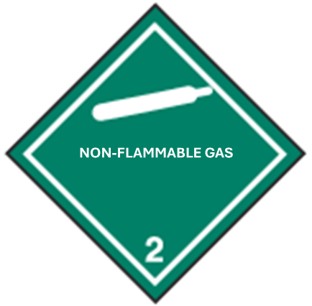
Class 2.2, Non-flammable, Non-toxic Gases - Text version
Green square on point with, in white: a line inside running parallel to the edge, the gas-cylinder symbol in the top corner, the words “NON-FLAMMABLE GAS” in the centre of the square and the number “2” in the bottom corner.
- Allow the display of labels on an empty means of containment provided that any marking indicating the presence of dangerous goods is covered. In the case of a means of containment that is a fibreboard large packaging, fibreboard box, a bag, a fibreboard IBC or a flexible IBC, the means of containment can be flattened in a way that clearly shows it is empty;
- Introduce an exemption for pressurized tanks used in water pump systems to align with the U.S. 49 CFR. The exemption will allow water pump system tanks to be filled to 280 kPa with compressed air, nitrogen or helium and transported to installation sites without having to meet the documentation, training, marking, reporting and specification packaging requirements;
- Add a requirement to display the words “NON-ODOURIZED”, “NOT ODOURIZED”, “NOT ODORIZED”, “NONODORIZED” or “SANS ODORISANT” on cylinders, portable tanks, highway tanks or tank cars containing non-odourized LPG; and
- Allow on a means of containment or shipping document the display of words that use the same spelling as the U.S. 49 CFR, the UN Recommendations, the ICAO TI or the IMDG code and differ from the TDGR. The allowance will include the use or absence of punctuation marks within the text, and the use of either uppercase or lowercase letters.
Use of packaging approved for air transport
The Regulations will allow dangerous goods to be transported by road or railway vehicle to or from an aircraft, an aerodrome or an air cargo facility in packaging that complies with the ICAO TI as prescribed in Part 12. As a result, dangerous goods in non-venting packagings could be transported by road or railway vehicle before or after a flight even though vented packagings would otherwise be required under the TDGR.
Changes to Part 12 – Air
The Regulations will consolidate all air provisions into Part 12, thus aligning them more closely with the ICAO TI, refine requirements, and update outdated exemptions.
General requirements
The ICAO TI will be incorporated by reference and provide the primary source of requirements for the transportation of dangerous goods by air. Part 12 is restructured to clearly identify when TDGR provisions will apply either instead of, or in addition to, specific ICAO TI provisions. For example, the requirements of the TDGR will continue to apply for containers for gases and radioactive materials; however, rather than applying in addition to the ICAO TI, the TDGR will apply instead of the equivalent ICAO TI provisions. The Regulations will also require that explosives be classified in accordance with the TDGRfootnote 22 instead of the ICAO TI.
Reporting
The reporting requirements for air transportation will be moved from Part 8 of the TDGR to Part 12. Reports of undeclared or misdeclared dangerous goods will be required to be submitted electronically rather than by phone. In addition, undeclared or misdeclared dangerous goods discovered in passenger or crew baggage will be reported within 10 days after the last day of the month during which the dangerous goods were discovered instead of as soon as possible. These reports will only be required for months in which the carrier has discovered undeclared or misdeclared dangerous goods in passenger or crew baggage; nil reports will not be required. Reports of dangerous goods discovered in cargo will still need to be submitted as soon as possible.
Exemptions
The Regulations will allow dangerous goods to be transported under ICAO TI exemptions, such as those for in-flight medical and veterinary aid, search and rescue operations, and for dropping in connection with avalanche control, agriculture, and forestry. The Regulations will also allow consignors and air carriers to use exemptions found in the TDGR for fire extinguishers, radioactive materials, samples for investigation, national defence, and cylinders transported from or for a vessel or aircraft for the purpose of refilling or requalification.
Part 12 of the TDGR includes a number of air-specific exemptions to facilitate the transportation of dangerous goods by air within Canada. The following changes will be made:
- The exemption for 1.4S explosives will be simplified and UN0044, PRIMERS, CAP TYPE and UN0373, SIGNAL DEVICES, HAND will be added to the list;
- The forbidden explosives exemption will apply only for transport to limited access locations and flights without passengers. In addition, instead of listing specific explosives, the exemption will apply to explosives for which packing instructions are provided in the Supplement to the ICAO TI;
- The aerial work exemption will apply to the aerial work activities regulated under the Canadian Aviation Regulations instead of a list of specific activities;
- Air-specific exemptions will be added for medical and clinical waste;
- An exemption from the requirement for handling labels on radioactive materials in excepted packages will be added;
- An exemption will be added for emergency response by air, and this exemption will not be limited to dedicated emergency response aircraft;
- An exemption will be added for dangerous goods required to be carried by enforcement officers (e.g. peace and wildlife officers) in the course of their duties;
- An exemption will be added for dangerous goods that are required for the safety of individuals on board of the aircraft and the operation and safety of an aircraft, such as fuel pumps and spare kits;
- The ICAO TI medical aid exemption will be extended to include the return of dangerous goods to the place of origin on an aircraft other than the one on which they were used; and
- The current exemptions for consumer commodities, geological core samples, and measuring instruments will be removed.
Training
- The Regulations will specify that a person who handles, offers for transport or transports dangerous goods by aircraft is required to be trained in accordance with Chapter 4 of Part 1 of the ICAO TI, in addition to maintaining a training certificate in accordance with Part 6 of the TDGR; and
- The Regulations will specify that the record of training must be kept in accordance with the ICAO TI despite the requirements found in section 6.6 of the TDGR.
Documentation
The Regulations will decrease the period that a consignor or carrier must retain a copy of a transport document for dangerous goods transported by aircraft from two years to one.
Limited access
The limited access provisions will no longer be restricted to specific categories of aircraft; they will apply for any aircraft that is flying directly to or from a limited access location. “Limited access location” will be defined as “a location to which there is no year-round access by a mode of transport other than air”.
In relation to the limited access provisions, the responsibility to classify dangerous goods and to use the correct packaging will be transferred to the air carrier as the carrier will need to know the limited access requirements (e.g. what quantities can be shipped and which means of containment can be used). This amendment will codify existing practices (air operators already routinely do this as a matter of course) and, therefore, the amendment is not expected to increase burden or costs for operators.
Limited access — gases
New provisions will allow non-flammable, non-toxic gases and flammable gases to be transported under the limited access provisions if they are not forbidden for transport under the ICAO TI.
The following flammable gases will be added to the list of gases that could be transported under the limited access provisions:
- UN1001, ACETYLENE, DISSOLVED
- UN1049, HYDROGEN, COMPRESSED
- UN1060, METHYLACETYLENE AND PROPADIENE MIXTURE, STABILIZED
- UN1954, COMPRESSED GAS, FLAMMABLE, N.O.S.
- UN1971, METHANE, COMPRESSED or NATURAL GAS, COMPRESSED with high methane content
The maximum capacity per cylinder for the gases listed will increase from 100 L to 110 L and the total capacity of all cylinders of these gases allowed on a passenger plane will increase from 120 L to 132 L.
Limited access — flammable liquids
UN1170, ETHANOL or ETHANOL SOLUTION or ETHYL ALCOHOL or ETHYL ALCOHOL SOLUTION, UN1230, METHANOL, and UN1987, ALCOHOLS, N.O.S. will be added to the list of flammable liquids that can be transported under the limited access provisions. Requirements will be modified to allow use of non-specificationfootnote 23 means of containment for quantities up to 25 L and to allow use of jerricans for quantities up to 60 L on passenger aircraft. For larger quantities, requirements for drums will be updated to reflect the types of drums currently in use. Packing Group III drums will no longer be allowed on passenger aircraft.
Limited access — bear bangers and bear spray
New provisions will be added to allow bear bangers and bear spray to be transported under the limited access provisions. An outer means of containment marked with the words “Bear Spray”, or “Bear Bangers” will be required, and they will need to be transported in a cargo compartment separate from the passenger cabin if the aircraft has one. Labelling requirements will not apply.
Limited access — paint
A new provision will allow paint and paint-related material (such as paint thinner) to be transported under the limited access provisions. In addition, these dangerous goods could be transported under this provision as limited quantities in inner packagings of up to 5 L.
Limited access — wet batteries
This provision will be simplified and modified to allow wet batteries that are UN2794, UN2795 or UN2800 to be transported in a rigid container, wooden slatted crate or on a pallet.
Limited access — vehicles, engines, and machinery
This provision will be simplified and revised to allow the transport of flammable gas-powered vehicles, engines, and machinery on passenger aircraft under the limited access provisions. The packing instructions and quantity limits in the ICAO TI for transporting these dangerous goods by cargo aircraft will apply.
Regulatory development
Consultation prior to prepublication in the Canada Gazette, Part I
International harmonization and the Regulatory Cooperation Council
The proposed amendments respecting international harmonization were presented to the Transportation of Dangerous Goods General Policy Advisory Council and the Multi-Association Committee on TDG stakeholders in 2019 and in summer 2020.
In early 2019, a 60-day web-based consultation was undertaken on the proposed amendments. Submissions were received from provincial governments, training centres, industry, and associations across the air, rail, marine, chemical, and fuel sectors.
Overall, there was a general support for harmonizing the TDGR with the most recent version of the UN Recommendations available at that time, as well as aligning the TDGR more closely with the United States’ regulations. One stakeholder, however, expressed concerns about the proposed changes to labels and placards for substances that are toxic by inhalation. In the consultation document, TC had failed to specify that the proposed changes would not affect the long-established placard for anhydrous ammonia, a toxic-by-inhalation gas widely used as fertilizer in Canadian farm fields. Once this was specified, the stakeholder had no further concerns.
Stakeholders emphasized that the proposed amendments would better align with the international codes, resulting in cost savings to industry, while maintaining or enhancing safety. Regarding the classification of dangerous goods, stakeholders expressed support for adopting dynamic references to the classification requirements of the UN Recommendations. However, they highlighted the need for a better understanding of how the process would operate in practice.
Stakeholders raised concerns that some proposed changes, such as the packaging requirements for oxygen generators, did not improve specificity as intended.
In response, TC published a comprehensive guidance material that accompanied the publication of the final version of the Regulations in the Canada Gazette that covers this and other amendments.
A second web-based consultation on the proposed amendments was held during the summer of 2020, a few months into the COVID-19 pandemic. The consultations also included virtual meetings with key stakeholders and associations. Seven submissions were received from associations representing consignors, carriers by road, air and sea, manufacturers of containers and dangerous goods such as chemicals, pharmaceuticals and electronics, as well as chemical and fuel industries. Stakeholders strongly supported the proposed provisions that will increase alignment with international codes and the U.S. 49 CFR and update the Canadian packaging standards and urged TC to expedite the publication of the final version of the Regulations.
Part 12 – Air
In spring 2016, TC consulted other government departments and key industry stakeholders over a seven-week comment period via email and an online questionnaire. Stakeholders were generally supportive of the amendments that deal with Part 12.
In spring and summer 2017, a 60-day web-based consultation was held for industry stakeholders and the public. Comments were received from provincial government wildlife, forestry and natural resources officials, air carriers, a paramedic association, air transportation associations, and industry associations. There was overall support for the proposal to update Part 12 of the TDGR, and specifically, the proposals to limit the air transport of explosives and remove exemptions that are no longer needed, such as the geological core samples and consumer commodities exemptions. There was also support for expanding the lists of flammable liquids and gases that could be transported under the limited access provisions and for adding exemptions for helicopter spare part kits and fuel pumps. Stakeholders were grateful to have a definition for “limited access”; however, they expressed concerns with the proposed options that were based on latitude (north of 60o), seasonality, or lack of road or ship access for defined periods of time throughout the year (for example three months). In response, TC revised and simplified the proposed definition.
A web-based consultation and virtual meetings with key stakeholders were held during the summer of 2020 to present the draft provisions of the Regulations. Four written submissions were received from associations representing pilots, air carriers, and the fuel industry. Stakeholders supported the proposals for updates to the air exemptions, electronic monthly reporting of undeclared and misdeclared dangerous goods, reduced retention time for transport documents, and allowing packages that are compliant with air requirements to be transported by road and railway vehicles. The revised “limited access” definition was welcomed, as were the proposals to update the limited access provisions, particularly those for flammable liquids and bear spray. Air carriers did not support removing the requirement to have a border of “red hatchings”footnote 24 on the transport document, as they use these marks to clearly identify the presence of dangerous goods. In response, TC dropped the proposed amendment and will maintain the “red hatchings” requirement.
Comments stemming from prepublication in the Canada Gazette, Part I
On November 16, 2022, the proposed amendments were published in the Canada Gazette, Part I, followed by a 75-day consultation period. Given the technical complexity and length of the amendment, stakeholders requested additional time to conduct a thorough review and provide meaningful input. Therefore, an extension of 19 days was granted. As such, the consultation period of 94 days concluded on February 28th, 2023. During that period, TC received 21 submissions, which together included 328 comments from subject matter experts, individuals, companies, and industry associations. All comments were carefully reviewed and taken into consideration.
The feedback received from stakeholders indicated general support for TC’s primary intent to harmonize the TDGR with international codes and the U.S. 49 CFR and practices. However, comments also highlighted several concerns, which are summarized and addressed below. Given the significant scope of the amendment, at the request of stakeholders, an informal consultation period occurred from December 27, 2023, to February 9, 2024, to verify that concerns raised during the prepublication period were addressed without compromising TC’s objectives. During the informal consultation, TC received 13 submissions containing a total of 182 comments. All comments were reviewed and considered in the final development of the Regulations. Of these, 69 resulted in further changes. The remaining 113 comments, including 53 comments that were duplicates of comments received during the prepublication in the Canada Gazette, Part I, did not lead to amendments at this stage. Stakeholders appreciated TC’s efforts to reduce administrative burden, regulatory overlap, and other issues raised during the official comment period and welcomed the new modifications.
Overall, the comments received did not warrant a major policy change or deviation from the original objectives. However, one substantive change arising from consultation relates to the proposal to incorporate by reference the classification scheme of the UN Recommendations into the TDGR. The intent of this proposal, as published in the Canada Gazette, Part I, was to enable stakeholders to apply the most current classification provisions and strengthen alignment with international codes.
Following stakeholder input and further analysis, TC determined that this approach would create challenges related to drafting consistency, regulatory interpretation and alignment with the Canadian regulatory framework. As a result, TC decided not to proceed with the incorporation by reference and will instead maintain the existing classification provisions under Part 2 of the TDGR, with targeted modifications to address stakeholder concerns and improve alignment with international codes. Several modifications described in the following sections stem directly from this decision.
The following sections provide a summary of the issues raised by stakeholders and subject matter experts and the actions taken by TC to address those issues.
Comment on return to prepublication in the Canada Gazette, Part I
Comment: Due to the complexity and length of this amendment, one stakeholder suggested that TC republish the proposal in the Canada Gazette, Part I, to allow for an additional commenting period.
TC response: In response, TC extended the consultation period by 19 days and conducted informal consultations for 45 days (December 27, 2023, to February 9, 2024) to gather additional feedback on the proposed changes before final publication in the Canada Gazette, Part II. During these consultations, no concerns were raised about the proposed modifications, and no stakeholders suggested a return to prepublication in the Canada Gazette, Part I.
TC also actively collaborated with stakeholders through various General Policy Advisory Council (GPAC) meetings and National Compliance Working Group (NCWG), providing an open forum to discuss issues and address concerns. Additionally, TC directly contacted certain stakeholders to further engage in these matters, and no additional feedback was received from those stakeholders.
Comments on clarity of the legal text
Comments: Several stakeholders raised concerns regarding the clarity of the proposed regulatory text and noted that some proposed provisions were not fully aligned with international codes. Specifically, stakeholders raised the following issues:
- The proposed requirements for the use of qualifying words with the shipping name were not fully aligned with international codes.
- The use of the term “shipping document” under the exemption for cargo transport units that are being fumigated is confusing and not fully aligned with international codes.
- The terms “passenger-carrying aircraft” and “dangerous goods safety marks” were not used consistently throughout the proposed regulatory text.
- The French and English versions of certain provisions were not aligned.
- The provisions regarding the information required on a shipping document were not fully aligned with international codes, and the proposed regulatory text made these provisions difficult to understand. Stakeholders sought clarification regarding the 24-hour telephone number requirements. Specifically, they wanted to know whether the requirement that the telephone connection made by the caller must not be broken applies when the 24-hour number belongs to an organization or agency, rather than the consignor.
TC response: To address these concerns, TC amended several provisions of the proposed regulatory text to improve clarity and harmonization. These amendments will:
- Align the requirements for the use of qualifying words (e.g. “STABILIZED,” “TEMPERATURE CONTROLLED,” “MOLTEN,” “SOLUTION,” and “MIXTURE”) with those of international codes.
- Align the requirements of the exemption for cargo transport units that are being fumigated with those of international codes and replace the term “shipping document” with “document.”
- Repeal the term “passenger-carrying aircraft” throughout the TDGR and replace “dangerous goods safety marks” with “dangerous goods marks” to align with the wording in the TDG Act.
- Further harmonize the French and English versions to remove discrepancies.
- Refine and align the requirements for the information to be included in shipping documents with those in international codes.
- Specify that the consignor is responsible for including a 24-hour telephone number on the shipping document. Whether that number belongs to the consignor, an organization, or an agency, the requirement that the caller’s connection must not be broken continues to apply.
TC published guidance material on its website prior to the final publication of the Regulations in the Canada Gazette, Part II, to help stakeholders clearly understand the changes and the new requirements.
Comments on incorporation by reference of the classification scheme of the UN Recommendations into the TDGR
Comments: While stakeholders initially supported the proposal to incorporate by reference the UN Recommendations’ classification scheme into the TDGR, concerns emerged following prepublication in the Canada Gazette, Part I. Nine submissions (60 comments) from stakeholders and subject matter experts have expressed concerns regarding the dynamic incorporation by reference of the UN Recommendations’ classification scheme into the TDGR. They highlighted potential issues if the UN Recommendations were to adopt new provisions that conflict with the Government of Canada’s views or practices, or if biennial updates to the UN Recommendations modified sections or paragraphs numbers, it could create regulatory misalignment or regulatory gaps.
TC response: TC acknowledges the classification scheme of the UN Recommendations does not entirely align with the Canadian regime. The TDG Act specifies that dangerous goods are included in the classes listed in its schedule, whereas the UN Recommendations state that dangerous goods are included in a class or a division. Furthermore, in Canada, the Canadian Nuclear Safety Commission and Natural Resources Canada are responsible for classifying dangerous goods included in Class 7, Radioactive Materials, and Class 1, Explosives, respectively, in accordance with the Packaging and Transport of Nuclear Substances Regulations, 2015, and the Explosives Act.
TC has determined that it is necessary to publish the amendment in the Canada Gazette, Part II, without the proposed incorporation by reference of the UN Recommendations’ classification scheme in its entirety. This approach preserves regulatory clarity and ensures that classification requirements applicable in Canada remain directly set out in the TDRG.
TC acknowledges that this decision will result in certain TDGR classification provisions remaining misaligned with the UN Recommendations. This may create compliance challenges for consignors who will have to rely on two different classification schemes when transporting dangerous goods internationally versus domestically. To mitigate potential impacts, TC will continue to permit the use of UN-based classification methods where authorized under the TDGR, provide ongoing guidance and support to stakeholders through updated interpretive materials and established communication channels, and prioritize future regulatory amendments aimed at progressively enhancing harmonization with the UN Recommendations. This approach is not expected to result in a net increase in administrative or compliance burden and reflects TC’s continued commitment to regulatory clarity, stakeholder support, and international alignment.
To minimize the impact of this decision, specific adjustments are made to Part 2 to include classification requirements for articles containing dangerous goods N.O.S. and requirements for the transportation of primary lithium metal cells and rechargeable lithium-ion cells. This update will improve alignment with the 22nd edition of the UN Recommendations and prevent regulatory gaps due to the addition of new UN numbers.
Furthermore, requirements for classifying marine pollutants that do not meet the criteria for inclusion in Classes 1 to 8 are relocated from Schedule 3 of the TDGR into Part 2 for consolidation with other classification provisions, with no change in existing requirements. Additionally, the drafting of some provisions is revised to improve coherence and avoid potential regulatory overlap that could result from this amendment.
Moving forward, TC will engage with stakeholders and subject matter experts to explore effective methods to dynamically incorporate by reference the classification scheme of the UN Recommendations into the TDGR, with minimal risk and administrative burden.
Comments on the exception for dangerous goods listed by name in Schedule 1
Comments: Two submissions (two comments) opposed the removal of the exception that allows dangerous goods listed by name in Schedule 1 of the TDGR not to be considered as dangerous goods if they are in any form, state, or concentration that does not meet the criteria for inclusion in any of the nine classes. This concern resulted from the proposed dynamic incorporation by reference of the full classification scheme of the UN Recommendations into the TDGR. Commenters indicated that this would have an unreasonable impact on what is defined as dangerous goods in Canada and would remove an important and reasonable exception for Canadians.
TC response: To reduce the administrative burden on stakeholders, TC did not repeal this exception and the classification scheme of Part 2 of the TDGR will remain mainly unchanged.
Comments on the use of the classification of a previous consignor or manufacturer and reverse logistics classification
Comments: Five submissions (six comments) raised concerns about the lack of requirements in the TDGR regarding the use of a previous consignor’s classification when returning shipments containing dangerous goods to the manufacturer, supplier, or distribution facility, when sending items containing dangerous goods to a waste facility for disposal, or when sending means of containment containing residue of dangerous goods to be refilled.
TC response: In 2014, the TDGR were modified and the text that explicitly allowed consignors to use the classification determined by a previous consignor or the manufacturer was removed. TC is keeping the status quo, and in an effort to reduce undeclared or misdeclared dangerous goods shipments, TC engaged in an awareness campaign on the safe return of dangerous goods through the transportation supply chain. Additionally, TC will initiate further consultations with stakeholders and subject matter experts to gain a more comprehensive understanding of the issues and safety implications associated with permitting the use of a manufacturer’s or a previous consignor’s classification. By gathering insight from stakeholders’ feedback, TC aims to establish a regulatory framework that clearly defines reverse logistics and outlines the specific conditions under which the classification of previous consignors might be utilized.
Comments on the proof of classification
Comments: Three submissions (three comments) indicated that the regulatory text proposed in the Canada Gazette, Part I, was too restrictive, suggesting that only a “test report” and a “lab report” would be accepted as proof of classification.
TC response: As the classification scheme of Part 2 of the TDGR remains mainly unchanged and to reduce confusion, TC maintained that the proof of classification can be a test report, a lab report or a document that explains how the dangerous goods were classified.
Comments on the information required on a shipping document
Comments: Seven submissions (26 comments) requested clarity on the type of information required on a shipping document, particularly regarding how dangerous goods should be identified using the terms “class,” “classe” or “division” as applicable. Stakeholders indicated that the new requirements were not aligned with international codes and would increase administrative and financial burden without adding safety benefits, as the shipping document templates and training materials would need to be updated. Additionally, one submission (one comment) indicated that the proposed regulatory text was lacking the necessary provisions to allow the 24-hour number and the ERAP telephone number to be displayed on the same line on a shipping document when those phone numbers are the same.
TC response: To reduce burden on stakeholders and align with international codes, TC allowed the use of the word “classe,” “class” or “division” on a shipping document. As the Regulations do not prohibit the display of the 24-hour number and the ERAP number on the same line on a shipping document if both numbers are the same, TC maintained the status quo.
Comments related to the reliance on the TDG Act
Comments: Although not a part of the proposal at prepublication, provinces and territories (PTs) raised concerns regarding recent amendments to the TDGR, sections 1.12 (Evidence – Marks and Prescribed Documents) and 1.13 (Defence – Due Diligence), which were repealed in an effort to remove duplication in 2023.footnote 21 PTs have indicated they rely on the TDGR — not the TDG Act — for enforcement. Without sections 1.12 and 1.13 in the TDGR, PTs may lack the authority to enforce key requirements, creating risks and potentially increasing safety risks due to reduced compliance and oversight.
PTs, as well as stakeholders and subject matter experts (three submissions; three comments), are also concerned about the proposed repeal of section 4.2 (Misleading Dangerous Goods Marks), as published in the Canada Gazette, Part I. These sections were repealed or proposed to be repealed because their content is already covered under the TDG Act.
However, repealing section 4.2 would also deprive PT inspectors of the ability to act against misleading dangerous goods marks, potentially compromising public safety.
TC response: To promote better harmonization between the federal regulatory regime and the regulatory regimes of PTs, TC reinstated sections 1.12 and 1.13 and is retaining section 4.2 in the TDGR.
Comments on covered dangerous goods marks
Comments: Four submissions (four comments) expressed concerns about the proposed conditions for considering dangerous goods marks as covered. Stakeholders and subject matter experts noted that if dangerous goods marks inside a closed vehicle are not properly covered, it could create confusion for emergency responders during an incident where the means of containment are ejected from the vehicle. In such cases, displaying a dangerous goods mark when no dangerous goods are present is misleading as to the presence of danger.
TC response: To avoid confusion and unnecessary actions by first responders, TC specified that dangerous goods marks on means of containment are considered covered when either
- all marks are fully obscured so that no part is visible; or
- the means of containment has been flattened in a way that clearly shows it is empty.
The provision also specifies which types of means of containment may be flattened for this purpose.
Comments on handwritten information on dangerous goods marks
Comments: Three submissions (three comments) requested TC’s clarification on the permissibility of handwritten information on placards and labels. This permission is important to stakeholders because it allows them to replace lost placards during transit.
TC response: As this matter is appropriately managed through established enforcement practices and does not present a safety concern, no regulatory amendment is proposed and no change to current practice is required.
Comments on the lithium battery mark
Comments: Four submissions (four comments) noted that the requirement to add the telephone number on the lithium battery mark was not aligned with international codes and the U.S. 49 CFR which do not require the display of the telephone number on the mark.
TC response: To maintain alignment with the international codes and the U.S. 49 CFR, the requirement for the telephone number to be displayed on the lithium battery mark is repealed.
Comments on the exemption related to human or animal specimens believed not to contain infectious substances
Comments: Subject matter experts (one submission; one comment) have indicated that the Exemption Related to Human or Animal Specimens Believed Not to Contain Infectious Substances found in Section 1.42 of the TDGR does not fully align with the UN Recommendations. The UN Recommendations clearly state that professional judgment, based on factors such as medical history and symptoms, is required to apply this exemption. Subject matter experts emphasized that this concept is critical to maintaining the message consistently communicated to stakeholders over the years.
TC response: TC initially proposed during the informal consultation to add a reference to the note found in the UN Recommendations, which specifies that professional judgment is required when applying this exemption. During the informal consultations in winter 2023–2024, one stakeholder suggested incorporating this note directly into the TDGR rather than referencing it. In response, TC revised its approach and explicitly included the requirements into the TDGR rather than incorporating the note by reference. TC then consulted affected stakeholders in winter 2024–2025 on this revised approach. No concerns were raised, as the change reflects TC’s longstanding message that professional judgment is necessary for using this exemption.
Comments on ERAP requirements for UN3549, MEDICAL WASTE, CATEGORY A, AFFECTING HUMANS, solid
Comments: One submission (one comment) indicated that the proposed regulatory text did not clearly state that an ERAP was not required for the import, offering, transport, or handling of UN3549, MEDICAL WASTE, CATEGORY A, AFFECTING HUMANS, solid. UN3549 is designated for solid medical waste resulting from the medical treatment of humans or veterinary treatment of animals. This includes solid medical waste containing Category A infectious substances.footnote 25
TC response: To alleviate the burden on hospitals and treatment centres when disposing solid medical waste, TC specified that an ERAP is not required for the import, offering, transport, or handling of UN3549, MEDICAL WASTE, CATEGORY A, AFFECTING HUMANS, solid due to the low pathogens load, which minimizes the risk of infection and transmission. However, UN3549 should not be used for waste generated from bioresearch or for any form of liquid waste.
Comments on ERAP requirements for dangerous goods classified under the U.S. 49 CFR
Comments: Subject matter experts (one submission; one comment) identified a regulatory gap in the proposed regulations. The proposal allowed for dangerous goods to be classified in accordance with the U.S. 49 CFR for transportation by road or rail from a place in Canada to a place in the United States, from a place in the United States to a place in Canada, or from a place in the United States through Canada to a place outside Canada. However, the proposal did not indicate that any dangerous goods that would require an ERAP if their classification was determined in accordance with Part 2 (Classification) of the TDGR still require an approved ERAP if the U.S. 49 CFR is to be used for classification.
TC response: TC specified that an approved ERAP is required for dangerous goods classified under the U.S. 49 CFR whenever those goods would require an ERAP if they were classified under the TDGR.
Comments on alignment with the U.S. 49 CFR — special permits
Comments: Subject matter experts (one submission; one comment) indicated that the language used for the provisions related to exports from Canada to the United States in accordance with a special permit issued under the U.S. 49 CFR was too permissive and could lead to the transportation of dangerous goods within Canada using American exemptions or special permits.
TC response: TC refined the provision to align it more closely with its intended purpose, which is to allow the return of means of containment with residual dangerous goods from a place in Canada to the U.S. under a special permit issued under the U.S. 49 CFR.
Comments on the renumbering of new special provisions
Comments: Four submissions (four comments) indicated that the proposed numbering system for new special provisions was unclear and misleading. This confusion arose because some special provisions were repealed, and their associated numbers were reassigned to new requirements within the same amendment.
TC response: In response to these concerns, TC agreed to allocate new numbers to these new special provisions and to clearly indicate “repealed” next to the repealed special provisions for a period of time that is sufficient to allow stakeholders to adapt to renumbering and avoid confusion or involuntary non-compliance.
Comments on the addition of examples in the TDGR
Comments: Subject matter experts (one submission; one comment) noted that the proposed wording for special provision 11, which sets out, among other things, the requirements for the classification of certain vehicles, should include examples of vehicles that meet the criteria to be considered as a vehicle under that special provision. It was also noted that this would help further align the regulatory text with the UN Recommendations.
TC response: To avoid any confusion that could arise from including specific examples of vehicles in the TDGR, the status quo is maintained. However, for the purpose of special provision 11, examples of vehicles defined as self-propelled apparatus designed to carry persons or goods include, but are not limited to,
- road vehicles, such as cars, motorcycles, three- and four-wheeled apparatus, trucks and bicycles equipped with a motor;
- railway vehicles and vehicles used for other modes of transport, such as locomotives, vessels and aircraft; and
- self-propelled work equipment, such as lawn tractors and self-propelled farming and construction equipment.
This also includes vehicles not equipped with at least one seating position and those transported in a means of containment, in which case certain parts may be detached from the frame to allow the vehicle to fit into that means of containment.
Comments on special provision 12
Comments: Subject matter experts (one submission; one comment) noted that the proposed wording of special provision 12 did not align with the IMDG Code and omitted key information relevant to the transport of UN 3166 and UN 3171 vehicles on domestic voyages, such as references to SOLAS stowage requirements.
TC response: Following feedback received after prepublication in the Canada Gazette, Part I, TC held internal discussions and decided to continue analyzing these requirements before proceeding with any regulatory changes. As a result, the proposal to amend special provision 12 has not been retained.
Comments on the new special provision for UN3149, HYDROGEN PEROXIDE AND PEROXYACETIC ACID MIXTURE
Comments: Subject matter experts (one submission; one comment) identified an oversight during prepublication, where a special provision equivalent to UN Recommendation 196 — assigned to UN3149, HYDROGEN PEROXIDE AND PEROXYACETIC ACID MIXTURE — was unintentionally omitted from the proposed regulatory text. The absence of that special provision in the TDGR could lead to the inappropriate use of the UN3149 classification and improper and unsafe transport of hydrogen peroxide and peroxyacetic acid mixture.
TC response: To avoid safety issues and promote harmonization with the UN Recommendations, TC added a new special provision in the TDGR that is equivalent to special provision 196 of the UN Recommendations.
Comments on special provision 43
Comments: Three submissions (three comments) from stakeholders and subject matter experts expressed concerns over the repeal of special provision 43, which specifies that certain dangerous goods are assigned to their respective classification based on human experience, rather than solely on standardized testing criteria. Repealing this special provision could lead to safety issues due to the potential misclassification of dangerous goods and compromise harmonization with the UN Recommendations.
TC response: TC has confirmed that each UN number subject to special provision 43 continues to be identified in Schedule 1 of the TDGR; as such, special provision 43 will be maintained.
Comments on special provision 146
Comments: Subject matter experts (one submission; one comment) raised concerns that the proposed wording for special provision 146 is too permissive and could lead to safety issues. Specifically, it could be interpreted to allow the use of the shipping name UN3509, PACKAGINGS DISCARDED, EMPTY, UNCLEANED for means of containment, i.e. containers that previously contained dangerous goods that pose a greater level of hazard than what the regulations intend to permit.
TC response: TC revised the provision to clearly specify which dangerous goods are covered under this special provision. This change will strengthen safety measures for the transportation of dangerous goods that are UN3509, PACKAGINGS DISCARDED, EMPTY, UNCLEANED.
Comments on the Military Specification: Tanks, Fabric, Collapsible: 3,000, 10,000, 20,000 and 50,000 Gallon, Fuel (MIL-T-52983G)footnote 26 standard
Comments: Six submissions (six comments) indicated that the repeal of the MIL-T-52983G standard, which sets out the requirements for the design and construction of collapsible fabric tanks, before the implementation of a new standard published by the Canadian Standards Association (CSA) would create an administrative burden on TC and the industry. Since TC’s intent is to incorporate the requirements of the MIL-T-52983G standard into a new CSA standard, repealing the MIL-T-52983G standard before the new CSA is ready to be incorporated into the Regulations would increase the number of ECs issued by TC and create a significant regulatory gap related to the transport of flammable liquid by aircraft within Canada.
TC response: To avoid creating a regulatory gap and increasing the need for ECs, the reference to the MIL-T-52983G is maintained, as the development of the new standard will not be finalized before the final publication of the Regulations in the Canada Gazette, Part II.
Comments on the restructure of Part 12
Comments: Five submissions (five comments) indicated that the layout of information in Part 12 is difficult to follow due to numerous references to the ICAO TI, making it hard to determine when the ICAO TI apply and when they do not. They also indicated that the new format necessitates the use of the ICAO TI to comply with Part 12 and suggested rewriting Part 12.
TC response: To assist stakeholders and TC inspectors in understanding the new structure of the requirements, TC developed guidance material available on TC’s website. In addition, the Regulations specified that Part 12 is a standalone part, meaning its requirements are self-contained and do not rely on provisions from other parts of the TDGR.
Comments on training requirements for air transport
Comments: Three submissions (three comments) raised concerns regarding the proposed training requirements for the transport of dangerous goods by aircraft. Specifically, it was noted that, since the proposed amendment to Part 6footnote 27 has been postponed, relying solely on the training requirements set out in Part 6 of the TDGR could create safety risks, as Part 6 includes references to some aspects of training that have been removed or modified in the ICAO TI. Therefore, relying solely on Part 6 would result in incomplete and insufficient training requirements to confirm that a person has the knowledge and training required to safely transport dangerous goods by aircraft.
TC response: To address this safety concern and confirm that employees receive adequate training, the Regulations refer to both Chapter 4 of Part 1 of the ICAO TI for compliance with the air training requirements and Part 6 of the TDGR for maintaining the training certificate requirement. Moreover, to reduce regulatory burden on the air sector and improve alignment with the ICAO TI, TC is requiring training records to be maintained in accordance with the ICAO TI rather than Part 6 of the TDGR. Under the ICAO TI, records must be kept for one year after they expire, compared to two years under the current TDGR.
Comments on the ERAP requirements for overflight of Canada
Comments: One submission (one comment) requested clarification on whether ERAP requirements apply to overflight, which specifically refers to the transport of dangerous goods by air from a place outside Canada through Canadian airspace to another place outside Canada without landing in Canada.
TC response: TC is of the view that no modifications to the Regulations are required. Therefore, TC has confirmed directly to the commenter that an ERAP is not required for overflight where dangerous goods are not offered for transport, handled, loaded, unloaded, or transported to or from Canada.
Comments on limited access location — Class 2.1, Flammable Gases
Comments: Two submissions (two comments) requested the addition of UN2037, GAS CARTRIDGES or RECEPTICALS, SMALL, CONTAINING GAS and UN3358, REFRIGERATING MACHINES to the list of dangerous goods that are exempted for transport to and from limited access locations, as the transport of these dangerous goods is essential for certain activities in remote communities. For example, the transport of UN3358 is needed to store vaccines, whereas, UN2037 is needed for camp stoves. These UN numbers are currently transported using ECs.
TC response: As a comprehensive risk analysis is needed to ensure their safe transport by air, UN2037 (gas cartridges) and UN3358 (refrigerating machines) are not being exempted at this time. These goods are subject to pressure changes and environmental conditions that could cause pressure-retaining components to burst. TC will work with industry to establish clear limits and conditions for transporting these goods without compromising safety.
Comments on limited access location — Class 3, Flammable Liquids
Comments: Three submissions (three comments) requested clarification on whether the letters “X” or “Y,” which indicate the packing group a package was tested for, must be displayed when means of containment containing dangerous goods listed in section 12.33 (1) are carried on passenger aircraft. The concern arises because the letter “X” signifies suitability for Packing Groups I, II, and III, while “Y” indicates suitability for Packing Groups II and III. This could be misinterpreted to imply that dangerous goods in section 12.33(1) may be assigned to Packing Group III.
TC response: To address this concern, TC specified that these dangerous goods can be transported on passenger aircraft if they meet the Packing Group II performance standard or higher.
Comments on the transition period
Comments: Seven submissions (seven comments) requested that the transition period be increased from six months to 12 months.
TC response: In an effort to alleviate stakeholder burden due to the extensive amendments, TC agreed to extend the transition period from 6 months to 12 months.
Changes made to the proposed Regulations since prepublication in the Canada Gazette, Part I
Following the prepublication of the proposed amendment to the TDGR in Part I of the Canada Gazette, the following changes were introduced:
- The requirements for the use of “qualifying words” were refined;
- The term “passenger carrying aircraft” was repealed throughout the TDGR;
- The term “shipping document” was replaced with “document” under the exemption for cargo transport units that are fumigated;
- The use of the words “Classe,” “class” or “division” on a shipping document is allowed and the information required on a shipping document was modified to align with the UN Recommendations;
- The entire classification scheme of the UN Recommendations will not be dynamically incorporated by reference in the TDGR; instead, specific amendments were made to Part 2;
- The new requirements for classifying articles containing dangerous goods N.O.S. were added to Part 2 of the TDGR;
- The new requirements for the transportation of primary lithium metal cells and rechargeable lithium-ion cells were added to Part 2 of the TDGR;
- Existing requirements for classification of marine pollutants that do not meet the criteria for inclusion in any of Classes 1 to 8 were moved to Part 2;
- The requirements for providing the 24-hour number that can be reached without breaking the line were specified;
- The requirement for the ERAP telephone number to be preceded with the letters “ERAP” or “PUI” was specified;
- The term “dangerous goods safety mark” was replaced with “dangerous goods marks”;
- The requirement for the display of the phone number for additional information on the lithium battery mark was repealed in alignment with the international codes and the U.S. 49 CFR;
- Sections 1.12, Evidence – Marks and Prescribed Documents, and 1.13, Defence – Due Diligence, that were repealed in the amendment entitled the Regulations Amending the Transportation of Dangerous Goods Regulations (Miscellaneous Program) were reinstated;
- Section 4.2, Misleading Dangerous Goods Marks, was maintained in the TDGR;
- The conditions under which the dangerous goods marks on means of containment are considered to be covered were specified;
- Text that communicates the dangerous goods hazards is permitted to be displayed on labels and placards in any language along with at least English or French;
- An ERAP is not required for the transport of UN3549, MEDICAL WASTE, CATEGORY A, AFFECTING HUMANS, solid;
- An approved ERAP is required for dangerous goods that are classified under the U.S. 49 CFR if the dangerous goods would require an approved ERAP if they were classified in accordance with Part 2 of the TDGR;
- Only means of containment containing a residue of dangerous goods can be transported from Canada to the U.S. under a special permit issued under the U.S. 49 CFR;
- The new special provisions were renumbered, and the repealed special provisions are marked as such for a period of time that is sufficient to allow stakeholders to comply with the new requirements instead of immediately replacing them with new requirements;
- A new special provision for the proper classification and transport of UN3149, HYDROGEN PEROXIDE AND PEROXYACETIC ACID MIXTURE, was introduced;
- The exception that allows dangerous goods listed by name in Schedule 1 of the TDGR to not be considered as dangerous goods, if they are in any form, state, or concentration that does not meet the criteria for inclusion in any of the nine classes, was not repealed;
- Special Provision 43 from the TDGR was not repealed;
- The reference to the MIL-T-52983G standard was not repealed;
- The training requirements of the ICAO TI and Part 6 for air transport were reincorporated;
- The requirements for training and segregation to the Aerial Work and Fire Suppression Exemption were reintroduced. These requirements were unintentionally omitted in the proposed amendments; and
- The transitional period was extended from six to 12 months.
Indigenous engagement, consultation and modern treaty obligations
In accordance with the Cabinet Directive on the Federal Approach to Modern Treaty Implementation, analysis was undertaken to determine whether the Regulations are likely to give rise to modern treaty obligations. This assessment examined the geographic scope and subject matter of the proposal in relation to modern treaties in effect. Upon examination, no implications or impacts on modern treaties were identified.
An assessment of the United Nations Declaration on the Rights of Indigenous Peoples Act was completed. The assessment concluded that the Regulations are expected to positively impact Indigenous communities’ economic and social rights, particularly in remote and northern regions, by improving safety and accessibility in the transportation of dangerous goods.
Potential intersections with the UN Declaration were identified, consistent with concerns previously raised by Indigenous groups regarding the TDGR. In August 2025, TC published a notice in the Indigenous Relations Engagement Opportunities Bulletin to seek input on the proposed air provisions. No concerns were raised. TC remains committed to ongoing engagement with Indigenous partners throughout the amendment process.
Instrument choice
The TDGR are largely harmonized with the requirements prescribed in the UN Recommendations. As a member of UN agencies, Canada actively contributes to their development by participating in meetings of the UN Economic and Social Council Sub-Committee of Experts on the Transport of Dangerous Goods. During these meetings, Canada discusses proposed amendments, submits its own and provides expert advice on international initiatives. As a member, Canada is expected to adopt into Canadian law the internationally agreed requirements that are in the UN Recommendations, the ICAO TI and the IMDG Code. To become law in Canada, these requirements must be put into regulations. Without regulatory amendments to incorporate the latest modifications to international codes and practices into the TDGR, Canadian requirements for dangerous goods marks, classification information, shipping names and packaging will not align with requirements in other jurisdictions, e.g. the European Union and the United States. This inconsistency will continue to create unnecessary burden for Canadian operators (as they will have to deal with different sets of requirements) and could cause potential safety risks for trade chain partners and first responders. No non-regulatory options were considered for these changes.
The Regulations update Canadian standards, which are incorporated by reference, to better align them with the UN Recommendations for the design, manufacture and use of means of containment. These changes must be set out in regulations because the standards only become legally binding when incorporated by reference in regulations. Without these amendments, Canadian consignors will lose out on cost savings related to the manufacture and use of means of containment and the use of reduced size labels for cylinders, negatively impacting their ability to be competitive in the international market. No non-regulatory options were considered for this change.
The Regulations will allow, under certain conditions, the transportation of dangerous goods from Canada to the United States in accordance with the classification, marking, labelling, placarding and documentation requirements of the U.S. 49 CFR. Furthermore, the use of special permits issued under the U.S. 49 CFR will be allowed for the transportation of means of containment with residue of dangerous goods by road and railway vehicles from Canada to the United States.
These changes need to be set out in regulations to fulfill commitments made between Canada and the United States to formally recognize each country’s regulatory regime through revisions to their respective regulations. Without these amendments, Canada will not be able to fulfill its commitment to reciprocity with the United States through amendments to the TDGR. No non-regulatory options were considered.
Finally, the Regulations will amend Part 12 of the TDGR to modernize air transportation requirements and update provisions for transport to remote locations and exemptions for medical, scientific, industrial, aerial and enforcement activities to reflect current domestic needs. These changes need to be set out in regulations because they are changes and improvements to existing regulatory provisions that can only be modified through a regulatory amendment. Without these amendments, the air provisions in the TDGR will continue to create a burden for stakeholders, particularly those in remote locations, many of which are Indigenous communities. No non-regulatory options were considered.
Regulatory analysis
The Regulations will be better aligned with international standards and codes, thereby minimizing the need for industry to comply with different Canadian and international regulatory frameworks.
The Regulations eliminate the need for many ECs by introducing provisions to authorize activities that do not comply with the existing TDGR. They will also provide flexibility for operators by extending the period to declare dangerous goods discovered in air carriers’ passenger baggage. Public safety will not be compromised by this change, because these reports are used to identify trends so air operators can target public awareness; accidents and incidents involving dangerous goods will still need to be reported as soon as possible.
The Regulations are expected to result in a total monetized benefit of $3.46 million, of which $0.1 million would occur to industry, and $3.36 million to the Government of Canada. The Regulations impose costs on some manufacturers of means of containment to retest registered container designs every five years. It is estimated that the total costs to industry would be approximately $2.39 million. The cost to the Government is estimated to be approximately $0.02 million to review undeclared dangerous goods reports. As a result, the Regulations are expected to generate a net benefit of $1.05 million (present value in 2024 Canadian dollars, discounted to 2026 at a 7% rate) between 2026 and 2035.
Following comments received during the prepublication of the Regulations in the Canada Gazette, Part I, TC revised some requirements. As a result, the cost-benefit analysis was updated to include the following:
- The new requirements for handling, offering for transport and transporting primary lithium metal cells and rechargeable lithium-ion cells as well as the alignment with the international codes and the U.S. 49 CFR on lithium battery mark requirements.
- The training record-keeping requirements found in Part 12 will align with the ICAO TI, which requires records to be kept for one year after they expire.
- The incorporation of the requirement to have a professional judgment when using Exemption Related to Human or Animal Specimens Believed Not to Contain Infectious Substances found in section 1.42, to align with the UN Recommendations.
The cost-benefit analysis was further refined to accurately capture impacts by using updated data, the updated coming-into-force date and transition periods.
More specifically, the number of containers requiring retesting has been updated from 727 to 794, and certain lab testing fees have decreased. The updated testing fees range between $1,000 and $2,400 instead of $1,000 to $4,000. The periodic retest of container designs will come into force on July 1, 2029, instead of 24 months following the publication of the Regulations. These adjustments have led to a reduction in industry costs from $3.13 million to $2.39 million between 2026 and 2035. Further, the total number of ECs to be eliminated has increased from 665 to 970 and has resulted in greater cost savings for both industry and government. Industry savings have increased from $0.04 million to $0.1 million, while government savings have increased from $2.66 million to $3.36 million from 2026 to 2035. As a result, the Regulations are now expected to generate a net benefit of $1.05 million between 2026 and 2035, instead of a net cost of $0.49 million.
Analytical framework
The costs and benefits for the Regulations have been assessed in accordance with the Treasury Board of Canada Secretariat (TBS) Policy on Cost-Benefit Analysis. Impacts are quantified and monetized, with only the direct costs and benefits for stakeholders being considered in the cost-benefit analysis.
Benefits and costs associated with the Regulations are assessed based on comparing the baseline scenario against the regulatory scenario. The baseline scenario depicts what is likely to happen in the future if the Government of Canada does not implement the Regulations. The regulatory scenario provides information on the intended outcomes as a result of the Regulations.
The analysis estimated the impact of the Regulations over a 10-year period from 2026 to 2035, with the year 2026 being when the Regulations are registered. Note that the formula used to calculate the discounted and annualized values under the Cost-benefit statement and the small business lens follows the methodology prescribed in TBS’s Canada’s Cost-Benefit Analysis Guide for regulatory proposals where impacts occurring in the first period are undiscounted. Unless otherwise stated, all values are expressed in present value in 2024 Canadian dollars, discounted to the year of 2026 at a 7% discount rate.
Impacted stakeholders
It is estimated that the Regulations will affect a total of 39 000 businesses involved in the dangerous goods industry in Canada, such as dangerous goods carriers, dangerous goods consignors or manufacturers of dangerous goods means of containment.
International harmonization
It is expected that the requirements of periodically retesting the dangerous goods container designs will affect a total of 137 container manufacturers. The number of impacted manufacturers is expected to stay stable over the analytical time frame. Based on previous EC requests, it is estimated that approximately 290 dangerous goods consignors will no longer need to apply for or renew their EC and, as a result, will save costs.
Air provisions
Approximately 1 500 air carriers will be required to report undeclared or misdeclared dangerous goods found in passenger baggage within 10 days after the last day of the month during which the dangerous goods were discovered instead of as soon as possible. Additionally, the Regulations will also eliminate the need for consignors and air carriers to renew approximately 680 ECs with respect to the transportation of dangerous goods by air, most of which are to limited access locations.
Baseline and regulatory scenarios
Baseline scenario
Under the baseline scenario, the transportation of dangerous goods would still be governed by the TDGR, which do not align with recent international codes nor allow reciprocity with certain United States requirements (U.S. 49 CFR). Furthermore, the TDGR would not include requirements for offering for transport, handling, or transporting primary lithium metal cells and rechargeable lithium-ion cells and would still be misaligned with international codes and the U.S. 49 CFR on lithium battery mark requirements. It would not incorporate several recent updates adopted in the international codes, including the IMDG Code and the UN Recommendations. As a result, stakeholders would not only face confusion due to the lack of harmonization between domestic and international frameworks but also continue incurring compliance costs particularly associated with non-essential discrepancies between these requirements. Further, human or animal specimens that are not considered to contain infectious substances are exempt from certain sections of the TDGR. While TC has issued guidance suggesting that a professional should determine this exemption, and the industry is currently adhering to TC’s recommendation, it would not be formalized in the Regulations under the baseline scenario.
Consignors and carriers would still need to request ECs and renew them every five years for some activities that are not authorized under the current TDGR. Also, container designs registered with TC would not have to be retested to prove that they still meet UN standards, which could result in containers no longer being safe for the transportation of dangerous goods. For example, UN packaging could be manufactured with materials or components that have changed over time, with or without the manufacturers’ knowledge, thereby invalidating the UN performance tests that were conducted on the original design.
Finally, the training record-keeping requirements found in Part 6 would still be misaligned with the ICAO TI, continuing creating confusion and inconsistency for regulated parties.
Regulatory scenario
Under the regulatory scenario, the Regulations will incorporate the 2022 updates to international standards (UN Recommendations and IMDG Code) as well as increase the reciprocity of regulatory requirements with the United States to facilitate the transportation of dangerous goods between both countries. The Regulations will introduce requirements for handling, offering for transport, and transporting primary lithium metal cells and rechargeable lithium-ion cells. The exemption for human or animal specimens that are not believed to contain infectious substances will be assessed by a professional, considering the specimen’s medical history, symptoms, relevant circumstances, and local endemic conditions. While the industry is already following TC’s recommendation to have a professional make this determination, it will be formally specified and included in the Regulations.
Updating various Canadian standards will eliminate the need for multiple ECs issued by TC, meaning consignors and carriers of dangerous goods will no longer be required to request or renew ECs every five years. The Regulations will also require container manufacturers to retest representative samples of their registered container designs every five years to ensure ongoing compliance with UN performance testing standards and to update any relevant information. The Regulations will specify that the record of training must be maintained in accordance with the ICAO TI. This will eliminate the discrepancy in the retention requirements, and all training records will be required to be kept for one year after they expire.
The Regulations will come into force upon publication in the Canada Gazette, Part II, and will include a twelve-month transition period. The requirements regarding periodic retest of container designs will come into force on July 1, 2029.
Costs and benefits
Costs
The Regulations will impose costs on some manufacturers of means of containment to retest registered container designs every five years. It is estimated that the total costs to the industry would be approximately $2.39 million.
The cost to the Government is estimated to be approximately $0.02 million.
Costs associated with international harmonization
Container retesting costs
As stated above, the Regulations will require container manufacturers to retest representative samples of the registered container designs every five years to confirm that they meet UN performance testing standards and that any new information relating to the containers is updated. This requirement will impact 137 container manufacturing companies across Canada. The cost of testing containers ranges between $1,000 and $2,400 depending on the type of container. Table 1 below illustrates the number of containers to be retested every five years and the average cost for lab testing by container type.
| Type of container | Total number of containers | Average cost for lab testing |
|---|---|---|
| 5H3, 5H4, 5M1, 5M2 | 84 | $1,000 |
| 1G, 4A, 4B, 4C1, 4D | 113 | $1,700 |
| 4G | 552 | $2,400 |
| 4GV, 4H1, 4H2, 6HG2 | 45 | $2,400 |
The container retesting requirement will come into force on July 1, 2029. The total cost associated with manufacturers retesting their container designs is estimated at $2.39 million.
Cost to the Government
There will be no incremental cost to TC to review undeclared dangerous goods reports. Air carriers are currently required to report undeclared or misdeclared dangerous goods by telephone to CANUTEC as soon as possible. The Regulations will require the reports to be submitted electronically instead. It will take about three hours for a TC officer to review and process the reported information every month.
TC’s TDG Public Awareness Program regularly informs stakeholders of updates to the TDGR through education and awareness campaigns by developing information documents, reaching out to targeted audiences, answering questions from the industry, and by doing presentations. It is expected that the Regulations will not add additional effort to the Program. Any costs associated with outreach and awareness with respect to the Regulations will be absorbed under the normal operating costs to administer the TDGR.
The total cost to the Government in reviewing undeclared dangerous goods reports is estimated to be approximately $0.02 million.
Qualitative cost
The Regulations will require the display of the words “NON-ODOURIZED,” “NOT ODOURIZED,” “NOT ODORIZED,” “NONODORIZED” or “SANS ODORISANT” on cylinders, portable tanks, highway tanks or tank cars containing non-odourized liquified petroleum gases. The Regulations will further align the TDGR with the U.S. 49 CFR. The cost to mark a means of containment with the words “NON-ODOURIZED” is estimated to be $2. However, according to TC subject matter experts, non-odourized LPG is transported by rail, with a majority of it being transported between Canada and the United States. As a result, these means of containment already have the markings in order to comply with the U.S. 49 CFR. The total cost is expected to be negligible.
Benefits
The Regulations are expected to improve alignment with international standards by incorporating best practices and uniform regulations, modernize certain requirements, and introduce flexibility in reporting to facilitate stakeholder compliance. As a result, the Regulations will create a fairer competitive environment for Canadian businesses involved in transporting dangerous goods by reducing regulatory barriers, while enhancing safety and security for employees and the public.
The harmonization with international codes, updates to air provisions, and alignment with U.S. regulations are expected to generate cost savings for both the industry and the Government of Canada. Considering both qualitative and quantified benefits, the advantages of the TDGR amendments are anticipated to outweigh their costs. The Regulations are expected to result in a total monetized benefit of $3.46 million.
Monetized benefits
Cost savings associated with international harmonization
The Regulations introduce special provisions as well as new types of means of containment, which will obviate the need for consignors to apply for ECs. A total of 290 ECs will be eliminated for some activities that do not comply with the current TDGR. Table 2 below summarizes the number of ECs and the activities for which dangerous goods consignors will no longer need to make a request. According to TC subject matter experts, it is expected that all applicants will continue to renew their ECs once they expire.footnote 28 For the cost saving calculation, the number of EC issuance and renewals by year was estimated by distributing equally the existing ECs over five years and renewed when they expire after five years.
| Type of activities | Number of existing ECs to be eliminated |
|---|---|
| Use of pallets. CAN/CGSB-43.150 | 180 |
| Extend period of use of plastic jerricans or drums. CAN/CGSB-43.150 | 3 |
| Means of containment for waste. CAN/CGSB-43.150 | 41 |
| Shoulder labels on cylinders | 4 |
| Water-pump systems | 3 |
| Transport of contaminated soil | 9 |
| Reciprocity of U.S. 49 CFR and special permits | 50 |
| Total ECs | 290 |
It takes about two hours to fill out a request for an EC and the average hourly salary plus overhead of a dangerous goods consignor employee for filling in an EC is $42.33. ECs are renewed every five years and renewal conditions are the same as for the first request. The total cost savings to dangerous goods consignors is estimated to be $0.03 million over the 10 years of analysis.
Cost savings associated with the air provisions
The Regulations will extend the period to report dangerous goods discovered in passenger baggage from as soon as possible to a monthly report. Based on the historical number of reports, there is a growth trend of about 3.6% of undeclared dangerous goods from year to year. In 2020, 177 reports were made to CANUTEC. Air carriers will now collect information and submit one electronic monthly report for all dangerous goods discovered in passenger baggage. TC has developed a reporting tool for air carriers to collect the required information and submit electronic reports. Larger air carriers that already have databases will likely opt to extract the information directly from their databases and email it to TC once a month, which will take a few minutes. According to subject matter experts, there are about 10 air carriers who most often call CANUTEC to report undeclared dangerous goods. The historical data suggests there are 16 calls on average per month from those 10 air carriers to CANUTEC. A call to report undeclared dangerous goods takes approximately 8 minutes to complete. Thus, air carriers spent on average 128 minutes per month to call CANUTEC. With the Regulations, it will take five minutes for air carriers to extract the undeclared dangerous goods information from their database and email it to TC once a month. This will result in a time saving of 123 minutes on average to 10 air carriers, which will result in a total cost savings estimated at $6,180 over the 10-year analytical period.
The Regulations will also allow various activities currently forbidden in the ICAO TI and done with an EC under the TDGR. It is expected that a total of 680 ECs will be eliminated with the introduction of the new provisions. Table 3 shows the breakdown of the number of existing ECs that air carriers and dangerous goods consignors will no longer need to request.
| Amendment to the TDGR Part 12 | Number of existing ECs to be eliminated |
|---|---|
| Allow the transportation of explosives forbidden in ICAO TI on aircraft from or to limited access locations | 14 |
| Allow larger aircraft to transport dangerous goods to remote areas (applicability of limited access) | 35 |
| Allow certain Class 3 flammable liquids under limited access provisions (UN1170, UN1230, UN1987) | 8 |
| Allow certain Class 2.1 flammable gases to be transported in cylinders under limited access provisions (UN1001, UN1049, UN1060, UN1954, UN1971) | 21 |
| Allow Class 2.2 non-flammable and non-toxic gases to be transported in cylinders under limited access provisions | 21 |
| Allow aerosols and bear spray transportation under limited access provisions (UN1950) | 202 |
| Allow non-specification packaging for wet batteries transported under the limited access provisions (UN2794, UN2795) | 52 |
| Allow transportation of bear bangers on passenger aircraft under limited access provisions (UN0312) | 202 |
| Provide exemptions for the transportation of dangerous goods for aerial work activities | 83 |
| Provide exemptions for the transportation of dangerous goods needed for emergency services | 9 |
| Provide exemptions for the transportation of dangerous goods in quantities needed by enforcement officers | 18 |
| Provide exemption for dangerous goods that are required for the operation and safety of an aircraft, such as fuel pumps and spare kits | 15 |
| Total ECs | 680 |
All ECs are renewed every five years and the total cost savings to air carriers and dangerous goods consignors is estimated to be $0.07 million.
Cost savings to the Government
The Regulations will result in an estimated total cost savings of $3.36 million to TC.
Currently, TC corresponds with manufacturers of means of containment for dangerous goods to determine whether their containers meet the UN standards required for renewal. The time required for reviewing and approving depends on the number of container designs registered by the manufacturer with TC. Based on current data, 53% of stakeholders registered three or fewer designs; 30% registered four to six designs; and 17% registered seven and more designs. Three designs or fewer take half a day to review and approve by TC; four to six designs take one day and seven and more designs take more than a day. The Regulations will require manufacturers to retest their container designs and send a digital report to TC for review. It will take two hours per design for TC to review and approve the container retest report. The new system will eliminate the time spent by TC getting information about the design from stakeholders and determining whether their container meets the requirements for renewal. This is expected to result in a cost saving of approximately $0.43 million to TC due to the reduction in time TC engineers will need to review and approve the container retest report.
The Regulations will also result in a cost saving of $2.92 million to TC, as it will no longer need to process and issue ECs. A total of 290 ECs for the international harmonization and 680 ECs for air provisions will be eliminated. Currently, dangerous goods consignors and carriers apply to request an EC, which is renewable every five years. ECs allow activities currently forbidden under the TDGR. The cost savings are related to the time TC will save for no longer reviewing and approving ECs.
Finally, with the Regulations, CANUTEC will no longer receive reports of undeclared dangerous goods. Air carriers will no longer need to call CANUTEC to report each time undeclared dangerous goods are found in passenger baggage. CANUTEC will save a few minutes each time undeclared dangerous goods are found in passenger baggage and the time it takes to review the reports. The total cost saving is estimated at $0.01 million.
Qualitative benefits
Canada’s international commitments
The Regulations will enable Canada to fulfill its international commitments. As a member of the UN, ICAO and IMO, Canada is expected to integrate the principles from these entities’ recommendations and codes into the TDGR, promoting global harmonization in the transportation of dangerous goods. This alignment will benefit Canadian businesses involved in handling dangerous goods for domestic and international trade by eliminating unnecessary discrepancies between domestic and international regulatory frameworks. Therefore, it will streamline the process of importing and exporting these goods for consignors and carriers.
Safety benefits
The addition of new UN numbers and shipping names in the Regulations will confirm that the classification system is harmonized with the one used by the international community. Furthermore, shipping dangerous goods under internationally recognized shipping names will allow timely communication and awareness of the hazards posed by the goods.
In addition, the changes to the requirements for display of labels and text size will confirm that the dangerous goods marks are visible, which will help verify that the dangerous goods are handled according to their classification and could potentially reduce incidents with impacts on the environment and public safety. In the case of an incident, the new requirements on dangerous goods marks will enable emergency responders to recognize hazards more quickly and help them make better informed decisions.
The introduction of new requirements for handling, offering for transport, and transporting lithium batteries, in alignment with international codes and the U.S. 49 CFR, will enhance overall safety in the transportation system by reducing the risk of incidents involving lithium batteries. Aligning requirements across jurisdictions will facilitate compliance efforts for stakeholders involved in trade, enhance operational efficiency, and improve regulatory consistency.
The amendments to Part 12 of the TDGR will positively impact public safety and emergency response times as the result of new exemptions for emergency response, medical aid, enforcement officers, fire suppression and operation of an aircraft. These new exemptions will facilitate the transport of dangerous goods required for emergency response, allowing for a faster response by first responders and thus limiting adverse consequences in an emergency.
The changes to Part 12 will further protect air passengers by narrowing the scope of the forbidden explosive exemption to reduce the risk of an incident or accident resulting from the transport of these explosives on passenger aircraft.
Operation and supply chain efficiency benefits
Along with the benefits associated with the incorporation of the principles laid down in the UN Recommendations, allowing dangerous goods to be transported in non-vented containers to and from an airport by road or railway vehicle will address compliance gaps in the TDGR and promote continuity in the operation of the supply chain of dangerous goods within the transportation system.
The new format of Part 12 will eliminate uncertainty regarding which requirements and exemptions apply and will provide a more precise framework for the application of the limited access provisions. This will reduce confusion and save consignors and air operators time while reducing the potential for non-compliance.
Changes to the limited access provisions will improve the quality of life of people living and working in remote areas, many of whom are Indigenous communities, by facilitating better access to essential goods and safety equipment, such as sanitizer, bear deterrents, fuels, batteries, engines, and machinery.
More flexible reporting requirements, data consistency, and alignment
The Regulations will reduce reporting requirements for airport operators. For example, requiring reports of undeclared and misdeclared dangerous goods to be submitted monthly in an electronic format instead of by phone will provide flexibility and consistency of data and allow for better analysis by authorities. In addition, the Regulations will eliminate discrepancies by aligning the training record retention requirements of the TDGR with those of the ICAO TI. The TDGR currently requires records to be kept for two years after expiry, while the ICAO TI requires one year. This alignment will reduce confusion by harmonizing requirements with international standards, helping regulated parties operate across jurisdictions, supporting greater consistency in compliance obligations and will reduce unnecessary record-keeping retention time without compromising safety.
Cost-benefit statement
- Number of years: 10 (2026–2035)
- Price year: 2024
- Present value base year: 2026
- Discount rate: 7%
| Impacted stakeholder | Description of cost | Base year (2026) | Year 2027 | Year 2029 | Final year (2035) | Total present value | Annualized value |
|---|---|---|---|---|---|---|---|
| Industry | Container retesting cost | $0.00 | $0.00 | $1,394.97 | $0.00 | $2,389.57 | $317.96 |
| Government | Cost to review undeclared dangerous goods reports | $0.00 | $2.66 | $2.32 | $1.55 | $18.53 | $2.47 |
| All stakeholders | Total costs | $0.00 | $2.66 | $1,397.29 | $1.55 | $2,408.09 | $320.43 |
Table f4 note(s)
|
|||||||
| Impacted stakeholder | Description of benefit | Base year (2026) | Year 2027 | Year 2029 | Final year (2035) | Total present value | Annualized value |
|---|---|---|---|---|---|---|---|
| Industry | Cost savings to industry | $0.00 | $14.40 | $12.64 | $8.59 | $101.42 | $13.50 |
| Government | Cost savings to TC and CANUTEC | $0.00 | $419.65 | $618.41 | $244.56 | $3,358.38 | $446.88 |
| All stakeholders | Total cost savings | $0.00 | $434.05 | $631.05 | $253.15 | $3,459.80 | $460.37 |
Table f5 note(s)
|
|||||||
| Impacted stakeholder | Base year (2026) | Year 2027 | Year 2029 | Final year (2035) | Total present value | Annualized value |
|---|---|---|---|---|---|---|
| Total cost | $0.00 | $2.66 | $1,397.29 | $1.55 | $2,408.09 | $320.43 |
| Total benefit | $0.00 | $434.05 | $631.05 | $253.15 | $3,459.80 | $460.37 |
| Net benefit | $0.00 | $431.39 | -$766.24 | $251.60 | $1,051.71 | $139.94 |
Table f6 note(s)
|
||||||
Qualitative benefits
- Alignment with international standards and efficiency: The Regulations will harmonize the TDGR with UN requirements, enhancing consistency in classification and hazard communication, and improving operational efficiency in both domestic and international trade.
- Enhanced safety and emergency response: The Regulations will improve labelling requirements, introduce targeted exemptions for emergency services, and strengthen passenger and public safety in air transport.
- Improve regulatory coherence and accessibility: The Regulations will simplify compliance and reporting requirements, facilitate supply chain continuity, and improve access to essential goods and safety equipment for remote and Indigenous communities.
Small business lens
Analysis under the small business lens concluded that the Regulations will impact small businesses.
Regarding direct costs related to the Regulations, 65 manufacturers out of 137 that need to retest their container designs are considered small businesses and will bear 47% of the container testing costs ($1.12 million). Industry informed the development of the revisions to the CAN/CGSB-43.150 Standard to verify that safety risks are minimized, while maintaining a flexible approach to retesting containers. Representatives of small businesses traditionally involved in the retest activities supported the addition of the periodic retesting, as it will continue to allow for flexibility that could lessen the impacts on businesses. For example, when retesting designs that are similar in nature, TC can assess, on a case-by-case basis, whether certain retesting requirements are needed.
The Regulations incorporate by reference the CAN/CGSB-43.150 standard and provide an interim period ending July 1, 2029, for the retesting of container designs. This will allow small businesses to either conduct retesting in-house or buy the approved packaging from a supplier at an affordable cost.
In the air mode, consignors and air operators that are small businesses will see a shorter retention time for shipping documents; however, in practice, there will be no reduction in compliance costs, as all infrastructure investments for data storage will have already been sunk. There is no anticipated incremental change to the associated administrative costs. Most carriers and dangerous goods consignors involved in specific activities related to the transportation of dangerous goods to or from remote areas are small businesses. These carriers will benefit from the anticipated cost savings associated with changes to the limited access provisions, which will remove the need for many ECs. They will also benefit from relaxing reporting requirements for dangerous goods discovered in passenger baggage.
One for one rule
The one-for-one rule applies, since there is an incremental decrease in administrative burden on business. The proposal is considered burden OUT under the rule, and no regulatory titles are repealed or introduced. As per the Red Tape Reduction Regulations, the assessment of administrative impacts was conducted for a period of 10 years commencing from registration. All values listed in this section are presented in 2012 dollars, discounted to 2012 at a rate of 7%.
Air carriers will have to report dangerous goods discovered in passenger baggage monthly instead of as soon as possible. This will allow air carriers to collect information and submit only one monthly electronic report for all dangerous goods discovered. Additionally, some consignors and carriers will no longer need to request ECs. It is estimated that around 10 air carriers and 970 dangerous goods consignorsfootnote 29 will see a decrease in administrative burden costs in an annualized amount of $4,378 or $4.47 annualized administrative costs per business. The Regulations will also reduce the retention period for training records from two years to one year. However, this change will not reduce administrative costs for businesses, as tasks such as filing, retrieval, and record disposal will remain unchanged — except that records may be deleted one year earlier. The cost of infrastructure for document storage is not considered administrative burden as defined in the Red Tape Reduction Act.
Regulatory cooperation and alignment
Regulatory cooperation enables authorities to exchange information, align standards and address shared priorities while maintaining public health, safety and environmental protections. The Canada-U.S. Regulatory Cooperation Council (RCC) is a bilateral forum that promotes regulatory alignment and supports reducing barriers to trade and investment by removing unnecessary regulatory barriers. The RCC fosters collaboration between regulators and stakeholders to reduce duplication, enhance transparency, and support economic growth. Joint efforts by regulators help to streamline regulations, improve coordination, and promote innovation, competitiveness, and cross-border trade. Aligning with the United States is particularly important for Canada due to the high volume of cross-border trade and integrated supply chains, which makes harmonization critical for efficiency, safety, and reducing compliance costs. While the Regulations are not directly related to a specific RCC initiative, they complement efforts made under the 2016–17 RCC Work Plan for Transportation of Dangerous Goods, which was closed in 2021. The Work Plan sought to align Canadian and U.S. regulations for the transportation of dangerous goods between Canada and the United States, including the mutual recognition of specifications for pressure receptacles and special permits and ECs.
TC carried multiple consultations between 2016 and 2024 with key stakeholders, including provincial governments, industry associations, carriers, and other federal departments. Feedback from these consultations demonstrated broad support for aligning the TDGR with the 22nd edition of the UN Recommendations and U.S. regulatory requirements to enhance international harmonization.
Stakeholders emphasized that alignment would reduce regulatory burden, improve consistency across jurisdictions, and support competitiveness while maintaining safety.
The analysis of stakeholder input confirmed that alignment with U.S. and international frameworks would facilitate cross-border transport of dangerous goods. As a result, the proposed amendments were advanced to modernize and harmonize the TDGR accordingly.
The Regulations will align more closely with the U.S. 49 CFR labelling and placarding requirements. For example, under the Regulations, placards prescribed in the United States will be accepted into Canada for cross-border transportation between Canada and the United States, which will eliminate the need to change the placards during cross-border transport. Such reciprocity will benefit consignors and carriers involved in import or export as well as reshipping activities between Canada and the United States. Streamlining these requirements will reduce operational costs and decrease errors that may lead to non-compliance. This alignment supports safer and more efficient cross-border transportation.
In addition, the Regulations will further align with the U.S. 49 CFR to allow for the seamless transportation of water pump system tanks and non-odourized LPG between the countries as well as dangerous goods transported by road and railway vehicles under American documentation and special permits. Allowing Canadian businesses to use U.S. special permits for transporting dangerous goods across the border will reduce administrative burdens and costs by eliminating the need for duplicate permits, thereby improving efficiency and facilitating cross-border trade. Finally, minor changes are to allow for the spelling and punctuation prescribed under the U.S. 49 CFR to be used in dangerous goods marks and documents in Canada. All of these changes will allow the TDGR to be more agile and further reduce regulatory burden.
International obligations
Lack of harmonization with international codes and the U.S. 49 CFR as well as safety standards could create trade barriers for Canadian industries, particularly in highly regulated sectors, like dangerous goods transport. Industries may face rejections, regulatory delays, or increased compliance costs in key export markets like the United States and European Union. If the TDGR are not updated in line with international codes and the U.S. 49 CFR, as well as with standards, Canadian exporters may need to rely on ECs, increasing administrative costs and complicating operations. Additionally, Canadian industries could fall behind global competitors, particularly in sectors dependent on dangerous goods. Furthermore, these Regulations will help ensure TC is meeting its international trade commitments, as outlined in the World Trade Organization agreement on Technical Barriers to Trade, by adopting relevant international standards and codes. Canada took additional commitments in the Canada-United States-Mexico Agreement (CUSMA) regarding the adoption and application of international standards. Through the Agreement, each Party committed to ensuring that technical regulations and adopted standards do not create unnecessary obstacles to trade. These Regulations satisfy this commitment by aligning with relevant international standards, which are also used by the United States, thereby reducing barriers to cross-border commerce. For these reasons, regulatory alignment with U.S. regulations ensures Canada remains compliant with its commitments under CUSMA, as well as the World Trade Organization.
Effects on the environment
In accordance with the Cabinet Directive on Strategic Environmental and Economic Assessment, a preliminary scan concluded that a strategic environmental and economic assessment is not required.
Gender-based analysis plus
The Regulations are targeted at stakeholders who import, offer for transport, handle, or transport dangerous goods in Canada. They are not expected to result in differential impacts based on identity factors, such as gender, race, ethnicity, sexuality, religion, age, etc. However, as the transportation trade is a male-dominated sector, men will most likely benefit the most by increased job availabilities and opportunities for employment.
The amendments to the TDGR air provisions address current domestic needs specific to remote locations. For example, commonly used dangerous goods, such as heating oil, propane, and paint, will be more accessible to communities in remote parts of Canada. Currently, these dangerous goods and many others are forbidden for transport and, therefore, it is necessary to obtain an EC that will allow their transport. The Regulations will eliminate unnecessary restrictions so that entire communities living in remote locations can access these dangerous goods promptly.
Implementation, compliance and enforcement, and service standards
Implementation
Coming into force
The Regulations will come into force upon publication in the Canada Gazette, Part II.
Transition period
The Regulations, including compliance with means of containment standards, include a 12-month transition period during which stakeholders can continue complying with the current TDGR. At the end of the 12-month transition period, stakeholders will have to comply with the new requirements.
Transition period for retesting of containers
The requirements regarding periodic retest of container designs prescribed under CAN/CGSB-43.150 will come into force on July 1, 2029.
Stakeholder awareness and inspector education
To raise awareness about the Regulations after they are published in the Canada Gazette, Part II, TC will inform stakeholders via the TDG Public Awareness Program, which includes
- Informing stakeholders through the TDG General Policy Advisory Council;
- Publishing articles in the TDG Newsletter, which is distributed free of charge to more than 23 000 readers in Canada and abroad and posted on the TC website; and
- Providing presentations at various conferences held by stakeholder groups (i.e. manufacturers and distributors of dangerous goods, road, rail, air and marine carriers, as well as first responders).
TC’s TDG Inspector Education Program develops, updates, and delivers training and training products and standard operating procedures to promote a consistent and uniform application of the TDG Compliance Strategy. TDG inspectors receive training on all amendments to the TDGR.
Compliance and enforcement
Oversight activities to verify compliance with the TDG Act and the TDGR are critical to confirm dangerous goods are imported, offered for transport, handled, or transported in a safe manner. Compliance with the TDG Act and the TDGR, including compliance with means of containment standards, is verified through inspections. These inspections are carried out at both the federal level and the provincial level and involve all modes of transport and all consignors of dangerous goods. Should an inspector identify non-compliance, the inspector will determine the appropriate action, which, depending on the nature and severity of the infraction, could include the detention of dangerous goods, the issuance of a fine (ticket), recommending the revocation of a registration certificate or a criminal prosecution.
These enforcement tools and activities are key elements of TC’s efforts to reduce risk to life, to protect property, to reduce environmental impacts, and to support the continued efficiency and effectiveness of the national transportation system.
Cost
All costs associated with stakeholder awareness, inspector education, compliance and enforcement, including the review of undeclared/misdeclared goods, will be managed within existing TC resources.
Contact
Stephen Ellsworth
Director
Policy and Regulatory Services
Transportation of Dangerous Goods Program Hub
Department of Transport
L’Esplanade Laurier
300 Laurier Avenue West
Ottawa, Ontario
K1A 1J2
Email: TC.TDGRegulatoryProposal-TMDPropositionReglementaire.TC@tc.gc.ca