
Regulations Amending the PCB Regulations and the Regulations Designating Regulatory Provisions for Purposes of Enforcement (Canadian Environmental Protection Act, 1999): SOR/2025-273
Canada Gazette, Part II, Volume 159, Number 27
Registration
SOR/2025-273 December 12, 2025
CANADIAN ENVIRONMENTAL PROTECTION ACT, 1999
P.C. 2025-925 December 11, 2025
Whereas, under subsection 332(1)footnote a of the Canadian Environmental Protection Act, 1999 footnote b, the Minister of the Environment published in the Canada Gazette, Part I, on December 23, 2023, a copy of the proposed Regulations Amending the PCB Regulations and the Regulations Designating Regulatory Provisions for Purposes of Enforcement (Canadian Environmental Protection Act, 1999) and persons were given an opportunity to file comments with respect to the proposed Regulations or a notice of objection requesting that a board of review be established and stating the reasons for the objection;
Whereas, under subsection 93(3) of that Act, the National Advisory Committee has been given an opportunity to provide advice under section 6footnote c of that Act;
And whereas, in the opinion of the Governor in Council, under subsection 93(4) of that Act, the proposed Regulations do not regulate an aspect of a substance that is regulated by or under any other Act of Parliament in a manner that provides, in the opinion of the Governor in Council, sufficient protection to the environment and human health;
Therefore, Her Excellency the Governor General in Council, on the recommendation of the Minister of the Environment and the Minister of Health, makes the annexed Regulations Amending the PCB Regulations and the Regulations Designating Regulatory Provisions for Purposes of Enforcement (Canadian Environmental Protection Act, 1999) under subsection 93(1)footnote d and section 286.1footnote e of the Canadian Environmental Protection Act, 1999 footnote b.
Regulations Amending the PCB Regulations and the Regulations Designating Regulatory Provisions for Purposes of Enforcement (Canadian Environmental Protection Act, 1999)
PCB Regulations
1 (1) The definition PCB in subsection 1(1) of the PCB Regulations footnote 1 is replaced by the following:
- PCB
- means a chlorobiphenyl described in item 1 of Part 1 of Schedule 1 to the Act. (BPC)
(2) Subsection 1(1) of the Regulations is amended by adding the following in alphabetical order:
- military equipment
- means equipment that is designed to be used in a combat or combat support function. (pièce d’équipement militaire)
(3) Section 1 of the Regulations is amended by adding the following after subsection (5):
Exception
(6) Despite subsections (3) to (5), the concentration of PCBs in a product may be determined without sampling and analysis if
- (a) the manufacturer’s original label or specifications in respect of the product indicate the concentration of PCBs, unless there is evidence that that indicated concentration does not represent the concentration of PCBs in the product with sufficient accuracy to determine whether the relevant concentration threshold has been surpassed; or
- (b) the product is substantially similar — including having regard to its type and age — to another product in which the concentration of PCBs is known as a result of either the application of paragraph (a) or sampling and analysis, unless there is evidence that that known concentration does not represent the concentration of PCBs in the product with sufficient accuracy to determine whether the relevant concentration threshold has been surpassed.
2 Subsection 5(2) of the Regulations is replaced by the following:
Release from equipment
(2) No person shall release more than one gram of PCBs into the environment from equipment referred to in section 16 that is in use or from equipment in use for which an extension has been granted under section 17 or 17.1.
3 Paragraph 6(c) of the Regulations is replaced by the following:
- (c) process, mix with another substance or use PCBs or a product containing PCBs.
4 Section 12 of the Regulations is replaced by the following:
Destruction
12 A person may process, or mix with another substance, PCBs or a product containing PCBs for the purpose of destroying the PCBs, or of recovering them for the purpose of destroying them, in an authorized facility that is authorized for that purpose.
5 Subsection 15(1) of the Regulations is replaced by the following:
Liquids for servicing — concentration less than 2 mg/kg
15 (1) A person may use liquids containing PCBs in a concentration of less than 2 mg/kg, and may mix such liquids with another substance, for the purpose of servicing equipment containing PCBs that is permitted to be used under these Regulations.
6 The Regulations are amended by adding the following after section 15:
Nuclear facilities
15.1 (1) A person may use equipment that contains PCBs at a nuclear facility, as defined in section 2 of the Nuclear Safety and Control Act, as long as all necessary measures are taken to minimize or eliminate any harmful effect of the PCBs on the environment and on human health and
- (a) the equipment is in an area, room or enclosure to which subsection 21(1) of the Radiation Protection Regulations applies; or
- (b) the equipment contains radioactive PCBs.
Damage
(2) If any of the equipment is damaged such that it releases PCBs, the owner of the equipment must immediately clean up any resulting contamination and immediately take measures to prevent any further release of PCBs from the equipment.
Military equipment
15.2 (1) An employee of the Department of National Defence, a member of the Canadian Forces or any person under the direct responsibility of such an employee or member may use military equipment that contains PCBs in any concentration if
- (a) the military equipment is owned by His Majesty in right of Canada and has been so owned since the day on which this section comes into force;
- (b) no alternative equipment that does not contain PCBs can be substituted for the military equipment; and
- (c) all necessary measures are taken to minimize or eliminate any harmful effect of the PCBs on the environment and on human health.
Damage
(2) If any of the military equipment is damaged such that it releases PCBs, the owner of the military equipment must immediately clean up any resulting contamination and immediately take measures to prevent any further release of PCBs from the military equipment.
Museums
15.3 (1) A museum may retain for display or research purposes an object that contains PCBs in any concentration if
- (a) the object was in the possession of the museum on the day on which this section comes into force;
- (b) the object has historical value, including having regard to its uniqueness within the museum’s collection;
- (c) the PCBs cannot be removed from the object without destroying it;
- (d) the area where the object is kept is equipped with a fire suppression system; and
- (e) all necessary measures are taken to minimize or eliminate any harmful effect of the PCBs on the environment and on human health.
Damage
(2) If any such object is damaged such that it releases PCBs, the owner of the museum must immediately clean up any resulting contamination and immediately take measures to prevent any further release of PCBs from the object.
7 Section 15.1 of the Regulations is amended by adding the following after subsection (2):
Inventory
(3) The owner of the equipment must keep an up-to-date inventory that contains the following information for each piece of equipment:
- (a) a description of the equipment, including the nameplate description and the manufacturer’s serial number, if any, and the use for which the equipment is required;
- (b) the quantity of liquids containing PCBs in the equipment, expressed in litres, the quantity of solids containing PCBs in the equipment, expressed in kilograms, and the concentration of PCBs in the liquids and solids, expressed in mg/kg, or, if any of that information is unknown, a statement to that effect;
- (c) the estimated date on which use of the equipment will no longer be required, if applicable; and
- (d) information demonstrating that all necessary measures are being taken to minimize or eliminate any harmful effect of the PCBs that are contained in the equipment on the environment and on human health.
8 Section 15.2 of the Regulations is amended by adding the following after subsection (2):
Inventory
(3) The owner of the military equipment must keep an up-to-date inventory that contains the following information for each piece of military equipment:
- (a) a description of the military equipment, including the nameplate description and the manufacturer’s serial number, if any, and the use for which the military equipment is required;
- (b) information demonstrating that no alternative equipment that does not contain PCBs could be substituted for the military equipment;
- (c) the quantity of liquids containing PCBs in the military equipment, expressed in litres, the quantity of solids containing PCBs in the military equipment, expressed in kilograms, and the concentration of PCBs in the liquids and solids, expressed in mg/kg, or, if any of that information is unknown, a statement to that effect;
- (d) the estimated date on which use of the military equipment will no longer be required, if applicable; and
- (e) information demonstrating that all necessary measures are being taken to minimize or eliminate any harmful effect of the PCBs that are contained in the military equipment on the environment and on human health.
9 Section 15.3 of the Regulations is amended by adding the following after subsection (2):
Inventory
(3) The owner of the museum must keep an up-to-date inventory that contains the following information for each object:
- (a) a description of the object, including the nameplate description and the manufacturer’s serial number, if any;
- (b) the quantity of liquids containing PCBs in the object, expressed in litres, the quantity of solids containing PCBs in the object, expressed in kilograms, and the concentration of PCBs in the liquids and solids, expressed in mg/kg, or, if any of that information is unknown, a statement to that effect;
- (c) the reason the object has historical value;
- (d) the reason the PCBs cannot be removed from the object; and
- (e) information demonstrating that all necessary measures are being taken to minimize or eliminate any harmful effect of the PCBs that are contained in the object on the environment and on human health.
10 (1) Subparagraph 16(1)(b)(ii) of the Regulations is replaced by the following:
- (ii) December 31, 2026, if the equipment is located at any other place.
(2) The portion of subsection 16(2) of the Regulations before paragraph (a) is replaced by the following:
Light ballasts and pole-top electrical transformers
(2) A person may use the following equipment containing PCBs in a concentration of 50 mg/kg or more until December 31, 2026, if the equipment is in use on September 5, 2008:
(3) Subsection 16(2.1) of the Regulations is replaced by the following:
Current transformers and other equipment
(2.1) A person may, from January 1, 2015 until December 31, 2026, use any current transformers, potential transformers, circuit breakers, reclosers and bushings that are located at an electrical generation, transmission or distribution facility and contain PCBs in a concentration of 500 mg/kg or more if that equipment is in use on September 5, 2008.
(4) Section 16 of the Regulations is amended by adding the following after subsection (3):
Notice to Minister
(4) A person who, on January 1, 2026, continues to use equipment referred to in subparagraph (1)(b)(ii) or subsection (2) or (2.1) must, within 120 days after the day on which this subsection comes into force, notify the Minister that the equipment is still in use.
11 The Regulations are amended by adding the following after section 17:
Extension beyond 2026
17.1 (1) A person may continue to use equipment referred to in subparagraph 16(1)(b)(ii) or subsection 16(2) or (2.1) until the date set out in an extension granted by the Minister under subsection (2) or (4).
Electrical facilities scheduled to close
(2) In the case of equipment referred to in subparagraph 16(1)(b)(ii) or subsection 16(2) or (2.1) that is located at an electrical generation, transmission or distribution facility that is scheduled for permanent closure on or before December 31, 2029, the Minister shall grant an extension up to the day on which the facility is scheduled to be permanently closed if
- (a) the person submits to the Minister a written application containing the information referred to in subsection (3);
- (b) the person is taking all necessary measures to minimize or eliminate any harmful effect of the PCBs in the equipment on the environment and on human health; and
- (c) the equipment bears the label required under section 29, if applicable.
Application information
(3) The application shall contain the following:
- (a) the name, civic and mailing addresses, telephone number, fax number, if any, and email address, if any, of the applicant and of any person authorized to act on the applicant’s behalf;
- (b) a technical description of the equipment that is the subject of the application, including
- (i) the type and function of the equipment,
- (ii) the quantity of liquids containing PCBs in the equipment, expressed in litres, the quantity of solids containing PCBs in the equipment, expressed in kilograms, and the concentration of PCBs in the liquids and solids, expressed in mg/kg, or, if any of that information is unknown, a statement to that effect, and
- (iii) the nameplate description and the manufacturer’s serial number, if any;
- (c) the unique identification number that is on the label required under section 29, if applicable;
- (d) the name, if any, and civic address of the facility where the equipment is located or, if there is no civic address, the location using the owner’s site identification system;
- (e) information demonstrating that the facility where the equipment is located is scheduled for permanent closure on or before December 31, 2029;
- (f) information demonstrating that the applicant is taking all necessary measures to minimize or eliminate any harmful effect of the PCBs that are contained in the equipment on the environment and on human health; and
- (g) the applicant’s plan, along with timelines, for ending the use of the equipment.
Other equipment
(4) In the case of any other equipment referred to in subparagraph 16(1)(b)(ii) or subsection 16(2) or (2.1) for which it is not technically or economically feasible to end its use by December 31, 2026 — or the last day of an existing extension under this subsection, if applicable — the Minister shall grant an extension up to the date applied for but no later than five years after the last day on which the equipment would otherwise be permitted to be used if
- (a) the person submits to the Minister a written application containing the information referred to in subsection (5);
- (b) the person is taking all necessary measures to minimize or eliminate any harmful effect of the PCBs in the equipment on the environment and on human health; and
- (c) the equipment bears the label required under section 29, if applicable.
Application information
(5) The application shall contain the following:
- (a) the information referred to in paragraphs (3)(a) to (d) and (f);
- (b) information demonstrating that, at the time of the application, it is not technically or economically feasible for the applicant to end their use of the equipment by the deadline referred to in subsection (4), including by removing the PCBs from the equipment; and
- (c) the applicant’s detailed plan for ending the use of the equipment including, as the case may be, information relating to the replacement of the equipment or the removal of the PCBs from the equipment and the proposed approach and timelines for final destruction of the PCBs.
Multiple extensions
(6) The Minister may grant multiple extensions under subsection (4) in respect of the same equipment.
Notice of change to information
(7) The applicant shall notify the Minister in writing of any change to the information provided under subsection (3) or (5) within 30 days after the day on which the change occurs.
False or misleading information
(8) The Minister shall refuse to grant an extension if the Minister has reasonable grounds to believe that the applicant has provided false or misleading information in support of their application.
Revocation
(9) The Minister shall revoke an extension if
- (a) the requirements set out in subsection (2) or (4), as the case may be, are no longer met during the period of the extension;
- (b) the Minister has reasonable grounds to believe that the applicant has provided false or misleading information to the Minister in support of their application; or
- (c) in the case of an extension under subsection (4), the Minister is satisfied that ending the use of the equipment has become feasible.
Revocation — reasons and representation
(10) The Minister shall not revoke an extension unless the Minister provides the applicant with
- (a) written reasons for the revocation; and
- (b) an opportunity to be heard, by written representation, in respect of the revocation.
12 (1) Subsection 22(1) of the Regulations is amended by striking out “or” at the end of paragraph (a) and by adding the following after paragraph (b):
- (c) equipment that contains radioactive PCBs whose activity concentration exceeds their unconditional clearance level, as defined in section 1 of the Nuclear Substances and Radiation Devices Regulations; or
- (d) for the duration of any extension granted by the Minister under subsection (4), military equipment whose use was previously permitted under section 15.2.
(2) Section 22 of the Regulations is amended by adding the following after subsection (3):
Application for extension — military equipment
(4) The Minister shall, on receipt of a written application containing the following information, grant an extension for the storage of military equipment up to the date applied for but no later than five years after the day on which the extension is granted:
- (a) a description of the military equipment and the use to which it was previously put;
- (b) the concentration of PCBs contained in the military equipment or, if the concentration is unknown, a statement to that effect;
- (c) the estimated date of the military equipment’s disposal and information demonstrating that it cannot be disposed of before that date; and
- (d) information demonstrating that all necessary measures are being taken to minimize or eliminate any harmful effect of the PCBs that are contained in the military equipment on the environment and on human health.
Multiple extensions — military equipment
(5) The Minister may grant multiple extensions under subsection (4) in respect of the same military equipment.
13 (1) Subsections 29(1) and (2) of the Regulations are replaced by the following:
Equipment and liquids for servicing equipment
29 (1) The owner of equipment referred to in section 16, other than equipment for which an extension has been applied for under section 17 or 17.1, or of a liquid used to service equipment under subsection 15(2) must, if feasible, affix a label in a readily visible location on the equipment or on the container of the liquid, no later than 30 days after the day on which the equipment or liquid ceases to be used.
Equipment for which extension applied for
(2) The owner of equipment for which an extension has been applied for under section 17 or 17.1 must, if feasible, affix a label in a readily visible location on the equipment.
(2) Paragraph 29(3)(b) of the Regulations is repealed.
(3) Subsection 29(3.1) of the Regulations is replaced by the following:
Containers for small equipment
(3.1) If it is not feasible for a label to be affixed to equipment because the equipment is too small, the owner of the equipment must, if the equipment is stored, affix the label referred to in subsection (4) in a readily visible location on the container in which the equipment is stored.
(4) Paragraph 29(4)(c) of the Regulations is replaced by the following:
- (c) in the case of equipment for which an extension is applied for under section 17 or 17.1, state a unique identification number.
14 The Regulations are amended by adding the following before section 33:
Equipment still in use at nuclear facility
32.1 The owner of equipment referred to in subsection 15.1(1) shall prepare a report that is current to December 31 of each calendar year in which they own the equipment that indicates that they own equipment whose use is permitted under that subsection.
Military equipment still in use
32.2 The owner of military equipment referred to in subsection 15.2(1) shall prepare a report that is current to December 31 of each calendar year in which they own the equipment that indicates that they own military equipment whose use is permitted under that subsection.
Museum object still in use
32.3 The owner of a museum that possesses an object referred to in subsection 15.3(1) shall prepare a report that is current to December 31 of each calendar year in which they possess the object that indicates that they possess an object whose retention is permitted under that subsection.
15 (1) The portion of subsection 33(3) of the Regulations before paragraph (a) is replaced by the following:
End of use of equipment — 2026
(3) The owner of the equipment referred to in subparagraph 16(1)(b)(ii) or subsection 16(2) — other than equipment for which an extension is granted under subsection 17.1(2) or (4) — shall prepare a report that is current to December 31 of each calendar year in which the person owns the equipment and that contains the following information:
(2) The portion of subsection 33(4) of the Regulations before paragraph (a) is replaced by the following:
End of use of equipment — 2026
(4) The owner of the equipment referred to in subsection 16(2.1) — other than equipment for which an extension is granted under subsection 17.1(2) or (4) — shall prepare a report that is current to December 31 of each calendar year in which the person owns the equipment and that contains the following information:
(3) Section 33 of the Regulations is amended by adding the following after subsection (4):
Equipment with extension
(5) The owner of the equipment for which an extension is granted under subsection 17.1(2) or (4) shall prepare a report that is current to December 31 of each calendar year in which they own the equipment and that contains the following information:
- (a) the information referred to in
- (i) paragraphs (3)(a) to (b), in the case of equipment referred to in subparagraph 16(1)(b)(ii) or subsection 16(2), and
- (ii) paragraph 4(a) and subparagraphs (4)(b)(ii) to (v), in the case of equipment referred to in subsection 16(2.1);
- (b) an indication of whether the equipment is still in use and, if so, a description of the progress made on ending the use of the equipment and any update to the plan or timelines for doing so; and
- (c) a description of the measures taken to minimize or eliminate any harmful effect of the PCBs in the equipment on the environment and on human health.
End of use of equipment — nuclear facilities
(6) The owner of equipment referred to in paragraph 22(1)(c) that is no longer being used in accordance with section 15.1 shall prepare a report that is current to December 31 of each calendar year in which they own the equipment and that contains the following information:
- (a) the information required under paragraphs (1)(a) and (d);
- (b) for each piece of equipment, the civic address of the facility where the equipment is located or, if there is no civic address, its location using the owner’s site identification system;
- (c) for each piece of equipment, the quantity of liquids containing PCBs in the equipment, expressed in litres, the quantity of solids containing PCBs in the equipment, expressed in kilograms, and the concentration of PCBs in those liquids and solids, expressed in mg/kg, or, if any of that information is unknown, a statement to that effect; and
- (d) the estimated timeline for the activity concentration of the radioactive PCBs in the equipment to be reduced to no greater than their unconditional clearance level, as defined in section 1 of the Nuclear Substances and Radiation Devices Regulations.
End of use of military equipment
(7) The owner of military equipment that contains PCBs in a concentration of 50 mg/kg or more and that is no longer being used in accordance with section 15.2 shall prepare a report that is current to December 31 of each calendar year in which they own the equipment and that contains the following information:
- (a) the information required under paragraphs (1)(a) and (d);
- (b) for each piece of military equipment, the civic address of the facility where the military equipment is located or, if there is no civic address, its location using the Department of National Defence’s site identification system; and
- (c) for each piece of military equipment, the quantity of liquids containing PCBs in the military equipment, expressed in litres, that fall into each of the following categories and the quantity of solids containing PCBs in the military equipment, expressed in kilograms, that fall into each of those categories, as well as the concentration of PCBs in those liquids and solids, expressed in mg/kg, or, if any of that information is unknown, a statement to that effect:
- (i) those that are stored on December 31 at a Department of National Defence or Canadian Forces PCB storage site,
- (ii) those that are sent, in the calendar year, to an authorized facility that is a transfer site,
- (iii) those that are sent, in the calendar year, to an authorized facility that is authorized to destroy them, and
- (iv) those that are destroyed in the calendar year.
End of use of museum objects
(8) The owner of a museum that possesses an object that contains PCBs in a concentration of 50 mg/kg or more and that is no longer being retained for display or research purposes under section 15.3 shall prepare a report that is current to December 31 of each calendar year in which they possess the object and that contains the following information:
- (a) the information required under paragraphs (1)(a) and (d);
- (b) for each object, the civic address of the facility where the object is located or, if there is no civic address, its location using the museum’s site identification system; and
- (c) for each object, the quantity of liquids containing PCBs in the object, expressed in litres, that fall into each of the following categories and the quantity of solids containing PCBs in the object, expressed in kilograms, that fall into each of those categories, as well as the concentration of PCBs in those liquids and solids, expressed in mg/kg, or, if any of that information is unknown, a statement to that effect:
- (i) those that are stored on December 31 at the museum’s PCB storage site,
- (ii) those that are sent, in the calendar year, to an authorized facility that is a transfer site,
- (iii) those that are sent, in the calendar year, to an authorized facility that is authorized to destroy them, and
- (iv) those that are destroyed in the calendar year.
16 (1) Subsection 39(1) of the Regulations is replaced by the following:
Date of submission of report
39 (1) The person who is required to prepare a report in accordance with any of sections 32.1 to 32.3, any of subsections 33(1), (2) and (4) to (8) or any of sections 34 to 38 shall submit it to the Minister on or before March 31 of the calendar year following the calendar year for which the report is made.
(2) Subsection 39(2) of the Regulations is amended by striking out “and” at the end of paragraph (f) and by replacing paragraph (g) with the following:
- (g) on or before March 31, 2028 for reports that are current to December 31 of the year 2027; and
- (h) on or before March 31, 2031 for reports that are current to December 31 of each of the years 2028 to 2030.
17 The portion of section 42 of the Regulations before paragraph (a) is replaced by the following:
Method of submission
42 Each report referred to in sections 32.1 to 38 shall be submitted electronically in the format provided by the Department of the Environment, but the report shall be submitted in writing if
Regulations Designating Regulatory Provisions for Purposes of Enforcement (Canadian Environmental Protection Act, 1999)
| Item | Column 2 Provisions |
|---|---|
| 22 |
|
Coming into Force
19 (1) Subject to subsection (2), these Regulations come into force on the day on which they are registered.
(2) Sections 7 to 9 come into force on the day that, in the sixth month after the month on which these Regulations are registered, has the same calendar number as the day on which these Regulations are registered or, if that sixth month has no day with that number, the last day of that sixth month.
REGULATORY IMPACT ANALYSIS STATEMENT
(This statement is not part of the Regulations.)
Issues
The PCB Regulations (the Regulations) set deadlines for ending the use of equipment containing polychlorinated biphenyls (PCBs) and limit the period of time that PCBs can be stored prior to destruction. The Department of the Environment (the Department) has identified the need to amend the Regulations to introduce necessary deferrals in some regulatory requirements.
PCB-containing equipment is located at certain nuclear facilities, including in highly radioactive areas. These areas with high radiation fields are designed to prevent the release of radioactive material into the environment and are rarely accessed during reactor operation. The removal of such equipment from these restricted areas would risk exposure to high radiation fields and could lead to unnecessary radiation doses for employees, potentially affecting their health and safety. In addition, there are no facilities in Canada that can destroy radioactive PCB waste. Although facilities that can handle such waste exist in the United States, export is not possible because the United States currently does not accept imports of PCB waste with concentrations of 2 mg/kg or more.
In addition, the Department of National Defence (DND) owns several pieces of PCB-containing equipment that are required to maintain older infrastructure, such as ships and aircrafts, for which no alternatives without PCBs currently exist. The use of such equipment is not permitted under the Regulations, and it must be taken out of use in accordance with the prescribed deadlines. In addition, DND requires longer timelines to dispose of military equipment due to the nature of the equipment and associated asset disposal requirements.
Further, some museums have objects of historical value containing PCBs in unknown concentrations. Determining these PCB concentrations would require destroying the objects, resulting in the loss of their historical significance. Currently, the use of such objects is not a permitted activity under the Regulations, and the objects must be taken out of use in accordance with the deadlines prescribed by the Regulations.
Some electrical generation, transmission and distribution facilities are slated to be decommissioned on or before December 31, 2029, shortly after the prescribed December 31, 2025, end-of-use deadline in the Regulations for certain equipment containing PCBs. Operators have requested an extension to the end-of-use deadline for the PCB-containing equipment located at these facilities.
Moreover, operators at other facilities, including those in hydroelectric utilities, pulp and paper manufacturing, iron and steel manufacturing, and mining and mineral manufacturing, have indicated that it is not currently feasible to remove their PCB-containing equipment from service by the 2025 end-of-use deadline, due to technical challenges, environmental protection concerns and public safety concerns. As a result, they have also requested an extension to the end-of-use deadline.
Finally, the Department has identified the need to clarify certain provisions of the Regulations. The requirement to destroy PCBs applies to those present in concentrations of 50 mg/kg or more. It is prohibited to dilute PCB-containing substances with other materials to reduce their concentration. There are indications that some regulated parties may be altering concentration levels to circumvent the Regulations. Such practices pose safety risks, as dilution does not eliminate PCBs and, therefore, does not meet the destruction requirement. Clarification is also needed to confirm that laboratory testing is not always required to determine PCB concentrations; in some cases concentrations can be reliably determined through alternative methods, including manufacturer labels or specifications, or by reference to the known concentrations of substantially similar products.
Amendments to the Regulations are needed to address these issues.
Background
PCBs are industrial chemicals that were synthesized and commercialized in North America in 1929. They were used in the manufacturing of electrical equipment, heat exchangers, hydraulic systems and several other specialized applications up to the late 1970s. They were never manufactured in Canada but were widely used here. PCBs are known to be persistent in environmental media and in human and animal tissue, and they are considered a threat to both human health and the environment. Due to their toxic nature, PCBs are included in Part 1 of Schedule 1 to the Canadian Environmental Protection Act, 1999 (CEPA). The Regulations minimize exposure to and environmental releases of PCBs.
The Regulations came into force in 2008 to implement the Government of Canada’s commitment to protect the health of people in Canada and the environment by preventing the release of PCBs and accelerating their phase-out. The most recent amendments, which came into force on January 1, 2015, repealed the Federal Mobile PCB Treatment and Destruction Regulations and, most notably, added an end-of-use deadline of December 31, 2025, for specific types of equipment, including certain electrical equipment located at electrical generation, transmission and distribution facilities, along with associated related reporting requirements.
The Regulations set deadlines to end the use of PCBs in concentrations at or above 50 mg/kgfootnote 3 in specific types of equipment and limit the period of time that PCBs can be stored prior to destruction. Since the coming into force of the Regulations, significant progress has been made toward destroying PCBs and products containing PCBs that are subject to the Regulations. Figure 1 shows the quantities of PCBs in use in Canada at concentrations greater than 500 mg/kg in equipment subject to the Regulations since their coming into force, indicating a significant decrease over time. Figure 2 shows the quantities of PCBs destroyed annually since the Regulations came into force.
Figure 1: Quantities (tonnes) of PCBs in use in Canada in equipment in accordance with the PCB Regulations
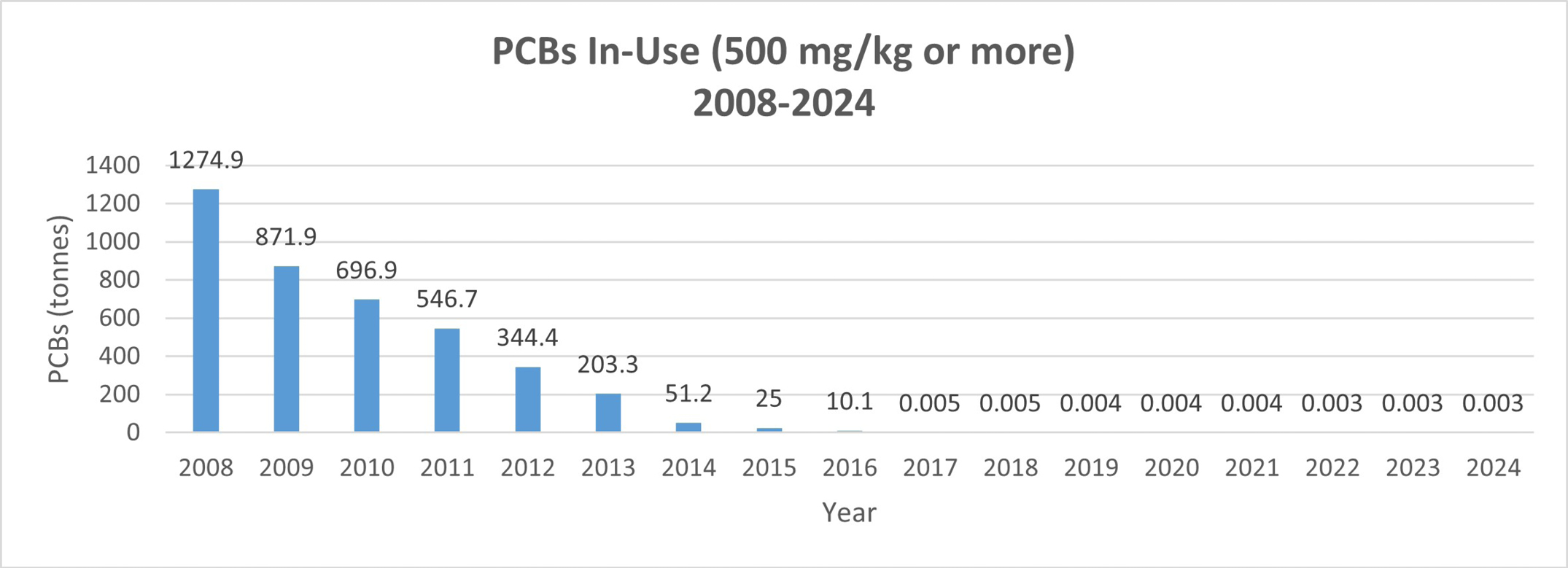
Figure 1: Quantities (tonnes) of PCBs in use in Canada in equipment in accordance with the PCB Regulations - Text version
Figure 1 provides the quantities of PCBs in use at concentrations greater than 500 mg/kg in equipment subject to the Regulations between the reporting years 2008 to 2024. Based on the reporting data, the following estimated quantities of PCBs were determined to be in use per year: 1 274.9 tonnes in 2008, 871.9 tonnes in 2009, 696.9 tonnes in 2010, 546.7 tonnes in 2011, 344.4 tonnes in 2012, 203.3 tonnes in 2013, 51.2 tonnes in 2014, 25 tonnes in 2015, 10.1 tonnes in 2016, 0.005 tonnes in 2017, 0.005 tonnes in 2018, 0.004 tonnes in 2019, 0.004 tonnes in 2020, 0.004 tonnes in 2021, 0.003 tonnes in 2022, 0.003 tonnes in 2023 and 0.003 tonnes in 2024.
Source of data: ePCB database reporting system.
Figure 2: Quantities (tonnes) of PCBs destroyed in Canada in accordance with the PCB Regulations
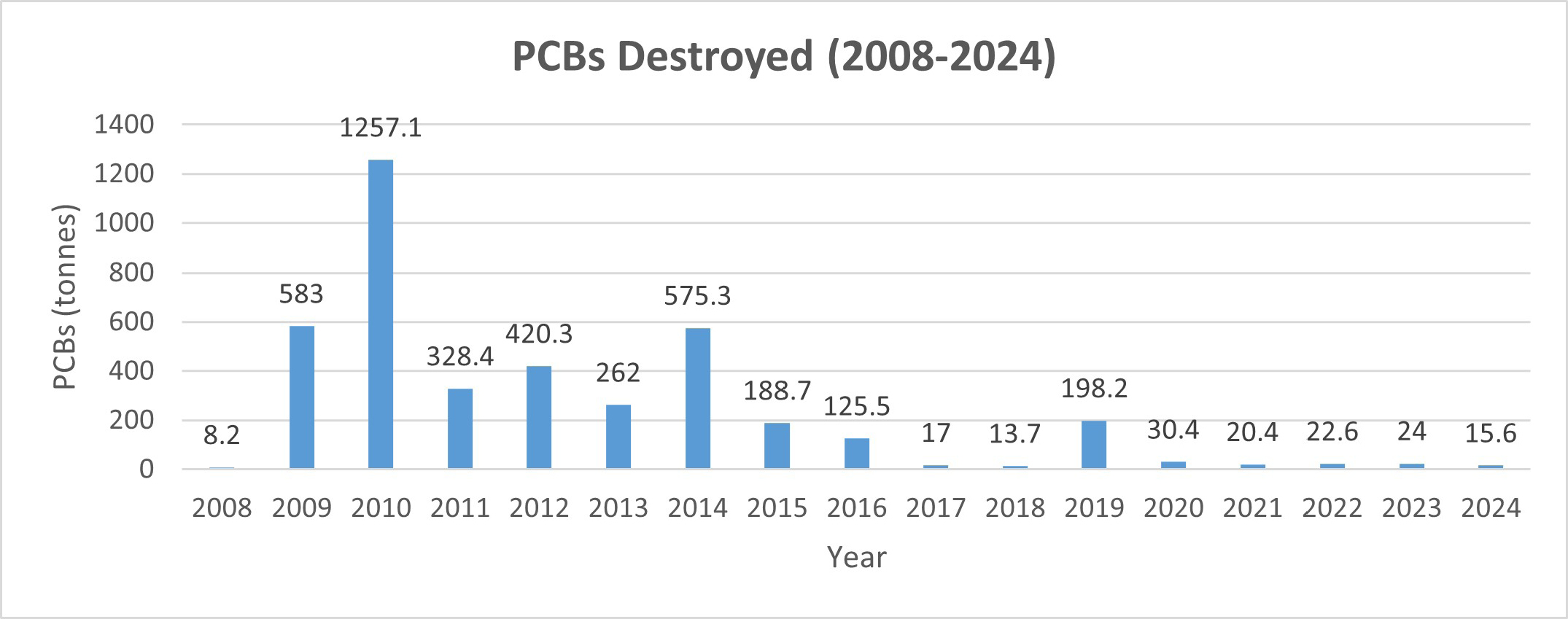
Figure 2: Quantities (tonnes) of PCBs destroyed in Canada in accordance with the PCB Regulations - Text version
Figure 2 provides the quantities of PCBs destroyed between the reporting years 2008 to 2024. Based on the reporting data, the following estimated quantities of PCBs were determined to be destroyed per year: 8.2 tonnes in 2008, 583 tonnes in 2009, 1 257.1 tonnes in 2010, 328.4 tonnes in 2011, 420.3 tonnes in 2012, 262 tonnes in 2013, 575.3 tonnes in 2014, 188.7 tonnes in 2015, 125.5 tonnes in 2016, 17 tonnes in 2017, 13.7 tonnes in 2018, 198.2 tonnes in 2019, 30.4 tonnes in 2020, 20.4 tonnes in 2021, 22.6 tonnes in 2022, 24 tonnes in 2023 and 15.6 tonnes in 2024.
Source of data: ePCB database reporting system.
Requirements under the Regulations, including more stringent release limits, have led to a reduction in PCB releases into the environment. In addition, the labelling and reporting requirements for PCBs provide the necessary information to monitor progress toward end-of-use targets.
The Department has identified the need to amend the Regulations to address issues identified through their implementation or that were not foreseen at the time they were published in 2008 and subsequently amended in 2014.
Objective
The objective of the Regulations Amending the PCB Regulations and the Regulations Designating Regulatory Provisions for Purposes of Enforcement (Canadian Environmental Protection Act, 1999) [the Amendments] is to provide flexibility for the use and storage of certain PCB-containing equipment under specific circumstances that were not foreseen when the Regulations came into force, while continuing to support the protection of the environment and human health.
Description
The Amendments will allow for the continued use and storage of certain PCB-containing equipment that is located at nuclear facilities. The owner of the equipment will be required to keep an up-to-date inventory that includes information related to each piece of equipment.
The Amendments will also allow for the continued use and storage of military equipment containing PCBs, for cases in which non-PCB alternatives cannot be substituted. Currently, the use of such equipment is not permitted under the Regulations, and the equipment must be taken out of use in accordance with the prescribed deadlines. The owner of the military equipment will be required to keep an up-to-date inventory that includes information related to each piece of equipment. The extended storage time for military equipment will be granted through an application process. The written application will require the inclusion of an estimated date of disposal and information demonstrating that the equipment cannot be disposed of before that date. This extension will give the DND the opportunity to plan for the time-consuming disposal requirements of military equipment.
As well, the Amendments will allow museums to retain PCB-containing objects of historical significance in their collections. Currently, the use of such objects is not a permitted activity under the Regulations, and the objects must be taken out of use in accordance with prescribed deadlines. Owners of museums that contain these objects will be required to keep an up-to-date inventory that includes information related to each object.
Further, the Amendments will defer the end-of-use deadline for certain PCB-containing electrical equipment (e.g. electrical capacitors, light ballasts, electrical transformers and their auxiliary electrical equipment) to December 31, 2026. Additionally, subject to ministerial approval, the continued use of such equipment beyond that date will be permitted in certain circumstances, where it is not technically or economically feasible to end its use by December 31, 2026, or where the equipment is located at an electrical generation, transmission or distribution facility that is scheduled for permanent closure on or before December 31, 2029. Extensions beyond the December 31, 2026, end-of-use deadline for prescribed equipment would be granted by the Minister through an application process. An extension will be granted if certain conditions are met, such as that the applicant is taking all necessary measures to minimize or eliminate the harmful effects of the PCBs in the equipment on the environment and on human health. Extensions can be granted for up to five years, and additional extensions may be granted in respect of the same equipment, if the conditions for the extension continue to be met. Finally, the Amendments will also clarify that although mixing PCB substances with other substances is permitted for the purpose of destroying the PCBs or servicing equipment containing PCBs, it is not permitted for the purpose of reducing the PCB concentration. The Amendments will also clarify that laboratory tests are not required to determine the concentration of PCBs if this can be determined by other reliable means.
The Amendments will introduce new related reporting requirements, which are consistent with the existing regulatory reporting framework.
Other related amendments
The Amendments will also amend the Regulations Designating Regulatory Provisions for Purposes of Enforcement (Canadian Environmental Protection Act, 1999) to list certain provisions of the Regulations, including provisions resulting from the Amendments.
Regulatory development
Consultations prior to prepublication in the Canada Gazette, Part I
A discussion document was published on September 24, 2020, for a 60-day consultation period to solicit comments from interested parties. The discussion document centred on issues relating to radioactive PCBs and the import of PCB waste in concentrations of over 2 mg/kg but less than 50 mg/kg. Interested parties took the opportunity to comment on other issues they had with the implementation of the Regulations at the same time. The Department received comments from different industry sectors, such as hydroelectricity, nuclear, energy and gas, waste management, and from the DND.
The Department also held bilateral meetings with certain regulated companies within these industry sectors to inform its continued analysis of outstanding issues pertaining to the Regulations. In response to feedback, the Department amended regulatory requirements related to deadlines for ending the use of PCB-containing equipment and the allowable storage period for PCBs prior to destruction. These changes will allow the continued use of certain PCB-containing objects and equipment beyond the 2025 end-of-use deadline, in certain circumstances and subject to regulatory requirements. A summary of that feedback and how it was considered can be found in the Canada Gazette, Part I.
Consultations following prepublication in the Canada Gazette, Part I
The proposed Amendments were prepublished in the Canada Gazette, Part I, on December 23, 2023, for a 60-day public comment period. They were also posted on the Government of Canada’s new online regulatory consultation system, where interested parties were encouraged to submit comments. In addition, emails were sent to approximately 1 450 interested parties to inform them of the formal consultation process. During and after the comment period, the Department met with several interested parties to clarify the intent of the proposed Amendments and to gather further details related to their written comments.
The Department received a total of 35 separate comment submissions regarding the proposed Amendments. These submissions were received from 14 interested parties, namely
- four from the nuclear sector;
- one from the DND;
- one from the waste management sector;
- one from the hydroelectric sector;
- two from museums;
- two from industry associations; and
- three from individuals.
There was stakeholder support for allowing the continued use and storage of PCB-containing equipment that is radioactive. There was also support for extending the use of certain PCB-containing equipment at electrical generation, transmission and distribution facilities that are scheduled for permanent closure by December 31, 2029. Museums supported the provision that allows PCB-containing objects of historical significance to continue to be retained or stored. However, many interested parties sought clarification related to definitions and the scope of the Amendments.
Some interested parties suggested additional considerations related to the import of PCB waste and the challenges associated with meeting the 2025 end-of-use deadline. One individual expressed significant concerns about allowing the continued use of PCB-containing equipment in electrical generation, transmission and distribution facilities scheduled for closure by 2029, as well as in nuclear facilities. The same individual also expressed concerns regarding the ongoing use of military equipment containing PCBs. The Department took these comments into account when developing the Amendments.
Further to the comments received during the public comment period, the Department also received comments from facilities in the iron and steel production and mining and mineral processing sectors in 2025. These facilities also expressed difficulties with meeting the 2025 end-of-use deadline, indicating the same challenges that had been outlined by the hydroelectric sector during the comment period.
Overview of the modifications made to the Regulations
The key change to the Regulations is the extension to the 2025 end-of-use deadline for additional pieces of PCB-containing equipment to December 31, 2026. This change was made in response to feedback from numerous facilities across various sectors that are unable to remove their equipment from service by the 2025 deadline due to technical challenges, environmental protection considerations and public safety concerns.
Comments from interested parties and responses provided by the Department are summarized below:
Nuclear facilities
Summary of comments: Nuclear facilities noted that the proposed text only addressed equipment containing radioactive PCBs, pointing out that PCB-containing equipment might also be present in radiological areas without being radiologically contaminated. They emphasized that the primary health and safety risk arises from radiologically contaminated areas and argued that all PCB-containing equipment located in such areas should be covered by the Amendments, rather than limiting the scope strictly to radioactive PCBs. Additionally, nuclear facilities suggested modifying the annual reporting requirement, noting that annual submissions for PCB-containing equipment in radioactive areas are unnecessary, as the status of the equipment rarely changes. To reduce administrative burden, they recommended decreasing the reporting frequency to once every three years, unless changes occur. Finally, nuclear facilities sought clarification on inventory requirements, specifically whether inventories must be submitted as part of the annual reporting. They also inquired whether a general description of PCB-containing equipment would be acceptable in cases where detailed information, such as concentration and quantity, is unavailable.
Response: The regulatory text has been revised to include all PCB-containing equipment in radiological areas. Nuclear facilities may continue to use and store such equipment until it can be safely removed and destroyed, ensuring worker health and safety by avoiding exposure to high radiation fields. To ensure better monitoring for regulatory compliance, annual reporting requirements remain in place to confirm the status of PCB-containing equipment in radiological areas and to document any changes. The Department has reviewed and confirmed that only essential information is collected through these requirements, thereby ensuring that administrative burden is minimized. Owners of PCB-containing equipment must continue to maintain an up-to-date inventory, although submission to the Department is not required. The inventory must include details such as PCB quantity and concentration; if any of this information is unknown, a statement to that effect must be provided.
Electrical facilities scheduled for permanent closure by December 31, 2029
Summary of comments: Electrical generation, transmission or distribution facilities scheduled for permanent closure by December 31, 2029, raised concerns about whether the extension for electrical facilities applied only to those shutting down permanently as a result of the Regulations Amending the Reduction of Carbon Dioxide Emissions from Coal-fired Generation of Electricity Regulations. Additionally, one facility inquired whether the extension could also apply to facilities undergoing major upgrades by December 31, 2029.
Response: The extension is applicable to prescribed equipment located at all electrical generation, transmission and distribution facilities scheduled for permanent closure by December 31, 2029, and is not limited to coal-fired generation facilities. However, it does not apply to facilities undergoing major upgrades. Such facilities are expected to remain operational and have the flexibility to replace their equipment with non-PCB alternatives, as needed.
2025 end-of-use deadline
Summary of comments: Hydroelectric and other facilities reiterated the logistical challenges of removing PCB-containing equipment. These facilities highlighted ongoing issues with PCB cross-contamination and the difficulty of testing equipment without causing irreversible damage. These challenges are further compounded by major supply chain backlogs and labour shortages that have persisted since the COVID-19 pandemic. As a result, these facilities stated that such issues are making it difficult to prepare for the 2025 end-of-use deadline and recommended targeted extensions on a case-by-case basis. They also argued that extensions would help address situations where replacement equipment is unavailable, scheduling delays are beyond the utility’s control, equipment is scheduled for permanent retirement shortly after the phase-out deadline, or unexpected PCB contamination is discovered too late for timely removal and replacement. Finally, these facilities suggested that an application process under the Amendments should require electrical utilities to demonstrate the need for an extension and outline plans in place to mitigate the risks of keeping PCB-containing equipment in service during the requested extension period.
Response: The Department acknowledges these challenges and has revised the Amendments to allow the continued use of certain PCB-containing equipment until December 31, 2026. This deferral applies to all regulated parties possessing equipment containing PCBs across multiple sectors. Specifically, the deferral extends to hydroelectric facilities (distinct from electrical generation, transmission, or distribution facilities scheduled for permanent closure by December 31, 2029), as well as to other facilities, including those engaged in pulp and paper manufacturing, iron and steel production, and mining and mineral processing activities. There will also be an option to apply for an extension beyond the 2026 deadline, and to have that extension renewed. Extensions will only be granted in cases where ending the use of the PCB-containing equipment by 2026 is not technically or economically feasible. As part of the application for an extension, regulated parties must submit a detailed plan that includes timelines, evidence demonstrating the infeasibility of removing the PCBs or ending the equipment’s use, and a clear description of how and when the PCB-containing equipment will be phased out.
Department of National Defence
Summary of comments: The Department received numerous comments seeking clarification on definitions, requirements and the scope of the section on military equipment. It was indicated that determining the quantity and concentration of PCBs requires a destructive test that would render the military equipment inoperable and irreparable. As a result, DND proposed that if the PCB concentration is unknown, a statement to that effect should be included in the extension application for military equipment storage.
Response: The Department will develop guidance, as needed, to provide further clarification. The regulatory text has been revised to address cases where PCB concentrations in military equipment are unknown. Extension applications for the storage of military equipment must include information on PCB concentrations; if the concentration is unknown, a statement to that effect must be provided.
Museums
Summary of comments: Museums expressed support for the continued retention of PCB-containing objects of historical significance for display and research purposes. They emphasized the importance of future acquisitions to document significant stories related to the energy transition and renewable energy. Concerns were raised about the availability of grants to assist museums in identifying, documenting and disposing of PCB-containing components. Additionally, museums sought clarification on definitions and the scope of the Amendments as they relate to museum collections.
Response: While museums can continue to retain PCB-containing objects, new acquisitions are not permitted due to environmental concerns. The Department remains committed to phasing out PCBs to protect human health and the environment; consequently, exchanges of these objects are not permitted. The Department does not have funding mechanisms in place to provide grants for PCB-related activities in museums. Guidance will be developed, as needed, to offer further clarification on how the Amendments impact museum collections.
Waste importers
Summary of comments: Regulated parties expressed support for the Department to complete a more thorough analysis before making changes to the prohibition on importing waste containing PCBs at concentrations between 2 mg/kg and 50 mg/kg. One waste importing facility suggested aligning PCB requirements for concentration levels between 2 mg/kg and 50 mg/kg with the Cross-border Movement of Hazardous Waste and Hazardous Recyclable Material Regulations. Another interested party suggested that the Department clarify the scientific rationale for permitting the import of PCB-contaminated waste within this concentration range to build support from the scientific community and industry. These suggestions were for the Department to consider for any future analysis.
Response: The Department will conduct a stakeholder engagement analysis and a review of the definitions of hazardous waste and hazardous recyclable material under the Cross-border Movement of Hazardous Waste and Hazardous Recyclable Material Regulations to ensure alignment, where necessary. Additionally, the Department will use the upcoming Departmental Stock Review Process as an opportunity to conduct a comprehensive review to address questions related to the management and handling of low-level PCB waste.
Mixing PCBs with other substances
Summary of comments: Interested parties, including hydroelectric facilities, raised concerns about the prohibition on the mixing of other substances with PCBs or products containing PCBs. These interested parties emphasized the need to top up and refill PCB-containing equipment with non-PCB oil during maintenance, as well as to consolidate PCB oil with non-PCB oil prior to destruction.
Response: The Amendments have been revised to allow the mixing of PCBs with other substances for the purposes of servicing PCB-containing equipment, or destroying the PCBs, in accordance with the Regulations. However, mixing for the purpose of diluting PCB concentrations remains prohibited.
Indigenous engagement, consultation and modern treaty obligations
As required by the Cabinet Directive on the Federal Approach to Modern Treaty Implementation, an assessment of modern treaty implications was conducted. The assessment did not identify any modern treaty implications or obligations.
The United Nations Declaration on the Rights of Indigenous Peoples (UN Declaration) is an international human rights instrument that sets out minimum standards for the survival, dignity and well-being of Indigenous peoples. The Government of Canada is committed to taking effective measures, including legislative and policy measures, in consultation and cooperation with Indigenous peoples, to achieve the objectives of the UN Declaration. The Amendments are not anticipated to intersect with the rights affirmed in the UN Declaration.
Instrument choice
To meet the objectives outlined above, it was determined that amending the Regulations was the only viable option. Maintaining the status quo was not considered feasible, as it would risk the safety of workers at nuclear facilities, hinder the preservation of objects of historical significance, impede military infrastructure, and impose additional burden on facilities facing technical and logistical challenges, including those scheduled for closure due to other federal obligations.
Regulatory analysis
The cost of the Amendments is estimated to be low. While the impacts have not been quantified or monetized, it is expected that the Amendments will result in a net benefit to Canadian society.
Benefits
In line with the Department’s red tape reduction efforts, the Amendments will defer the costs associated with replacing or modifying PCB-containing equipment to a future date, resulting in a one-time cost savings. Replacement will not be required during the deferral period, nor will immediate replacement be required for parties that apply for and are granted an extension beyond the end-of-use deadline. Table 1 below presents the non-quantified benefits.
The one-year extension to December 31, 2026, allows regulated parties to continue using their PCB-containing equipment for an additional year, deferring the costs of replacement or modification to a later date. This results in a one-time cost savings, as immediate replacement is not required. The one-year extension will also provide sufficient time for regulated parties to plan for compliance with the Amendments.
In addition, the prohibition on mixing PCBs with other substances, except as provided in the Regulations, will ensure that regulated parties respect the required concentration levels, without being able to dilute the concentration of PCBs as a workaround to the Regulations. This will ensure that high concentration PCB substances are destroyed in accordance with the Regulations. As a result, this leads to a reduction in the risk of release and, therefore, minimizes PCB exposure for people in Canada and the environment.
Current regulatory requirements relating to the release of PCBs to the environment, and prohibitions on the manufacture, export, import, sale, processing, and use of PCBs and products containing PCBs, will, subject to the Amendments, continue to apply. Furthermore, where PCB-containing equipment is sealed and/or contained within a building, releases of PCBs to the environment are expected to be low. Hence, the potential environmental and health impacts are expected to be low.
| Affected regulated party | Expected benefits |
|---|---|
| Nuclear facilities | These facilities will benefit from one-time cost savings related to removing, transporting and destroying their PCB-containing equipment (mainly ballasts) by December 31, 2025. They will be permitted to continue to use PCB-containing equipment and to store such equipment past the deadline. In addition, this will ensure the health and safety of workers at nuclear facilities by preventing the risk of exposure to high radiation fields. |
| Electrical generation, transmission and distribution facilities, and other facilities or parties that have equipment containing PCBs | These facilities/parties will benefit from one-time cost savings arising from not having to remove, destroy or replace their PCB-containing equipment by December 31, 2025. In the case of electrical generation, transmission and distribution facilities, this will also facilitate alignment with facility closures resulting from the implementation of the Reduction of Carbon Dioxide Emissions from Coal-fired Generation of Electricity Regulations. |
| Museums | Museums will benefit from one-time cost savings by not having to remove or destroy their objects of historical value. The significance of historical objects in museums will be preserved, contributing to the protection of Canadian heritage. |
| Department of National Defence (DND) | DND will benefit from one-time cost savings due to not being required to replace parts or vehicles with equipment containing PCB oils before the end of their useful life. DND will benefit from the continued use and storage of military equipment containing PCBs, for which non-PCB alternatives cannot be substituted. This will contribute to preserving DND’s operational capacity. |
Costs
The consensus among scientists around the world is that PCBs should be (and are) classified as probable human carcinogens. People in Canada are exposed to very small amounts of PCBs through food intake and, to a lesser extent, through air, soil and water. The Amendments will result in a slower phase-out of some PCB-containing equipment; however, given that PCB-containing equipment is sealed and/or contained within a building, the risk of releases of PCBs to the environment are expected to be low. The Amendments are not expected to have a major impact on the risk of exposure to releases of PCBs. The risk to human health and the environment from accidental exposure due to prolonged use or storage is low.
The Minister of Environment would, subject to the requirements set out in the Amendments, grant extensions for the continued use of PCB-containing equipment in certain circumstances, where the equipment is located at an electrical generation, transmission or distribution facility that is scheduled for permanent closure on or before December 31, 2029, or where it is not technically or economically feasible to end its use by December 31, 2026. In such cases, the PCB-containing equipment could continue to be used until the date set out in the extension. For these facilities, there will be administrative costs associated with the applications to extend the use of their PCB-containing equipment.
The Amendments will not result in any direct costs associated with the one-year extension, nor will the extension require the issuance of extension permits. Furthermore, no equipment is anticipated to be decommissioned or destroyed as a result of the one-year extension period.
Regarding the requirement for certain regulated parties to keep an inventory of PCB-containing equipment, they already have gathered the necessary information for the inventory as part of the existing reporting and record keeping requirements. Therefore, there is only expected to be minimal incremental costs.
The Amendments will result in additional costs to the Department related to informing regulated parties and processing applications for extensions to continue using certain PCB-containing equipment. This is expected to be low because the current PCB regulatory framework, along with current implementation, compliance and enforcement policies and programs, will remain in place. The costs associated with processing applications are expected to be low, based on the assumption that only a limited number of extension applications will be submitted over an extended period. The estimated costfootnote 4 to the government for processing each application to extend the use of PCB-containing equipment is approximately $400.
Small business lens
The Amendments may affect museums, which are considered small enterprises. However, they will not result in additional compliance or administrative costs for these organizations. Costs will be deferred to a later date, when museums choose to dispose of PCB-containing objects of historical value by sending them for destruction. These small businesses will not be required to apply for permission to retain such objects beyond the 2025 deadline, as continued possession will be a permitted activity under the Amendments.
One-for-one rule
The one-for-one rule applies, since there is an incremental increase in administrative burden on businesses. The proposal is considered a burden IN under the rule, and no regulatory titles have been repealed or introduced. The Amendments would result in an annualized administrative total cost of $1,357. As noted in the Department’s Red Tape Reduction Report, the Amendments provide deferrals that will allow facilities to continue using certain PCB-containing equipment beyond the deadline of December 2025.
As per the Red Tape Reduction Regulations, the assessment of administrative impacts was conducted for a period of 10 years commencing from registration. All values listed in this section are presented in 2012 dollars, discounted to 2012 at a rate of 7%. The average wage (including overhead) of the responsible individual for all tasks is estimated to be $47.10.
Up to 34 businesses would spend three hours learning about the administrative requirements of the Regulations in the first year that the Amendments are registered, which represents an annualized total cost of $284.
Facilities granted an extension would be required to continue to submit annual reports containing information about the equipment containing PCBs that is still in use, along with a description of the progress made on ending use, the plan to remove it, and measures taken to minimize harm to the environment and humans. This represents an annualized total cost of $316. Up to 34 businesses would spend 30 minutes to perform this task once per year. However, four electric generating facilities are expecting to shut down at the end of 2029 and would stop submitting reports.
Applications for an extension represent an annualized total cost of $757. Up to 34 businesses, such as electric, or hydroelectric, generating facilities, would spend 8 hours to perform this task in the first year of the analysis.
Regulatory cooperation and alignment
The Amendments are not expected to have any impact on regulatory cooperation and alignment. The Amendments will continue to respect Canada’s international obligations and commitments.
International obligations
Governments around the world have implemented various regulatory initiatives, both domestically and through international collaboration, to reduce human and ecological exposure to PCBs.
Canada is a party to several international agreements that promote the sound management of PCBs, including the Stockholm Convention on Persistent Organic Pollutants (POPs) [the Stockholm Convention] and the Protocol on Persistent Organic Pollutants (POPs) under the United Nations Economic Commission for Europe’s Convention on Long-Range Transboundary Air Pollution. Both agreements have legally binding obligations for eliminating the use and release of PCBs.
These international agreements generally require that determined efforts to eliminate PCBs be made within a specified period. Even with the Amendments, Canada will have made such determined efforts. Further, these Amendments would ensure that equipment and objects containing PCBs would ultimately be destroyed in an environmentally sound manner, which is consistent with the obligations under the Stockholm Convention and the Protocol on Persistent Organic Pollutants. Canada has also committed to eliminating PCB releases into the environment under the North American Regional Action Plan for PCBs, developed by the Commission for Economic Cooperation established under the North American Free Trade Agreement.
Effects on the environment
In accordance with the Cabinet Directive on the Environmental Assessment of Policy, Plan and Program Proposals, a strategic environmental assessment concluded that the Amendments would likely have minor effects on the environment and human health.
The Amendments will simply defer timelines for certain PCB-containing equipment and will continue to ensure that PCBs are managed in an environmentally safe manner. Most of the PCB-containing equipment that is captured by the deferral is sealed or located within buildings, which serves to minimize the risk of PCBs entering the environment. This could prevent incidental human exposure. The existing prohibition on the release of PCBs to the environment will continue to apply.
The Amendments are also in line with the 2022–2026 Federal Sustainable Development Strategy (FSDS) goal 12 of reducing waste and transitioning to zero-emission vehicles, which includes actions aimed at managing risks to protect Canadians from harmful substances. The Amendments are also in line with the associated United Nations 2030 Agenda Sustainable Development Goal (SDG) 12 of ensuring sustainable consumption and production patterns, particularly target 12.4 of achieving the environmentally sound management of chemicals and all wastes throughout their life cycle.
Right to a healthy environment
The Government of Canada has a duty, in the administration of CEPA, to protect the right to a healthy environment as provided for under CEPA, subject to reasonable limits. An implementation framework sets out considerations to protect this right and uphold the principles described in the framework. Work to inform the Amendments was completed before the implementation framework was published on July 19, 2025. Recognizing that CEPA decisions are informed by analyses and consultations that are often the result of years of work, a transition period is in place to allow the Department and Health Canada to support continued protection of the environment and human health. The objective of the transition period is to continue to advance timely CEPA decisions and actions, while consideration of the right to a healthy environment and relevant principles are being fully integrated into the administration of CEPA. The Amendments are proceeding under the transition period referenced in the framework.
The Amendments include conditions to ensure that all necessary measures are taken to minimize or eliminate any harmful effects of the PCBs on the environment and on human health. As a result, they will support the protection of human health and the environment from harmful substances.
Although the implementation framework was not available to be applied from the beginning of the work undertaken to inform the Amendments, many of the elements included in the framework were considered. For example, the best available science and evidence were relied upon in developing the Amendments. The Department also consulted with stakeholders and Indigenous partners, beginning in September 2020 (see the “Consultations” section) and considered vulnerable populations (see the “Gender-based analysis plus” section).
Gender-based analysis plus
No gender-based analysis plus (GBA+) impacts have been identified for the Amendments.
Implementation, compliance and enforcement, and service standards
Implementation
The Amendments come into force on the day on which they are registered, except for sections 7 to 9 of the Amendments, which require equipment owners and museum owners to keep an up-to-date inventory for each piece of equipment or object. The requirements in sections 7 to 9 will come into force six months from the day on which the Amendments are registered.
To implement the Amendments, the Department will undertake several compliance promotion activities. These activities will aim to raise awareness and promote a high level of compliance as early as possible during the regulatory implementation process.
Compliance and enforcement
Members of the regulated community will be responsible for ensuring compliance with the Amendments, and for producing and maintaining evidence of conformity. To assist regulated parties in understanding the new requirements, the existing guidance material will be updated and posted on the Department’s website. The updated material will provide details on the new administrative provisions and requirements.
Implementation and enforcement actions will continue to be undertaken by the Department in accordance with the Canadian Environmental Protection Act (CEPA): compliance and enforcement policy (the Policy). As the Amendments will be made under CEPA, enforcement officers will apply the Policy when verifying compliance with the regulatory provisions.
Service standards
The Amendments provide the possibility to apply for an extension for the storage of military equipment.
The Amendments also defer the end-of-use deadline for certain PCB-containing equipment to December 31, 2026, and allow for the submission of applications to continue using such equipment beyond that date if the equipment is located at an electrical generation, transmission and distribution facility that is due to be decommissioned by December 2029, or if it is not technically or economically feasible to end its use by December 31, 2026.
In such cases, all applications, without fees, will be submitted to the Minister of the Environment. The administrative procedure will not be expected to take more than 60 days once all the required documentation is provided. The Department will make every effort to respond promptly to extension applications and to complete the administrative procedure.
Compliance with the service standards for processing extension applications will be monitored and evaluated as part of normal regulatory performance measurement and evaluation.
Contacts
Tracey Spack
Executive Director
Waste Reduction and Management Division
Environment and Climate Change Canada
351 Saint-Joseph Boulevard
Gatineau, Quebec
K1A 0H3
Email: bpc-pcb@ec.gc.ca
Matthew Watkinson
Executive Director
Regulatory Analysis and Valuation Division
Economic Analysis Directorate
Strategic Policy Branch
Environment and Climate Change Canada
351 Saint-Joseph Boulevard
Gatineau, Quebec
K1A 0H3
Email: ravd.darv@ec.gc.ca