
Canada Gazette, Part I, Volume 160, Number 25: Regulations Amending the Energy Efficiency Regulation, 2016 (Amendment 19)
June 20, 2026
Statutory authority
Energy Efficiency Act
Sponsoring department
Natural Resources Canada
REGULATORY IMPACT ANALYSIS STATEMENT
(This statement is not part of the Regulations.)
Executive summary
Amendment 19 of the Energy Efficiency Regulations, 2016 would support four key Government of Canada priorities: energy security, climate action, affordability for Canadians, and trade. Amendment 19 would reduce energy consumption and greenhouse gas (GHG) emissions and support trade by adding or updating energy efficiency and testing standards for several new and currently regulated energy-using products used in homes, commercial and institutional buildings, and industries. It would also support red tape reduction efforts by removing outdated and obsolete standards and consolidating regulatory text.
The cumulative net benefits of Amendment 19 are estimated to be approximately $26.7 billion (present value) by 2050, with cumulative benefits exceeding cumulative costs by a ratio of more than 3:1. By 2050, the cumulative benefits and costs from Amendment 19 would be approximately $37.6 billion and $10.9 billion (present value), respectively. On an annualized average basis, the net benefits would be approximately $1.4 billion, with benefits and costs at approximately $1.99 billion and $576 million, respectively. Amendment 19 would result in a total annual reduction of energy consumption in Canada of approximately 48 petajoules (PJ) or 13.2 terawatt-hours (TWh) and 3 megatonnes of carbon dioxide equivalent (MtCO2e) of GHG emission reductions in 2050; and total cumulative energy consumption and GHG emission reductions of approximately 675 PJ (187.6 TWh) and 38 MtCO2e by 2050. The projected annual energy savings in 2050 would represent enough energy to power approximately 540 000 Canadian houses for a year, and enough energy would be saved by 2050 to power approximately 7.7 million homes for a year. The energy efficiency gains for Amendment 19 would represent the 5th largest since the inception of the Energy Efficiency Regulations.
Amendment 19 was established through an evidence-based analysis of market data and a cost-benefit analysis, while balancing various public interest considerations. Canada is following the lead of other jurisdictions when analyzing where to leverage minimum energy performance standards to support energy security climate action, affordability for Canadian households, businesses, and industrial sectors, and trade.
Amendment 19 would raise the energy efficiency standards for approximately 20 products (electric motors, clothes washers, clothes dryers, refrigerators, freezers, etc.) in the Canadian market; incorporate minor changes to approximately 15 products to support trade and improve regulatory implementation; and remove approximately 300 outdated standards and associated requirements to support the government red tape reduction initiative. The regulatory changes proposed are informed by years of stakeholder consultations since 2022.
Issues
Energy efficiency is a means to strategically enhance energy security, climate action, affordability for Canadian households, businesses, and industrial sectors, and trade. Canada’s building sector (including homes, commercial and institutional buildings) and industrial sector are a significant contributor to Canada’s total energy consumption and GHG emissions. Regulating the energy use of products is one of the most cost-effective tools available to the Government to reduce energy consumption and GHG emissions and help Canadians save on energy-related costs.
In today’s economic and geopolitical climate, strengthening energy efficiency standards of products is necessary to pursue Canada’s domestic energy efficiency policies of achieving the goals of (1) supporting affordability by saving money for Canadian consumers, businesses, institutions, and industries; (2) contributing to a more competitive, sustainable, and resilient economy; (3) leveraging energy efficiency as a strategic, low-cost manner to mitigate the impacts of increasing electric grid demands across Canada and support energy security; (4) achieving GHG emission reductions; and (5) facilitating trade within Canada and across North America, through the use of a set of consistent, national level standards to which dealers (including manufacturers and importers) must comply. The current regulations also contain some outdated standards which need to be removed to support the government red-tape initiatives.
Without Amendment 19, demand on Canada’s electricity grid would be higher, the lowest performing energy-using products would continue to be sold in Canada’s market, and Canadians and businesses would not reap the benefits of cost savings generated through adoption of more efficient products.
Background
In 1992, Parliament passed the Energy Efficiency Act, giving Natural Resources Canada (NRCan) the authority to regulate energy efficiency standards, testing standards, prescribed information, and labelling of energy-using products. The Energy Efficiency Act has since been amended in 2009 and 2017 and is undergoing modernization through Bill S-4 to provide new authorities to reflect the evolving marketplaces (see LEGISinfo S-4).
In 1995, the Energy Efficiency Regulations came into force to reduce energy consumption in Canada. In 2016, the Energy Efficiency Regulations, 2016 (Regulations) replaced the original Energy Efficiency Regulations to remove references to obsolete and out-of-date standards and improve the organization of the regulatory text.
Since 1995, there have been 18 Governor-in-Council regulatory amendments published in the Canada Gazette to keep up with technology improvements and remove the worst performing products from Canada’s marketplace. There are currently over 70 energy-using products subject to the Regulations. Today, the Regulations continue to reduce energy consumption in Canada and remain a key tool to:
- Save money for Canadian consumers, businesses, institutions, and industries.
- Contribute to a more competitive, sustainable, and resilient economy.
- Support energy security through reductions in electricity grid demands.
- Set a level playing field for efficient products nationwide, reducing trade barriers for energy-using products across interprovincial and international borders.
- Reduce GHG emissions and contribute to efforts to minimize climate change.
The Regulations have an outsized positive impact on energy savings, GHG emission reductions, and cost savings for households and businesses at low cost to government. From the inception of the Energy Efficiency Regulations in 1995 to the latest Regulations (Amendment 18) published in April 2025, the following results will be achieved:
- The energy efficiency gains made by 2030 will be equivalent to powering all of Canada’s approximately 16 million existing households for approximately 6 years, increasing to 13 years by 2050 (based on residential energy consumption in 2023).
- Cumulative savings of approximately $214 billion (in 2023 dollars) by 2030 on utility bills from residential, commercial and industrial sectors.
Objective
The objectives of Amendment 19 are to:
- Reduce energy consumption associated with various energy-using products used in homes, businesses, institutions, and industries.
- Support Canada’s energy security needs through reductions in electricity grid demands from identified energy-using products.
- Set a level playing field for dealers through a strong set of national energy efficiency standards.
- Ensure that the standards from other jurisdictions that are incorporated by reference in the Regulations are maintained as intended, regardless of potential future actions taken by a jurisdiction.
- Reduce red tape burden associated with outdated standards and fragmented regulatory text.
Description
Amendment 19 seeks to achieve the maximum energy savings that are both technologically and economically feasible at this time. It would add or update energy efficiency requirements for several new and currently regulated energy-using products, focussing on key changes that would support Canada’s affordability, competitiveness, internal and external trade, energy security, and climate change objectives. Amendment 19 would also support the government red tape reduction efforts by removing references to obsolete and out-of-date standards and by improving the organization of the regulatory text, making it easier for regulated parties to find and understand the requirements that apply to their products. The regulatory text at the end of this document should be consulted for a complete list of the proposed changes. In summary, Amendment 19 would:
(a) Increase energy savings by introducing products into the Regulations with associated requirements for energy efficiency standards, testing standards, verification, labelling, and provision of information
Air cleaners
Amendment 19 would adopt the tier 2 energy efficiency standards in Title 10 of the U.S. Code of Federal Regulations (CFR) and incorporate by reference the corresponding CFR testing standard, as amended from time to time. Amendment 19 would also introduce EnerGuide labelling requirements for air cleaners generally harmonized with the proposed U.S. Federal Trade Commission Energy Labeling Rule that would require EnergyGuide labels for air cleaners. The new requirements for energy efficiency and testing standards would apply to products manufactured on or after December 31, 2027, and the new requirements for labelling would apply to products manufactured on or after December 31, 2028.
Computer room air conditioners
Amendment 19 would adopt the energy efficiency standards in the CFR and incorporate by reference the corresponding CFR testing standard, as amended from time to time. The new requirements would apply to products manufactured on or after May 28, 2028.
Gas clothes dryers
Amendment 19 would adopt the energy efficiency standards in the CFR and incorporate by reference the corresponding CFR testing standard, as amended from time to time. Amendment 19 would also introduce EnerGuide labelling requirements for gas clothes dryers generally harmonized with the U.S. Federal Trade Commission Energy Labeling Rule that requires EnergyGuide labels for gas clothes dryers. The new requirements for energy efficiency and testing standards would apply to products manufactured on or after March 1, 2028, and the new requirements for labelling would apply to products manufactured on or after March 1, 2029.
Pool heaters
Amendment 19 would adopt the energy efficiency standards in the CFR and incorporate by reference the corresponding CFR testing standard, as amended from time to time. Amendment 19 would also introduce EnerGuide labelling requirements for pool heaters generally harmonized with the U.S. Federal Trade Commission Energy Labeling Rule that requires EnergyGuide labels for pool heaters. The new requirements for energy efficiency and testing standards would apply to products manufactured on or after May 30, 2028, and the new requirements for labelling would apply to products manufactured on or after May 30, 2029.
Pool pump motors
Amendment 19 would adopt the energy efficiency standards in the CFR and incorporate by reference the testing standard in the Canadian Standards Association (CSA) standard, as amended from time to time. The new requirements would apply to products manufactured on or after January 1, 2028.
(b) Increase energy savings by expanding the scope, introducing, or updating energy efficiency and testing standards of some currently regulated products
Battery chargers
Amendment 19 would expand the scope of battery chargers to include uninterruptible power supplies. Amendment 19 would adopt the energy efficiency standards in the CFR and incorporate by reference the corresponding CFR testing standard, as amended from time to time. For battery chargers that are not uninterruptible power supplies, the CFR testing standard referenced in the Regulations, as amended from time to time, would become the only testing option (removing the CSA standard). The new requirements would apply starting on January 1, 2028.
Clothes washers
Amendment 19 would expand the scope of clothes washers to include semi-automatic clothes washers. For household clothes washers, Amendment 19 would adopt the energy efficiency standards in the CFR and incorporate by reference the corresponding CFR testing standard, as amended from time to time, as the only testing option (removing the CSA standard). For clothes washers, other than household clothes washers, Amendment 19 would incorporate by reference the CFR testing standard, as amended from time to time, as an alternative testing option. The new energy efficiency and testing standard requirements would apply starting on March 1, 2028, and the new labelling requirements for semi-automatic clothes washers would apply starting on March 1, 2029.
Dishwashers
Amendment 19 would adopt the energy efficiency standards in the CFR and incorporate by reference the corresponding CFR testing standard, as amended from time to time, as the only testing option (removing the CSA standard). The new requirements would apply starting on April 23, 2027.
Electric clothes dryers
Amendment 19 would adopt the energy efficiency standards in the CFR and continue to incorporate by reference the corresponding CFR testing standard, as amended from time to time, as the only testing option (removing the CSA standard). The new requirements would apply starting on March 1, 2028.
Electric motors
Amendment 19 would expand the scope of electric motors to include motors with a capacity of up to 559 kW and air-over electric motors. Amendment 19 would adopt the energy efficiency standards in the CFR and incorporate by reference the corresponding CFR testing standard, as amended from time to time. The new requirements would apply starting on June 1, 2027.
Electric ranges
Amendment 19 would adopt the energy efficiency standards in the CFR and incorporate by reference the corresponding CFR testing standard, as amended from time to time, as the only testing option (removing the CSA standard). This would update performance standards for smooth electric cooktops, remove the energy efficiency standards for coil cooktops, and change the energy efficiency standard for electric ovens to a prescriptive requirement of not having a linear power supply. Also, Amendment 19 would phase out the current labelling requirements, in harmonization with the United States. The new requirements would apply starting on January 31, 2028.
Freezers
Amendment 19 would adopt the energy efficiency standards in the CFR and incorporate by reference the corresponding CFR testing standard, as amended from time to time, as the only testing option (removing the CSA standard). The new requirements would apply starting on January 31, 2029, or January 31, 2030, depending on the product type.
Gas-fired instantaneous water heaters
For household gas-fired instantaneous water heaters, Amendment 19 would adopt the energy efficiency standards in the CFR. For commercial gas-fired instantaneous water heaters, Amendment 19 would introduce hot water supply boilers as a commercial water heater product class alongside commercial instantaneous gas-fired water heaters. Amendment 19 would adopt the energy efficiency standards in the CFR and incorporate by reference the corresponding CFR testing standard, as amended from time to time. The new requirements would apply to household products starting on January 1, 2032, and to commercial products starting on January 1, 2028.
Gas-fired storage water heaters
For household gas-fired storage water heaters, Amendment 19 would adopt the energy efficiency standards in the CFR. For commercial gas-fired storage water heaters, Amendment 19 would adopt the energy efficiency standards in the CFR, remove the differentiation between the energy efficiency standards for replacement and non-replacement units, and incorporate by reference the corresponding CFR testing standard, as amended from time to time. The new requirements would apply to household products starting on January 1, 2032, and to commercial products starting on January 1, 2028.
Gas furnaces (commercial)
Amendment 19 would expand the scope of gas furnaces to remove the upper input capacity limit of 117.23 kW (400,000 Btu/h). Amendment 19 would adopt the energy efficiency standards in the CFR and incorporate by reference the corresponding CFR testing standard, as amended from time to time, for commercial gas furnaces, other than gas furnaces for relocatable buildings or replacement non-condensing gas furnaces. The new requirements would apply starting on January 1, 2028.
Gas ranges
Amendment 19 would adopt the energy efficiency standards in the CFR and incorporate by reference the corresponding CFR testing standard, as amended from time to time, as the only testing option. This would add performance standards for gas cooking products, remove the energy efficiency standard related to the continuously burning pilot light for gas cooking tops, and add a prescriptive standard to remove continuously burning pilot lights for gas portable indoor cooking tops. Also, Amendment 19 would phase out the current labelling requirements in harmonization with the United States. The new requirements would apply starting on January 31, 2028.
Ground-source heat pumps
Amendment 19 would include the following for ground-source heat pumps: (1) expand the scope of ground-source heat pumps to include direct-exchange ground-source heat pumps in harmonization with the scope of Ontario regulations; (2) reinstate energy efficiency and testing standards (CSA) for water-to-water ground-source heat pumps; (3) increase the stringency of energy efficiency standards; (4) replace the CSA testing standard with a more recent CSA testing standard for water-to-air ground-source heat pumps; and (5) introduce energy efficiency standards and incorporate by reference the Air-Conditioning, Heating, and Refrigeration Institute (AHRI) testing standard, as amended from time to time, for direct-exchange ground-source heat pumps. The new requirements would apply starting on January 1, 2028.
Integrated clothes washer-dryers
Amendment 19 would, for the washing function, adopt the energy efficiency standards in the CFR and incorporate by reference the corresponding CFR testing standard as the only testing option (removing the CSA standard), as amended from time to time. For the drying function, Amendment 19 would adopt the energy efficiency standards in the CFR and incorporate by reference the corresponding CFR testing standard, as amended from time to time, as the only testing option (removing the CSA standard). The new requirements would apply starting on March 1, 2028.
Oil-fired water heaters (household)
Amendment 19 would adopt the energy efficiency standards in the CFR. The new requirements would apply starting on January 1, 2032.
Recovery ventilators
Amendment 19 would introduce energy efficiency standards for energy and heat recovery ventilators and update the CSA testing standard with the new 2024 version that better harmonizes with the ENERGY STAR® requirements. The new requirements would apply starting on January 1, 2028.
Refrigerators and combination refrigerator-freezers
Amendment 19 would adopt the energy efficiency standards in the CFR and incorporate by reference the corresponding CFR testing standard, as amended from time to time, as the only testing option (removing the CSA standard). The new requirements would apply starting on January 31, 2029, or January 31, 2030, depending on the product type.
(c) Allow regulated parties to voluntarily comply with the new requirements earlier by including an early compliance option
Amendment 19 would include provisions allowing regulated parties to voluntarily comply with new requirements at least one year before the requirements become mandatory. Such provisions would help expedite products into the Canadian market that meet the new requirements, thereby allowing Canadians to start saving money and energy sooner. Products with such a provision are clothes washers, integrated clothes washer-dryers, dishwashers, freezers, refrigerators and combination refrigerator-freezers, and ranges (cooking product). For more information see the section “Implementation, compliance and enforcement, and service standards.”
(d) Support trade and improve regulatory implementation
For ceiling fans, Amendment 19 would make minor changes to correct the reference to the energy efficiency standards in the CFR to maintain harmonization with the U.S. efficiency metric, i.e. the Ceiling Fan Energy Index (CFEI). Thus, the energy efficiency standards would be split between large-diameter ceiling fans and ceiling fans other than large-diameter ceiling fans. As a result, two more data would be collected for large diameter ceiling fans: CFEI at high speed and CFEI at 40% of high speed or the nearest speed that is not less than 40% of high speed.
For central air conditioners and central heat pumps, Amendment 19 would make minor changes to the prescribed information, requiring the equipment category used in testing and calculation of the reported efficiency metrics to be reported.
For commercial electric water heaters, Amendment 19 would expand the scope of the product to include commercial electric instantaneous water heaters. Also, Amendment 19 would adopt the energy efficiency standards in the CFR and incorporate by reference the corresponding CFR testing standard, as amended from time to time, for commercial electric water heaters, including commercial electric instantaneous water heaters and household-duty electric commercial water heaters. The new requirements would apply starting on January 1, 2028.
For commercial oil-fired water heaters, Amendment 19 would introduce hot water supply boilers as a commercial water heater product class alongside commercial instantaneous oil-fired water heaters. Amendment 19 would incorporate by reference the testing standard in the CFR, as amended from time to time. The new requirements would apply starting on January 1, 2028.
For external power supplies, Amendment 19 would make minor changes to remove the CSA testing standard, as an alternative to the CFR testing standard, to maintain harmonization with the U.S. standard. The energy efficiency requirements would also be corrected by removing an unnecessary specification, as all security external power supplies should be treated as regular external power supplies after July 1, 2017.
For gas fireplaces, Amendment 19 would make minor changes to update the reference to the latest version 2024 of the CSA testing standard starting on January 1, 2029.
For general service fluorescent lamps, Amendment 19 would make minor changes to correct an error in the reference for the energy efficiency standards in the CFR and an error in the energy efficiency standard requirements.
For general service lamps, Amendment 19 would make minor changes to labelling requirements to allow dealers to use the NRCan in-house design label without modifications.
For household electric water heaters, Amendment 19 would introduce heat pump water heaters, adopt the energy efficiency standards in the CFR and reference the corresponding testing standard in the CFR, as amended from time to time. The new requirements would apply starting on January 1, 2028.
For internal water loop heat pumps, Amendment 19 would make minor changes to clarify the reference to the CSA standard.
For large condensing units, Amendment 19 would update the reference to the latest 2017 version of a CSA testing standard.
For line voltage thermostats, Amendment 19 would make minor changes to prescribed information to add an item to the list of required data, i.e. the calculated standard error at the minimum, average and maximum temperatures.
For miscellaneous refrigeration products, Amendment 19 would make minor changes to prescribed information by adding the total refrigerated volume.
For small electric motors, Amendment 19 would update the references to the latest 2022 version for two CSA testing standards.
For televisions, Amendment 19 would update the definition of the product to more fully harmonize with the U.S. network-connected TVs, and incorporate by reference the corresponding CFR testing standard for network-connected TVs, as amended from time to time. The new requirements would apply starting on September 11, 2027.
For energy-using products specified for the purpose of ministerial regulations, Amendment 19 would update the Regulations to ensure the Minister can exercise the ministerial regulations authority to maintain harmonization of requirements with another jurisdiction. The following products would be added to the list in section 11.1 of prescribed products (where the terms household water heaters and commercial water heaters would replace the term water heaters, and the term cooking products would replace the term gas ranges):
- Air cleaners
- Commercial water heaters
- Computer room air conditioners
- Cooking products
- Household water heaters
- Pool heaters
- Pool pump motors
- Televisions
For standards of other jurisdiction incorporated by reference, Amendment 19 would clarify the protection against potential backsliding of the jurisdiction that could cause the Regulations to no longer work as intended. For instance, energy efficiency standards incorporated by reference would continue to apply at their current level if another jurisdiction subsequently reduced its requirements.
(e) Support the government red tape reduction initiative
Amendment 19 would remove reference to outdated standards and associated requirements to reduce the length of the regulatory text and make it easier for stakeholders to understand the requirements. This would automatically apply to most currently regulated products, ensuring that only the most recent standards remain in the Regulations and apply to all regulated products, regardless of the period of manufacture. Approximately 300 outdated standards and associated requirements would be removed. Those changes would be implemented one year after publication in the Canada Gazette, Part II for all products, with some exceptions for select Amendment 19 products. More information is provided in the section “Implementation, compliance and enforcement, and service standards.” NRCan welcomes input on the proposed approach and when those changes would be implemented to ensure that the proposal reduces burden.
Amendment 19 would also group the following product by function to facilitate the search for energy efficiency standards, testing standards and other requirements:
- Electric clothes dryers and new regulated gas clothes dryers would be grouped under one subdivision, called clothes dryers (as opposed to creating an additional subdivision).
- All household water heaters (including new regulated household heat pump water heaters) and all commercial water heaters would be grouped under two subdivisions, called household water heaters and commercial water heaters (as opposed to the current four subdivisions).
- Electric ranges and gas ranges would be grouped under the same subdivision, called cooking products (as opposed to the current two subdivisions).
- Pool pumps and new regulated pool pump motors and pool heaters would be grouped under one division, called pool products (pool pumps would be transferred from the pumps division).
Considerations
For some products, updates to energy efficiency and testing standards are made even when the market is already compliant. This ensures the most current testing procedures are used, prevents less efficient products from entering Canada, and supports the collection of useful energy-efficiency data as the market grows. This is the case for heat pump water heaters, electric water heaters, and commercial oil-fired water heaters.
The use of ambulatory incorporation by reference of standards from another jurisdiction throughout Amendment 19 ensures that harmonization is maintained without disruption. Ambulatory incorporation by reference provides certainty to industry, reduces trade impacts and the need for double testing, and minimizes barriers and costs for regulated parties to serve both markets. Section 1.1 of the Regulations and the proposed clarifying changes above would ensure that Canada’s energy efficiency policy intentions would be maintained in situations where standards that are incorporated by reference from another jurisdiction are repealed or reduced by the jurisdiction and Canada does not intend to backslide with the respective jurisdiction.
Canada continuously monitors the standards of other jurisdictions that are incorporated by reference. If a proposed incorporation in Amendment 19 is repealed or reduced before publication in the Canada Gazette, Part II, NRCan may consider alternatives to ambulatory incorporation.
Regulatory development
Consultation
Stakeholders, including regulated parties, consumers, and other interested parties were informed of the changes being considered in Amendment 19 and were provided opportunities to comment at several points from 2022. Overall, stakeholders were generally supportive of the approach despite some concerns. Groups that were informed include, but are not limited to, manufacturers, distributors, importers, retailers supplying the Canadian market, industry associations, Indigenous partners, federal departments, energy utilities supplying energy in Canada, certification bodies, custom brokers, consumer associations using regulated energy-using products, contractors, builders, energy efficiency advocates and non-governmental advocacy organizations, and other interested stakeholders who have signed to our mailing list (see Subscribe to Regulations updates). The key activities used to communicate details to, and gather comments from, the stakeholder community about Amendment 19 are outlined below.
Information about publications and webinars has been distributed to stakeholders via targeted emails to over 6 000 stakeholders. In turn, many of these individuals and organizations forwarded this information, providing access to a large audience of stakeholders. The main publications and webinars made available include:
- Notices of intent: In 2022 and 2023, notices of intent were published in the Canada Gazette, Part I, to inform stakeholders of NRCan regulatory plans on household appliances.
- Forward Regulatory Plan: In April 2024, NRCan first indicated its intention to move forward with Amendment 19 in its Forward Regulatory Plan, which was reaffirmed in September 2025 (see Amendments to Canada’s Energy Efficiency Regulations, 2016, under Forward Regulatory Plan: 2026 to 2028).
- Technical bulletin: In June 2024, technical bulletins were published for gas-fired furnaces (commercial), televisions, electric motors, ranges, air cleaners, gas clothes dryers, computer room air conditioners, pool heaters and pool pump motors, uninterruptible power supplies, recovery ventilators, heat pumps, and commercial water heaters to collect stakeholder views on the requirements being considered.
- Webinar: Between June and November 2024, webinars were hosted with stakeholders to discuss the content of the technical bulletins and sought input on Amendment 19 and potential implications for any subset of the population.
NRCan held additional meetings with the main manufacturers’ associations impacted by Amendment 19 to further inform them about the content of Amendment 19. NRCan also met with other partners, including Indigenous partners, national and international departments, agencies and committees, to discuss the potential impact of Amendment 19.
Stakeholders will continue to be informed of progress via notices in targeted mailouts and will be invited to contribute at several points during the regulatory development process. NRCan also conducts the following activities to inform stakeholders and gather their feedback and advice on regulatory policy:
- Updates of the Energy Efficiency Regulations web page of the NRCan website where stakeholders can find up-to-date information about energy efficiency standards in Canada.
- Ongoing bilateral discussions with major industry associations to discuss regulatory changes.
- Ongoing monthly meeting with provinces and territories to discuss federal and provincial regulations.
Summary of comments received from impacted parties
The following elaborates only where there were substantive discussions, describing how those discussions were taken into account in the development of Amendment 19.
Comments that apply to a few products
Concern: Third-party verification
- Comment: Regulated parties requested a reconsideration of third-party verification requirements for air cleaners and uninterruptible power supplies.
- Response: It is not uncommon for regulated parties to be concerned about the potential for additional costs associated with third-party verification of newly regulated products. In general, past experience has demonstrated that concerns about third-party verification requirements are alleviated once regulated parties are provided with more information and certification bodies begin to offer verification programs for newly regulated products. NRCan has maintained the use of third-party verification as the means of assessing compliance for all products to provide a level of independence, transparency, and credibility to the regulatory program. To reduce compliance burden, a manufacturer’s own laboratory can be used to test a product provided that it satisfies the requirements of the certification body.
Concern: Timing for the application of requirements
- Comment: Some industry associations and manufacturers asked for more time before the requirements for uninterrupted power supplies, televisions, and heat pump water heaters come into force.
- Response: NRCan has updated the period applicable for new requirements to January 1, 2028, for uninterrupted power supplies, September 11, 2027, for televisions, January 1, 2028, (with an early compliance option) for household heat pump water heaters.
Concern: Digital labelling
- Comment: An energy efficiency advocate recommended NRCan to consider including a new requirement for digital EnerGuide labels for all appliances.
- Response: The Regulations currently require physical labelling and do not provide the authority to mandate digital-only labelling. However, the modernization of the Energy Efficiency Act specifically considers the introduction of digital labelling as a potential new authority to consider in the future.
Air cleaners
Concern: Labelling
- Comment: The Home Appliance Manufacturers asked to improve labelling through more flexible formats and clearer energy metrics.
- Response: To effectively communicate energy performance information, all air cleaners would be required to carry an EnerGuide label that would be generally harmonized with the proposed U.S. EnergyGuide labels (once finalized in the United States). NRCan will continue to monitor the Federal Trade Commission’s EnergyGuide label rulemaking process and work to minimize unnecessary inconsistencies while ensuring that the EnerGuide label provides clear and consistent information to Canadian consumers.
Commercial water heaters
Concern: Definition
- Comment: Multiple commentors supported harmonizing NRCan’s product definitions with U.S. standards, specifically 10 CFR 431.102. Industry associations jointly requested clearer commercial water heater definitions that would include “commercial” and input capacity descriptors to avoid confusion between household and commercial categories. Two manufacturers echoed this, emphasizing the need for consistency and regulatory clarity. One of them suggested adding a definition for “flow-activated instantaneous water heater” to harmonize with U.S. terminology.
- Response: Amendment 19 would reorganize Division 6 for Water Heaters, sorting household water heaters from commercial water heaters and placing them into dedicated subdivisions to simplify the regulatory text and eliminate the duplication in the current subdivisions. In addition, Amendment 19 would include a definition for hot water supply boilers and define flow-activated instantaneous water heaters in the commercial water heater subdivision to further support harmonization of commercial water heaters with the U.S. DOE.
Electric motors
Concern: Variable frequency drives
- Comment: An energy efficiency advocate noted that more significant energy savings could be achieved by incorporating a requirement for variable frequency drives (VFDs) on electric motors.
- Response: VFDs are known for their energy saving capabilities in applications that do not require constant speed or constant power draw throughout their operating cycles. VFDs are not included in Amendment 19 because more research is needed to understand their use in different application scenarios requiring electric motors, and to determine how to evaluate their performance.
Concern: Inverter-only motors
- Comment: The National Electrical Manufacturers Association and various other stakeholders asked that the term inverter-only motors be defined to avoid potential confusion with inverter capable motors.
- Response: NRCan has included a definition for inverter-only motor in Amendment 19.
Gas fireplaces
Concern: Testing standard
- Comment: Testing bodies and manufacturers emphasized that the 2015 version of the testing standard CSA P.4.1 contains outdated calculations and errors and urged NRCan to adopt the 2024 version as soon as possible.
- Response: NRCan has updated the reference to the latest 2024 version of the CSA P.4.1 testing standard, which would apply starting on or after January 1, 2029.
Gas furnaces
Concern: Energy efficiency standards for commercial furnaces
- Comment: An energy efficiency advocate recommended stronger efficiency requirements for commercial gas furnaces, citing climate-specific benefits and existing precedents in the Regulations. It suggested a 90% minimum thermal efficiency for non-rooftop units, and a minimum 85% thermal efficiency for rooftop commercial gas furnaces and oil-fired units.
- Response: The suggested levels reflect objectives outside the scope of Amendment 19 for commercial furnaces, which focusses on updating requirements to harmonize with U.S. DOE test procedures and efficiency levels. The efficiency levels analyzed for Amendment 19 were selected based on available data, harmonization with the amendment’s purpose, and feasibility of analysis within the regulatory framework. NRCan will consider the stakeholder’s suggestion when identifying priorities for future regulatory or program development. Meanwhile, the expanded scope and increased stringency of the Amendment 19 proposal would deliver energy savings and trade benefits.
Concern: Testing standards for commercial gas furnaces
- Comment: An energy efficiency advocate supported the inclusion of the TE2 (“thermal efficiency 2”) metric in testing standards for commercial gas furnaces, noting its improved accuracy in capturing part-load and jacket losses compared to the previous metric (“TE”, thermal efficiency).
- Response: At the time of writing this document, the U.S. DOE had withdrawn the test procedure that introduced the TE2 metric. Accordingly, NRCan has not proposed performance levels relying on the TE2 test procedure. Amendment 19 would remain harmonized with the United States and with TE, using CFR Appendix A to Subpart D of Part 431, Title 10.
Heat pump water heaters
Concern: Commercial heat pump water heaters
- Comment: Manufacturers supported harmonizing definitions for commercial heat pump water heaters with the United States, and a manufacturer recommended the inclusion of the refrigeration cycle to match the U.S. definition.
- Response: NRCan has not included commercial heat pump water heaters in Amendment 19 due to uncertainty about the capacity of commercial heat pump water heating testing laboratories.
Concern: Small heat pump water heaters
- Comment: In joint comments, industry associations requested the removal of the phrase “except for small heat pump water heaters”, arguing it would introduce ambiguity and would be unnecessary in the Canadian regulatory context. Two manufacturers echoed this, with one noting that it is not relevant given Canada’s separate treatment of electric resistance and heat pump water heaters. One manufacturer opposed the exclusion of small heat pump water heaters, arguing the exclusion is only justified if heat pump water heaters are treated as a subset of electric storage water heaters and that they are able to meet the efficiency standards.
- Response: In consideration of these comments and other analysis, NRCan has removed the distinct definition and requirements that were initially proposed for small household heat pump water heaters.
Concern: Energy efficiency standards
- Comment: An energy efficiency advocate and a manufacturer opposed NRCan’s separate categorization of heat pump water heaters and electric resistance water heaters, arguing it would limit policy options and slow heat pump water heater adoption. The advocate shared analysis showing significant operating cost savings in cold climates and emphasized that both technologies serve the same consumer utility. Another advocate echoed this, warning that separate energy efficiency standards for heat pump water heaters could eliminate affordable models and hinder adoption, especially after the discontinuation of Greener Homes rebates. They recommended harmonizing with the U.S. scope and cited the Northwest Energy Efficiency Alliance cool climate test procedure to address Canadian conditions.
- Response: The inclusion of heat pump water heaters in the Regulations would facilitate data collection to inform future policy decisions. NRCan analysis has determined that all known heat pump water heater models satisfy the proposed levels, so availability and choice would not be affected. Though not as efficient as heat pump water heaters, electric resistance water heaters remain an important affordable option for Canadians and the performance of resistance water heaters was significantly improved through the previous Amendment 18.
Concern: Gas-fired units
- Comment: A manufacturer recommended broadening NRCan’s definition of household heat pump water heaters by removing the word electricity. It argued that this term unnecessarily excludes gas-fired heat pump water heaters, which are currently used in commercial applications and could be viable for household use in the future. The manufacturer’s position was that the definition should be technology-neutral to allow for innovation and market development. While it supported the overall direction of NRCan’s heat pump water heater regulation, it recommended this definitional change.
- Response: NRCan has not identified any gas-fired heat pump water heaters in Canada and concluded that the proposed definition was reasonable and appropriate. Should non-electric heat pumps enter the market, adjustments to the Regulations could be made in the future.
Pool heaters
Concern: Definition and prescribed information
- Comment: A manufacturer requested to clarify the scope of the Regulations to only include household (consumer) pool heaters and to add reporting requirements on the Integrated Thermal Efficiency and Input Capacity metrics for gas-fired pool heaters, and the Integrated Thermal Efficiency and Active Electrical Power for electric pool heaters.
- Response: NRCan has modified the reporting requirements and definitions for pool heaters to better harmonize with the U.S. Department of Energy (DOE). To ensure harmonization with the U.S. DOE and to secure energy savings for residential and commercial users, NRCan’s proposal would not make a distinction between consumer and commercial pool heaters, and would not limit the scope to household pool heaters.
Pool pump motors
Concern: Pressure booster cleaner pumps
- Comment: A manufacturer commented that requirements for pressure booster cleaner pumps should be considered separately from pool filtration pump applications because motors used in pressure booster pump applications are different from those of filtration pump applications. The proposed requirements do not properly assess the innovations in multi-stage pump impeller designs, do not harmonize with the recently published pool pump regulation, and are not economically justified. It was also noted that a legal challenge to the U.S. DOE pool pump motor rule was under review by the U.S. Court of Appeals.
- Response: NRCan notes that, assuming the same motor output power, there are no technological features that distinguish a pool pump motor used in a pressure booster cleaner pump from a pool pump motor used in a filtering application. Were single-speed motors exempt from this specific application, there would be no ability to enforce that single-speed motors would not be used for other non-pressure booster cleaner pump applications. Regarding the legal challenge to the U.S. DOE pool pump motor rule, the Court of Appeals found, in January 2025, that the DOE’s explanations for the variable-speed requirements of pool pump motors were reasonable and upheld the DOE’s final rule, maintaining the requirement of variable speed motors. NRCan has maintained its proposal for pool pump motor requirements that are aligned with those of the U.S. DOE.
Ranges (gas and electric)
Concern: Labelling
- Comment: An energy efficiency advocate expressed concern that NRCan’s proposal to remove the EnerGuide labelling requirement would make it challenging for consumers to estimate life cycle costs, thereby increasing the likelihood of purchasing inefficient appliances. It recommended that NRCan consider keeping the EnerGuide label for cooking products and expand the scope of appliance labelling requirements.
- Response: Annual energy consumption information would continue to be reported to NRCan and available online on NRCan’s searchable product list should consumers wish to estimate life cycle costs. Amendment 19 proposal to remove requirements for EnerGuide labelling is harmonized with the U.S. requirements and would be reconsidered should the United States introduce labelling requirements in the future.
Concern: Coil cooktops
- Comment: An energy efficiency advocate expressed concern with repealing efficiency requirements for coil cooktops, since they are typically purchased for rentals or by low-income households. The commenter recommended the same requirements as electric smooth-top appliances apply.
- Response: NRCan has maintained its proposal to remove the requirements for coil cooktops because they have very low shipments in Canada and have very little opportunities to improve their efficiency, making it hard to justify a deviation from harmonization with the United States.
Televisions
Concern: Energy efficiency standards
- Comment: An energy efficiency advocate recommended strong energy efficiency standards for smart televisions.
- Response: The United States does not regulate the energy performance of televisions and NRCan has decided to remain harmonized at this time to minimize trade barriers in North America. Nonetheless, NRCan currently regulates televisions for standby and off mode power and has maintained these requirements for products without network connected functionality to avoid backsliding. Furthermore, information gathering would allow NRCan to collect data to inform future policies, including with respect to the need for energy efficiency standards.
Concern: Labelling
- Comment: An energy efficiency advocate recommended EnerGuide labelling and harmonization with the European Union Ecodesign for Electronic Displays and repairability requirements. A manufacturer recommended harmonizing with the U.S. Federal Trade Commission’s energy label for the minimum screen size requirement (16 inch minimum). An industry association voiced concerns about physical labels and recommended the use of more dynamic and accessible means to deliver information.
- Response: In an effort to minimize North American trade barriers, Amendment 19 would more fully harmonize television requirements with the U.S. DOE because its testing standard better characterizes the energy consumption and performance of modern televisions, and NRCan does not have the regulatory authority for repairability. NRCan’s proposal would not harmonize with the Federal Trade Commission’s labelling, given its more limited scope, which concerns a minimum screen size of 16 inches. Nevertheless, NRCan might consider electronic labelling in the future and will continue monitoring the progress of the U.S. voluntary agreement for televisions. The manufacturer signatories of the voluntary agreement have committed to providing public access to energy consumption information for all new models of televisions sold in Canada.
Indigenous engagement, consultation and modern treaty obligations
As required by the Cabinet Directive on the Federal Approach to Modern Treaty Implementation, an assessment of modern treaty implications was conducted on Amendment 19. The assessment did not identify any modern treaty implications or obligations and determined that Amendment 19 does not trigger the Crown’s duty to consult.
In addition, a United Nations Declaration on the Rights of Indigenous Peoples (UN Declaration) consistency analysis was conducted on Amendment 19. The assessment concluded that there are potential intersections with the UN Declaration and that Amendment 19 is consistent with the United Declaration.
NRCan sent information to national Indigenous organizations, regional Indigenous governments and organizations, and Modern Treaty and Self-Governing partners. These documents informed them of this proposed regulatory amendment and offered to meet to discuss their perspectives. Bilateral discussions occurred with Assembly of First Nations, Métis National Council, Inuit Tapiriit Kanatami. NRCan has not received comments from Indigenous partners regarding the Regulations or Amendment 19. However, NRCan has heard from Indigenous partners that energy efficiency is important to them because it reduces energy costs, supports energy sovereignty, and aligns with Indigenous values of stewardship. NRCan has also heard that green buildings contribute to Indigenous partners’ health, social and economic goals.footnote 1
Outreach will continue as Amendment 19 moves through the regulatory process, and NRCan remains ready to respond to questions and provide additional information upon request.
Instrument choice
Maintaining the baseline scenario (no action)
Maintaining the status quo would lead to missed opportunities to reduce energy consumption, leaving households with higher energy costs from their utility bills. Given Canada’s commitment to reach net zero by 2050 and the fact that, in 2023, Canada’s building sector accounted for more than 16% of direct national emissions and was indirectly responsible for another 5% through electricity generation–related emissions, maintaining the status quo would not contribute to incremental reductions towards the achievement of the net-zero goal. Due to the current uncertainty regarding U.S. regulatory measures related to product energy efficiency, maintaining the status quo would not clarify the protection against possible backsliding of incorporated standards. Finally, maintaining the status quo option would not deliver on the federal government’s commitment to cutting red tape from the regulatory system, from which NRCan committed to reducing the complexity of the Regulations through actions like grouping similar products by function and withdrawing outdated standards.
Developing voluntary mechanisms
Under a voluntary approach, the existing requirements found in the Regulations would be repealed, and voluntary agreements would be negotiated with dealers to follow specified energy efficiency and testing standards on a voluntary basis. Under a voluntary mechanism, energy efficiency gains would not be guaranteed, there would be no enforcement authority, and it would be difficult to verify energy efficiency achievements given the variety of products and models on the market. This would undermine the intent of the Energy Efficiency Act, and Canada’s broader strategy to advance energy efficiency, which aligns with practices adopted by many other countries. Finally, without mandatory reporting, NRCan could not publish verified energy performance data, limiting informed decisions for consumers, businesses, utilities, governments, and researchers.
Regulatory actions (Amendment 19)
Amendment 19 would provide confidence that energy use would be reduced, would enable harmonization to be maintained seamlessly with the use of ambulatory incorporation by reference , and would provide NRCan with the ability to adjust to changes quickly with new products for which the Minister could update through ministerial regulations, when maintaining harmonization of products where there is already a policy to harmonize. Amendment 19 would clarify the protection of incorporated standards from other jurisdictions against potential backsliding of the jurisdiction, thus maintaining the integrity of the Regulations. Finally, Amendment 19 would reduce the complexity of the Regulations by removing outdated requirements and grouping similar products within the same subdivision, making it easier for regulated parties to identify applicable requirements. These changes would support the Treasury Board’s efforts to reduce red tape, efforts that would not be possible under the status quo or voluntary mechanisms.
Regulatory analysis
Benefits and costs
Summary
The cumulative net benefits of Amendment 19 are estimated to be approximately $26.7 billion (present value) for products shipped by 2050, with cumulative benefits exceeding cumulative costs by a ratio of more than 3:1. By 2050, the present value of cumulative benefits and costs from the Amendment are estimated to be approximately $37.6 billion and $10.9 billion, respectively. See Table 1 for a summary description of the benefits and costs.
| Costs | Monetized benefits | Quantified benefits | Unaccounted non-energy benefits and costs |
|---|---|---|---|
|
|
|
|
Annual reductions in energy consumption associated with Amendment 19 are estimated at approximately 10 PJ (2.6 TWh) in 2030, reaching 48 PJ (13.2 TWh) in 2050 and accumulating to 675 PJ (187.6 TWh) by 2050, as the sale of more efficient products steadily replaces the pre-Amendment 19 stock. This is equivalent to powering 7.7 million Canadian households by 2050. Canadian consumers would also realize economic benefits in the form of reduced energy costs due to the implementation of Amendment 19. It is estimated that cumulative energy savings of $18.98 billion (present value) would be realized by 2050.
Annual reductions in GHG emissions resulting from the reduction in energy consumption are estimated to be 0.6 MtCO2e in 2030, reaching 2.7 MtCO2e in 2050 with a total accumulation over that period of 38 MtCO2e by 2050. It is estimated that, by applying a social cost of carbon dioxide equivalent to these reductions, the cumulative economic benefits associated with GHG emission reductions would be approximately $16.7 billion (present value) by 2050. This is calculated as the value of avoided damages from GHG emission reductions, which benefit society in general, not only the consumers purchasing the more efficient products.
The cumulative present value of incremental technology costs ($9.7 billion), including installation costs ($-77 million) and maintenance costs ($1.2 billion), associated with Amendment 19 is estimated to be just over $10.9 billion by 2050. Finally, dishwashers and clothes washers would save energy, in part, through reduced water consumption. The expected water savings are estimated to be 481 million cubic metres (m3) of water by 2050.
Methodology, assumptions, and data
NRCan analyzed the economic gains to be made through Amendment 19 and the impact on Canadian society within a cost-benefit analysis framework. The costs and benefits per product associated with the proposed requirements were obtained by comparing the following scenarios and assuming that Canada’s costs and benefits come entirely from Amendment 19, not from any influence of other jurisdictions’ actions (no spillover effects):
- The baseline scenario (i.e. no Amendment 19): Markets characterized by the market studies completed between 2023 and 2025
- The regulatory scenario (i.e. Amendment 19): The implementation of requirements compared with those in the baseline market scenario
Products subject to Amendment 19 are only included in the cost-benefit analysis if they are linked to energy savings, water savings, or incremental technology, installation, maintenance, compliance (including third-party verification costs and packaging labelling), and administrative costs (including familiarization, submitting information, and coordinating verification). No other benefits or costs were modelled by products.
Methodology to estimate costs
It is assumed that incremental business costs, including those associated with more efficient technologies, compliance, and administration, remain constant over the analysis period and are passed on to consumers. This assumption simplifies the methodology since individual business decisions that affect retail product prices are unknown.
The analysis does not attempt to predict actual changes in product prices. Instead, it quantifies the economic impacts that can be directly attributable to Amendment 19 using as reference a conservative assumption on costs due to improving the energy efficiency of the products. In practice, there are many other factors that can increase or decrease the final retail price that a consumer sees for a given product model (e.g. transportation costs, labour costs, product features not related to energy efficiency, pricing strategies). The analysis does not account for these factors. Incremental costs related to installation and maintenance over the lifetime of the product are also evaluated, if applicable.
Finally, as a result of Amendment 19 coming into force, the Government would be required to increase its compliance, inspection, and enforcement efforts for the suite of energy-using products with changing requirements. This would equate to two additional full-time equivalent resources for NRCan, which would be managed within existing reference levels.
Methodology to estimate benefits
Energy savings for each product were estimated by comparing the energy used by products available on the market today against the modified version of that product that would meet the updated energy efficiency standards. The difference was multiplied by the annual shipments of products that do not meet the proposed energy efficiency standards and multiplied by the lifetime of the product to calculate total energy savings per product. Results were summed across all affected products to estimate the total energy saved by the amendment. Energy savings were monetized using the cost of energy saved (e.g. dollars per kilowatt-hour). In practice, the estimated energy savings could be less, all other things being equal, if consumers were choosing to “use” their savings in a way that increases energy consumption. For example, a more efficient pool heater may lead a consumer to maintain a warmer pool or extend the heating season, thereby reducing expected energy savings and increasing the use of the heating service. This phenomenon is known as the rebound effect, which is not accounted for in this analysis.footnote 2 Water savings for affected products were calculated using the same methodology as energy saving but using the cost of water saved (i.e. cost of water and wastewater service in Canada per m3).
The reductions in GHG emissions were calculated by applying fuel-specific emission factors to the resulting energy savings. To remain consistent with the U.S. methodology and produce more realistic GHG savings, the reductions attributable to diminished electricity consumption reported throughout this document were calculated by applying the emission factors associated with the marginal fuels used to generate the electricity that would be saved through implementation of Amendment 19.footnote 3 To allow comparison with outcomes reported by Environment and Climate Change Canada, the reductions in GHG emissions were also calculated by applying an average emission factor (see the “Sensitivity analysis” section). Total reductions in GHG emissions with the average emission factor are estimated to be approximately 24 MtCO2e by 2050 (versus 38 MtCO2e with the marginal emission factor). Emission reductions can come directly from products that combust fossil fuels to generate heat, or at the point of electricity generation for electrical products. These reductions might be offset if the energy saved by Amendment 19 is used by another growing demand. GHG emissions were monetized and incorporated into the analysis using a social cost of carbon. The social cost of carbon represents an estimate of the economic value of avoided climate change damages at the global level, for current and future generations, because of reducing GHG emissions.
Assumptions
The key assumptions used in the main analysis are the following:
- The analysis covers shipments impacted by Amendment 19 between 2027 and 2050. Shipments are assumed to not be impacted by voluntary early compliance.
- The baseline scenario reflects Canadian market conditions in 2024 (i.e. the most recent data available at the time market studies for the products were conducted).
- Benefits and costs are measured in real constant 2024 dollars.
- A 2% real discount rate is applied to all benefits and costs with values discounted to 2026.footnote 4
- Canadian average energy prices are based on data from Environment and Climate Change Canada’s 2022 reference case emission projections.footnote 5
- Canadian average water prices are based on a study prepared for NRCan that estimated the average residential ratepayer costs of water and wastewater service in Canada to be $3.73 per m3 (in 2023 dollars), where it is assumed that all water that comes into the home eventually becomes wastewater.footnote 6
- The social cost of carbon used in this analysis is calculated by Environment and Climate Change Canada at $271/tonne of carbon dioxide equivalent in 2025 (in 2021 dollars), increasing each year with the expected growth in damages.footnote 7
- Costs incurred by manufacturers to produce more efficient technologies, and compliance and administration burden are assumed to be passed on to consumers.
- Incremental costs associated with more efficient technology are assumed to be constant, despite evidence that such costs come down with time, owing to improvements in manufacturing processes and economies of scale as higher volumes of product models with new technology enter the market.footnote 8 This assumption could lead to overestimates of manufacturing incremental costs; however, it provides a conservative assessment of overall net benefits.
- No taxes are included in the analysis (product costs, installation costs, energy, etc.). This is because the taxes are considered transfer payments and, thus, are not a net cost to society.
Data collection and sources
Most of the data for the analysis were collected on a product-by-product basis, through market studies. The studies provided key inputs to the analysis, such as the market size, the portion of the market that meets or does not meet the proposed new or more stringent energy efficiency standards, the benchmarks that best represent the market, energy savings from the baseline scenario to the regulatory scenario, costs of moving from the baseline scenario to the regulatory scenario, product lifetime, and installation and maintenance costs. The market studies are considering leading jurisdictions when analyzing appropriate minimum energy performance standards for Canada. All assumptions and data sources are detailed in the cost-benefit analysis report.
Cost-benefit statement
- Number of years: 24 (2027 to 2050)
- Price year: 2024
- Present value base year: 2026
- Discount rate: 2%
| Energy-using product | Product costs table b2 note a table b2 note b table b2 note f | Product benefits table b2 note a table b2 note c table b2 note f | Product net benefits table b2 note a table b2 note f |
|---|---|---|---|
| Air cleaners | -$37 table b2 note d | $177 | $214 |
| Computer room air conditioners | $23 | $44 | $21 |
| Gas clothes dryers | $87 | $188 | $100 |
| Household heat pumps water heaters | $0.22 | No impact | -$0.22 |
| Pool heaters | $461 | $2,753 | $2,292 |
| Pool pump motors | $4,057 | $10,929 | $6,871 |
| Battery Charges | $15 | $46 | $31 |
| Clothes washers including integrated clothes washer-dryers (for washing component) | $1,348 | $2,831 | $1,483 |
| Dishwashers | $45 | $642 | $597 |
| Electric clothes dryers including integrated clothes washer-dryers (for drying component) | $851 | $3,829 | $2,978 |
| Electric motors | $175 | $1,953 | $1,778 |
| Ranges | $34 | $802 | $768 |
| Electric water heaters | $0.02 | No impact | -$0.03 |
| Freezers | $558 | $1,084 | $526 |
| Gas-fired instantaneous water heaters (household) | $103 | $520 | $417 |
| Gas-fired instantaneous water heaters (commercial) | $213 | $2,988 | $2,775 |
| Gas-fired storage water heaters (household) | $723 | $3,191 | $2,468 |
| Gas-fired storage water heaters (commercial) | $126 | $545 | $419 |
| Oil-fired water heaters (household) | $0.70 | $4 | $3 |
| Gas furnaces | $5 | $76 | $71 |
| Ground-source heat pumps | $162 | $244 | $81 |
| Refrigerators and combination refrigerator-freezers | $1,834 | $4,239 | $2,405 |
| Recovery ventilators | $107 | $499 | $393 |
| External power supplies, line voltage thermostats, televisions, gas fireplaces, general service lamps, general service fluorescent lamps, ceiling fans | $0.1 | No impact | -$0.1 |
| Total of all products | $10,892 | $37,584 | $26,692 |
Table b2 note(s)
|
|||
| Impacted stakeholder | Description of benefit | Annual total in 2027 table b3 note a | Annual total in 2030 table b3 note a | Annual total in 2040 table b3 note a | Annual total in 2050 table b3 note a | Cumulative total by 2050 table b3 note b | Annual average over the 2027–2050 period table b3 note c |
|---|---|---|---|---|---|---|---|
| Consumers | Pre-tax fuel (electricity) savings | $33 | $849 | $1,125 | $1,326 | $18,980 | $1,003 |
| Water savings | $6 | $91 | $108 | $125 | $1,871 | $99 | |
| Canadians | Avoided GHG damages | $25 | $623 | $1,018 | $1,233 | $16,733 | $885 |
| All stakeholders | Total benefits | $65 | $1,563 | $2,251 | $2,684 | $37,584 | $1,987 |
Table b3 note(s)
|
|||||||
| Impacted stakeholder | Description of cost | Annual total in 2027 table b4 note c | Annual total in 2030 table b4 note c | Annual total in 2040 table b4 note c | Annual total in 2050 table b4 note c | Cumulative total by 2050 table b4 note d | Annual average over the 2027–2050 period table b4 note e |
|---|---|---|---|---|---|---|---|
| Consumers | Technology, installation and maintenance costs | $6 | $479 | $648 | $764 | $10,877 | $575 |
| Industry | Administrative burden table b4 note a | $1 | $0.07 | $0.07 | $0.07 | $2 | $0.09 |
| Compliance costs table b4 note a | $3 | $1 | $1 | $1 | $13 | $1 | |
| Government | Government costs table b4 note b | $0.24 | $0 | $0 | $0 | $0.24 | $0.01 |
| All stakeholders | Total costs | $10 | $479 | $648 | $765 | $10,892 | $576 |
Table b4 note(s)
|
|||||||
| Impact | Annual total in 2027 table b5 note a | Annual total in 2030 table b5 note a | Annual total in 2040 table b5 note a | Annual total in 2050 table b5 note a | Cumulative total by 2050 table b5 note b | Annual average over the 2027–2050 period table b5 note c |
|---|---|---|---|---|---|---|
| Total benefits table b5 note d | $65 | $1,563 | $2,251 | $2,684 | $37,584 | $1,987 |
| Total costs | $10 | $479 | $648 | $765 | $10,892 | $576 |
| Net impact | $55 | $1,084 | $1,602 | $1,919 | $26,692 | $1,411 |
Table b5 note(s)
|
||||||
Quantified (non-monetized) and qualitative impacts
| Impact | Description of impact | Annual total in 2027 | Annual total in 2030 | Annual total in 2040 | Annual total in 2050 | Cumulative total by 2050 | Annual average over the 2027–2050 period |
|---|---|---|---|---|---|---|---|
| Canadians | Energy savings in PJ (TWh) | 0.05 (0.01) | 10 (2.6) | 34 (9.4) | 48 (13.2) | 675 (187.6) | 28 (7.8) |
| GHG emission reductions (MtCO2e) | 0.00 | 1 | 2 | 3 | 38 | 2 | |
| Water savings (millions of m3) | 0.13 | 6 | 25 | 32 | 481 | 20 |
Positive impacts
Positive impacts from Amendment 19 are energy and water savings, as well as reductions in GHG emissions, installation and maintenance cost savings, and administrative cost savings from red tape reduction (quantified non-$ impacts are summarized in Table 6 above). It would also provide additional non-quantified benefits:
- Regulatory stability by using ambulatory references and expansion of products eligible for future ministerial regulations. This reduces periods of regulatory misalignment, makes efficient use of government resources and avoids future duplicate testing for industry.
- Lower operating costs for businesses and institutions, supporting productivity, competitiveness, and reinvestment-driven economic activity.
- Reduced electricity consumption decreases peak load pressures on utilities and limits the need for additional generation, transmission, and distribution infrastructure.
- Verified energy performance data collected through NRCan’s compliance program support informed purchasing decisions by households and businesses and strengthen future policy development and evidence-based regulatory decision-making.
Negative impacts
Negative impacts from Amendment 19 are increased technology costs, installation and maintenance costs, compliance costs, administrative burden and government administration.
Sensitivity analysis
Given that several inputs into the analysis are subject to a certain degree of uncertainty, in addition to the baseline scenario, sensitivity analyses were performed using
- The average emission factor for electricityfootnote 9
- A 7% discount rate
- No social cost of carbon (SCC)
- A 10% reduction in the estimated incremental costs
- The lowest and highest regional energy prices
- A 25% addition and a 25% reduction in water prices (high and low water prices)
Overall, the various sensitivity scenarios support estimates of positive net benefits for all products, with cumulative net benefits (in present value) by 2050 in the range of $9,958 million (no SCC) to $82,713 million (high energy prices), in comparison to $26,692 million of net benefits under the reference case, as shown in Table 7.
| Variable | Sensitivity case | Costs table b7 note a table b7 note b | Benefits table b7 note a table b7 note c | Net benefits table b7 note a table b7 note c |
|---|---|---|---|---|
| Reference case (from Table 5) | N/A | $10,892 | $37,584 | $26,692 |
| GHG emission factor | Average factor | $10,892 | $31,421 | $20,529 |
| Discount rate | 7% | $6,052 | $16,202 | $10,149 |
| Social cost of carbon | None | $10,892 | $20,850 | $9,958 |
| Energy price | High | $10,892 | $93,605 | $82,713 |
| Low | $10,760 | $29,178 | $18,418 | |
| Incremental costs | Low | $9,920 | $37,584 | $27,664 |
| Water price | High | $10,892 | $38,051 | $27,159 |
| Low | $10,892 | $37,116 | $26,224 | |
Table b7 note(s)
|
||||
Distributional impact analysis
The incremental costs and the benefits would be distributed differently depending on the product sector of use and whether we are only considering direct net benefits from using the product or benefits to Canadians as a whole. Incremental costs and water and energy savings benefits would be perceived by the consumer who purchases a more efficient product, energy savings benefits from pumping and purifying less water would be perceived by utilities that serve water to the residential sector, and GHG emission reductions benefits would be perceived by Canadians at large, including consumers of more efficient products.
Overall, by 2050, most of the costs and benefits would occur in the residential sector with estimated net benefits (in present value) of over $15.5 billion, in comparison to $9.9 and $1.3 billion in the commercial and industrial sectors. The largest incremental costs and benefits would be felt in the markets of residential pool pump motors and refrigerators and combination refrigerator-freezers followed by commercial pool pump motors and gas-fired instantaneous water heaters.
The analysis shows that, for each product impacted by Amendment 19, total per unit benefits would outweigh the incremental cost associated with a more efficient unit. Also, for most products, the money that would be saved on energy and water bills would offset the technological costs that would result from improving the product’s energy efficiency, if any. However, for gas clothes dryers and pool pump motors used in the residential sector, over half of consumers in the market might experience a net monetary loss when purchasing a more efficient product if money savings during the useful life of the product are not enough to cover the incremental costs. Likewise, for commercial size gas-fired storage water heaters used in the commercial sector, about three quarters of consumers might experience a net monetary loss when purchasing a more efficient product. In the case of ground-source heat pumps used in the residential and commercial sectors, less than a quarter of customers are at risk of experiencing a net loss because most shipments would already meet the new energy efficiency standards.footnote 10 However, it is important to consider that incremental costs to consumers may not materialize to the extent modelled, as manufactures often find novel ways to reduce costs when meeting energy efficiency standards. Details on this analysis can be found in the cost-benefit analysis report.
Small business lens
It is expected that approximately 7 313 small businesses may be impacted by Amendment 19. Overall, the compliance and administrative costs to small businesses would increase, in annualized average, by a total of $686,879 or $94 per small business (Table 10).
The products covered by Amendment 19 are mostly manufactured outside of Canada by multinational companies. Twenty-two Canadian-based manufacturers have been identified by the market studies used for Amendment 19 to be producing some of the products, 61% of which are small businesses; however many are not subject to the Regulations as they do not ship their products from one province to another for the purpose of sale or lease. Exceptions are for pool heaters and water heaters that have manufacturers located in Canada and shipping products between provinces (in the case of water heaters, the Canadian-based manufacturer only sells its products in Canada). Also, there are many small businesses that import energy-using products in the country, but the majority of the businesses that import some of the products included in Amendment 19 are not expected to be significantly impacted financially, given that it would still be possible for them to import products that meet or exceed the proposed energy efficiency standards and Canadians would still look for them when needing to replace their products. Amendment 19 would ensure that more efficient products are imported and sold to Canadians and no flexibility for small businesses is planned.
Small business lens summary
- Number of small businesses impacted: 7 313
- Number of years: 24 (2027 to 2050)
- Price year: 2024
- Present value base year: 2025
- Discount rate: 7%
| Administrative or compliance | Description of benefit | Present value | Annualized value |
|---|---|---|---|
| Administrative | Red tape reduction activity to streamline regulatory text reducing familiarization time | $78,005 | $6,801 |
| Compliance | N/A | N/A | N/A |
| Total | Total benefits | $278,005 | $6,801 |
| Administrative or compliance | Description of cost | Present value | Annualized value |
|---|---|---|---|
| Administrative | Familiarization with Amendment 19 | $520,036 | $45,341 |
| Submitting energy efficiency reports | $188,449 | $16,431 | |
| Submitting import reports | $404,713 | $35,287 | |
| Coordinating verification | $18,185 | $1,586 | |
| Compliance | Verification costs | $6,665,806 | $581,185 |
| Packaging labeling | $158,865 | $13,851 | |
| Total | Total costs | $7,956,055 | $693,681 |
| Amount | Present value | Annualized value |
|---|---|---|
| Net impact on all impacted small businesses (Total benefits minus total costs) | -$7,878,049 | -$686,879 |
| Average net impact on each impacted small business (Net impact divided by number of impacted small businesses) | -$1,077 | -$94 |
Small businesses and other businesses that are expected to assume incremental costs have been engaged in the pre-consultation and through targeted emails to manufacturers, importers and industry associations, among others. No compliance issues associated with small businesses were raised about Amendment 19 during this engagement.
One-for-one rule
- Number of total businesses impacted: 7 929
- Number of years: 10 (2027–2036)
- Price year: 2012
- Present value base year: 2012
- Discount rate: 7%
| Totals | Annualized value | Annualized values per business |
|---|---|---|
| Familiarization with Amendment 19 table b11 note a | $21,756 | $3 |
| Submitting energy efficiency reports | $6,111 | $211 |
| Submitting import reports | $11,818 | $3 |
| Coordinating verification | $553 | $23 |
| Total administrative costs (all impacted businesses) | $40,238 | $5 |
Table b11 note(s)
|
||
Overall, Amendment 19 is considered an “in” under the one-for-one rule. It would increase the administrative burden, in annualized average, by approximately $40,238 administrative costs to industry or $4 per business (all single businesses impacted). No comments were received from stakeholders on the impacts of Amendment 19 on administrative burden.
Familiarization with Amendment 19
Familiarization with new or updated requirements in the Regulations is a one-time incremental administrative function that would apply to dealers subject to the changes of Amendment 19. The task involves reviewing Amendment 19 and understanding the new and updated regulatory requirements. It is assumed that this task would be performed upon the publication of Amendment 19. This burden is estimated by multiplying the number of hours required to complete the task by the average hourly wage of the people performing it, and then by the total number of affected businesses. NRCan red tape reduction efforts to streamline the regulatory text in Amendment 19 are projected to save approximately 15% of familiarization time.
Submitting energy efficiency reports
Amendment 19 would introduce an administrative burden associated with the provision of information in an energy efficiency report that must be filed with NRCan before an energy-using product is imported or shipped across provinces and territories (see energy efficiency report under Introduction to the Regulations). An energy efficiency report must be filed only when a product model is not already listed in NRCan’s energy-efficient model database (Searchable Product List). A one-time administrative burden is considered for new products, or those whose scope has been expended, to take into account the effort required to complete the form for the first time. An ongoing added burden is applied to products that have new reporting elements that differ from reporting requirements already in place in other jurisdictions, based on the market for the specific products. This burden is estimated by multiplying the number of hours required to complete the task, the average hourly wage of the people performing it, and the total number of reports that would be filed per year.
Submitting import reports
Amendment 19 would introduce an administrative burden associated with the submission of information in an import report that must be submitted to the Canada Border Services Agency each time an energy-using product is imported into Canada (see import reporting under Introduction to the Regulations). An ongoing added burden would apply to all newly regulated products and subcategories of newly regulated products. This burden is estimated by multiplying the number of hours required to complete the task, the average hourly wage of the people performing it, and the total number of reports that would be submitted per year based on estimated reporting frequencies.
Coordinating verification
Amendment 19 would introduce third-party verification requirements for new products, as well as those increasing the scope of currently regulated products. Those would require administrative coordination of the third-party verification process. This burden is estimated by multiplying the number of hours required to complete the task, the average hourly wage of the people performing it, and the total number of businesses impacted.
Regulatory cooperation and alignment
Amendments to the Regulations were developed in line with previous regulatory cooperation efforts made to address or avoid unnecessary regulatory differences within Canada and within North America (see Table 12 for a summary of the regulatory cooperation associated with Amendment 19).
- The federal Energy Efficiency Regulations are widely viewed by all stakeholders as the preferred approach to establish a set of consistent, national energy efficiency standards for the marketplace. Discussions through existing channels and formal processes under the Regulatory Reconciliation and Cooperation Table (RCT) of the Canadian Free Trade Agreement aim to reduce and eliminate, to the extent possible, barriers to trade within Canada. At present, there are six provinces that regulate energy-using products that are manufactured and sold within their own province. No territories have their own regulations. To enhance coordination efforts, NRCan and the regulating provinces have collaborated to develop A Federal-Provincial-Territorial Cooperation Framework on Energy Efficiency Standards and Regulations (PDF). It should also be noted that, under An Act to enact the Free Trade and Labour Mobility in Canada Act and the Building Canada Act, which received royal assent on June 26, 2025, a good produced, used or distributed in accordance with a provincial requirement would be considered to meet any comparable federal requirement. More information can be found on this guidance web page: Compliance using the Free Trade and Labour Mobility in Canada Act.
- The Canada–United States–Mexico Free Trade Agreement (CUSMA) includes provisions in support of harmonization and regulatory practice requirements across North America. Annex 12-D of Chapter 12 of CUSMA states that each party shall consider adopting energy performance standards and test procedures adopted by another party. CUSMA, however, does not mandate harmonization, recognizing that successful efforts at harmonization should not diminish consumer welfare, consumer protection and national energy efficiency objectives.
| Product | Regulatory cooperation within Canada | Regulatory cooperation in North America |
|---|---|---|
| Air cleaners | The introduction of this product in the Regulations would automatically apply to New Brunswick which incorporates by reference the Regulations for all products. The other regulating provinces could update their regulations, based on their respective policy objectives, and the RCT cooperation framework. | Adding this product in the Regulations would match the scope of products regulated in the United States. The energy efficiency and testing standards would harmonize with the prevailing standards used by manufacturers in North America. |
| Battery chargers | The introduction of standards for uninterruptible power supply in the Regulations would be harmonized with Ontario and would automatically apply to New Brunswick which incorporates by reference the Regulations for all products. It should also be noted that Ontario incorporates by reference the Regulations for battery chargers. The other regulating provinces could update their regulations, based on their respective policy objectives, and the RCT cooperation framework. | Adding uninterruptible power supply in the Regulations would match the scope of products regulated in the United States. The energy efficiency and testing standards would harmonize with the prevailing standards used by manufacturers in North America. |
| Clothes dryers | The introduction of standards for gas clothes dryers in the Regulations would be harmonized with Ontario and would automatically apply, along with the updated standards for electric clothes dryers, to provinces that incorporate by reference the Regulations for all products (New Brunswick) and for specific products, including clothes dryers (Quebec and Ontario for all clothes dryers, and Nova Scotia for electric clothes dryers). The other regulating provinces could update their regulations, based on their respective policy objectives, and the RCT cooperation framework. | Adding gas clothes dryers in the Regulations would match the scope of products regulated in the United States. The energy efficiency and testing standards would harmonize (for gas clothes dryers) and remained harmonized (for electric clothes dryers) with the prevailing standards used by manufacturers in North America. |
| Clothes washers | The introduction of standards for semi-automatic clothes washers in the Regulations would automatically apply, along with the other updated standards, to provinces that incorporate by reference the Regulations for all products (New Brunswick) and for specific products, including clothes washers (Ontario, Quebec, and Nova Scotia). The other regulating provinces could update their regulations, based on their respective policy objectives, and the RCT cooperation framework. | Adding semi-automatic clothes washers in the Regulations would match the scope of products regulated in the United States. The energy efficiency and testing standards would harmonize (for semi-automatic clothes washers) and remained harmonized (for the currently regulated clothes washers) with the prevailing standards used by manufacturers in North America. |
| Computer room air conditioners | The introduction of this product in the Regulations would be harmonized with Ontario and would automatically apply to New Brunswick which incorporates by reference the Regulations for all products. The other regulating provinces could update their regulations, based on their respective policy objectives, and the RCT cooperation framework. | Adding this product in the Regulations would match the scope of products regulated in the United States. The energy efficiency and testing standards would harmonize with the prevailing standards used by manufacturers in North America. |
| Dishwashers | The update of standards for dishwashers would automatically apply to provinces that incorporate by reference the Regulations for all products (New Brunswick) and for specific products, including this one (Ontario, Quebec, and Nova Scotia). The other regulating provinces could update their regulations, based on their respective policy objectives, and the RCT cooperation framework. |
The energy efficiency and testing standards would remain harmonized with the prevailing standards used by manufacturers in North America. |
| Electric motors | The update of standards for electric motors would automatically apply to provinces that incorporate by reference the Regulations for all products (New Brunswick) and for specific products, including this one (Ontario, Quebec, and Nova Scotia). The other regulating provinces could update their regulations, based on their respective policy objectives, and the RCT cooperation framework. |
The energy efficiency and testing standards would remain harmonized with the prevailing standards used by manufacturers in North America. |
| Freezers, refrigerators and combination refrigerators-freezers | The update of standards for freezers, refrigerators and combination refrigerators-freezers would automatically apply to provinces that incorporate by reference the Regulations for all products (New Brunswick) and for specific products, including these ones (Ontario, Quebec, and Nova Scotia).The other regulating provinces could update their regulations, based on their respective policy objectives, and the RCT cooperation framework. |
The energy efficiency and testing standards would remain harmonized with the prevailing standards used by manufacturers in North America. |
| Integrated clothes washer-dryers | The update of standards for integrated clothes washer-dryers would automatically apply to provinces that incorporate by reference the Regulations for all products (New Brunswick) and for specific products, including this one (Ontario and Quebec). The other regulating provinces could update their regulations, based on their respective policy objectives, and the RCT cooperation framework. | The energy efficiency and testing standards would remain harmonized with the prevailing standards used by manufacturers in North America. |
| Pool heaters | The introduction of gas-fired pool heaters in the Regulations would be harmonized with Ontario, and the introduction of all pool heaters would automatically apply to New Brunswick which incorporates by reference the Regulations for all products. The other regulating provinces could update their regulations, based on their respective policy objectives, and the RCT cooperation framework. | Adding this product in the Regulations would match the scope of products regulated in the United States. The energy efficiency and testing standards would be harmonized with the prevailing standards used by manufacturers in North America. |
| Pool pump motors | The introduction of this product in the Regulations would automatically apply to New Brunswick, which incorporates by reference the Regulations for all products. The other regulating provinces could update their regulations, based on their respective policy objectives, and the RCT cooperation framework. | Adding this product in the Regulations would match the scope of products regulated in the United States. The energy efficiency and testing standards would be harmonized with the prevailing standards used by manufacturers in North America. |
| Gas-fired instantaneous water heaters | The update of standards for gas-fired instantaneous water heaters would automatically apply to provinces that incorporate by reference the Regulations for all products (New Brunswick) and for specific products, including this one (Ontario). The other regulating provinces could update their regulations, based on their respective policy objectives, and the RCT cooperation framework. | The energy efficiency standards and testing standards would be harmonized with the prevailing standards used by manufacturers in North America. Adding hot water supply boilers as a commercial water heater product class alongside commercial gas-fired instantaneous water heaters would match the scope of products regulated in the United States. Furthermore, consolidating all household and commercial water heaters into two distinct subdivisions would harmonize with the structure of U.S. regulations. |
| Gas-fired storage water heaters | The update of standards for gas-fired storage water heaters would automatically apply to provinces that incorporate by reference the Regulations for all products (New Brunswick) and for specific products, including this one (Ontario and Nova Scotia). The other regulating provinces could update their regulations, based on their respective policy objectives, and the RCT cooperation framework. |
The energy efficiency and testing standards would be harmonized with the prevailing standards used by manufacturers in North America. Furthermore, consolidating all household and commercial water heaters into two distinct subdivisions would harmonize with the structure of U.S. regulations. |
| Gas furnaces (commercial) | The introduction of standards for gas furnaces that have an input rate greater than or equal to 117.23 kW (400 000 Btu/h) would automatically apply to provinces that incorporate by reference the Regulations for all products (New Brunswick) and for specific products, including these ones (Nova Scotia). The other regulating provinces could update their regulations, based on their respective policy objectives, and the RCT cooperation framework. |
Adding gas furnaces that have an input rate greater than or equal to 117.23 kW (400 000 Btu/h) in the Regulations would match the scope of products regulated in the United States. The energy efficiency and testing standards would be harmonized with the prevailing standards used by manufacturers in North America. |
| Ground-source heat pumps | The introduction of standards for water-to-water and direct-exchange ground-source heat pumps would, along with the other updated standards, automatically apply to provinces that incorporate by reference the Regulations for all products (New Brunswick) and for specific products, including these ones (Quebec and Nova Scotia). The introduction of standards for water-to-water and direct-exchange ground-source heat pumps would harmonize with the scope of products regulated by Ontario. The other regulating provinces could update their regulations, based on their respective policy objectives, and the RCT cooperation framework. |
Adding water-to-water and direct-exchange ground-source heat pumps in the Regulations would introduce some regulatory differences with the scope of products regulated in the United States (the United States does not regulate ground-source heat pumps), mandating dealers importing into Canada or shipping inter-provincially for the purpose of sale or lease, to meet prescribed energy efficiency standards, testing standards, reporting and verification requirements. This burden already exists to some extent in Canada, as Ontario currently mandates that products offered for sale in the province must adhere to new energy efficiency and testing standards outlined in its regulation. It should be noted however that both Canada and the United States cover ground-source heat pumps product under their ENERGY STAR@ program. |
| Oil-fired water heaters | The update of standards for oil-fired water heaters would automatically apply to provinces that incorporate by reference the Regulations for all products (New Brunswick) and for specific products, including this one (Ontario and Quebec) and household oil-fired water heaters (Nova Scotia). The other regulating provinces could update their regulations, based on their respective policy objectives, and the RCT cooperation framework. | The energy efficiency and testing standards would be harmonized with the prevailing standards used by manufacturers in North America. Furthermore, consolidating all household and commercial water heaters into two distinct subdivisions would harmonize with the structure of U.S. regulations. |
| Ranges (cocking products) | The update of electric and gas ranges would automatically apply to provinces that incorporate by reference the Regulations for all products (New Brunswick) and for specific products, including ranges (Ontario, Quebec, and Nova Scotia). The other regulating provinces could update their regulations, based on their respective policy objectives, and the RCT cooperation framework. |
The consolidation of electric ranges and gas ranges into one subdivision entitled cooking products would harmonize with the structure of U.S. regulations. The energy efficiency and testing standards would remain harmonized with the prevailing standards used by manufacturers in North America. |
| Recovery ventilators | The introduction of energy efficiency standards for energy and heat recovery ventilators would automatically apply, along with other changes, to New Brunswick, which incorporates by reference the Regulations for all products. The other regulating provinces could update their regulations, based on their respective policy objectives, and the RCT cooperation framework. | Adding energy efficiency standards for energy and heat recovery ventilators in the Regulations would introduce some regulatory differences with the United States where the product is not regulated, mandating dealers importing into Canada or shipping inter-provincially for the purpose of sale or lease, to meet prescribed energy efficiency standards, testing standards, reporting and verification requirements. This burden already exists to some extent in Canada, as the Canadian ENERGY STAR@ program currently required that products certified with their logo offered for sale in Canada must adhere to new energy efficiency and testing standards outlined in Amendment 19. |
International obligations
Similar to other technical regulations, NRCan would notify the World Trade Organisation under the Technical Barriers to Trade Agreement when the proposed changes are prepublished in the Canada Gazette, Part I and when the finalized changes are published in the Canada Gazette, Part II, and respect the 6 months delay before requirements come into force.
Effects on the environment
Amendment 19 is expected to generate positive environmental effects by reducing energy consumption, lowering GHG emissions, and decreasing pressure on electricity systems through updated efficiency standards and improved product performance. These benefits may accumulate over time when combined with other federal, provincial, and territorial initiatives aimed at reducing emissions and improving energy system resilience. No significant negative environmental effects are anticipated, as the proposal does not involve physical disturbance or activities known to cause environmental harm.
Gender-based analysis plus
Overall, Amendment 19 is expected to reduce household energy and water costs, although the distribution of these benefits may vary by location, socio-economic circumstances, or identity. Amendment 19 is not expected to have disproportionate negative impacts on women, people from the 2SLGBTQI community, racialized people, seniors, peoples with disabilities or Indigenous People. However, if Amendment 19 leads to increased product costs, low-income households could be more significantly affected, as discussed below.
Households facing higher energy prices, such as those in rural, northern, and remote communities that are not connected to the national electricity grid and rely on more expensive energy sources like diesel generators, would experience greater net benefits from reductions in energy bills. In addition, many remote communities are located in northern regions and typically have colder groundwater temperatures, resulting in higher-than-average daily energy consumption for water heating. Hence, households in these communities could benefit more from purchasing more energy-efficient dishwashers, clothes washers, water heaters and pool heaters. However, it should be noted that heat pump water heaters’ performance decreases in colder climates and that residential private pools are not common in northern and remote communities due to a shorter pool season and higher transport and installation costs. Approximately 25% of the people living in rural and remote communities are Indigenous peoples.footnote 11
Energy and water bill savings could help alleviate the financial burden on low-income households. Nevertheless, higher product costs could have a more significant impact on these households. In 2022, 10.9% of households were considered low-income and largely included Indigenous peoples, women, racialized people, single-parent families, younger and older people (under 30 and aged 65 and over), and those with a high school degree or less.footnote 12 Energy-efficient product upgrades in rental units may reduce energy costs for renters who pay their own utilities, but may not benefit renters whose utilities are included in rent.footnote 13 In 2021, approximately 33% of households were renters, and renters were more likely to be low-income households.
Implementation, compliance and enforcement, and service standards
Amendment 19 would come into force six months after the date of publication in the Canada Gazette, Part II. Nevertheless, for the following products, a transitional provision allowing for early compliance with the new requirements would come into force on the day on which Amendment 19 is published in the Canada Gazette, Part II:
- Clothes washers and integrated clothes washer-dryers
- Dishwashers
- Ranges (cooking product)
Provisions related to the removal of outdated standards and associated requirements, resulting in all regulated products having to meet the latest standards, would come into force one year after the date of publication in the Canada Gazette, Part II. Exceptions are listed below, along with the coming into force dates by which products must meet the latest standards.footnote 14
- Battery chargers, gas furnaces, recovery ventilators: January 1, 2029
- Central air conditioners and heat pumps: 6 months after publication in the Canada Gazette, Part II
- Clothes washers, electric clothes dryers and integrated clothes washer-dryers: March 1, 2029
- Electric motors: June 1, 2028
- Gas fireplaces: January 1, 2030
- Ranges (cooking products): January 31, 2028
For products prescribed under the Regulations, NRCan employs a third-party verification system using the services of certification bodies accredited by the Standards Council of Canada. Verified energy performance data is submitted to NRCan by the regulated parties in an energy efficiency report. This report is required for each product model before the first importation or interprovincial shipment.
Existing NRCan procedures for the collection of information for commercial imports of prescribed products apply to products affected by Amendment 19. These procedures involve crosschecking required import data received from customs release documents with the energy efficiency reports that regulated parties have submitted to NRCan. This allows verification of prescribed products imported into Canada.
In addition to ongoing compliance and marketplace monitoring activities, NRCan surveys and tests products in the context of monitoring compliance outcomes with product-specific compliance audits. Depending on the product, inspections, in-store audits and testing of products are also conducted. NRCan also conducts product testing on a complaint-driven basis. The market is highly competitive, and suppliers are cognizant of performance claims made by their competitors.
Contact
Jamie Hulan
Senior Director
Equipment and Housing Division
Office of Energy Efficiency
Energy Efficiency and Technology Sector
Natural Resources Canada
580 Booth Street
Ottawa, Ontario
K1A 0E4
Email: EEregulations-reglementEE@nrcan-rncan.gc.ca
PROPOSED REGULATORY TEXT
Notice is given that the Governor in Council proposes to make the annexed Regulations Amending the Energy Efficiency Regulations, 2016 (Amendment 19) under sections 20footnote a, 20.2footnote b and 25 of the Energy Efficiency Act footnote c.
Interested persons may make representations concerning the proposed Regulations within 70 days after the date of publication of this notice. They are strongly encouraged to use the online commenting feature that is available on the Canada Gazette website but if they use email, mail or any other means, the representations should cite the Canada Gazette, Part I, and the date of publication of this notice, and be sent to Jamie Hulan, Senior Director, Equipment and Housing Division, Office of Energy Efficiency, Energy Efficiency and Technology Sector, Natural Resources Canada, 580 Booth Street, Ottawa, Ontario K1A 0E4 (email: EEregulations-reglementEE@nrcan-rncan.gc.ca).
Ottawa, June 12, 2026
Janna Rinaldi
Assistant Clerk of the Privy Council
Regulations Amending the Energy Efficiency Regulations, 2016 (Amendment 19)
Amendments
1 Paragraph (b) of the definition identificateur unique du moteur in subsection 1(1) of the French version of the Energy Efficiency Regulations, 2016 footnote 15 is replaced by the following:
- b) la puissance nominale du moteur, exprimée en kilowatts pour un moteur de type de conception de la CEI ou en horse-power pour un moteur de type de conception de la NEMA;
2 Section 1.1 of the English version of the Regulations is replaced by the following:
Standards and procedures of other jurisdiction incorporated by reference
1.1 Despite these Regulations, if an energy efficiency standard or test procedure that is incorporated by reference in these Regulations as amended from time to time is a standard or procedure set out in the laws of another jurisdiction and that standard or procedure is subsequently repealed or revoked in that other jurisdiction, the reference to the standard or procedure in these Regulations is deemed to be a reference to that standard or procedure as it read on the day before the day on which it was repealed or revoked and the standard or test procedure continues to apply for the purposes of these Regulations.
3 The Regulations are amended by adding the following after section 1.1:
Amendment of standards and procedures of another jurisdiction incorporated by reference
1.2 Despite these Regulations, if an energy efficiency standard or test procedure that is incorporated by reference into these Regulations as amended from time to time is a standard or procedure set out in the laws of another jurisdiction and that standard or procedure is subsequently amended by that jurisdiction with the result that the energy efficiency requirement for an energy-using product is reduced, the reference to the standard or procedure in these Regulations is deemed to be a reference to that standard or procedure as it read on the day before the day on which it was amended and the standard or test procedure continues to apply for the purposes of these Regulations.
4 Section 11.1 of the Regulations is replaced by the following:
Subsection 20.1(2) of the Act
11.1 The energy-using products set out in Schedule 5 are specified for the purposes of subsection 20.1(2) of the Act.
5 The heading “Definition” before section 12 in the French version of the Regulations is replaced by the following:
Définitions et interprétation
6 (1) The definition CSA C300-12 in section 12 of the Regulations is repealed.
(2) The definitions CSA C360-03 and CSA C361-92 in section 12 of the Regulations are repealed.
(3) The definition CSA C361-16 in section 12 of the Regulations is repealed.
(4) Section 12 of the Regulations is amended by adding the following in alphabetical order:
- 10 C.F.R. 430.32(a)(1)
- means Table 1 to paragraph 430.32(a)(1) of Subpart C, Part 430 of Title 10 to the United States Code of Federal Regulations, as amended from time to time. (10 C.F.R. 430.32(a)(21))
- 10 C.F.R. 430.32(a)(2)
- means Table 3 to paragraph 430.32(a)(2) of Subpart C, Part 430 of Title 10 to the United States Code of Federal Regulations, as amended from time to time. (10 C.F.R. 430.32(a)(2))
- 10 C.F.R. 430.32(a)(3)
- means Table 5 to paragraph 430.32(a)(3) of Subpart C, Part 430 of Title 10 to the United States Code of Federal Regulations, as amended from time to time. (10 C.F.R. 430.32(a)(3))
- 10 C.F.R. Appendix A
- means Appendix A to Subpart B, Part 430 of Title 10 to the United States Code of Federal Regulations, entitled Uniform Test Method for Measuring the Energy Consumption of Refrigerators, Refrigerator-Freezers, and Miscellaneous Refrigeration Products, as amended from time to time. (appendice A 10 C.F.R.)
- 10 C.F.R. Appendix J
- means Appendix J to Subpart B of Part 430 of Title 10 to the United States Code of Federal Regulations, entitled Uniform Test Method for Measuring the Energy Consumption of Automatic and Semi-Automatic Clothes Washers, as amended from time to time. (appendice J 10 C.F.R.)
- 10 C.F.R. Appendix J2
- means Appendix J2 to Subpart B of Part 430 of Title 10 to the United States Code of Federal Regulations, entitled Uniform Test Method for Measuring the Energy Consumption of Automatic and Semi-automatic Clothes Washers, as amended from time to time. (appendice J2 10 C.F.R.)
- av
- means, in respect of an energy-using product referred to in Subdivision E, F or K of this Division, its adjusted volume, expressed in litres. (vc)
7 The Regulations are amended by adding the following after section 12:
Variables I and K
12.1 For the purposes of calculating the annual energy efficiency of an energy-using product referred to in Subdivision E, F or K of this Division and providing information in respect of that product
- (a) the variable I is equal to
- (i) 1, if the product has an automatic ice maker, or
- (ii) 0, if the product does not have an automatic ice maker; and
- (b) the variable K is equal to the value of the product’s door coefficient set out in 10 C.F.R. 430.32(a)(2) or 10 C.F.R. 430.32(a)(3).
8 (1) Subsection 13(1) of the Regulations is replaced by the following:
EnerGuide label
13 (1) The following energy-using products must be labelled in the form set out in Schedule 1:
- (a) an energy-using product prescribed in any of Subdivisions A to G and K of this Division; and
- (b) an energy-using product prescribed in Subdivision M of this Division that is manufactured on or after December 31, 2028.
(2) The Regulations are amended by adding the following after section 13:
Label — air cleaners
13.1 The label of an energy-using product prescribed in Subdivision M must
- (a) be an adhesive tag that is readily visible when the product is viewed from the front; or
- (b) be printed on the principal display panel of the product’s package.
9 Section 16 of the Regulations is replaced by the following:
Definitions
16 The following definitions apply in this Subdivision:
- clothes dryer
- means a household tumble-type clothes dryer that uses forced air circulation and whose clothes container and blowers are driven by one or more electric motors. (sécheuse)
- electric clothes dryer
- means a clothes dryer that uses electricity for its heat source. (sécheuse électrique)
- gas clothes dryer
- means a clothes dryer that uses propane or natural gas for its heat source. (sécheuse à gaz)
10 Paragraphs 17(a) and (b) of the Regulations are replaced by the following:
- (a) compact, if its clothes container has a capacity of less than 125 L (4.4 cubic feet); or
- (b) standard, if its clothes container has a capacity of 125 L (4.4 cubic feet) or more.
11 Sections 18 and 19 of the Regulations are replaced by the following:
Energy-using product
18 (1) Subject to subsections (2) and (3), a clothes dryer is prescribed as an energy-using product.
Limit — electric clothes dryers
(2) An electric clothes dryer is not considered to be an energy-using product for the purposes of sections 4, 5, 13 to 15 and 19 unless it is manufactured on or after February 3, 1995.
Limit — gas clothes dryers
(3) A gas clothes dryer is not considered to be an energy-using product
- (a) for the purposes of sections 4, 5 and 19, unless it is manufactured on or after March 1, 2028; or
- (b) for the purposes of sections 13 to 15, unless it is manufactured on or after March 1, 2029.
Energy efficiency standards
19 (1) The energy efficiency standards set out in column 3 of the table to this section apply to clothes dryers described in column 1 that are manufactured during the periods set out in column 4.
Testing standard
(2) A clothes dryer complies with the energy efficiency standard if it meets that standard when tested in accordance with testing procedures established by the standard set out in column 2 that are applicable to a clothes dryer as defined in section 16.
| Item | Column 1 Energy-using Product |
Column 2 Testing Standard |
Column 3 Energy Efficiency Standard |
Column 4 Period of Manufacture |
|---|---|---|---|---|
| 1 | Electric clothes dryers | CSA C361-16 or 10 C.F.R. Appendix D2 | CSA C361-16, Table 1 | On or after February 3, 1995 and before March 1, 2028 |
| 2 | Compact electric clothes dryers (120 V) | 10 C.F.R. Appendix D2 | Combined energy factor ≥ 1.96 kg/kWh (4.33 lb/kWh) | On or after March 1, 2028 |
| 3 | Compact electric clothes dryers that are vented (240 V) | 10 C.F.R. Appendix D2 | Combined energy factor ≥ 1.62 kg/kWh (3.57 lb/kWh) | On or after March 1, 2028 |
| 4 | Compact electric clothes dryers that are not vented (240 V) | 10 C.F.R. Appendix D2 | Combined energy factor ≥ 1.22 kg/kWh (2.68 lb/kWh) | On or after March 1, 2028 |
| 5 | Standard electric clothes dryers | 10 C.F.R. Appendix D2 | Combined energy factor ≥ 1.78 kg/kWh (3.93 lb/kWh) | On or after March 1, 2028 |
| 6 | Compact gas clothes dryers that are vented | 10 C.F.R. Appendix D2 | Combined energy factor ≥ 0.92 kg/kWh (2.02 lb/kWh) | On or after March 1, 2028 |
| 7 | Standard gas clothes dryers that are vented | 10 C.F.R. Appendix D2 | Combined energy factor ≥ 1.58 kg/kWh (3.48 lb/kWh) | On or after March 1, 2028 |
12 (1) Item 1 of the table to section 19 of the Regulations is repealed.
| Item | Column 4 Period of Manufacture |
|---|---|
| 2 | On or after February 3, 1995 |
| 3 | On or after February 3, 1995 |
| 4 | On or after February 3, 1995 |
| 5 | On or after February 3, 1995 |
13 (1) Section 20 of the Regulations is replaced by the following:
Information
20 For the purpose of subsection 5(1) of the Act, the information set out in column 3 of the table to this section must be collected and provided to the Minister in respect of a clothes dryer described in column 1 and, if applicable, the information must be collected in accordance with the standard set out in column 2.
| Item | Column 1 Energy-using Product |
Column 2 Testing Standard |
Column 3 Information |
|---|---|---|---|
| 1 | Electric clothes dryers manufactured on or after February 3, 1995 and before March 1, 2028 | CSA C361-16 or 10 C.F.R. Appendix D2, for the information set out in paragraphs (c) to (f) |
|
| 2 | Clothes dryers manufactured on or after March 1, 2028 | 10 C.F.R. Appendix D2, for the information set out in paragraphs (c) to (h) |
|
(2) Section 20 of the Regulations is replaced by the following:
Information
20 For the purpose of subsection 5(1) of the Act, the following information must be collected in accordance with 10 C.F.R. Appendix D2 and provided to the Minister in respect of a clothes dryer:
- (a) the capacity of its clothes container, expressed in litres;
- (b) its annual energy consumption, expressed in kilowatt-hours;
- (c) its combined energy factor, expressed in kilograms per kilowatt-hour; and
- (d) the drying controls that it has, namely, timed, auto-temp or auto-moisture.
14 Sections 21 and 22 of the Regulations are replaced by the following:
Definitions
21 The following definitions apply in this Subdivision.
- automatic,
- in respect of a clothes washer, means that the clothes washer has an internal control system that regulates the water temperature without the need for user intervention after the machine is set in operation. (automatique)
- clothes washer
- means an electrically operated clothes washer that is top- or front-loaded and that does not require mechanical fastening to a floor or wall. (laveuse)
- semi-automatic,
- in respect of a clothes washer, means that the clothes washer needs user intervention to adjust external water valves to regulate the water temperature. (semi-automatique)
Size category
22 For the purposes of these Regulations, the size category of a clothes washer is,
- (a) in the case of a clothes washer that is manufactured before March 1, 2028,
- (i) compact, if it has a clothes container capacity of less than 45 L (1.6 cubic feet), or
- (ii) standard, if it has a clothes container capacity of 45 L (1.6 cubic feet) or more;
- (b) in the case of a top-loaded clothes washer that is manufactured on or after March 1, 2028,
- (i) ultra-compact, if it has a clothes container capacity of less than 45 L (1.6 cubic feet), or
- (ii) standard, if it has a clothes container capacity of 45 L (1.6 cubic feet) or more; and
- (c) in the case of a front-loaded clothes washer that is manufactured on or after March 1, 2028,
- (i) compact, if it has a clothes container capacity of less than 85 L (3.0 cubic feet), or
- (ii) standard, if it has a clothes container capacity of 85 L (3.0 cubic feet) or more.
15 Paragraphs 23(2)(a) and (b) of the Regulations are replaced by the following:
- (a) for the purposes of sections 4, 5 and 24, unless it is manufactured
- (i) in the case of a semi-automatic household clothes washer, on or after March 1, 2028, and
- (ii) in the case of any other clothes washer, on or after February 3, 1995; or
- (b) for the purposes of sections 13 to 15, unless it is manufactured
- (i) in the case of a semi-automatic household clothes washer, on or after March 1, 2029, and
- (ii) in the case of any other clothes washer, on or after February 3, 1995.
16 (1) The table to section 24 of the Regulations is replaced by the following:
| Item | Column 1 Energy-using Product |
Column 2 Testing Standard |
Column 3 Energy Efficiency Standard |
Column 4 Period of Manufacture |
|---|---|---|---|---|
| 1 | Clothes washers that are top-loaded, other than household clothes washers | CSA C360-13 or 10 C.F.R. Appendix J2 | Modified energy factor ≥ 38.23 L/kWh/cycle Integrated water factor ≤ 1.18 L/cycle/L |
On or after February 3,1995 |
| 2 | Clothes washers that are front-loaded, other than household clothes washers | CSA C360-13 or 10 C.F.R. Appendix J2 | Modified energy factor ≥ 56.63 L/kWh/cycle Integrated water factor ≤ 0.55 L/cycle/L |
On or after February 3,1995 |
| 3 | Household clothes washers that are automatic | CSA C360-13 or 10 C.F.R. Appendix J2 | CSA C360-13, Table 10 | On or after February 3,1995 and before March 1, 2028 |
| 4 | Household clothes washers that are automatic, top-loaded and have a capacity < 45 L (1.6 cubic feet) | 10 C.F.R. Appendix J | Energy efficiency ratio ≥ 1.72 kg/kWh/cycle (3.79 lb/kWh/cycle) Water efficiency ratio ≥ 34.7 g/L/cycle (0.29 lb/US gallon/cycle) |
On or after March 1, 2028 |
| 5 | Household clothes washers that are automatic, top-loaded and have a capacity ≥ 45 L (1.6 cubic feet) | 10 C.F.R. Appendix J | Energy efficiency ratio ≥ 1.94 kg/kWh/cycle (4.27 lb/kWh/cycle) Water efficiency ratio ≥ 68.3 g/L/cycle (0.57 lb/US gallon/cycle) |
On or after March 1, 2028 |
| 6 | Household clothes washers that are automatic, front-loaded and have a capacity < 85 L (3.0 cubic feet) | 10 C.F.R. Appendix J | Energy efficiency ratio ≥ 2.28 kg/kWh/cycle (5.02 lb/kWh/cycle) Water efficiency ratio ≥ 85.1 g/L/cycle (0.71 lb/US gallon/cycle) |
On or after March 1, 2028 |
| 7 | Household clothes washers that are automatic, front-loaded and have a capacity ≥ 85 L (3.0 cubic feet) | 10 C.F.R. Appendix J | Energy efficiency ratio ≥ 2.5 kg/kWh/cycle (5.52 lb/kWh/cycle) Water efficiency ratio ≥ 92.3 g/L/cycle (0.77 lb/US gallon/cycle) |
On or after March 1, 2028 |
| 8 | Household clothes washers that are semi-automatic | 10 C.F.R. Appendix J | Energy efficiency ratio ≥ 0.96 kg/kWh/cycle (2.12 lb/kWh/cycle) Water efficiency ratio ≥ 32.4 g/L/cycle (0.27 lb/US gallon/cycle) |
On or after March 1, 2028 |
(2) Item 3 of the table to section 24 of the Regulations is repealed.
| Item | Column 4 Period of Manufacture |
|---|---|
| 4 | On or after February 3, 1995 |
| 5 | On or after February 3, 1995 |
| 6 | On or after February 3, 1995 |
| 7 | On or after February 3, 1995 |
17 (1) Section 25 of the Regulations is replaced by the following:
Information
25 For the purpose of subsection 5(1) of the Act, the information set out in column 3 of the table to this section must be collected and provided to the Minister in respect of a clothes washer described in column 1 and, if applicable, the information must be collected in accordance with the standard set out in column 2.
| Item | Column 1 Energy-using Product |
Column 2 Testing Standard |
Column 3 Information |
|---|---|---|---|
| 1 | Household clothes washers manufactured on or after February 3, 1995 and before March 1, 2028 | CSA C360-13, for the information set out in paragraphs (c) to (i) |
|
| 2 | Household clothes washers manufactured on or after March 1, 2028 | 10 C.F.R. Appendix J, for the information set out in paragraphs (c) to (g) |
|
| 3 | Clothes washers, other than household clothes washers, manufactured on or after February 3, 1995 | CSA C360-13 or 10 C.F.R. Appendix J2, for the information set out in paragraphs (c) to (j) |
|
| Item | Column 1 Energy-using Product |
Column 2 Testing Standard |
Column 3 Information |
|---|---|---|---|
| 1 | Household clothes washers that are automatic | 10 C.F.R. Appendix J, for the information set out in paragraphs (c) to (f) |
|
| Item | Column 1 Energy-using Product |
|---|---|
| 2 | Household clothes washers that are semi-automatic and manufactured on or after March 1, 2028 |
(4) Paragraph 2(e) of the table to section 25 of the Regulations is repealed.
18 (1) The Regulations are amended by adding the following after section 25:
Early compliance
25.1 A clothes washer that is manufactured before March 1, 2028 is deemed to satisfy the requirements of sections 24 and 25 if it satisfies the requirements of those sections, as amended by the Regulations Amending the Energy Efficiency Regulations, 2016 (Amendment 19) that are applicable to clothes washers manufactured on or after March 1, 2028.
(2) Section 25.1 of the Regulations is replaced by the following:
Early compliance
25.1 A clothes washer that is manufactured before March 1, 2028 is deemed to satisfy the requirements of sections 24 and 25 if it satisfies the requirements of those sections that would have applied to the clothes washer if it had been manufactured on or after March 1, 2028.
(3) Section 25.1 of the Regulations is repealed.
19 (1) The definition V in section 26 of the Regulations is replaced by the following:
- V
- means
- (a) in respect of an integrated clothes washer-dryer that is not a combination clothes washer-dryer, the volumes, expressed in litres, of the clothes containers for the clothes washer component and the clothes dryer component; and
- (b) in respect of an integrated clothes washer-dryer that is a combination clothes washer-dryer, the volume, expressed in litres, of the clothes container. (V)
(2) Paragraph (a) of the definition combination clothes washer-dryer in section 26 of the Regulations is replaced by the following:
- (a) a clothes washer function and clothes dryer function that utilize the same clothes container;
20 Section 27 of the Regulations is replaced by the following:
Size category — other than combination clothes washer-dryer
27 (1) For the purposes of these Regulations, the size category of an integrated clothes washer-dryer manufactured before March 1, 2028 that is not a combination clothes washer-dryer is
- (a) compact, if its clothes dryer component has a clothes container with a capacity of less than 125 L (4.4 cubic feet) and its clothes washer component has a clothes container with a capacity of less than 45 L (1.6 cubic feet); or
- (b) standard, if its clothes dryer component has a clothes container with a capacity of 125 L (4.4 cubic feet) or more and its clothes washer component has a clothes container with a capacity of 45 L (1.6 cubic feet) or more.
Size category — combination clothes washer-dryer
(2) For the purposes of these Regulations, the size category of a combination clothes washer-dryer manufactured before March 1, 2028 is
- (a) compact, if its clothes container has a capacity of less than 45 L (1.6 cubic feet); or
- (b) standard, if its clothes container has a capacity of 45 L (1.6 cubic feet) or more.
21 Section 27 of the Regulations is repealed.
22 Section 30 of the Regulations is replaced by the following:
Energy efficiency standards — manufacture before March 1, 2028
30 (1) The following energy efficiency standards apply to an integrated clothes washer-dryer that is manufactured on or after February 3, 1995 and before March 1, 2028:
- (a) in respect of its clothes washer component, the energy efficiency standard set out in Table 10 to CSA C360-13; and
- (b) in respect of its clothes dryer component, the energy efficiency standard set out in Table 1 to CSA C361-16.
Testing standard
(2) An integrated clothes washer-dryer complies with the energy efficiency standard if it meets that standard when tested in accordance with testing procedures established by the following standards that are applicable to an integrated clothes washer-dryer as defined in section 26:
- (a) in respect of the energy efficiency standard for its clothes washer component, CSA C360-13; and
- (b) in respect of the energy efficiency standard for its clothes dryer component, CSA C361-16 or 10 C.F.R. Appendix D2.
Energy efficiency standards — manufacture on or after March 1, 2028
30.1 (1) The following energy efficiency standards apply to an integrated clothes washer-dryer that is manufactured on or after March 1, 2028:
- (a) in respect of a clothes washer component described in column 1 of Table 1 to this section, the energy efficiency standard set out in column 2; and
- (b) in respect of a clothes dryer component described in column 1 of Table 2 to this section, the energy efficiency standard set out in column 2.
| Item | Column 1 Clothes Washer Component |
Column 2 Energy Efficiency Standard |
|---|---|---|
| 1 | Automatic, top-loaded, with a capacity < 45 L (1.6 cubic feet) | Energy efficiency ratio ≥ 1.72 kg/kWh/cycle (3.79 lb/kWh/cycle) Water efficiency ratio ≥ 34.7 g/L/cycle (0.29 lb/US gallon/cycle) |
| 2 | Automatic, top-loaded, with a capacity ≥ 45 L (1.6 cubic feet) | Energy efficiency ratio ≥ 1.94 kg/kWh/cycle (4.27 lb/kWh/ cycle) Water efficiency ratio ≥ 68.3 g/L/cycle (0.57 lb/US gallon/cycle) |
| 3 | Automatic, front-loaded, with a capacity < 85 L (3.0 cubic feet) | Energy efficiency ratio ≥ 2.28 kg/kWh/cycle (5.02 lb/kWh/ cycle) Water efficiency ratio ≥ 85.1 g/L/cycle (0.71 lb/US gallon/cycle) |
| 4 | Automatic, front-loaded, with a capacity ≥ 85 L (3.0 cubic feet) | Energy efficiency ratio ≥ 2.5 kg/kWh/cycle (5.52 lb/kWh/cycle) Water efficiency ratio ≥ 92.3 g/L/cycle (0.77 lb/US gallon/cycle) |
| 5 | Semi-automatic | Energy efficiency ratio ≥ 0.96 kg/kWh/cycle (2.12 lb/kWh/cycle) Water efficiency ratio ≥ 32.4 g/L/cycle (0.27 lb/US gallon/cycle) |
| Item | Column 1 Clothes Dryer Component |
Column 2 Energy Efficiency Standard |
|---|---|---|
| 1 | Electric (120 V) with a capacity < 45 L (1.6 cubic feet) and not a dryer component of a combination clothes washer-dryer | Combined energy factor ≥ 1.96 kg/kWh (4.33 lb/kWh) |
| 2 | Electric (240V), vented, with a capacity < 45 L (1.6 cubic feet) and not a dryer component of a combination clothes washer-dryer | Combined energy factor ≥ 1.62 kg/kWh (3.57 lb/kWh) |
| 3 | Electric (240V), not vented, with a capacity < 45 L (1.6 cubic feet) and not a dryer component of a combination clothes washer-dryer | Combined energy factor ≥ 1.22 kg/kWh (2.68 lb/kWh) |
| 4 | Electric with a capacity ≥ 45 L (1.6 cubic feet) and not a dryer component of a combination clothes washer-dryer | Combined energy factor ≥ 1.78 kg/kWh (3.93 lb/kWh) |
| 5 | Uses gas, is vented, with a capacity < 45 L (1.6 cubic feet) | Combined energy factor ≥ 0.92 kg/kWh (2.02 lb/kWh) |
| 6 | Uses gas, is vented, with a capacity ≥ 45 L (1.6 cubic feet) | Combined energy factor ≥ 1.58 kg/kWh (3.48 lb/kWh) |
| 7 | Dryer component of a combination clothes washer-dryer that is electric and not vented | Combined energy factor ≥ 1.06 kg/kWh (2.33 lb/kWh) |
Testing standard
(2) An integrated clothes washer-dryer complies with the energy efficiency standard if it meets that standard when tested in accordance with testing procedures established by the following standards that are applicable to an integrated clothes washer-dryer as defined in section 26:
- (a) in respect of the energy efficiency standard for its clothes washer component, 10 C.F.R. Appendix J; and
- (b) in respect of the energy efficiency standard for its clothes dryer component, 10 C.F.R. Appendix D2.
23 Section 30 of the Regulations is repealed.
24 The portion of subsection 30.1(1) of the Regulations before paragraph (a) is replaced by the following:
Energy efficiency standards
30.1 (1) The following energy efficiency standards apply to an integrated clothes washer-dryer that is manufactured on or after February 3, 1995:
25 (1) Item 1 of the table to section 31 of the Regulations is repealed.
| Item | Column 1 Energy-using Product |
|---|---|
| 2 | Integrated clothes washer-dryers manufactured on or after February 3, 1995 and before March 1, 2028 |
| Item | Column 1 Energy-using Product |
Column 2 Testing Standard |
Column 3 Information |
|---|---|---|---|
| 3 | Integrated clothes washer-dryers manufactured on or after March 1, 2028 | 10 C.F.R. Appendix J for clothes washer function 10 C.F.R. Appendix D2 for clothes dryer function |
|
26 Section 31 of the Regulations is replaced by the following:
Information
31 (1) For the purpose of subsection 5(1) of the Act, the following information must be provided to the Minister in respect of an integrated clothes washer-dryer:
- (a) its type;
- (b) its V;
- (c) the annual energy consumption, in kWh, for the clothes washer function and the clothes dryer function;
- (d) whether it is vented or not vented;
- (e) for the clothes washer function,
- (i) whether it is automatic or semi-automatic,
- (ii) whether it is top-loaded or front-loaded,
- (iii) its energy efficiency ratio, expressed in kg/kWh/cycle, and
- (iv) its water efficiency ratio, expressed in g/L/cycle; and
- (f) for the dryer function,
- (i) whether it is vented or not vented,
- (ii) the capacity of the clothes container, expressed in L,
- (iii) its nominal voltage,
- (iv) its combined energy factor, expressed in kg/kWh, and
- (v) the drying controls that it has, namely, timed, auto-temp or auto-moisture.
Standard
(2) The information referred to in paragraphs (1)(b) to (f) must be collected in accordance with the following standards:
- (a) for information relating to the clothes washer function, 10 C.F.R. Appendix J; and
- (b) for information relating to the clothes dryer function, 10 C.F.R. Appendix D2.
27 (1) The Regulations are amended by adding the following after section 31:
Early compliance
31.1 An integrated clothes washer-dryer that is manufactured before March 1, 2028 is deemed to satisfy the requirements of sections 30 and 31 if it satisfies the requirements of those sections, as amended by the Regulations Amending the Energy Efficiency Regulations, 2016 (Amendment 19) that are applicable to an integrated clothes washer-dryer manufactured on or after March 1, 2028.
(2) Section 31.1 of the Regulations is replaced by the following:
Early compliance
31.1 An integrated clothes washer-dryer that is manufactured before March 1, 2028 is deemed to satisfy the requirements of sections 30 and 31 if it satisfies the requirements of those sections that would have applied to the integrated clothes washer-dryer if it had been manufactured on or after March 1, 2028.
(3) Section 31.1 of the Regulations is repealed.
28 (1) The definition CSA C373-04 in section 32 of the Regulations is repealed.
(2) Section 32 of the Regulations is amended by adding the following in alphabetical order:
- 10 C.F.R. Appendix C2
- means Appendix C2 to Subpart B, Part 430 of Title 10 to the United States Code of Federal Regulations, entitled Uniform Test Method for Measuring the Energy Consumption of Dishwashers, as amended from time to time. (appendice C2 10 C.F.R.)
29 (1) The table to section 37 of the Regulations is replaced by the following:
| Item | Column 1 Energy-using Product |
Column 2 Testing Standard |
Column 3 Energy Efficiency Standard |
Column 4 Period of Manufacture |
|---|---|---|---|---|
| 1 | Dishwashers | CSA C373-14 | CSA C373-14, Table 2 | On or after February 3,1995 and before April 23, 2027 |
| 2 | Dishwashers that are standard | 10 C.F.R. Appendix C2 | Total annual energy consumption ≤ 223 kWh Water consumption per cycle ≤ 12.5 L (3.3 US gallons) |
On or after April 23, 2027 |
| 3 | Dishwashers that are compact | 10 C.F.R. Appendix C2 | Total annual energy consumption ≤ 174 kWh Water consumption per cycle ≤ 11.7 L (3.1 US gallons) |
On or after April 23, 2027 |
(2) Item 1 of the table to section 37 of the Regulations is repealed.
| Item | Column 4 Period of Manufacture |
|---|---|
| 2 | On or after February 3, 1995 |
| 3 | On or after February 3, 1995 |
30 (1) Items 1 and 2 of the table to section 38 of the Regulations are repealed.
| Item | Column 1 Energy-using Product |
|---|---|
| 3 | Dishwashers manufactured on or after February 3, 1995 and before April 23, 2027 |
| Item | Column 1 Energy-using Product |
Column 2 Testing Standard |
Column 3 Information |
|---|---|---|---|
| 4 | Dishwashers manufactured on or after April 23, 2027 | 10 C.F.R. Appendix C2, for information set out in paragraphs (b) and (c) |
|
31 Section 38 of the Regulations is replaced by the following:
Information
38 (1) For the purpose of subsection 5(1) of the Act, the following information must be provided to the Minister in respect of a dishwasher:
- (a) its type and size category;
- (b) its total annual energy consumption, expressed in kWh; and
- (c) its water consumption, expressed in L/cycle.
Standard
(2) The information referred to in paragraphs (1)(b) and (c) must be collected in accordance with 10 C.F.R. Appendix C2.
32 (1) The Regulations are amended by adding the following after section 38:
Early compliance
38.1 A dishwasher that is manufactured before April 23, 2027 is deemed to satisfy the requirements of sections 37 and 38 if it satisfies the requirements of those sections, as amended by the Regulations Amending the Energy Efficiency Regulations, 2016 (Amendment 19) that are applicable to a dishwasher manufactured on or after April 23, 2027.
(2) Section 38.1 of the Regulations is replaced by the following:
Early compliance
38.1 A dishwasher that is manufactured before April 23, 2027 is deemed to satisfy the requirements of sections 37 and 38 if it satisfies the requirements of those sections that would have applied to the dishwasher if it had been manufactured on or after April 23, 2027.
(3) Section 38.1 of the Regulations is repealed.
33 Section 41 of the Regulations is replaced by the following:
Type
41 For the purposes of these Regulations, a refrigerator or combination refrigerator-freezer is
- (a) if it is manufactured before January 31, 2029, a type described in any of the product types 1 to 7-BI and 11 to 15I of Table 1 to CSA C300-15; or
- (b) if it is manufactured on or after January 31, 2029, a type that is described in any of product classes 1 to 7-BI and 11 to 15I of Table 1 to 10 C.F.R. 430.32(a)(1).
34 The table to section 43 of the Regulations is replaced by the following:
| Item | Column 1 Energy-using Product |
Column 2 Testing Standard |
Column 3 Energy Efficiency Standard |
Column 4 Period of Manufacture |
|---|---|---|---|---|
| 1 | Refrigerators and combination refrigerator-freezers that are type 1, 1A, 2, 3, 3A, 4, 5, 6 or 7 | CSA C300-15 | CSA C300-15, Table 1 | On or after February 3,1995 and before January 31, 2030 |
| 2 | Refrigerators and combination refrigerator-freezers that are type 3-BI, 3A-BI, 4-BI, 5-BI, 5A, 5A-BI, 7-BI, 11, 11A, 12, 13, 13A, 14 or 15 | CSA C300-15 | CSA C300-15, Table 1 | On or after February 3,1995 and before January 31, 2029 |
| 3 | Combination refrigerator-freezers that are type 3-BI | 10 C.F.R. Appendix A | Annual energy consumption in kWh ≤ 0.291av + 238.4 + 28I | On or after January 31, 2029 |
| 4 | Refrigerators that are type 3A-BI | 10 C.F.R. Appendix A | Annual energy consumption in kWh ≤ (0.255av + 205.7) × K | On or after January 31, 2029 |
| 5 | Combination refrigerator-freezers that are type 4-BI | 10 C.F.R. Appendix A | Annual energy consumption in kWh ≤ (0.310av + 307.4) × K + 28I | On or after January 31, 2029 |
| 6 | Combination refrigerator-freezers that are type 5-BI | 10 C.F.R. Appendix A | Annual energy consumption in kWh ≤ (0.305av + 309.9) × K + 28I | On or after January 31, 2029 |
| 7 | Combination refrigerator-freezers that are type 5A | 10 C.F.R. Appendix A | Annual energy consumption in kWh ≤ (0.274av + 351.9) × K | On or after January 31, 2029 |
| 8 | Combination refrigerator-freezers that are type 5A-BI | 10 C.F.R. Appendix A | Annual energy consumption in kWh ≤ (0.290av + 370.7) × K | On or after January 31, 2029 |
| 9 | Combination refrigerator-freezers that are type 7-BI | 10 C.F.R. Appendix A | Annual energy consumption in kWh ≤ (0.311av + 384.1) × K | On or after January 31, 2029 |
| 10 | Refrigerators and combination refrigerator-freezers that are type 11 | 10 C.F.R. Appendix A | Annual energy consumption in kWh ≤ 0.271av + 214.5 | On or after January 31, 2029 |
| 11 | Refrigerators that are type 11A | 10 C.F.R. Appendix A | Annual energy consumption in kWh ≤ 0.235av + 186.2 | On or after January 31, 2029 |
| 12 | Combination refrigerator-freezers that are type 12 | 10 C.F.R. Appendix A | Annual energy consumption in kWh ≤ (0.188av + 302.2) × K | On or after January 31, 2029 |
| 13 | Combination refrigerator-freezers that are type 13 | 10 C.F.R. Appendix A | Annual energy consumption in kWh ≤ 0.375av + 305.3 + 28I | On or after January 31, 2029 |
| 14 | Refrigerators that are type 13A | 10 C.F.R. Appendix A | Annual energy consumption in kWh ≤ (0.291av + 233.4) × K | On or after January 31, 2029 |
| 15 | Combination refrigerator-freezers that are type 14 | 10 C.F.R. Appendix A | Annual energy consumption in kWh ≤ 0.217av + 411.2 + 28I | On or after January 31, 2029 |
| 16 | Combination refrigerator-freezers that are type 15 | 10 C.F.R. Appendix A | Annual energy consumption in kWh ≤ 0.375av + 305.3 + 28I | On or after January 31, 2029 |
| 17 | Combination refrigerator-freezers that are type 1 | 10 C.F.R. Appendix A | Annual energy consumption in kWh ≤ 0.240av + 191.3 | On or after January 31, 2030 |
| 18 | Refrigerators that are type 1A | 10 C.F.R. Appendix A | Annual energy consumption in kWh ≤ 0.204av + 164.6 | On or after January 31, 2030 |
| 19 | Combination refrigerator-freezers that are type 2 | 10 C.F.R. Appendix A | Annual energy consumption in kWh ≤ (0.240av + 191.3) × K | On or after January 31, 2030 |
| 20 | Combination refrigerator-freezers that are type 3 | 10 C.F.R. Appendix A | Annual energy consumption in kWh ≤ 0.242av + 198.6 + 28I | On or after January 31, 2030 |
| 21 | Refrigerators that are product type 3A | 10 C.F.R. Appendix A | Annual energy consumption in kWh ≤ (0.212av + 171.4) × K | On or after January 31, 2030 |
| 22 | Combination refrigerator-freezers that are type 4 | 10 C.F.R. Appendix A | Annual energy consumption in kWh ≤ (0.257av + 254.9) × K + 28I | On or after January 31, 2030 |
| 23 | Combination refrigerator-freezers that are type 5 | 10 C.F.R. Appendix A | Annual energy consumption in kWh ≤ (0.269av + 272.6) × K + 28I | On or after January 31, 2030 |
| 24 | Combination refrigerator-freezers that are type 6 | 10 C.F.R. Appendix A | Annual energy consumption in kWh ≤ 0.252av + 280.0 | On or after January 31, 2030 |
| 25 | Combination refrigerator-freezers that are type 7 | 10 C.F.R. Appendix A | Annual energy consumption in kWh ≤ (0.258av + 322.5) × K | On or after January 31, 2030 |
35 Section 44 of the Regulations is replaced by the following:
Information
44 For the purpose of subsection 5(1) of the Act, the information set out in column 3 of the table to this section must be collected and provided to the Minister in respect of a refrigerator or combination refrigerator-freezer described in column 1 and, if applicable, the information must be collected in accordance with the standard set out in column 2.
| Item |
Column 1 Energy-using Product |
Column 2 Testing Standard |
Column 3 Information |
|---|---|---|---|
1 |
Refrigerators and combination refrigerator-freezers that are type 3-BI, 3A-BI, 4-BI, 5-BI, 5A, 5A-BI, 7-BI, 11, 11A, 12, 13, 13A, 14 or 15 and manufactured on or after February 3, 1995 and before January 31, 2029 |
CSA C300-15, for information set out in paragraphs (b) to (e) |
|
2 |
Refrigerators and combination refrigerator-freezers that are type 3-BI, 3A-BI, 4-BI, 5-BI, 5A, 5A-BI, 7-BI, 11, 11A, 12, 13, 13A, 14 or 15 and manufactured on or after January 31, 2029 |
10 C.F.R. Appendix A, for information set out in paragraphs (b) to (g) |
|
3 |
Refrigerators and combination refrigerator-freezers that are type 1,1A, 2, 3, 3A, 4, 5, 6 or 7 and manufactured on or after February 3, 1995 and before January 31, 2030 |
CSA C300-15, for information set out in paragraphs (b) to (e) |
|
4 |
Refrigerators and combination refrigerator-freezers that are type 1,1A, 2, 3, 3A, 4, 5, 6 or 7 and manufactured on or after January 31, 2030 |
10 C.F.R. Appendix A, for information set out in paragraphs (b) to (g) |
|
Early compliance
44.1 (1) A refrigerator or combination refrigerator-freezer that is type 3-BI, 3A-BI, 4-BI, 5-BI, 5A, 5A-BI, 7-BI, 11, 11A, 12, 13, 13A, 14 or 15 and manufactured on or after January 31, 2028 is deemed to satisfy the requirements of sections 43 and 44 if it satisfies the requirements of those sections that would have applied to that product if it had been manufactured on or after January 31, 2029.
Early compliance
(2) A refrigerator or combination refrigerator-freezer that is type 1, 1A, 2, 3, 3A, 4, 5, 6 or 7 and manufactured on or after January 31, 2028 is deemed to satisfy the requirements of sections 43 and 44 if it satisfies the requirements of those sections that would have applied to that product if it had been manufactured on or after January 31, 2030.
36 Section 45 of the Regulations is replaced by the following:
Definitions
45 The following definitions apply in this Subdivision.
- freezer
- means a household freezer that has a capacity of 850 L (30 cubic feet) or less. (congélateur)
- 10 C.F.R. Appendix B
- means Appendix B to Subpart B, Part 430 of Title 10 to the United States Code of Federal Regulations, entitled Uniform Test Method for Measuring the Energy Consumption of Freezers, as amended from time to time. (appendice B 10 C.F.R.)
37 Section 47 of the Regulations is replaced by the following:
Type
47 For the purposes of these Regulations, a freezer is
- (a) if it is manufactured before January 31, 2029, a type described in any of the product types 8 to 10A and 16 to 18 of Table 1 to CSA C300-15; or
- (b) if it is manufactured on or after January 31, 2029, a type that is described in any of product classes 8 to 10A and 16 to 18 of Table 1 to 10 C.F.R. 430.32(a)(1).
38 The table to section 49 of the Regulations is replaced by the following:
| Item | Column 1 Energy-using Product | Column 2 Testing Standard | Column 3 Energy Efficiency Standard | Column 4 Period of Manufacture |
|---|---|---|---|---|
| 1 | Freezers | CSA C300-15 | CSA C300-15, Table 1 | On or after February 3,1995 and before January 31, 2029 |
| 2 | Freezers that are type 8 | 10 C.F.R. Appendix B | Annual energy consumption in kWh ≤ 0.197av + 193.7 | On or after January 31, 2029 |
| 3 | Freezers that are type 9 | CSA C300-15 | CSA C300-15, Table 1 | On or after January 31, 2029 and before January 31, 2030 |
| 4 | Freezers that are type 9 | 10 C.F.R. Appendix B | Annual energy consumption in kWh ≤ (0.259av + 194.1) × K + 28I | On or after January 31, 2030 |
| 5 | Freezers that are type 9-BI | 10 C.F.R. Appendix B | Annual energy consumption in kWh ≤ (0.331av + 247.9) × K + 28I | On or after January 31, 2029 |
| 6 | Freezers that are type 9A-BI | 10 C.F.R. Appendix B | Annual energy consumption in kWh ≤ 0.348av + 288.9 | On or after January 31, 2029 |
| 7 | Freezers that are type 10 | 10 C.F.R. Appendix B | Annual energy consumption in kWh ≤ 0.257av + 107.8 | On or after January 31, 2029 |
| 8 | Freezers that are type 10A | 10 C.F.R. Appendix B | Annual energy consumption in kWh ≤ 0.362av + 148.1 | On or after January 31, 2029 |
| 9 | Freezers that are type 16 | 10 C.F.R. Appendix B | Annual energy consumption in kWh ≤ 0.260av + 191.8 | On or after January 31, 2029 |
| 10 | Freezers that are type 17 | 10 C.F.R. Appendix B | Annual energy consumption in kWh ≤ 0.323av + 316.7 | On or after January 31, 2029 |
| 11 | Freezers that are type 18 | 10 C.F.R. Appendix B | Annual energy consumption in kWh ≤ 0.278av + 107.8 | On or after January 31, 2029 |
39 Section 50 of the Regulations is replaced by the following:
Information
50 For the purpose of subsection 5(1) of the Act, the information set out in column 3 of the table to this section must be collected and provided to the Minister in respect of a freezer described in column 1 and, if applicable, the information must be collected in accordance with the standard set out in column 2.
| Item | Column 1 Energy-using Product |
Column 2 Testing Standard |
Column 3 Information |
|---|---|---|---|
| 1 | Freezers manufactured on or after February 3, 1995 and before January 31, 2029 | CSA C300-15, for information set out in paragraphs (b) to (d) |
|
| 2 | Freezers that are type 8, 9-BI, 9A-BI, 10, 10A, 16, 17 or 18 and manufactured on or after January 31, 2029 | 10 C.F.R. Appendix B, for information set out in paragraphs (b) to (d) |
|
| 3 | Freezers that are type 9 and manufactured on or after January 31, 2029 and before January 31, 2030 | CSA C300-15, for information set out in paragraphs (b) to (d) |
|
| 4 | Freezers that are type 9 and manufactured on or after January 31, 2030 | 10 C.F.R. Appendix B, for information set out in paragraphs (b) to (d) |
|
Early compliance
50.1 (1) A freezer that is type 8, 9-BI, 9A-BI, 10, 10A, 16, 17 or 18 and manufactured on or after January 31, 2028 is deemed to satisfy the requirements of sections 49 and 50 if it satisfies the requirements of those sections that would have applied to that product if it had been manufactured on or after January 31, 2029.
Early compliance — type 9
(2) A freezer that is type 9 and manufactured on or after January 31, 2028 is deemed to satisfy the requirements of sections 49 and 50 if it satisfies the requirements of those sections that would have applied to that product if it had been manufactured on or after January 31, 2030.
40 The definition electric range in section 51 of the Regulations is replaced by the following:
- electric range
- means a household electric range that is manufactured before January 31, 2028. It does not include a portable range that is designed for an electrical supply of 120 V or a microwave oven. (cuisinière électrique)
41 Subsection 54(2) of the Regulations is replaced by the following:
Limit
(2) However, for the purposes of sections 4, 5, 13 to 15 and 55, an electric range is not considered to be an energy-using product unless it is manufactured on or after February 3, 1995 and before January 31, 2028.
42 The portion of item 7 of the table to section 55 of the Regulations in column 3 is replaced by the following:
| Item | Column 3 Period of Manufacture |
|---|---|
| 7 | On or after August 1, 2003 and before January 31, 2028 |
| Item | Column 1 Energy-using Product |
|---|---|
| 2 | Electric ranges that have at least one surface element and at least one oven and that are manufactured on or after August 1, 2003 and before January 31, 2028 |
| Item | Column 1 Energy-using Product |
|---|---|
| 4 | Electric ranges that have at least one oven but no surface element and that are manufactured on or after August 1, 2003 and before January 31, 2028 |
| Item | Column 1 Energy-using Product |
|---|---|
| 6 | Electric ranges that are counter-mounted, have at least one surface element but no oven and are manufactured on or after August 1, 2003 and before January 31, 2028 |
44 The Regulations are amended by adding the following after section 56:
Early compliance
56.1 An electric range that is manufactured before January 31, 2028 is deemed to satisfy the requirements of sections 55 and 56 if it satisfies the requirements of sections 86 and 87, as enacted by the Regulations Amending the Energy Efficiency Regulations, 2016 (Amendment 19), that would have applied to it if it were a cooking product as defined in the section 84, as enacted by those Regulations.
45 Subdivision G of Division 1 of Part 2 of the Regulations is repealed.
46 The portion of section 57 of the Regulations before paragraph (a) is replaced by the following:
Definition of gas range
57 In this Subdivision, gas range means a household propane or natural gas range that is manufactured before January 31, 2028, has an electrical power source, is used for food preparation and provides at least one of the following functions:
47 Subsection 58(2) of the Regulations is replaced by the following:
Limit
(2) However, for the purposes of sections 4, 5 and 59, a gas range is not considered to be an energy-using product unless it is manufactured on or after February 3, 1995 and before January 31, 2028.
48 The Regulations are amended by adding the following after section 60:
Early compliance
60.1 A gas range that is manufactured before January 31, 2028 is deemed to satisfy the requirements of sections 58 and 59 if it satisfies the requirements of sections 86 and 87, as enacted by sections the Regulations Amending the Energy Efficiency Regulations, 2016 (Amendment 19), that would have applied to it if it were a cooking product as defined in the section 84, as enacted by those Regulations.
49 Subdivision H of Division 1 of Part 2 to the Regulations is repealed.
50 The definitions CSA C749-07 and CSA C749-94 in section 61 of the Regulations are repealed.
51 Paragraph 62(2)(a) of the Regulations is replaced by the following:
- (a) in the case of a portable dehumidifier, it is manufactured on or after December 31, 1998; and
52 The table to section 63 of the Regulations is replaced by the following:
| Item | Column 1 Energy-using Product |
Column 2 Testing Standard |
Column 3 Energy Efficiency Standard |
Column 4 Period of Manufacture |
|---|---|---|---|---|
| 1 | Portable dehumidifiers | 10 C.F.R. Appendix X1 | Minimum integrated energy factor applicable, based on product’s capacity, as set out in 10 C.F.R. 430.32(v)(2) | On or after December 31, 1998 |
| 2 | Whole-home dehumidifiers | 10 C.F.R. Appendix X1 | Minimum integrated energy factor applicable, based on product’s case volume, as set out in 10 C.F.R. 430.32(v)(2) | On or after June 13, 2019 |
53 Section 64 of the Regulations is replaced by the following:
Information
64 For the purpose of subsection 5(1) of the Act, the following information must be collected in accordance with 10 C.F.R. Appendix X1 and provided to the Minister in respect of a dehumidifier:
- (a) if the product is a portable dehumidifier, its water removal capacity, expressed in litres per day;
- (b) if the product is a whole-home dehumidifier, its case volume, expressed in litres (cubic feet);
- (c) its integrated energy factor, expressed in litres per kilowatt hour; and
- (d) its standby power, expressed in watts.
54 The definition 10 C.F.R. Appendix A in section 70 of the Regulations is repealed.
55 (1) Items 1 and 2 of the table to section 73 of the Regulations are repealed.
| Item | Column 4 Period of Manufacture |
|---|---|
| 3 | On or after January 1, 2008 |
| 4 | On or after January 1, 2008 |
56 (1) The portion of subsection 74(1) of the Regulations before paragraph (a) is replaced by the following:
Information
74 (1) For the purpose of subsection 5(1) of the Act, the following information must be collected in accordance with 10 C.F.R. Appendix A and provided to the Minister in respect of a miscellaneous refrigeration product:
(2) Paragraph 74(1)(b) of the Regulations is replaced by the following:
- (b) its total refrigerated volume, expressed in litres (cubic feet);
- (b.1) the value of av; and
(3) Subsection 74(2) of the Regulations is repealed.
57 Section 75 of the Regulations is amended by adding the following in alphabetical order:
10 C.F.R. 430.32(s)(2)(ii) means subparagraph 430.32(s)(2)(ii) of Subpart C, Part 430 of Title 10 to the United States Code of Federal Regulations, as amended from time to time. (10 C.F.R. 430.32(s)(2)(ii))
58 Sections 78 and 79 of the Regulations are replaced by the following:
Energy efficiency standard
78 (1) The energy efficiency standards set out in column 2 of the table to this section apply to ceiling fans described in column 1 that are manufactured during the periods set out in column 3.
Testing standard
(2) A ceiling fan complies with the energy efficiency standard if it meets that standard when tested in accordance with testing procedures established by 10 C.F.R. Appendix U that are applicable to a ceiling fan as defined in section 75.
| Item | Column 1 Energy-using Product |
Column 2 Energy Efficiency Standard |
Column 3 Period of Manufacture |
|---|---|---|---|
| 1 | Ceiling fans, other than those that are large-diameter | 10 C.F.R. 430.32(s)(2)(i) | On or after January 21, 2020 |
| 2 | Ceiling fans that are large-diameter | 10 C.F.R. 430.32(s)(2)(ii) | On or after January 21, 2020 |
Information
79 For the purpose of subsection 5(1) of the Act, the information set out in column 3 of the table to this section must be collected in accordance with the standard set out in column 2 and provided to the Minister in respect of a ceiling fan described in column 1.
| Item | Column 1 Energy-using Product |
Column 2 Testing Standard |
Column 3 Information |
|---|---|---|---|
| 1 | Ceiling fans that are manufactured on or after January 21, 2020, other than those that are large-diameter | 10 C.F.R. Appendix U, for information set out in paragraphs (b) to (e) |
|
| 2 | Ceiling fans that are large-diameter and manufactured on or after January 21, 2020 | 10 C.F.R. Appendix U, for information set out in paragraphs (b) to (d) |
|
SUBDIVISION M
Air Cleaners
Definitions
80 The following definitions apply in this Subdivision.
- 10 C.F.R. Appendix FF
- means Appendix FF to Subpart B, Part 430 of Title 10 to the United States Code of Federal Regulations, entitled Uniform Test Method for Measuring the Energy Consumption of Air Cleaners, as amended from time to time. (appendice FF 10 C.F.R.)
- air cleaner
- means a self-contained product that
- (a) is designed to improve indoor air quality;
- (b) plugs into a wall outlet;
- (c) contains a fan for air circulation;
- (d) has a means to remove particulates, volatile organic compounds or microorganisms from the air or has a means to destroy or deactivate them; and
- (e) has a PM2.5CADR of at least 0.283 but not more than 16.99.
It does not include
- (f) a central air conditioner;
- (g) a room air conditioner;
- (h) a portable air conditioner;
- (i) a dehumidifier;
- (j) a furnace;
- (k) a product that improves indoor air quality and is designed to be mounted to a ceiling; or
- (l) a product that improves indoor air quality solely by means of ultraviolet light and does not have a fan for air circulation. (purificateur d’air)
- integrated energy factor,
- in respect of an air cleaner, means its PM2.5CADR per watt, expressed in cubic metres per minute per watt or in cubic feet per minute per watt. (taux d’efficacité énergétique intégré)
- PM2.5CADR
- means a measurement of an air cleaner’s effectiveness at removing fine particulate matter (PM2.5) from the air, expressed in cubic metres per minute. (PM2,5CADR)
Energy-using product
81 (1) An air cleaner is prescribed as an energy-using product.
Limit
(2) However, for the purposes of sections 4, 5 and 82, an air cleaner is not considered to be an energy-using product unless it is manufactured on or after December 31, 2027.
Energy efficiency standards
82 (1) The energy efficiency standards set out in column 2 of the table to this section apply to air cleaners described in column 1 that are manufactured during the periods set out in column 3.
Testing standard
(2) An air cleaner complies with the energy efficiency standard if it meets that standard when tested in accordance with testing procedures established by 10 C.F.R. Appendix FF that are applicable to an air cleaner as defined in section 80.
| Item | Column 1 Energy-using Product |
Column 2 Energy Efficiency Standard |
Column 3 Period of Manufacture |
|---|---|---|---|
| 1 | Air cleaners that have a PM2.5CADR ≥ 0.283 m3/min (10 cfm) but < 2.832 m3/min (100 cfm) | Integrated energy factor ≥ 0.054 m3/min/W (1.9 cfm/W) | On or after December 31, 2027 |
| 2 | Air cleaners that have a PM2.5CADR ≥ 2.832 m3/min (100 cfm) but < 4.248 m3/min (150 cfm) | Integrated energy factor ≥ 0.068 m3/min/W (2.4 cfm/W) | On or after December 31, 2027 |
| 3 | Air cleaners that have a PM2.5CADR ≥ 4.248 m3/min (150 cfm) | Integrated energy factor ≥ 0.082 m3/min/W (2.9 cfm/W) | On or after December 31, 2027 |
Information
83 For the purpose of subsection 5(1) of the Act, the following information must be collected in accordance with 10 C.F.R. Appendix FF and provided to the Minister in respect of an air cleaner:
- (a) whether it is portable or wall-mounted;
- (b) its PM2.5CADR;
- (c) its integrated energy factor; and
- (d) its annual energy consumption, expressed in kilowatt-hours.
[84 to 106 reserved]
59 The Regulations are amended by adding the following after section 83:
SUBDIVISION N
Cooking Products
Definitions
84 The following definitions apply in this Subdivision.
- 10 C.F.R. Appendix I1
- means Appendix I1 to Subpart B of Part 430 of Title 10 to the United States Code of Federal Regulations, entitled Uniform Test Method for Measuring the Energy Consumption of Conventional Cooking Products, as amended from time to time. (appendice I1 10 C.F.R.)
- combined cooking product
- means a household cooking appliance that consists of at least one cooking top or oven in combination with at least one other cooking top, oven or appliance functionality. (appareil de cuisson combiné)
- cooking product
- means a cooking top, oven or combined cooking product. (appareil de cuisson)
- cooking top
- means a household cooking appliance that consists of a horizontal surface containing one or more surface units that use a gas flame, electric resistance heating or electric inductive heating, and includes a cooking top component of a combined cooking product. (table de cuisson)
- oven
- means a household cooking appliance that consists of one or more compartments that use a gas flame or electric resistance heating. It includes an oven component of a combined cooking product, but it does not include a portable or counter top oven that uses electric resistance heating and is designed for an electrical supply of 120 volts. (four)
Energy-using product
85 (1) A cooking product is prescribed as an energy-using product.
Limit
(2) However, for the purposes of sections 4, 5 and 86, a cooking product is not considered to be an energy-using product unless it is manufactured on or after February 3, 1995.
Energy efficiency standards
86 (1) The energy efficiency standards set out in column 2 of the table to this section apply to cooking products described in column 1 that are manufactured during the periods set out in column 3.
Testing standard
(2) A cooking product complies with the energy efficiency standard if it meets that standard when tested in accordance with testing procedures established by 10 C.F.R. Appendix I1 that are applicable to a cooking product as defined in section 84.
| Item | Column 1 Energy-using Product |
Column 2 Energy Efficiency Standard |
Column 3 Period of Manufacture |
|---|---|---|---|
| 1 | Cooking tops that have a smooth element, use electric resistance heating or electric inductive heating and are stand alone or a component of a combined cooking product | Integrated annual energy consumption ≤ 207 kWh (706 kBtu), excluding annual energy consumption of downdraft venting system | On or after February 3, 1995 |
| 2 | Cooking tops that use a gas flame and are stand alone or a component of a combined cooking product | Integrated annual energy consumption ≤ 519 kWh (1,770 kBtu), excluding annual energy consumption of downdraft venting system | On or after February 3, 1995 |
| 3 | Cooking tops that use a gas flame and are portable and for indoor use | Is not equipped with continuously burning pilot light | On or after February 3, 1995 |
| 4 | Ovens that use a gas flame or electric resistance heating and are stand alone or a component of a combined cooking product | Control system does not have a linear power supply For oven that uses a gas flame, control system is not equipped with continuously burning pilot light | On or after February 3, 1995 |
Information
87 For the purpose of subsection 5(1) of the Act, the following information must be collected in accordance with 10 C.F.R. Appendix I1 and provided to the Minister in respect of a cooking product:
- (a) whether it is a cooking top, oven or combined cooking product;
- (b) if it is a combined cooking product, the following components that it has, namely, a cooking top, oven or microwave oven;
- (c) the energy source that the product uses, namely, electricity, gas or both;
- (d) if it is a cooking top or combined cooking product with a cooking top component, the technology used to heat its surface, namely, a gas burner, an electric resistive coil, a smooth electric resistance element or electric induction;
- (e) if it is an oven or a combined cooking product with an oven component, whether its control system has a linear power supply; and
- (f) the product’s integrated annual energy consumption, expressed in kilowatt hours.
[88 to 106 reserved]
60 (1) The definitions 10 C.F.R. Appendix M, CSA C656-05 and CSA C656-14 in section 107 of the Regulations are repealed.
(2) The definitions CSA C746-06 and CSA C746-98 in section 107 of the Regulations are repealed.
(3) Section 107 of the Regulations is amended by adding the following in alphabetical order:
- AHRI 210/240-2024
- means the AHRI standard AHRI 210/240-2024 (I-P) entitled Performance Rating of Unitary Air-conditioning and Air-source Heat Pump Equipment. (AHRI 210/240-2024)
(4) Section 107 of the Regulations is amended by adding the following in alphabetical order:
- CSA C746-17
- means the CSA standard CAN/CSA-C746-17 entitled Energy performance rating for large and single packaged vertical air conditioners and heat pumps. (CSA C746-17)
61 The definition CSA C746-17 in section 116 of the Regulations is repealed.
62 Tables 1 to 3 to section 118 of the Regulations are replaced by the following:
| Item | Column 1 Energy-using Product |
Column 2 Testing Standard |
Column 3 Energy Efficiency Standard |
Column 4 Period of Manufacture |
|---|---|---|---|---|
| 1 | Large air conditioners that have a cooling capacity ≥ 19 kW but < 40 kW and either an electric heating section or no heating section | CSA C746-17 or 10 C.F.R. Appendix A | Energy efficiency ratio ≥ 11.2 IEER ≥ 14.8 |
On or after December 31, 1998 |
| 2 | Large air conditioners that have a cooling capacity ≥ 40 kW but < 70 kW and either an electric heating section or no heating section | CSA C746-17 or 10 C.F.R. Appendix A | Energy efficiency ratio ≥ 11.0 IEER ≥ 14.2 |
On or after December 31, 1998 |
| 3 | Large air conditioners that have a cooling capacity ≥ 70 kW but < 223 kW and either an electric heating section or no heating section | CSA C746-17 or 10 C.F.R. Appendix A | Energy efficiency ratio ≥ 10.0 IEER ≥ 13.2 |
On or after January 1, 2010 |
| 4 | Large air conditioners that have a cooling capacity ≥ 19 kW but < 40 kW and a heating section other than an electric heating section | CSA C746-17 or 10 C.F.R. Appendix A | Energy efficiency ratio ≥ 11.0 IEER ≥ 14.6 |
On or after December 31, 1998 |
| 5 | Large air conditioners that have a cooling capacity ≥ 40 kW but < 70 kW and a heating section other than an electric heating section | CSA C746-17 or 10 C.F.R. Appendix A | Energy efficiency ratio ≥ 10.8 IEER ≥ 14.0 |
On or after December 31, 1998 |
| 6 | Large air conditioners that have a cooling capacity ≥ 70 kW but < 223 kW and a heating section other than an electric heating section | CSA C746-17 or 10 C.F.R. Appendix A | Energy efficiency ratio ≥ 9.8 IEER ≥ 13.0 |
On or after January 1, 2010 |
| Item | Column 1 Energy-using Product |
Column 2 Testing Standard |
Column 3 Energy Efficiency Standard |
Column 4 Period of Manufacture |
|---|---|---|---|---|
| 1 | Large air conditioners that have a cooling capacity ≥ 19 kW but < 40 kW and either an electric heating section or no heating section | CSA C746-17 | Energy efficiency ratio ≥ 12.1 IEER ≥ 11.7 |
On or after December 31, 1998 |
| 2 | Large air conditioners that have a cooling capacity ≥ 40 kW but < 70 kW and either an electric heating section or no heating section | CSA C746-17 | Energy efficiency ratio ≥ 12.5 IEER ≥ 11.2 |
On or after December 31, 1998 |
| 3 | Large air conditioners that have a cooling capacity ≥ 19 kW but < 40 kW and a heating section other than an electric heating section | CSA C746-17 | Energy efficiency ratio ≥ 11.9 IEER ≥ 11.5 |
On or after December 31, 1998 |
| 4 | Large air conditioners that have a cooling capacity ≥ 40 kW but < 70 kW and a heating section other than an electric heating section | CSA C746-17 | Energy efficiency ratio ≥ 12.3 IEER ≥ 11.0 |
On or after December 31, 1998 |
| 5 | Large air conditioners that have a cooling capacity ≥ 70 kW but < 223 kW and either an electric heating section or no heating section | CSA C746-17 | Energy efficiency ratio ≥ 12.4 IEER ≥ 11.1 |
On or after January 1, 2010 |
| 6 | Large air conditioners that have a cooling capacity ≥ 70 kW but < 223 kW and a heating section other than an electric heating section | CSA C746-17 | Energy efficiency ratio ≥ 12.2 IEER ≥ 10.9 |
On or after January 1, 2010 |
| Item | Column 1 Energy-using Product |
Column 2 Testing Standard |
Column 3 Energy Efficiency Standard |
Column 4 Period of Manufacture |
|---|---|---|---|---|
| 1 | Large air conditioners that have a cooling capacity ≥ 19 kW but < 40 kW and either an electric heating section or no heating section | CSA C746-17 | Energy efficiency ratio ≥ 12.1 IEER ≥ 11.7 |
On or after December 31, 1998 |
| 2 | Large air conditioners that have a cooling capacity ≥ 40 kW but < 70 kW and either an electric heating section or no heating section | CSA C746-17 | Energy efficiency ratio ≥ 12.0 IEER ≥ 11.2 |
On or after December 31, 1998 |
| 3 | Large air conditioners that have a cooling capacity ≥ 19 kW but < 40 kW and a heating section other than an electric heating section | CSA C746-17 | Energy efficiency ratio ≥ 11.9 IEER ≥ 11.5 |
On or after December 31, 1998 |
| 4 | Large air conditioners that have a cooling capacity ≥ 40 kW but < 70 kW and a heating section other than an electric heating section | CSA C746-17 | Energy efficiency ratio ≥ 11.8 IEER ≥ 11.0 |
On or after December 31, 1998 |
| 5 | Large air conditioners that have a cooling capacity ≥ 70 kW but < 223 kW and either an electric heating section or no heating section | CSA C746-17 | Energy efficiency ratio ≥ 11.9 IEER ≥ 11.1 |
On or after January 1, 2010 |
| 6 | Large air conditioners that have a cooling capacity ≥ 70 kW but < 223 kW and a heating section other than an electric heating section | CSA C746-17 | Energy efficiency ratio ≥ 11.7 IEER ≥ 10.9 |
On or after January 1, 2010 |
63 Section 119 of the Regulations is replaced by the following:
Information
119 (1) For the purpose of subsection 5(1) of the Act, the following information must be provided to the Minister in respect of a large air conditioner:
- (a) its product classification as set out in Column II of Table 1 of CSA C746-17;
- (b) its cooling capacity, expressed in kilowatts (British thermal units per hour);
- (c) its energy efficiency ratio;
- (d) whether the product has a heating section and, if so, whether it is electric or other than electric; and
- (e) its IEER.
Standard
(2) The information referred to in paragraphs (1)(b) to (e) must be collected in accordance with CSA C746-17 or 10 C.F.R. Appendix A.
64 The definitions CSA C744-04 and CSA C744-14 in section 120 of the Regulations are repealed.
65 Sections 122 and 123 of the Regulations are replaced by the following:
Energy efficiency standards
122 (1) The energy efficiency standards set out in Table 2 to CSA C744-17 apply to packaged terminal air conditioners.
Testing standard
(2) A packaged terminal air conditioner complies with the energy efficiency standard if it meets that standard when tested in accordance with testing procedures established by CSA C744-17 that are applicable to a packaged terminal air conditioner as defined in section 120.
Information
123 For the purpose of subsection 5(1) of the Act, the following information must be collected in accordance with CSA C744-17 and provided to the Minister in respect of a packaged terminal air conditioner:
- (a) its cooling capacity, expressed in kilowatts (British thermal units per hour);
- (b) its energy efficiency ratio; and
- (c) whether the product is a replacement unit.
66 The definition through-the-wall in section 124 of the Regulations is repealed.
67 Tables 1 and 2 to section 126 of the Regulations are replaced by the following:
| Item | Column 1 Energy-using Product |
Column 2 Testing Standard |
Column 3 Energy Efficiency Standard |
Column 4 Period of Manufacture |
|---|---|---|---|---|
| 1 | Single package central air conditioners, other than those that are space-constrained | 10 C.F.R. Appendix M1 | Seasonal energy efficiency ratio 2 is ≥ 13.4 Off mode power consumption ≤ 30 W |
On or after February 3, 1995 |
| 2 | Single package central air conditioners that are space-constrained | 10 C.F.R. Appendix M1 | Seasonal energy efficiency ratio 2 is ≥ 11.7 Off mode power consumption ≤ 30 W |
On or after February 3, 1995 |
| Item | Column 1 Energy-using Product |
Column 2 Testing Standard |
Column 3 Energy Efficiency Standard |
Column 4 Period of Manufacture |
|---|---|---|---|---|
| 1 | Single package central air conditioners, other than those that are space-constrained | 10 C.F.R. Appendix F1 | Seasonal energy efficiency ratio 2 is ≥ 13.4 | On or after February 3, 1995 |
| 2 | Single package central air conditioners that are space-constrained | 10 C.F.R. Appendix F1 | Seasonal energy efficiency ratio 2 is ≥ 13.9 | On or after February 3, 1995 |
68 The table to section 127 of the Regulations is replaced by the following:
| Item | Column 1 Energy-using Product |
Column 2 Testing Standard |
Column 3 Information |
|---|---|---|---|
| 1 | Single package central air conditioners that are three-phase | 10 C.F.R. Appendix F1, for information set out in paragraphs (b) and (c) |
|
| 2 | Single package central air conditioners that are single-phase | 10 C.F.R. Appendix M1, for information set out in paragraphs (b) to (d) |
|
69 Section 127.1 of the Regulations is repealed.
70 The table to section 130 of the Regulations is replaced by the following:
| Item | Column 1 Energy-using Product |
Column 2 Energy Efficiency Standard |
Column 3 Period of Manufacture |
|---|---|---|---|
| 1 | Single package vertical air conditioners that have a cooling capacity < 19 kW (65,000 Btu/h) | Energy efficiency ratio ≥ 11.0 | On or after January 1, 2011 |
| 2 | Single package vertical air conditioners that have a cooling capacity ≥ 19 kW (65,000 Btu/h) but < 39.5 kW (135,000 Btu/h) | Energy efficiency ratio ≥ 10.0 | On or after January 1, 2011 |
| 3 | Single package vertical air conditioners that have a cooling capacity ≥ 39.5 kW (135,000 Btu/h) but < 70 kW (240,000 Btu/h) | Energy efficiency ratio ≥ 10.0 | On or after January 1, 2011 |
71 Tables 1 and 2 to section 134 of the Regulations are replaced by the following:
| Item | Column 1 Energy-using Product |
Column 2 Testing Standard |
Column 3 Energy Efficiency Standard |
Column 4 Period of Manufacture |
|---|---|---|---|---|
| 1 | Split system central air conditioners, other than those that are space-constrained or that are small-duct and high-velocity | 10 C.F.R. Appendix M1 | Seasonal energy efficiency ratio 2 is ≥ 13.4 Off mode power consumption ≤ 30 W |
On or after February 3, 1995 |
| 2 | Split system central air conditioners that are small-duct and high-velocity | 10 C.F.R. Appendix M1 | Seasonal energy efficiency ratio 2 is ≥ 12.0 Off mode power consumption ≤ 30 W |
On or after February 3, 1995 |
| 3 | Split system central air conditioners that are space-constrained | 10 C.F.R. Appendix M1 | Seasonal energy efficiency ratio 2 is ≥ 11.7 Off mode power consumption ≤ 30 W |
On or after February 3, 1995 |
| Item | Column 1 Energy-using Product |
Column 2 Testing Standard |
Column 3 Energy Efficiency Standard |
Column 4 Period of Manufacture |
|---|---|---|---|---|
| 1 | Split system central air conditioners, other than those that are space-constrained or that are small-duct and high-velocity | 10 C.F.R. Appendix F1 | Seasonal energy efficiency ratio 2 is ≥ 13.4 | On or after February 3, 1995 |
| 2 | Split system central air conditioners that are small-duct and high-velocity | 10 C.F.R. Appendix F1 | Seasonal energy efficiency ratio 2 is ≥ 13.0 | On or after February 3, 1995 |
| 3 | Split system central air conditioners that are space-constrained | 10 C.F.R. Appendix F1 | Seasonal energy efficiency ratio 2 is ≥ 12.7 | On or after February 3, 1995 |
72 The table to section 135 of the Regulations is replaced by the following:
| Item | Column 1 Energy-using Product |
Column 2 Testing Standard |
Column 3 Information |
|---|---|---|---|
| 1 | Split system central air conditioners that are three-phase | 10 C.F.R. Appendix F1, for information set out in paragraphs (b) and (c) |
|
| 2 | Split system central air conditioners that are single-phase | 10 C.F.R. Appendix M1, for information set out in paragraphs (b) to (d) |
|
73 Section 135.1 of the Regulations is repealed.
74 Subsection 138(2) of the Regulations is replaced by the following:
Testing standard
(2) A large condensing unit complies with the energy efficiency standard if it meets that standard when tested in accordance with testing procedures established by CSA C746-17 that are applicable to a large condensing unit as defined in section 136.
75 The portion of section 139 of the Regulations before paragraph (b) is replaced by the following:
Information
139 For the purpose of subsection 5(1) of the Act, the following information must be collected in accordance with CSA C746-17 and provided to the Minister in respect of a large condensing unit:
- (a) its classification as set out in Column II of Table 1 of CSA C746-17;
76 The definitions CSA C743-02 and CSA C743-09 in section 140 of the Regulations are repealed.
77 Sections 142 and 143 of the Regulations are replaced by the following:
Energy efficiency standard
142 (1) A chiller must meet the energy efficiency standards for coefficient of performance and integrated part-load value that are applicable to the product as set out for Path A or Path B in Table 6.8.1-3 to ASHRAE 90.1-16.
Testing standard
(2) A chiller complies with the energy efficiency standard if it meets that standard when tested in accordance with testing procedures established in the column entitled “Test Procedure” of Table 6.8.1-3 of ASHRAE 90.1-16 that are applicable to a chiller as defined in section 140.
Information
143 For the purpose of subsection 5(1) of the Act, the following information must be collected in accordance with the testing procedures established in the column entitled “Test Procedure” of Table 6.8.1-3 of ASHRAE 90.1-16 and provided to the Minister in respect of a chiller:
- (a) its type;
- (b) its net cooling or heating capacity, in kilowatts (tons);
- (c) its coefficient of performance;
- (d) the applicable compliance path for the energy efficiency standard, namely, Path A or Path B;
- (e) its integrated part-load value; and
- (f) if it is a centrifugal chiller designed for non-standard operation, a list of the non-standard operating conditions.
78 The Regulations are amended by adding the following after section 148:
SUBDIVISION J
Computer Room Air Conditioners
Definitions
149 The following definitions apply in this Subdivision.
- 10 C.F.R. Appendix E1
- means Appendix E1 to Subpart F of Part 431 of Title 10 to the United States Code of Federal Regulations, entitled Uniform Test Method for Measuring the Energy Consumption of Computer Room Air Conditioners, as amended from time to time. (appendice E1 10 C.F.R.)
- ceiling-mounted computer room air conditioner
- means a computer room air conditioner whose airflow is ducted or non-ducted and for which the unit housing the evaporator coil is configured for indoor installation on or through a ceiling. (climatiseur de salle informatique monté au plafond)
- computer room air conditioner
- means a packaged or split system air conditioner that is marketed for use in a computer room or data processing room or for any other information technology cooling application. (climatiseur de salle informatique)
- floor-mounted computer room air conditioner
- means a computer room air conditioner that is configured for an airflow that is up-flow, down-flow or horizontal-flow and for which the unit housing the evaporator coil is configured for indoor installation on a solid floor, raised floor or floor stand. (climatiseur de salle informatique monté au sol)
- NSenCOP,
- in respect of a computer room air conditioner, means net sensible coefficient of performance, which is the ratio of the air conditioner’s net sensible cooling capacity, in kilowatts, to its total power input, in kilowatts. (NSenCOP)
Energy-using product
150 (1) A computer room air conditioner is prescribed as an energy-using product.
Limit
(2) However, for the purposes of sections 4, 5 and 151, a computer room air conditioner is not considered to be an energy-using product unless it is manufactured on or after May 28, 2028.
Energy efficiency standards — floor-mounted
151 (1) The energy efficiency standards in relation to airflow that are set out in column 2 of Table 1 to this section apply to floor-mounted computer room air conditioners — with a down-flow airflow or an up-flow and ducted airflow — that have a cooling equipment type and cooling capacity set out in column 1.
Energy efficiency standards — floor-mounted
(2) The energy efficiency standards in relation to airflow that are set out in column 2 of Table 2 to this section apply to floor-mounted computer room air conditioners — with a up-flow and non-ducted airflow or a horizontal airflow — that have a cooling equipment type and cooling capacity set out in column 1.
Energy efficiency standards — ceiling-mounted
(3) The energy efficiency standards in relation to airflow that are set out in column 2 of Table 3 to this section apply to ceiling-mounted computer room air conditioners — with ducted or non-ducted airflow — that have a cooling equipment type and cooling capacity set out in column 1.
Testing standard
(4) A computer room air conditioner complies with the energy efficiency standard if it meets that standard when tested in accordance with testing procedures established by 10 C.F.R. Appendix E1 that are applicable to a computer room air conditioner as defined in section 149.
| Item | Column 1 Energy-using Product |
Column 2 NSenCOP |
||
|---|---|---|---|---|
| Cooling Equipment Type | Cooling Capacity | Down-flow | Upflow Ducted | |
| 1 | Air-cooled without fluid economizer | < 23.4 kW (80,000 Btu/h) | ≥ 2.70 | ≥ 2.67 |
| 2 | Air-cooled without fluid economizer | ≥ 23.4 kW (80,000 Btu/h) but < 86.5 kW (295,000 Btu/h) | ≥ 2.58 | ≥ 2.55 |
| 3 | Air-cooled without fluid economizer | ≥ 86.5 kW (295,000 Btu/h) but < 273 kW (930,000 Btu/h) | ≥ 2.36 | ≥ 2.33 |
| 4 | Air-cooled with fluid economizer | < 23.4 kW (80,000 Btu/h) | ≥ 2.70 | ≥ 2.67 |
| 5 | Air-cooled with fluid economizer | ≥ 23.4 kW (80,000 Btu/h) but < 86.5 kW (295,000 Btu/h) | ≥ 2.58 | ≥ 2.55 |
| 6 | Air-cooled with fluid economizer | ≥ 86.5 kW (295,000 Btu/h) but < 273 kW (930,000 Btu/h) | ≥ 2.36 | ≥ 2.33 |
| 7 | Water-cooled without fluid economizer | < 23.4 kW (80,000 Btu/h) | ≥ 2.82 | ≥ 2.79 |
| 8 | Water-cooled without fluid economizer | ≥ 23.4 kW (80,000 Btu/h) but < 86.5 kW (295,000 Btu/h) | ≥ 2.73 | ≥ 2.70 |
| 9 | Water-cooled without fluid economizer | ≥ 86.5 kW (295,000 Btu/h) but < 273 kW (930,000 Btu/h) | ≥ 2.67 | ≥ 2.64 |
| 10 | Water-cooled with fluid economizer | < 23.4 kW (80,000 Btu/h) | ≥ 2.77 | ≥ 2.74 |
| 11 | Water-cooled with fluid economizer | ≥ 23.4 kW (80,000 Btu/h) but < 86.5 kW (295,000 Btu/h) | ≥ 2.68 | ≥ 2.65 |
| 12 | Water-cooled with fluid economizer | ≥ 86.5 kW (295,000 Btu/h) but < 273 kW (930,000 Btu/h) | ≥ 2.61 | ≥ 2.58 |
| 13 | Glycol-cooled without fluid economizer | < 23.4 kW (80,000 Btu/h) | ≥ 2.56 | ≥ 2.53 |
| 14 | Glycol-cooled without fluid economizer | ≥ 23.4 kW (80,000 Btu/h) but < 86.5 kW (295,000 Btu/h) | ≥ 2.24 | ≥ 2.21 |
| 15 | Glycol-cooled without fluid economizer | ≥ 86.5 kW (295,000 Btu/h) but < 273 kW (930,000 Btu/h) | ≥ 2.21 | ≥ 2.18 |
| 16 | Glycol-cooled with fluid economizer | < 23.4 kW (80,000 Btu/h) | ≥ 2.51 | ≥ 2.48 |
| 17 | Glycol-cooled with fluid economizer | ≥ 23.4 kW (80,000 Btu/h) but < 86.5 kW (295,000 Btu/h) | ≥ 2.19 | ≥ 2.16 |
| 18 | Glycol-cooled with fluid economizer | ≥ 86.5 kW (295,000 Btu/h) but < 273 kW (930,000 Btu/h) | ≥ 2.15 | ≥ 2.12 |
| Item | Column 1 Energy-using Product |
Column 2 NSenCOP |
||
|---|---|---|---|---|
| Cooling Equipment Type | Cooling Capacity | Upflow Non-ducted | Horizontal-flow | |
| 1 | Air-cooled without fluid economizer | < 19.1 kW (65,000 Btu/h) | ≥ 2.16 | ≥ 2.65 |
| 2 | Air-cooled without fluid economizer | ≥ 19.1 kW (65,000 Btu/h) but < 70.3 kW (240,000 Btu/h) | ≥ 2.04 | ≥ 2.55 |
| 3 | Air-cooled without fluid economizer | ≥ 70.3 kW (240,000 Btu/h) but < 223 kW (760,000 Btu/h) | ≥ 1.89 | ≥ 2.47 |
| 4 | Air-cooled with fluid economizer | < 19.1 kW (65,000 Btu/h) | ≥ 2.09 | ≥ 2.65 |
| 5 | Air-cooled with fluid economizer | ≥ 19.1 kW (65,000 Btu/h) but < 70.3 kW (240,000 Btu/h) | ≥ 1.99 | ≥ 2.55 |
| 6 | Air-cooled with fluid economizer | ≥ 70.3 kW (240,000 Btu/h) but < 223 kW (760,000 Btu/h) | ≥ 1.81 | ≥ 2.47 |
| 7 | Water-cooled without fluid economizer | < 19.1 kW (65,000 Btu/h) | ≥ 2.43 | ≥ 2.79 |
| 8 | Water-cooled without fluid economizer | ≥ 19.1 kW (65,000 Btu/h) but < 70.3 kW (240,000 Btu/h) | ≥ 2.32 | ≥ 2.68 |
| 9 | Water-cooled without fluid economizer | ≥ 70.3 kW (240,000 Btu/h) but < 223 kW (760,000 Btu/h) | ≥ 2.20 | ≥ 2.60 |
| 10 | Water-cooled with fluid economizer | < 19.1 kW (65,000 Btu/h) | ≥ 2.35 | ≥ 2.71 |
| 11 | Water-cooled with fluid economizer | ≥ 19.1 kW (65,000 Btu/h) but < 70.3 kW (240,000 Btu/h) | ≥ 2.24 | ≥ 2.60 |
| 12 | Water-cooled with fluid economizer | ≥ 70.3 kW (240,000 Btu/h) but < 223 kW (760,000 Btu/h) | ≥ 2.12 | ≥ 2.54 |
| 13 | Glycol-cooled without fluid economizer | < 19.1 kW (65,000 Btu/h) | ≥ 2.08 | ≥ 2.48 |
| 14 | Glycol-cooled without fluid economizer | ≥ 19.1 kW (65,000 Btu/h) but < 70.3 kW (240,000 Btu/h) | ≥ 1.90 | ≥ 2.18 |
| 15 | Glycol-cooled without fluid economizer | ≥ 70.3 kW (240,000 Btu/h) but < 223 kW (760,000 Btu/h) | ≥ 1.81 | ≥ 2.18 |
| 16 | Glycol-cooled with fluid economizer | < 19.1 kW (65,000 Btu/h) | ≥ 2.00 | ≥ 2.44 |
| 17 | Glycol-cooled with fluid economizer | ≥ 19.1 kW (65,000 Btu/h) but < 70.3 kW (240,000 Btu/h) | ≥ 1.82 | ≥ 2.10 |
| 18 | Glycol-cooled with fluid economizer | ≥ 70.3 kW (240,000 Btu/h) but < 223 kW (760,000 Btu/h) | ≥ 1.73 | ≥ 2.10 |
| Item | Column 1 Energy-using Product |
Column 2
NSenCOP |
||
|---|---|---|---|---|
| Cooling Equipment Type | Cooling Capacity | Ducted | Non-ducted | |
| 1 | Air-cooled with free air discharge condenser and without fluid economizer | < 8.50 kW (29,000 Btu/h) | ≥ 2.05 | ≥ 2.08 |
| 2 | Air-cooled with free air discharge condenser and without fluid economizer | ≥ 8.50 kW (29,000 Btu/h) but < 19.1 kW (65,000 Btu/h) | ≥ 2.02 | ≥ 2.05 |
| 3 | Air-cooled with free air discharge condenser and without fluid economizer | ≥ 19.1 kW (65,000 Btu/h) but < 223 kW (760,000 Btu/h) | ≥ 1.92 | ≥ 1.94 |
| 4 | Air-cooled with free air discharge condenser and fluid economizer | < 8.50 kW (29,000 Btu/h) | ≥ 2.01 | ≥ 2.04 |
| 5 | Air-cooled with free air discharge condenser and fluid economizer | ≥ 8.50 kW (29,000 Btu/h) but < 19.1 kW (65,000 Btu/h) | ≥ 1.97 | ≥ 2.00 |
| 6 | Air-cooled with free air discharge condenser and fluid economizer | ≥ 19.1 kW (65,000 Btu/h) but < 223 kW (760,000 Btu/h) | ≥ 1.87 | ≥ 1.89 |
| 7 | Air-cooled with ducted condenser and without fluid economizer | < 8.50 kW (29,000 Btu/h) | ≥ 1.86 | ≥ 1.89 |
| 8 | Air-cooled with ducted condenser and without fluid economizer | ≥ 8.50 kW (29,000 Btu/h) but < 19.1 kW (65,000 Btu/h) | ≥ 1.83 | ≥ 1.86 |
| 9 | Air-cooled with ducted condenser and without fluid economizer | ≥ 19.1 kW (65,000 Btu/h) but < 223 kW (760,000 Btu/h) | ≥ 1.73 | ≥ 1.75 |
| 10 | Air-cooled with ducted condenser and fluid economizer | < 8.50 kW (29,000 Btu/h) | ≥ 1.82 | ≥ 1.85 |
| 11 | Air-cooled with ducted condenser and fluid economizer | ≥ 8.50 kW (29,000 Btu/h) but < 19.1 kW (65,000 Btu/h) | ≥ 1.78 | ≥ 1.81 |
| 12 | Air-cooled with ducted condenser and fluid economizer | ≥ 19.1 kW (65,000 Btu/h) but < 223 kW (760,000 Btu/h) | ≥ 1.68 | ≥ 1.70 |
| 13 | Water-cooled without fluid economizer | < 8.50 kW (29,000 Btu/h) | ≥ 2.38 | ≥ 2.41 |
| 14 | Water-cooled without fluid economizer | ≥ 8.50 kW (29,000 Btu/h) but < 19.1 kW (65,000 Btu/h) | ≥ 2.28 | ≥ 2.31 |
| 15 | Water-cooled without fluid economizer | ≥ 19.1 kW (65,000 Btu/h) but < 223 kW (760,000 Btu/h) | ≥ 2.18 | ≥ 2.20 |
| 16 | Water-cooled with fluid economizer | < 8.50 kW (29,000 Btu/h) | ≥ 2.33 | ≥ 2.36 |
| 17 | Water-cooled with fluid economizer | ≥ 8.50 kW (29,000 Btu/h) but < 19.1 kW (65,000 Btu/h) | ≥ 2.23 | ≥ 2.26 |
| 18 | Water-cooled with fluid economizer | ≥ 19.1 kW (65,000 Btu/h) but < 223 kW (760,000 Btu/h) | ≥ 2.13 | ≥ 2.16 |
| 19 | Glycol-cooled without fluid economizer | < 8.50 kW (29,000 Btu/h) | ≥ 1.97 | ≥ 2.00 |
| 20 | Glycol-cooled without fluid economizer | ≥ 8.50 kW (29,000 Btu/h) but < 19.1 kW (65,000 Btu/h) | ≥ 1.93 | ≥ 1.98 |
| 21 | Glycol-cooled without fluid economizer | ≥ 19.1 kW (65,000 Btu/h) but < 223 kW (760,000 Btu/h) | ≥ 1.78 | ≥ 1.81 |
| 22 | Glycol-cooled with fluid economizer | < 8.50 kW (29,000 Btu/h) | ≥ 1.92 | ≥ 1.95 |
| 23 | Glycol-cooled with fluid economizer | ≥ 8.50 kW (29,000 Btu/h) but < 19.1 kW (65,000 Btu/h) | ≥ 1.88 | ≥ 1.93 |
| 24 | Glycol-cooled with fluid economizer | ≥ 19.1 kW (65,000 Btu/h) but < 223 kW (760,000 Btu/h) | ≥ 1.73 | ≥ 1.76 |
Information
152 For the purpose of subsection 5(1) of the Act, the following information must be collected in accordance with 10 C.F.R. Appendix E1 and provided to the Minister in respect of a computer room air conditioner:
- (a) whether it is floor-mounted or ceiling-mounted;
- (b) its air flow, namely,
- (i) if it is floor-mounted, down-flow, up-flow and ducted, upflow and non-ducted or horizontal-flow, and
- (ii) if it is ceiling-mounted, ducted or non-ducted; and
- (c) its cooling equipment type, namely,
- (i) air-cooled without a fluid economizer,
- (ii) air-cooled with a fluid economizer,
- (iii) air-cooled with a free air discharge condenser and without a fluid economizer,
- (iv) air-cooled with a free air discharge condenser and a fluid economizer,
- (v) air-cooled with a ducted condenser and without a fluid economizer,
- (vi) air-cooled with a ducted condenser and a fluid economizer,
- (vii) water-cooled without a fluid economizer,
- (viii) water-cooled with a fluid economizer,
- (ix) glycol-cooled without a fluid economizer, or
- (x) glycol-cooled with a fluid economizer;
- (d) its net sensible cooling capacity, expressed in kilowatts (British thermal units per hour); and
- (e) its NSenCOP.
[153 to 185 reserved]
79 (1) The definitions CSA C656-05, CSA C656-14, CSA C13256-1 and 10 C.F.R. Appendix M in section 186 of the Regulations are repealed.
(2) The definition CSA C746-06 in section 186 of the Regulations is repealed.
(3) Section 186 of the Regulations is amended by adding the following in alphabetical order:
- AHRI 210/240-2024
- means the AHRI standard AHRI 210/240-2024 (I-P) entitled Performance Rating of Unitary Air-conditioning and Air-source Heat Pump Equipment. (AHRI 210/240-2024)
- CSA C13256-1-01
- means the CSA standard CAN/CSA-C13256-1-01 entitled Water-Source Heat Pumps — Testing and Rating for Performance — Part 1: Water-to-Air and Brine-to-Air Heat Pumps. (CSA C13256-1-01)
(4) Section 186 of the Regulations is amended by adding the following in alphabetical order:
- CSA C746-17
- means the CSA standard CAN/CSA-C746-17 entitled Energy performance rating for large and single packaged vertical air conditioners and heat pumps. (CSA C746-17)
80 Section 187 of the Regulations is replaced by the following:
Definitions
187 The following definitions apply in this Subdivision.
- AHRI 871-16
- means the AHRI standard AHRI 871-2016 (R2-2023) (SI) entitled Performance Rating of Direct Geoexchange Heat Pumps. (AHRI 871-16)
- CSA C13256-2-01
- means the CSA standard CAN/CSA-C13256-2-01 entitled Water-Source Heat Pumps — Testing and Rating for Performance — Part 2: Water-to-water and Brine-to-water heat pumps. (CSA C13256-2-01)
- ground-source heat pump
- means a single package or split system heat pump that is factory-built, has a cooling or heating capacity of less than 40 kW (135,000 Btu/h) and is designed for application in a direct-exchange ground-source system or an open- or closed-loop ground-source system. (thermopompe géothermique)
81 Sections 189 and 190 of the Regulations are replaced by the following:
Energy efficiency standards
189 (1) The energy efficiency standards set out in column 3 of the table to this section apply to ground-source heat pumps described in column 1 that are manufactured during the periods set out in column 4.
Testing standard
(2) A ground-source heat pump complies with the energy efficiency standard if it meets that standard when tested in accordance with testing procedures established by the standard set out in column 2 that are applicable to a ground-source heat pump as defined in section 187.
| Item | Column 1 Energy-using Product |
Column 2 Testing Standard |
Column 3 Energy Efficiency Standard |
Column 4 Period of Manufacture |
|---|---|---|---|---|
| 1 | Ground-source heat pumps designed for application in open-loop water-to-air system or closed-loop brine-to-air system | CSA C13256-1-01 |
|
On or after February 3, 1995 and before January 1, 2028 |
| 2 | Ground-source heat pumps designed for application in open-loop water-to-air system |
CSA C13256-1-01 |
|
On or after January 1, 2028 |
| 3 | Ground-source heat pump designed for application in closed-loop brine-to-air system | CSA C13256-1-01 |
|
On or after January 1, 2028 |
| 4 | Ground-source heat pump designed for application in open-loop water-to-water system |
CSA C13256-2-01 |
|
On or after January 1, 2028 |
| 5 | Ground-source heat pumps designed for application in closed-loop brine-to-water system | CSA C13256-2-01 |
|
On or after January 1, 2028 |
| 6 | Ground-source heat pumps designed for application in direct exchange-to-air system |
AHRI 871-16 |
|
On or after January 1, 2028 |
| 7 | Ground-source heat pump designed for application in direct exchange-to-water system |
AHRI 871-16 |
|
On or after January 1, 2028 |
Information
190 For the purpose of subsection 5(1) of the Act, the information set out in column 3 of the table to this section must be collected in accordance with the standard set out in column 2 and provided to the Minister in respect of a ground-source heat pump described in column 1.
| Item |
Column 1 Energy-using Product |
Column 2 Testing Standard |
Column 3 Information |
|---|---|---|---|
1 |
Ground-source heat pumps designed for application in open-loop water-to-air system or closed-loop brine-to-air system that are manufactured on or after February 3, 1995 |
CSA C13256-1-01, except for information set out in subparagraph (b)(i) |
|
2 |
Ground-source heat pumps designed for application in open-loop water-to-water system or closed-loop brine-to-water system that are manufactured on or after January 1, 2028 |
CSA C13256-2-01, except for information set out in subparagraph (b)(i) |
|
3 |
Ground-source heat pumps designed for application in direct exchange-to-air system or direct exchange-to-water system that are manufactured on or after January 1, 2028 |
AHRI 871-16 |
|
82 (1) Item 1 of the table to section 189 of the Regulations is repealed.
| Item | Column 4 Period of Manufacture |
|---|---|
| 2 | On or after February 3, 1995 |
| 3 | On or after February 3, 1995 |
83 Subsection 193(2) of the Regulations is replaced by the following:
Testing standard
(2) An internal water loop heat pump complies with the energy efficiency standard if it meets that standard when tested in accordance with testing procedures established by CSA C13256-1-01 that are applicable to an internal water loop heat pump as defined in section 191.
84 The portion of section 194 of the Regulations before paragraph (a) is replaced by the following:
Information
194 For the purpose of subsection 5(1) of the Act, the following information must be collected in accordance with CSA C13256-1-01 and provided to the Minister in respect of an internal water loop heat pump:
85 (1) The definition CSA C746-17 in section 195 of the Regulations is repealed.
(2) The definitions AHRI 340/360 and CSA C746-98 in section 195 of the Regulations are repealed.
86 Tables 1 and 2 to section 197 of the Regulations are replaced by the following:
| Item | Column 1 Energy-using Product |
Column 2 Testing Standard |
Column 3 Energy Efficiency Standard |
Column 4 Period of Manufacture |
|---|---|---|---|---|
| 1 | Large heat pumps that have a cooling capacity ≥ 19 kW but < 40 kW | CSA C746-17 or 10 C.F.R. Appendix A |
|
On or after December 31, 1998 |
| 2 | Large heat pumps that have a cooling capacity ≥ 40 kW but < 70 kW | CSA C746-17 or 10 C.F.R. Appendix A |
|
On or after December 31, 1998 |
| 3 | Large heat pumps that have a cooling capacity ≥ 70 kW but < 223 kW | CSA C746-17 or 10 C.F.R. Appendix A |
|
On or after January 1, 2010 |
| Item | Column 1 Energy-using Product |
Column 2 Testing Standard |
Column 3 Energy Efficiency Standard |
Column 4 Period of Manufacture |
|---|---|---|---|---|
| 1 | Large heat pumps that have a cooling capacity ≥ 19 kW but < 40 kW | CSA C746-17 or 10 C.F.R. Appendix A |
|
On or after December 31, 1998 |
| 2 | Large heat pumps that have a cooling capacity ≥ 40 kW but < 70 kW | CSA C746-17 or 10 C.F.R. Appendix A |
|
On or after December 31, 1998 |
| 3 | Large heat pumps that have a cooling capacity ≥ 70 kW but < 223 kW | CSA C746-17 or 10 C.F.R. Appendix A |
|
On or after January 1, 2010 |
87 Section 198 of the Regulations is replaced by the following:
Information
198 (1) For the purpose of subsection 5(1) of the Act, the following information must be provided to the Minister in respect of a large heat pump:
- (a) its product classification as set out in the second and third columns — under the heading “AHRI type” — of Table 2 to CSA C746-17;
- (b) its cooling capacity and its heating capacity, expressed in kilowatts (British thermal units per hour);
- (c) its heating coefficient of performance at 8.3°C and at –8.3°C;
- (d) its energy efficiency ratio;
- (e) whether the product has a heating section and, if so, whether it is electric or other than electric; and
- (f) its IEER.
Standard
(2) The information referred to in paragraphs (1)(b) to (f) must be collected in accordance with CSA C746-17 or 10 C.F.R. Appendix A.
88 The definition CSA C744-04 in section 199 of the Regulations is repealed.
89 Sections 201 and 202 of the Regulations are replaced by the following:
Energy efficiency standards
201 (1) The energy efficiency standards set out in Table 2 to CSA C744-17 apply to packaged terminal heat pumps.
Testing standard
(2) A packaged terminal heat pump complies with the energy efficiency standard if it meets that standard when tested in accordance with testing procedures established by CSA C744-17 that are applicable to a packaged terminal heat pump as defined in section 199.
Information
202 For the purpose of subsection 5(1) of the Act, the following information must be collected in accordance with CSA C744-17 and provided to the Minister in respect of a packaged terminal heat pump:
- (a) its cooling capacity and its heating capacity, expressed in kilowatts (British thermal units per hour);
- (b) its heating coefficient of performance;
- (c) its energy efficiency ratio; and
- (d) whether the product is a replacement unit.
90 The definition through-the-wall in section 203 of the Regulations is repealed.
91 Tables 1 and 2 to section 205 of the Regulations are replaced by the following:
| Item | Column 1 Energy-using Product |
Column 2 Testing Standard |
Column 3 Energy Efficiency Standard |
Column 4 Period of Manufacture |
|---|---|---|---|---|
| 1 | Single package central heat pumps, other than those that are space-constrained | 10 C.F.R. Appendix M1, except that the very low temperature heating test (H4) must be conducted |
|
On or after February 3, 1995 |
| 2 | Single package central heat pumps that are space-constrained | 10 C.F.R. Appendix M1, except that the very low temperature heating test (H4) must be conducted |
|
On or after February 3, 1995 |
| Item | Column 1 Energy-using Product |
Column 2 Testing Standard |
Column 3 Energy Efficiency Standard |
Column 4 Period of Manufacture |
|---|---|---|---|---|
| 1 | Single package central heat pumps, other than those that are space-constrained | 10 C.F.R. Appendix F1, except that the very low temperature heating test (H4) must be conducted |
|
On or after February 3, 1995 |
| 2 | Single package central heat pumps that are space-constrained | 10 C.F.R. Appendix F1, except that the very low temperature heating test (H4) must be conducted |
|
On or after February 3, 1995 |
92 The table to section 206 of the Regulations is replaced by the following:
| Item | Column 1 Energy-using Product |
Column 2 Testing Standard |
Column 3 Information |
|---|---|---|---|
| 1 | Single package central heat pumps that are single-phase | 10 C.F.R. Appendix M1, except that the very low temperature heating test (H4) must be conducted for information set out in paragraphs (b) to (h) |
|
| 2 | Single package central heat pumps that are three-phase | 10 C.F.R. Appendix F1, except that the very low temperature heating test (H4) must be conducted for information set out in paragraphs (b) to (g) |
|
93 Section 206.1 of the Regulations is repealed.
94 The table to section 209 of the Regulations is replaced by the following:
| Item | Column 1 Energy-using Product |
Column 2 Energy Efficiency Standard |
Column 3 Period of Manufacture |
|---|---|---|---|
| 1 | Single package vertical heat pumps that have a cooling capacity < 19 kW (65,000 Btu/h) |
|
On or after January 1, 2011 |
| 2 | Single package vertical heat pumps that have a cooling capacity ≥ 19 kW (65,000 Btu/h) but < 39.5 kW (135,000 Btu/h) |
|
On or after January 1, 2011 |
| 3 | Single package vertical heat pumps that have a cooling capacity ≥ 39.5 kW (135,000 Btu/h) but < 70 kW (240,000 Btu/h) |
|
On or after January 1, 2011 |
95 Tables 1 and 2 to section 213 of the Regulations are replaced by the following:
| Item | Column 1 Energy-using Product |
Column 2 Testing Standard |
Column 3 Energy Efficiency Standard |
Column 4 Period of Manufacture |
|---|---|---|---|---|
| 1 | Split system central heat pumps, other than those that are space-constrained or that are small-duct and high-velocity | 10 C.F.R. Appendix M1, with the very low temperature heating test (H4) conducted at –15°C (5°F) |
|
On or after December 31, 1998 |
| 2 | Split system central heat pumps that are small-duct and high-velocity | 10 C.F.R. Appendix M1, with the very low temperature heating test (H4) conducted at –15°C (5°F) |
|
On or after December 31, 1998 |
| 3 | Split system central heat pumps that are space-constrained | 10 C.F.R. Appendix M1, with the very low temperature heating test (H4) conducted at –15°C (5°F) |
|
On or after December 31, 1998 |
| Item | Column 1 Energy-using Product |
Column 2 Testing Standard |
Column 3 Energy Efficiency Standard |
Column 4 Period of Manufacture |
|---|---|---|---|---|
| 1 | Split system central heat pumps, other than those that are space-constrained or that are small-duct and high-velocity | 10 C.F.R. Appendix F1, except that the very low temperature heating test (H4) must be conducted |
|
On or after December 31, 1998 |
| 2 | Split system central heat pumps that are space-constrained | 10 C.F.R. Appendix F1, except that the very low temperature heating test (H4) must be conducted |
|
On or after December 31, 1998 |
| 3 | Split system central heat pumps that are small-duct and high-velocity | 10 C.F.R. Appendix F1, except that the very low temperature heating test (H4) must be conducted |
|
On or after December 31, 1998 |
96 The table to section 214 of the Regulations is replaced by the following:
| Item | Column 1 Energy-using Product |
Column 2 Testing Standard |
Column 3 Information |
|---|---|---|---|
| 1 | Split system central heat pumps that are single-phase | 10 C.F.R. Appendix M1, except that the very low temperature heating test (H4) must be conducted for information set out in paragraphs (b) to (h) |
|
| 2 | Split system central heat pumps that are three-phase | 10 C.F.R. Appendix F1, except that the very low temperature heating test (H4) must be conducted for information set out in paragraphs (b) to (g) |
|
97 Section 214.1 of the Regulations is repealed.
98 (1) The definition gas furnace in section 257 of the Regulations is replaced by the following:
- gas furnace
- means an automatic operating gas-fired central forced air furnace that uses propane or natural gas. It does not include a furnace that is for a park model trailer or recreational vehicle. (générateur d’air chaud à gaz)
(2) Section 257 of the Regulations is amended by adding the following in alphabetical order:
- 10 C.F.R. Appendix A
- means Appendix A to Subpart D of Part 431 of Title 10 to the United States Code of Federal Regulations, entitled Uniform Test Method for Measurement of the Energy Efficiency of Commercial Warm Air Furnaces (Thermal Efficiency), as amended from time to time. (appendice A 10 C.F.R.)
| Item | Column 4 Period of Manufacture |
|---|---|
| 7 | On or after February 3, 1995 and before January 1, 2028 |
| Item | Column 1 Energy-using Product |
Column 2 Testing Standard |
Column 3 Energy Efficiency Standard |
Column 4 Period of Manufacture |
|---|---|---|---|---|
| 7.1 | Gas furnaces, other than gas furnaces for relocatable buildings or replacement non-condensing gas furnaces, that have an input rate of > 65.92 kW (225,000 Btu/h) | 10 C.F.R. Appendix A | Thermal efficiency ≥ 81% | On or after January 1, 2028 |
| Item | Column 1 Energy-using Product |
|---|---|
| 8 | Gas furnaces for relocatable buildings that have an input rate of ≤ 117.23 kW (400,000 Btu/h) |
| 9 | Replacement non-condensing gas furnaces that have an input rate of ≤ 117.23 kW (400,000 Btu/h) |
(4) The table to section 259 of the Regulations is replaced by the following:
| Item | Column 1 Energy-using Product |
Column 2 Testing Standard |
Column 3 Energy Efficiency Standard |
Column 4 Period of Manufacture |
|---|---|---|---|---|
| 1 | Gas furnaces, other than gas furnaces for relocatable buildings or replacement non-condensing gas furnaces, that have an input rate ≤ 65.92 kW (225,000 Btu/h), use single-phase electric current and do not have an integrated cooling component | CSA P.2, for annual fuel utilization efficiency 10 C.F.R. Appendix AA, for FER |
|
On or after February 3, 1995 |
| 2 | Gas furnaces that are outdoor furnaces, have an input rate ≤ 65.92 kW (225,000 Btu/h), use single-phase electric current and have an integrated cooling component | CSA P.2, for annual fuel utilization efficiency 10 C.F.R. Appendix AA, for FER |
|
On or after December 31, 2009 |
| 3 | Gas furnaces, other than gas furnaces for relocatable buildings or replacement non-condensing gas furnaces, that are space-constrained, have an input rate ≤ 65.92 kW (225,000 Btu/h) and have an integrated cooling component | CSA P.2 | Annual fuel utilization efficiency ≥ 90% | On or after December 31, 2009 |
| 4 | Gas furnaces that have an input rate ≤ 65.92 kW (225,000 Btu/h) and use three-phase electric current | CSA 2.3 |
|
On or after February 3, 1995 |
| 5 | Gas furnaces, other than gas furnaces for relocatable buildings or replacement non-condensing gas furnaces, that have an input rate > 65.92 kW (225,000 Btu/h) | 10 C.F.R. Appendix A | Thermal efficiency ≥ 81% | On or after February 3, 1995 |
| 6 | Gas furnaces for relocatable buildings that have an input rate ≤ 117.23 kW (400,000 Btu/h) | CSA P.2, for annual fuel utilization efficiency 10 C.F.R. Appendix AA, for FER |
|
On or after July 3, 2019 |
| 7 | Replacement non-condensing gas furnaces that have an input rate ≤ 117.23 kW (400,000 Btu/h) | CSA P.2, for annual fuel utilization efficiency 10 C.F.R. Appendix AA, for FER |
|
On or after July 3, 2019 |
100 (1) Items 1 and 2 of the table to section 260 of the Regulations are repealed.
(2) Item 2.2 of the table to section 260 of the Regulations is repealed.
| Item | Column 1 Energy-using Product |
|---|---|
| 4 | Gas furnaces that have an input rate > 65.92 kW (225,000 Btu/h) but ≤ 117.23 kW (400,000 Btu/h) and are manufactured on or after February 3, 1995 and before January 1, 2028 |
| Item | Column 1 Energy-using Product |
Column 2 Testing Standard |
Column 3 Information |
|---|---|---|---|
| 4.1 | Gas furnaces, other than gas furnaces for relocatable buildings or replacement non-condensing gas furnaces, that are space-constrained, have an input rate > 65.92 kW (225,000 Btu/h) and are manufactured on or after January 1, 2028 | 10 C.F.R. Appendix A |
|
| Item | Column 1 Energy-using Product |
|---|---|
| 5 | Gas furnaces for relocatable buildings that have an input rate ≤ 117.23 kW (400,000 Btu/h) and are manufactured on or after January 1, 2024 |
| 6 | Replacement non-condensing gas furnaces that have an input rate ≤ 117.23 kW (400,000 Btu/h) and are manufactured on or after January 1, 2024 |
101 The definition CSA B212 in section 261 of the Regulations is repealed.
102 Sections 263 and 264 of the Regulations are replaced by the following:
Energy efficiency standards
263 (1) The following energy efficiency standards apply to an oil-fired furnace:
- (a) it must have an annual fuel utilization efficiency greater than or equal to 83%; and
- (b) its must have an FER that is less than or equal to the FER set out in 10 C.F.R. 430.32(y) for the product class “Non-Weatherized, Non-Condensing Oil Furnace Fan (NWO-NC)”.
Testing standard
(2) An oil-fired furnace complies with the energy efficiency standard if it meets that standard when tested in accordance with testing procedures established by the following standards that are applicable to an oil-fired furnace as defined in section 261:
- (a) CSA P.2, for the annual fuel utilization efficiency; and
- (b) 10 C.F.R. Appendix AA, for the FER.
Information
264 (1) For the purpose of subsection 5(1) of the Act, the following information must be provided to the Minister in respect of an oil-fired furnace:
- (a) its input rate, in kilowatts (British thermal units per hour);
- (b) its annual fuel utilization efficiency;
- (c) its FER, expressed in W/472 L/s (W/1,000 cubic feet per minute); and
- (d) its maximum airflow (Qmax), expressed in L/s (cubic feet per minute).
Standard
(2) The information must be collected in accordance with
- (a) CSA P.2, for the information set out in paragraphs (1)(a) and (b); and
- (b) 10 C.F.R. Appendix AA, for the information set out in paragraphs (1)(c) and (d).
103 (1) The definition CSA P.4.1 in section 265 of the Regulations is repealed.
(2) The definition CSA P.4.1-15 in section 265 of the Regulations is repealed.
(3) Section 265 of the Regulations is amended by adding the following in alphabetical order:
- CSA P.4.1:24
- means the CSA standard CSA P.4.1:24 entitled Testing Method for Measuring Fireplace Efficiency. (CSA P.4.1:24)
| Item | Column 4 Period of Manufacture |
|---|---|
| 2 | On or after January 1, 2020 and before January 1, 2029 |
| Item | Column 1 Energy-using Product |
Column 2 Testing Standard |
Column 3 Energy Efficiency Standard |
Column 4 Period of Manufacture |
|---|---|---|---|---|
| 3 | Heating gas fireplaces | CSA P.4.1:24, for fireplace efficiency | Fireplace efficiency ≥ 50% Product must be capable of
|
On or after January 1, 2029 |
(3) Item 2 of the table to section 266.1 of the Regulations is repealed.
105 (1) The portion of subsection 267(1) of the Regulations before paragraph (a) is replaced by the following:
Information
267 (1) For the purpose of subsection 5(1) of the Act, the following information must be collected in accordance with CSA P.4.1:24 and provided to the Minister in respect of a gas fireplace:
(2) Paragraphs 267(2)(a) and (b) of the Regulations are replaced by the following:
- (a) CSA P.4.1-15, if the product is manufactured on or after June 1, 2003 and before January 1, 2029; or
- (b) CSA P.4.1:24, if the product is manufactured on or after January 1, 2029.
(3) Subsection 267(2) of the Regulations is repealed.
106 (1) The definitions CSA C439-18 and sensible heat recovery efficiency in section 276 of the Regulations are repealed.
(2) The definitions energy-recovery ventilator and heat-recovery ventilator in section 276 of the Regulations are replaced by the following:
- energy-recovery ventilator
- means a factory-built packaged unit that has fans or blowers, has a maximum tested airflow of not more than 142 L/s (300 ft³/min) at 0°C and transfers heat and moisture between two isolated airstreams. (ventilateur-récupérateur d’énergie)
- heat-recovery ventilator
- means a factory-built packaged unit that has fans or blowers, has a maximum tested airflow of not more than 142 L/s (300 ft³/min) at 0°C and transfers heat between two isolated airstreams. (ventilateur-récupérateur de chaleur)
(3) Section 276 of the Regulations is amended by adding the following in alphabetical order:
- CSA C439:24
- means the CSA standard CSA C439:24, entitled Laboratory methods of test for rating the performance of heat/energy-recovery ventilators. (CSA C439:24)
107 Subsection 277(2) of the Regulations is replaced by the following:
Limit
(2) However, an energy-recovery ventilator is not considered to be an energy-using product
- (a) for the purposes of sections 4 and 5, unless it is manufactured on or after January 1, 2020; or
- (b) for the purposes of section 277.1, unless it is manufactured on or after January 1, 2028.
108 Section 278 of the Regulations is replaced by the following:
Energy efficiency standards
277.1 (1) The energy efficiency standards set out in column 2 of the table to this section apply to energy-recovery ventilators described in column 1 that are manufactured during the periods set out in column 3.
Testing standard
(2) An energy-recovery ventilator complies with the energy efficiency standard if it meets that standard when tested in accordance with testing procedures established by CSA C439:24 that are applicable to an energy-recovery ventilator as defined in section 276, except that the net outdoor airflows used in tests to measure sensible recovery efficiency and fan efficacy must be within 10% of each other.
| Item | Column 1 Energy-using Product |
Column 2 Energy Efficiency Standard |
Column 3 Period of Manufacture |
|---|---|---|---|
| 1 | Energy-recovery ventilators that are not marked for use only where the outdoor design temperature is ≥ –10°C |
|
On or after January 1, 2028 |
| 2 | Energy-recovery ventilators that are marked for use only where the outdoor design temperature is ≥ –10°C |
|
On or after January 1, 2028 |
Information
278 For the purpose of subsection 5(1) of the Act, the following information must be collected in accordance with CSA C439:24 — except that the net outdoor airflows used in tests to measure sensible recovery efficiency and fan efficacy must be within 10% of each other — and be provided to the Minister in respect of an energy-recovery ventilator:
- (a) its maximum tested airflow at 0°C, expressed in L/s (cfm);
- (b) its sensible recovery efficiency at 0°C, expressed as a percentage, and the associated net outdoor airflow, expressed in L/s (cfm), and fan efficacy, expressed in L/s/W (cfm/W); and
- (c) unless the unit is marked for use only where the outdoor design temperature is greater than or equal to –10°C, its sensible recovery efficiency at –25°C, expressed as a percentage, and the associated net outdoor airflow, expressed in L/s (cfm).
109 Subsection 279(2) of the Regulations is replaced by the following:
Limit
(2) However, a heat-recovery ventilator is not considered to be an energy-using product
- (a) for the purposes of sections 4 and 5, unless it is manufactured on or after January 1, 2020; or
- (b) for the purposes of section 279.1, unless it is manufactured on or after January 1, 2028.
110 Section 280 of the Regulations is replaced by the following:
Energy efficiency standards
279.1 (1) The energy efficiency standards set out in column 2 of the table to this section apply to heat-recovery ventilators described in column 1 that are manufactured during the periods set out in column 3.
Testing standard
(2) A heat-recovery ventilator complies with the energy efficiency standard if it meets that standard when tested in accordance with testing procedures established by CSA C439:24 that are applicable to a heat-recovery ventilator as defined in section 276, except that the net outdoor airflows used in tests to measure sensible recovery efficiency and fan efficacy must be within 10% of each other.
| Item | Column 1 Energy-using Product |
Column 2 Energy Efficiency Standard |
Column 3 Period of Manufacture |
|---|---|---|---|
| 1 | Heat-recovery ventilators that are not marked for use only where the outdoor design temperature is ≥ –10°C |
|
On or after January 1, 2028 |
| 2 | Heat-recovery ventilators that are marked for use only where the outdoor design temperature is ≥ –10°C |
|
On or after January 1, 2028 |
Information
280 For the purpose of subsection 5(1) of the Act, the following information must be collected in accordance with CSA C439:24, except that the net outdoor airflows used in tests to measure sensible recovery efficiency and fan efficacy must be within 10% of each other, and be provided to the Minister in respect of a heat-recovery ventilator:
- (a) its maximum nominal airflow at 0°C, expressed in L/s (cfm);
- (b) its sensible recovery efficiency at 0°C, expressed as a percentage, and the associated net outdoor airflow, expressed in L/s (cfm), and fan efficacy, expressed in L/s/W (cfm/W); and
- (c) unless the unit is marked for use only where the outdoor design temperature is greater than or equal to –10°C, its sensible recovery efficiency at –25°C, expressed as a percentage, and the associated net outdoor airflow, expressed in L/s (cfm).
111 The definition CGA P.2 in section 315 of the Regulations is repealed.
112 Table 1 to section 317 of the Regulations is replaced by the following:
| Item | Column 1 Energy-using Product |
Column 2 Testing Standard |
Column 3 Energy Efficiency Standard |
Column 4 Period of Manufacture |
|---|---|---|---|---|
| 1 | Household gas boilers that are intended for low pressure steam systems | CSA P.2, for annual fuel utilization efficiency, standby power and off-mode power |
|
On or after December 31, 1998 |
| 2 | Household gas boilers that are intended for hot water systems and have tankless domestic water heating coils | CSA P.2, for annual fuel utilization efficiency, standby power and off-mode power |
|
On or after December 31, 1998 |
| 3 | Household gas boilers that are intended for hot water systems and do not have tankless domestic water heating coils | CSA P.2, for annual fuel utilization efficiency, standby power and off-mode power |
|
On or after December 31, 1998 |
113 The table to section 318 of the Regulations is replaced by the following:
| Item | Column 1 Energy-using Product |
Column 2 Testing Standard |
Column 3 Information |
|---|---|---|---|
| 1 | Household gas boilers that are intended for low pressure steam systems | CSA P.2, for information set out in paragraphs (b) to (e) |
|
| 2 | Household gas boilers, other than those that are intended for low pressure steam systems | CSA P.2, for information set out in paragraphs (b) to (e) |
|
| 3 | Commercial gas boilers | 10 C.F.R. Appendix A, for information set out in paragraphs (b) and (c) |
|
114 Section 319 of the Regulations is replaced by the following:
Definition of oil-fired boiler
319 In this Subdivision, oil-fired boiler means a boiler that is intended for application in a low pressure steam, or hot water, central heating system, has an input rate of less than 2 930.71 kW (10,000,000 Btu/h) and is
- (a) exclusively oil-fired; or
- (b) capable of being fired, at the choice of the user, by either oil or another fuel. (chaudière à mazout)
115 Table 1 to section 321 of the Regulations is replaced by the following:
| Item | Column 1 Energy-using Product |
Column 2 Testing Standard |
Column 3 Energy Efficiency Standard |
Column 4 Period of Manufacture |
|---|---|---|---|---|
| 1 | Household oil-fired boilers that are intended for low pressure steam systems | CSA P.2 |
|
On or after December 31, 1998 |
| 2 | Household oil-fired boilers that are intended for hot water systems and have tankless domestic water heating coils | CSA P.2 |
|
On or after December 31, 1998 |
| 3 | Household oil-fired boilers that are intended for hot water systems and do not have tankless domestic water heating coils | CSA P.2 |
|
On or after December 31, 1998 |
116 The table to section 322 of the Regulations is replaced by the following:
| Item | Column 1 Energy-using Product |
Column 2 Testing Standard |
Column 3 Information |
|---|---|---|---|
| 1 | Household oil-fired boilers | CSA P.2, for information set out in paragraphs (b) to (e) |
|
| 2 | Commercial oil-fired boilers | 10 C.F.R. Appendix A, for information set out in paragraphs (b) and (c) |
|
117 Sections 369 to 386 of the Regulations are replaced by the following:
Definitions
369 The following definitions apply in this Division.
- 10 C.F.R. Appendix E
- means Appendix E to Subpart B, Part 430 of Title 10 to the United States Code of Federal Regulations, entitled Uniform Test Method for Measuring the Energy Consumption of Water Heaters, as amended from time to time, except for sections 5.1.1 and 5.1.2. (appendice E 10 C.F.R.)
- CSA C191-04
- means the CSA standard CAN/CSA-C191-04 entitled Performance of Electric Storage Tank Water Heaters for Domestic Hot Water Service. (CSA C191-04)
- CSA P.3:15
- means the CSA standard CSA-P.3:15 entitled Testing method for measuring energy consumption and determining efficiencies of gas-fired and fuel oil-fired water heaters. (CSA P.3:15)
- electric storage water heater
- means a stationary storage tank water heater that heats water solely by electric resistance, is intended for use on a pressurized water system and has a Vr of at least 50 L (13.21 US gallons). (chauffe-eau électrique à réservoir)
- gas-fired instantaneous water heater
- means a flow-activated water heater that uses propane or natural gas for fuel, has a Vr that is less than or equal to 38 L (10 US gallons) and has an input rate to Vr ratio of at least 309 W/L (4,000 Btu/h/US gallon). (chauffe-eau instantané alimenté au gaz)
- gas-fired storage water heater
- means a stationary storage tank water heater that uses propane or natural gas for fuel and has a Vr of at least 76 L (20 US gallons). (chauffe-eau à réservoir alimenté au gaz)
- maximum flow rate
- means, in respect of a gas-fired instantaneous water heater, the maximum litres per minute (gallons per minute) of hot water that the water heater can supply while operating in a steady state and maintaining a nominal temperature rise of 37.3°C (67°F). (débit maximal)
- oil-fired storage water heater
- means a stationary storage tank water heater that uses oil for fuel and has a Vr of at least 76 L (20 US gallons). (chauffe-eau à réservoir à mazout)
- Veff
- means the effective storage volume, expressed in litres, of a water heater’s storage tank. (Veff)
- Vr
- means the nominal volume, expressed in litres, of a water heater’s storage tank. (Vr)
- Vs
- means the measured storage volume, expressed in litres, of a water heater’s storage tank. (Vs)
- water heater
- means a product that is designed to heat potable water for use on demand outside the heater. (chauffe-eau)
SUBDIVISION A
Household Water Heaters
Definitions
370 The following definitions apply in this Subdivision.
- bottom inlet
- means a cold-water inlet, other than one with a dip tube, that enters near the bottom of a water heater’s storage tank. (entrée inférieure)
- CSA B211-00
- means the CSA standard CAN/CSA-B211-00 entitled Energy Efficiency of Oil-Fired Storage Tank Water Heaters. (CSA B211-00)
- CSA P.3-04
- means the CSA standard CAN/CSA-P.3-04 entitled Testing Method for Measuring Energy Consumption and Determining Efficiencies of Gas-Fired Storage Water Heaters. (CSA P.3-04)
- first-hour rating
- means the measure of the maximum volume of hot water that a water heater can supply within an hour that begins when the water in the water heater is fully heated. (capacité de première heure)
- household electric storage water heater
- means an electric storage water heater that has a nominal input of less than or equal to 12 kW (40,982 Btu/h). (chauffe-eau domestique électrique à réservoir)
- household gas-fired instantaneous water heater
- means a gas-fired instantaneous water heater that has a nominal input of less than or equal to 58.56 kW (200,000 Btu/h) and a Vr of less than or equal to 7.6 L (2 US gallons) and that is designed to provide hot water at a temperature of less than or equal to 82.2°C (180°F). (chauffe-eau instantané domestique alimenté au gaz)
- household gas-fired storage water heater
- means a gas-fired storage water heater that has a nominal input of less than or equal to 21.97 kW (75,000 Btu/h). (chauffe-eau domestique à réservoir alimenté au gaz)
- household heat pump water heater
- means a factory-built packaged stationary water heater that uses a vapour compression cycle to transfer external thermal energy to potable water, has a Vr of at least 76 L (20 US gallons) and has a maximum nominal current of 24 amperes at a voltage of less than or equal to 250 volts. It does not include a split-system water heater. (chauffe-eau domestique à thermopompe)
- household oil-fired storage water heater
- means an oil-fired storage water heater that has a nominal input of less than or equal to 30.5 kW (105,000 Btu/h). (chauffe-eau domestique à réservoir à mazout)
- household water heater
- means a class of products that is composed of the following water heaters:
- (a) household electric storage water heaters;
- (b) household gas-fired storage water heaters;
- (c) household gas-fired instantaneous water heaters;
- (d) household heat pump water heaters; and
- (e) household oil-fired storage water heaters. (chauffe-eau domestique)
Energy-using product
371 (1) A household water heater is prescribed as an energy-using product.
Limits
(2) However, for the purposes of sections 4, 5 and 372, a household water heater is not considered to be an energy-using product unless
- (a) in the case of a household gas-fired instantaneous water heater, it is manufactured on or after January 1, 2020;
- (b) in the case of a household heat pump water heater, it is manufactured on or after January 1, 2028; and
- (c) in any other case, it is manufactured on or after February 3, 1995.
Energy efficiency standards
372 (1) The energy efficiency standards set out in column 3 of the table to this section apply to household water heaters described in column 1 that are manufactured during the periods set out in column 4.
Testing standard
(2) A household water heater complies with the energy efficiency standard if it meets that standard when tested in accordance with testing procedures established by the standard set out in column 2 that are applicable to a household water heater as defined in section 370.
| Item |
Column 1 Energy-using Product |
Column 2 Testing Standard |
Column 3 Energy Efficiency Standard |
Column 4 Period of Manufacture |
|---|---|---|---|---|
1 |
Household electric storage water heaters with Vr ≥ 50 L (13.2 US gallons) but ≤ 270 L (71.3 US gallons) |
CSA C191-04 |
Standby loss, in W,
|
On or after February 3, 1995 and before May 6, 2029 |
2 |
Household electric storage water heaters with Vr ˃ 270 L (71.3 US gallons) but ≤ 454 L (120 US gallons) |
CSA C191-04 |
Standby loss, in W,
|
On or after February 3, 1995 and before May 6, 2029 |
3 |
Household electric storage water heaters with Vr ≥ 50 L (13.2 US gallons) but < 76 L (20 US gallons) |
CSA C191-04 |
Standby loss, in W,
|
On or after May 6, 2029 |
4 |
Household electric storage water heaters with Vr ≥ 76 L (20 US gallons) but ≤ 208 L (55 US gallons) |
10 C.F.R. Appendix E |
Uniform energy factor
|
On or after May 6, 2029 |
5 |
Household electric storage water heaters with Vr ˃ 208 L (55 US gallons) but ≤ 454 L (120 US gallons) |
10 C.F.R. Appendix E |
Uniform energy factor ≥ 0.9349 − 0.000026 Veff |
On or after May 6, 2029 |
6 |
Household gas-fired storage water heaters with Vr ≥ 76 L (20 US gallons) but ≤ 379 L (100 US gallons) |
CSA P.3-04, for energy factor CSA P.3:15, for uniform energy factor |
Must have one of the following:
|
On or after February 3, 1995 and before May 6, 2029 |
7 |
Household gas-fired storage water heaters with Vr ≥ 76 L (20 US gallons) but ≤ 379 L (100 US gallons) |
10 C.F.R. Appendix E |
Uniform energy factor
|
On or after May 6, 2029 and before January 1, 2032 |
8 |
Household gas-fired storage water heaters with Vr ≥ 76 L (20 US gallons) but ≤ 208 L (55 US gallons) |
10 C.F.R. Appendix E |
Uniform energy factor
|
On or after January 1, 2032 |
9 |
Household gas-fired storage water heaters with Vr ˃ 208 L (55 US gallons) but ≤ 379 L (100 US gallons) |
10 C.F.R. Appendix E |
Uniform energy factor
|
On or after January 1, 2032 |
10 |
Household gas-fired storage water heaters with Vr > 379 L (100 US gallons) |
CSA P.3-04, for energy factor CSA P.3:15, for uniform energy factor |
Must have one of the following:
|
On or after February 3, 1995 and before May 6, 2029 |
11 |
Household gas-fired storage water heaters with Vr > 379 L (100 US gallons) |
10 C.F.R. Appendix E |
Uniform energy factor
|
On or after May 6, 2029 |
12 |
Household gas-fired instantaneous water heaters with maximum flow rate < 6.4 L/min (1.7 US gallons/min) |
CSA P.3:15 |
Uniform energy factor ≥ 0.86 |
On or after January 1, 2020 and before May 6, 2029 |
13 |
Household gas-fired instantaneous water heaters with maximum flow rate ≥ 6.4 L/min (1.7 US gallons/min) |
CSA P.3:15 |
Uniform energy factor ≥ 0.87 |
On or after January 1, 2020 and before May 6, 2029 |
14 |
Household gas-fired instantaneous water heaters with maximum flow rate < 6.4 L/min (1.7 US gallons/min) |
10 C.F.R. Appendix E |
Uniform energy factor ≥ 0.86 |
On or after May 6, 2029 and before January 1, 2032 |
15 |
Household gas-fired instantaneous water heaters with maximum flow rate ≥ 6.4 L/min (1.7 US gallons/min) |
10 C.F.R. Appendix E |
Uniform energy factor ≥ 0.87 |
On or after May 6, 2029 and before January 1, 2032 |
16 |
Household gas-fired instantaneous water heaters with maximum flow rate < 6.4 L/min (1.7 US gallons/min) |
10 C.F.R. Appendix E |
Uniform energy factor ≥ 0.89 |
On or after January 1, 2032 |
17 |
Household gas-fired instantaneous water heaters with maximum flow rate ≥ 6.4 L/min (1.7 US gallons/min) but < 15.1 L/min (4.0 US gallons/min) |
10 C.F.R. Appendix E |
Uniform energy factor ≥ 0.91 |
On or after January 1, 2032 |
18 |
Household gas-fired instantaneous water heaters with maximum flow rate ≥ 15.1 L/min (4.0 US gallons/min) |
10 C.F.R. Appendix E |
Uniform energy factor ≥ 0.93 |
On or after January 1, 2032 |
19 |
Household oil-fired storage water heaters with a Vr ≥ 76 L (20 US gallons) but < 189 L (50 US gallons) |
CSA B211-00, for energy factor CSA P.3:15, for uniform energy factor |
Must have one of the following:
|
On or after February 3, 1995 and before May 6, 2029 |
20 |
Household oil-fired storage water heaters with Vr ≥ 76 L (20 US gallons) but < 189 L (50 US gallons) |
10 C.F.R. Appendix E |
Uniform energy factor
|
On or after May 6, 2029 and before January 1, 2032 |
21 |
Household oil-fired storage water heaters with Vr ≥ 76 L (20 US gallons) but < 189 L (50 US gallons) |
10 C.F.R. Appendix E |
Uniform energy factor
|
On or after January 1, 2032 |
22 |
Household oil-fired storage water heaters with Vr ≥ 189 L (50 US gallons) |
CSA B211-00, for energy factor CSA P.3:15, for uniform energy factor |
Must have one of the following:
|
On or after February 3, 1995 and before May 6, 2029 |
23 |
Household oil-fired storage water heaters with Vr ≥ 189 L (50 US gallons) |
10 C.F.R. Appendix E |
Uniform energy factor
|
On or after May 6, 2029 |
24 |
Household heat pump water heaters with Vr ≤ 208 L (55 US gallons) |
10 C.F.R. Appendix E |
Uniform energy factor ≥ 2.30 |
On or after January 1, 2028 |
25 |
Household heat pump water heaters with Vr ˃ 208 L (55 US gallons) but ≤ 454 L (120 US gallons) |
10 C.F.R. Appendix E |
Uniform energy factor ≥ 2.50 |
On or after January 1, 2028 |
Information
373 For the purpose of subsection 5(1) of the Act, the information set out in column 3 of the table to this section must be collected in accordance with the standard set out in column 2 and provided to the Minister in respect of a household water heater described in column 1.
| Item | Column 1 Energy-using Product |
Column 2 Testing Standard |
Column 3 Information |
|---|---|---|---|
| 1 | Household electric storage water heaters manufactured on or after February 3, 1995 and before May 6, 2029 | CSA C191-04 |
|
| 2 | Household electric storage water heaters manufactured on or after May 6, 2029 with Vr ≥ 50 L (13.2 US gallons) but < 76 L (20 US gallons) | CSA C191-04 |
|
| 3 | Household electric storage water heaters manufactured on or after May 6, 2029 with Vr ≥ 76 L (20 US gallons) but ≤ 454 L (120 US gallons) | 10 C.F.R. Appendix E |
|
| 4 | Household gas-fired storage water heaters manufactured on or after February 3, 1995 and before May 6, 2029 |
|
|
| 5 | Household gas-fired storage water heaters manufactured on or after May 6, 2029 | 10 C.F.R. Appendix E |
|
| 6 | Household gas-fired instantaneous water heaters manufactured on or after January 1, 2020 and before May 6, 2029 | CSA P.3:15 |
|
| 7 | Household gas-fired instantaneous water heaters manufactured on or after May 6, 2029 | 10 C.F.R. Appendix E |
|
| 8 | Household oil-fired storage water heater manufactured on or after February 3, 1995 and before May 6, 2029 |
|
|
| 9 | Household oil-fired storage water heaters manufactured on or after May 6, 2029 | 10 C.F.R. Appendix E |
|
| 10 | Household heat pump water heaters | 10 C.F.R. Appendix E |
|
SUBDIVISION B
Commercial Water Heaters
Definitions
374 The following definitions apply in this Subdivision.
- 10 C.F.R. 431.106
- means section 431.106 of Subpart G, Part 431 of Title 10 to the United States Code of Federal Regulations, entitled Uniform test method for the measurement of energy efficiency of commercial water heating equipment, as amended from time to time. (10 C.F.R. 431.106)
- commercial electric instantaneous water heater
- means a flow-activated water heater that heats water solely by electric resistance and has an input rate to Vr ratio of at least 309 W/L (4,000 Btu/h/US gallon) and a nominal input of greater than 12 kW (40,982 Btu/h). (chauffe-eau instantané commercial électrique)
- commercial electric storage water heater
- means an electric storage water heater that has a nominal input of greater than 12 kW (40,982 Btu/h). (chauffe-eau commercial électrique à réservoir)
- commercial gas-fired instantaneous water heater
- means a gas-fired instantaneous water heater that has a nominal input of greater than 58.56 kW (200,000 Btu/h). (chauffe-eau commercial instantané alimenté au gaz)
- commercial gas-fired storage water heater
- means a gas-fired storage water heater that has a nominal input of greater than 21.97 kW (75,000 Btu/h). (chauffe-eau commercial à réservoir alimenté au gaz)
- commercial hot water supply boiler
- means a packaged boiler that
- (a) uses propane, natural gas or oil for fuel;
- (b) has a nominal input of at least 87.9 kW (300,000 Btu/h) but not more than 3 663 kW (12,500,000 Btu/h);
- (c) has an input rate to Vr ratio of at least 309 W/L (4,000 Btu/h/US gallon); and
- (d) has temperature and pressure controls necessary for heating potable water for purposes other than space heating or has the heating of potable water for that purpose among its indicated uses in the manufacturer’s product literature, product marketing or product installation and operation instructions or on the product’s markings. (chaudière commerciale de production d’eau chaude)
- commercial oil-fired instantaneous water heater
- means a water heater that uses oil for fuel and has a Vr of at least 76 L (20 US gallons), an input rate to Vr ratio of at least 309 W/L (4,000 Btu/h/US gallon) and a nominal input of greater than 61.0 kW (210,000 Btu/h). (chauffe-eau instantané commercial à mazout)
- commercial oil-fired storage water heater
- means an oil-fired storage water heater that has a nominal input of greater than 30.5 kW (105,000 Btu/h). (chauffe-eau commercial à réservoir à mazout)
- commercial water heater
- means a class of products that is composed of the following boilers and water heaters:
- (a) commercial electric instantaneous water heaters;
- (b) commercial electric storage water heaters;
- (c) commercial gas-fired instantaneous water heaters;
- (d) commercial gas-fired storage water heaters;
- (e) commercial hot water supply boilers;
- (f) commercial oil-fired instantaneous water heaters;
- (g) commercial oil-fired storage water heaters;
- (h) household-duty commercial electric instantaneous water heaters;
- (i) household-duty commercial gas-fired storage water heaters; and
- (j) household-duty commercial oil-fired storage water heaters. (chauffe-eau commercial)
- household-duty commercial electric instantaneous water heater
- means a commercial electric instantaneous water heater that is designed to provide hot water at a temperature of less than or equal to 82.2°C (180°F) and uses a single-phase external power supply. (chauffe-eau instantané commercial électrique à usage domestique)
- household-duty commercial gas-fired storage water heater
- means a commercial gas-fired storage water heater that
- (a) is designed to provide hot water at a temperature of less than or equal to 82.2°C (180°F);
- (b) has a Vr of less than or equal to 454 L (120 US gallons);
- (c) has a nominal input of less than or equal to 30.5 kW (105,000 Btu/h); and
- (d) if the water heater requires electricity to operate, uses a single-phase external power supply. (chauffe-eau commercial à réservoir alimenté au gaz à usage domestique)
- household-duty commercial oil-fired storage water heater
- means a commercial oil-fired storage water heater that
- (a) is designed to provide hot water at a temperature of less than or equal to 82.2°C (180°F);
- (b) has a Vr of less than or equal to 454 L (120 US gallons);
- (c) has a nominal input of less than or equal to 41.0 kW (140,000 Btu/h); and
- (d) if the water heater requires electricity to operate, uses a single-phase external power supply. (chauffe-eau commercial à réservoir à mazout à usage domestique)
Energy-using product
375 (1) A commercial water heater is prescribed as an energy-using product.
Limits
(2) However, for the purposes of sections 4, 5 and 376,
- (a) a commercial electric storage water heater, commercial oil-fired storage water heater or household-duty commercial oil-fired storage water heater is not considered to be an energy-using product unless it is manufactured on or after January 1, 2020;
- (b) a commercial gas-fired instantaneous water heater, commercial gas-fired storage water heater or household-duty commercial gas-fired storage water heater is not considered to be an energy-using product unless it is manufactured on or after July 1, 2023; and
- (c) a commercial electric instantaneous water heater, commercial hot water supply boiler, commercial oil-fired instantaneous water heater or household-duty commercial electric instantaneous hot water heater is not considered to be an energy-using product unless it is manufactured on or after January 1, 2028.
Energy efficiency standards — other than household-duty
376 (1) The energy efficiency standards set out in column 2 of Table 1 to this section apply to commercial water heaters described in column 1 that are manufactured during the periods set out in column 3.
Energy efficiency standards — household-duty
(2) The energy efficiency standards set out in column 3 of Table 2 to this section apply to household-duty commercial water heaters described in column 1 that are manufactured during the periods set out in column 4.
Testing standard
(3) A commercial water heater complies with the energy efficiency standard if
- (a) in the case of a commercial water heater referred to in subsection (1), it meets that standard when tested in accordance with testing procedures established by 10 C.F.R. 431.106 that are applicable to a commercial water heater as defined in section 374; and
- (b) in the case a of household-duty commercial water heater referred to in subsection (2), it meets that standard when tested in accordance with testing procedures established by the standard set out in column 2 of Table 2 to this section that are applicable to a commercial water heater as defined in section 374.
| Item | Column 1 Energy-using Product |
Column 2 Energy Efficiency Standard |
Column 3 Period of Manufacture |
|---|---|---|---|
| 1 | Commercial electric storage water heaters with Vr < 530 L (140 US gallons) | Standby loss, in %/h, ≤ 0.30 + 102.2 ÷ Vs | On or after January 1, 2020 |
| 2 | Commercial gas-fired storage water heaters with Vr ≤ 530 L (140 US gallons) | If product is a replacement unit,
If product is not a replacement unit,
|
On or after July 1, 2023 and before January 1, 2028 |
| 3 | Commercial gas-fired storage water heaters with Vr > 530 L (140 US gallons) | If product is a replacement unit, thermal efficiency ≥ 80% If product is not a replacement unit, thermal efficiency ≥ 90% |
On or after July 1, 2023 and before January 1, 2028 |
| 4 | Commercial gas-fired storage water heaters | Thermal efficiency ≥ 95% If product has a Vr ≤ 530 L (140 US gallons), does not have a standing pilot light and has a flue damper or fan-assisted combustion, standby loss, in kW (Btu/h), ≤ 0.84 (1.25 Q + 16.57 √ Vs) |
On or after January 1, 2028 |
| 5 | Commercial oil-fired storage water heaters with Vr ≤ 530 L (140 US gallons) | Thermal efficiency ≥ 80% Standby loss, in kW (Btu/h), ≤ 1.25 Q + 16.57 √ Vs |
On or after January 1, 2020 and before January 1, 2028 |
| 6 | Commercial oil-fired storage water heaters with Vr > 530 L (140 US gallons) | Thermal efficiency ≥ 80% | On or after January 1, 2020 and before January 1, 2028 |
| 7 | Commercial oil-fired storage water heaters | Thermal efficiency ≥ 80% If product has a Vr ≤ 530 L (140 US gallons), does not have a standing pilot light and has a flue damper or |
On or after January 1, 2028 |
| 8 | Commercial electric instantaneous water heaters with Vr < 38 L (10 US gallons) | Thermal efficiency ≥ 80% | On or after January 1, 2028 |
| 9 | Commercial electric instantaneous water heaters with Vr ≥ 38 L (10 US gallons) | Thermal efficiency ≥ 77% Standby loss, in %/h, ≤ 2.30 + 253.6 ÷ Vs |
On or after January 1, 2028 |
| 10 | Commercial gas-fired instantaneous water heaters | Thermal efficiency ≥ 94% | On or after July 1, 2023 and before January 1, 2028 |
| 11 | Commercial gas-fired instantaneous water heaters with Vr < 38 L (10 US gallons) |
Thermal efficiency ≥ 96% | On or after January 1, 2028 |
| 12 | Commercial gas-fired instantaneous water heaters with Vr of ≥ 38 L (10 US gallons) |
Thermal efficiency ≥ 96% If product has a standing pilot light and does not have a flue damper or |
On or after January 1, 2028 |
| 13 | Commercial hot water supply boilers that are gas-fired and with Vr < 38 L (10 US gallons) |
Thermal efficiency ≥ 96% | On or after January 1, 2028 |
| 14 | Commercial hot water supply boilers that are gas-fired and with Vr ≥ 38 L (10 US gallons) |
Thermal efficiency ≥ 96% If product has a standing pilot light and does not have a flue damper or |
On or after January 1, 2028 |
| 15 | Commercial oil-fired instantaneous water heaters with Vr < 38 L (10 US gallons) | Thermal efficiency ≥ 80% | On or after January 1, 2028 |
| 16 | Commercial oil-fired instantaneous water heaters with Vr ≥ 38 L (10 US gallons) | Thermal efficiency ≥ 78% If product has a standing pilot light and does not have a flue damper or |
On or after January 1, 2028 |
| 17 | Commercial hot water supply boilers that are oil-fired and with Vr < 38 L (10 US gallons) |
Thermal efficiency ≥ 80% | On or after January 1, 2028 |
| 18 | Commercial hot water supply boilers that are oil-fired and with Vr ≥ 38 L (10 US gallons) |
Thermal efficiency ≥ 78% If product has a standing pilot light and does not have a flue damper or |
On or after January 1, 2028 |
| Item | Column 1 Energy-using Product |
Column 2 Testing Standard |
Column 3 Energy Efficiency Standard |
Column 4 Period of Manufacture |
|---|---|---|---|---|
| 1 | Household-duty commercial gas-fired storage water heaters | CSA P.3:15 | If product is a replacement unit, uniform energy factor If product is not a replacement unit, uniform energy factor |
On or after July 1, 2023 and before January 1, 2028 |
| 2 | Household-duty commercial gas-fired storage water heaters | 10 C.F.R. 431.106 | Uniform energy factor
|
On or after January 1, 2028 |
| 3 | Household-duty commercial oil-fired storage water heaters | CSA P.3:15 | Uniform energy factor ≥ 0.6740 –0.00035 Vs | On or after January 1, 2020 and before January 1, 2028 |
| 4 | Household-duty commercial oil-fired storage water heaters | 10 C.F.R. 431.106 | Uniform energy factor
|
On or after January 1, 2028 |
| 5 | Household-duty commercial electric instantaneous water heaters with rated input ≤ 58.6 kW and Vr ≤ 7.6 L (2 US gallons) |
10 C.F.R. 431.106 | Uniform energy factor ≥ 0.80 | On or after January 1, 2028 |
Information
377 For the purpose of subsection 5(1) of the Act, the information set out in column 3 of the table to this section must be collected in accordance with the standard set out in column 2 and provided to the Minister in respect of a commercial water heater described in column 1.
| Item | Column 1 Energy-using Product |
Column 2 Testing Standard |
Column 3 Information |
|---|---|---|---|
| 1 | Commercial electric storage water heaters | 10 C.F.R. 431.106 |
|
| 2 | Commercial gas-fired storage water heaters | 10 C.F.R. 431.106 |
|
| 3 | Commercial oil-fired storage water heaters | 10 C.F.R. 431.106 |
|
| 4 | Commercial electric instantaneous water heaters | 10 C.F.R. 431.106 |
|
| 5 | Commercial gas-fired instantaneous water heaters | 10 C.F.R. 431.106 |
|
| 6 | Commercial oil-fired instantaneous water heaters | 10 C.F.R. 431.106 |
|
| 7 | Commercial hot water supply boilers | 10 C.F.R. 431.106 |
|
| 8 | Household-duty commercial gas-fired storage water heaters manufactured on or after July 1, 2023 but before January 1, 2028 | CSA P.3:15 |
|
| 9 | Household-duty commercial gas-fired storage water heaters manufactured on or after January 1, 2028 | 10 C.F.R. 431.106 |
|
| 10 | Household-duty commercial oil-fired storage water heaters manufactured on or after July 1, 2023 but before January 1, 2028 | CSA P.3:15 |
|
| 11 | Household-duty commercial oil-fired storage water heaters manufactured on or after January 1, 2028 | 10 C.F.R. 431.106 |
|
| 12 | Household-duty commercial electric instantaneous water heaters | 10 C.F.R. 431.106 |
|
118 Subsection 426(3) of the Regulations is replaced by the following:
Font and size — units
(3) The words “lumens”, “lumens/watt”, “watts”, “hours”, “heures” and “Kelvin” and the upper case letter “K” must be in the same font and be equal in size, but they must not be a larger size than the size of the words referred to in subsection (2).
119 The heading before section 437 of the Regulations is repealed.
120 (1) The definition 10 C.F.R. 430.32(n)(4) in section 445 of the Regulations is repealed.
(2) The definition CSA C819-11 in section 445 of the Regulations is repealed.
(3) Section 445 of the Regulations is amended by adding the following in alphabetical order:
- 10 C.F.R. 430.32(n)(3)
- means the table to paragraph 430.32(n)(3) of Subpart C, Part 430 of Title 10 to the United States Code of Federal Regulations, as amended from time to time. (10 C.F.R. 430.32(n)(3))
| Item | Column 2 Energy Efficiency Standard |
|---|---|
| 2 | CSA C819-16, Table 1 or 10 C.F.R. 430.32(n)(3) |
122 Section 447 of the Regulations is replaced by the following:
Energy efficiency standards
447 (1) The energy efficiency standards set out in Table 1 to CSA C819-16 or 10 C.F.R. 430.32(n)(3) apply to general service fluorescent lamps.
Testing standard
(2) A general service fluorescent lamp complies with the energy efficiency standard if it meets that standard when tested in accordance with testing procedures established by CSA C819-16 or 10 C.F.R. Appendix R that are applicable to a general service fluorescent lamp as defined in section 445.
123 Subsection 448(2) of the Regulations is replaced by the following:
Standard
(2) The information must be collected in accordance with CSA C819-16 or 10 C.F.R. Appendix R.
124 The definition CSA C654-10 in subsection 449(1) of the Regulations is repealed.
125 Subsection 450(2) of the Regulations is replaced by the following:
Limit
(2) However, for the purposes of sections 4, 5 and 451, a fluorescent lamp ballast is not considered to be an energy-using product unless
- (a) it is manufactured on or after February 3, 1995; or
- (b) in the case of a T12 dimming ballast, it is manufactured on or after November 14, 2014 and
- (i) it is designed to operate an F32T8, F34T12, F40T10 or F40T12 rapid start fluorescent lamp or an F96T12ES, F96T12IS, F96T12HO or F96T12HO ES fluorescent lamp, and
- (ii) it is not designed to be used in an outdoor sign and to operate two F96T12HO fluorescent lamps in ambient temperatures at or below –28.9°C.
126 (1) Item 1 of the table to section 451 of the Regulations is repealed.
| Item | Column 4 Period of Manufacture |
|---|---|
| 2 | On or after February 3, 1995 |
127 (1) Item 1 of the table to section 452 of the Regulations is repealed.
| Item | Column 1 Energy-using Product |
|---|---|
| 2 | Fluorescent lamp ballasts, other than T12 dimming ballasts, manufactured on or after February 3, 1995 |
128 The table to section 509 of the Regulations is replaced by the following:
| Item | Column 1 Energy-using Product |
Column 2 Energy Efficiency Standard |
Column 3 Period of Manufacture |
|---|---|---|---|
| 1 | Torchieres that have no additional sockets | Total power ≤ 75 W | On or after January 1, 2007 |
| 2 | Torchieres that have one or more additional sockets | Total power ≤ 100 W | On or after January 1, 2007 |
129 Subparagraph 516(2)(b)(ii) of the Regulations is repealed.
130 (1) Item 1 of the table to section 517 of the Regulations is repealed.
| Item | Column 4 Period of Manufacture |
|---|---|
| 2 | On or after January 1, 2010 |
| 3 | On or after January 1, 2010 |
| 4 | On or after January 1, 2010 |
131 (1) The definition CSA C62301 in section 573 of the Regulations is repealed.
(2) Section 573 of the Regulations is amended by adding the following in alphabetical order:
- CSA C62301:11
- means the CSA standard CAN/CSA-C62301:11 entitled Household electrical appliances – Measurement of standby power. (CSA C62301:11)
132 (1) Item 1 of the table to section 576 of the Regulations is repealed.
| Item | Column 3 Period of Manufacture |
|---|---|
| 2 | On or after May 1, 2011 |
| 3 | On or after May 1, 2011 |
133 (1) Paragraph 577(b) of the Regulations is repealed.
(2) The portion of paragraph 577(c) of the Regulations before subparagraph (i) is replaced by the following:
- (c) if it has standby mode, its power consumption in that mode, expressed in watts, as applicable,
134 (1) Subsection 580(1) of the Regulations is replaced by the following:
Energy efficiency standards
580 (1) The following energy efficiency standards apply to a video product:
- (a) it must be capable of entering standby mode or off mode; and
- (b) its power consumption must be, as applicable,
- (i) less than or equal to 1 W when in standby mode with the information display active,
- (ii) less than or equal to 0.5 W when in standby mode with the information display inactive,
- (iii) less than or equal to 0.5 W when in standby mode without an information display, and
- (iv) less than or equal to 0.5 W when in off mode.
(2) The table to section 580 of the Regulations is repealed.
135 (1) Paragraph 581(a) of the Regulations is repealed.
(2) The portion of paragraph 581(b) of the Regulations before subparagraph (i) is replaced by the following:
- (b) if it has standby mode, its power consumption in that mode, expressed in watts, as applicable,
136 (1) The definition standby mode in section 582 of the Regulations is repealed.
(2) The definition television in section 582 of the Regulations is replaced by the following:
- television
- means a product that is designed to produce dynamic video and
- (a) has an internal tuner that is encased within the product’s housing;
- (b) is powered by mains power; and
- (c) is capable of receiving dynamic visual content from wired or wireless sources. (téléviseur)
(3) Section 582 of the Regulations is amended by adding the following in alphabetical order:
- 10 C.F.R. Appendix H
- means Appendix H to Subpart B, Part 430 of Title 10 to the United States Code of Federal Regulations, entitled Uniform Test Method for Measuring the Power Consumption of Television Sets, as amended from time to time. (appendice H 10 C.F.R.)
- network connection functionality
- means a television’s capability to receive dynamic visual content from network connections. (fonction de connexion réseau)
137 Sections 584 and 585 of the Regulations are replaced by the following:
Energy efficiency standards
584 (1) The energy efficiency standards set out in column 2 of the table to this section apply to televisions described in column 1 that are manufactured during the periods set out in column 3.
Testing standard
(2) A television complies with the energy efficiency standard if it meets that standard when tested in accordance with testing procedures established by CSA C62301:11 that are applicable to a television as defined in section 582.
| Item | Column 1 Energy-using Product |
Column 2 Energy Efficiency Standard |
Column 3 Period of Manufacture |
|---|---|---|---|
| 1 | Televisions | Capable of entering standby mode or off mode. Power consumption is, as applicable,
|
On or after May 1, 2011 and before September 11, 2027 |
| 2 | Televisions without network connection functionality | Capable of entering standby mode or off mode. Power consumption is, as applicable,
|
On or after September 11, 2027 |
Information
585 For the purpose of subsection 5(1) of the Act, the information set out in column 3 of the table to this section must be collected in accordance with the standard set out in column 2 and provided to the Minister in respect of a television described in column 1.
| Item |
Column 1 Energy-using Product |
Column 2 Testing Standard |
Column 3 Information |
|---|---|---|---|
1 |
Televisions manufactured on or after May 1, 2011 and before September 11, 2027 |
CSA C62301:11 |
|
2 |
Televisions without network connection functionality that are manufactured on or after September 11, 2027 |
CSA C62301:11 |
|
3 |
Televisions with network connection functionality, a diagonal screen size ≥ 38 cm (15 in) and manufactured on or after September 11, 2027 |
10 C.F.R. Appendix H |
|
138 The definition CSA C381.1 in subsection 586(1) of the Regulations is repealed.
| Item | Column 2 Testing Standard |
|---|---|
| 2 | 10 C.F.R. Appendix Z |
| Item | Column 2 Testing Standard |
Column 3 Energy Efficiency Standard |
|---|---|---|
| 3 | 10 C.F.R. Appendix Z | 10 C.F.R. 430.32(w)(1)(i) |
| Item | Column 2 Testing Standard |
|---|---|
| 5 | 10 C.F.R. Appendix Z |
140 Section 588 of the Regulations is replaced by the following:
Energy efficiency standards
588 (1) The energy efficiency standards set out in column 2 of the table to this section apply to external power supplies described in column 1 that are manufactured during the periods set out in column 3.
Testing standard
(2) An external power supply complies with the energy efficiency standard if it meets that standard when tested in accordance with testing procedures established by 10 C.F.R. Appendix Z that are applicable to an external power supply as defined in subsection 586(1).
| Item | Column 1 Energy-using Product |
Column 2 Energy Efficiency Standard |
Column 3 Period of Manufacture |
|---|---|---|---|
| 1 | Direct operation external power supplies other than replacement external power supplies | CSA C381.1-17, Table D.1, for efficiency in active mode and power in no-load mode | On or after July 1, 2010 |
| 2 | Indirect operation external power supplies other than replacement external power supplies | 10 C.F.R. 430.32(w)(1)(i) | On or after July 1, 2010 |
| 3 | Replacement external power supplies | CSA C381.1-17, Table D.1, for efficiency in active mode and power in no-load mode | On or after July 1, 2013 |
| Item | Column 2 Testing Standard |
|---|---|
| 2 | 10 C.F.R. Appendix Z |
| Item | Column 2 Testing Standard |
|---|---|
| 3 | 10 C.F.R. Appendix Z |
| Item | Column 2 Testing Standard |
|---|---|
| 5 | 10 C.F.R. Appendix Z |
142 Section 589 of the Regulations is replaced by the following:
Information
589 For the purpose of subsection 5(1) of the Act, the following information must be collected in accordance 10 C.F.R. Appendix Z and provided to the Minister in respect of an external power supply:
- (a) information that indicates whether the product is a single-voltage external power supply or a multiple voltage external power supply;
- (b) for each voltage output, its nominal output voltage at the highest and lowest settings and information that indicates whether that voltage is AC or DC;
- (c) its nominal output power, expressed in watts, at the highest and lowest power settings, if applicable;
- (d) its average efficiency at the highest and lowest power settings, if applicable;
- (e) its power in no-load mode, expressed in watts;
- (f) the Roman numeral mark, if applicable;
- (g) information that indicates whether the product bears a verification mark; and
- (h) information that indicates whether the product is a replacement external power supply or a security external power supply and, if it is one of those power supplies, the end-use product or equipment, as applicable, and the model number and brand of that end-use product or equipment.
143 (1) The definition low-speed vehicle in section 590 of the Regulations is repealed.
(2) The portion of the definition backup battery charger in section 590 of the Regulations before paragraph (b) is replaced by the following:
- backup battery charger
- means a device, other than an uninterruptible power supply, that
- (a) is incorporated into an end-use product, including a device that uses an external power supply and is designed to operate continuously using mains power; and
(3) The portion of the definition battery charger in section 590 of the Regulations before paragraph (c) is replaced by the following:
- battery charger
- means a device that charges the battery of an end-use product, regardless of whether the device is embedded in that product. It does not include:
- (a) a device that charges the battery of an automobile;
- (b) a device that charges the battery of a medical device, as defined in section 1 of the Medical Devices Regulations, other than a wheelchair;
(4) Section 590 of the Regulations is amended by adding the following in alphabetical order:
- automobile
- means a four-wheeled self-propelled vehicle that is designed for use on highways and has a gross vehicle weight rating of less than 4 536 kg (10,000 pounds). (automobile)
- multi-mode capable
- means, in respect of an uninterruptible power supply, that the power supply can operate in two or more of the following input dependency modes:
- (a) voltage and frequency dependent mode;
- (b) voltage and frequency independent mode; and
- (c) voltage independent mode. (multimode)
- uninterruptible power supply
- means a battery charger consisting of a combination of convertors, switches and batteries or other energy storage devices that maintains the continuity of load power in the event of an AC input power failure, uses a NEMA 1-15P or 5-15P input plug and has an AC output. (dispositif d’alimentation sans coupure)
144 Subsection 591(2) of the Regulations is replaced by the following:
Limit
(2) However, for the purposes of sections 4, 5 and 592, a battery charger is not considered to be an energy-using product unless it is manufactured
- (a) in the case of an uninterruptible power supply, on or after January 1, 2028; or
- (b) in any other case, on or after June 13, 2019.
145 Sections 592 and 593 of the Regulations are replaced by the following:
Energy efficiency standards
592 (1) The energy efficiency standards set out in column 2 of the table to this section apply to battery chargers described in column 1 that are manufactured during the periods set out in column 3.
Testing standard
(2) A battery charger complies with the energy efficiency standard if it meets that standard when tested in accordance with testing procedures established by 10 C.F.R. Appendix Y that are applicable to a battery charger as defined in section 590.
| Item | Column 1 Energy-using Product |
Column 2 Energy Efficiency Standard |
Column 3 Period of Manufacture |
|---|---|---|---|
| 1 | Battery chargers, other than uninterruptible power supplies | CSA C381.2-17, Table C.1 | On or after June 13, 2019 |
| 2 | Uninterruptible power supplies | CSA C381.2-17, Table E.1 | On or after January 1, 2028 |
Information
593 For the purpose of subsection 5(1) of the Act, the information set out in column 2 of the table to this section must be collected in accordance with 10 C.F.R. Appendix Y and provided to the Minister in respect of a battery charger described in column 1.
| Item | Column 1 Energy-using Product | Column 2 Information |
|---|---|---|
| 1 | Battery chargers, other than uninterruptible power supplies, manufactured on or after June 13, 2019 |
|
| 2 | Uninterruptible power supplies, other than those that are multi-mode capable, manufactured on or after January 1, 2028 |
|
| 3 | Uninterruptible power supplies that are multi-mode capable and manufactured on or after January 1, 2028 |
|
146 Section 597 of the Regulations is amended by striking out “and” at the end of paragraph (f), by adding “and” at the end of paragraph (g) and by adding the following after paragraph (g):
- (h) its calculated standard error at the minimum, average and maximum temperatures.
147 Sections 638 and 639 of the Regulations are replaced by the following:
Energy efficiency standards
638 (1) A commercial refrigerator must meet the energy efficiency standards for that product set out in Table 6 to CSA C657.
Testing standard
(2) A commercial refrigerator complies with the energy efficiency standard if it meets that standard when tested in accordance with testing procedures established by CSA C657, Test Procedure B, that are applicable to a commercial refrigerator as defined in section 636.
Information
639 For the purpose of subsection 5(1) of the Act, the following information must be collected in accordance with CSA C657, Test Procedure B, and provided to the Minister in respect of a commercial refrigerator:
- (a) its Edaily; and
- (b) for each of its compartments,
- (i) its equipment class designation and its TDA or V, as applicable, and
- (ii) if it is tested at its lowest temperature setting, the integrated average temperature, expressed in degrees Celsius, at the lowest temperature setting.
148 Subsection 640(2) of the Regulations is replaced by the following:
Limits
(2) However, for the purposes of sections 4, 5 and 641, a commercial refrigerator-freezer is not considered to be an energy-using product unless it is manufactured on or after April 1, 2007.
149 Sections 641 and 642 of the Regulations are replaced by the following:
Energy efficiency standard
641 (1) A commercial refrigerator-freezer must meet the energy efficiency standard for that product set out in Table 6 to CSA C657.
Testing standard
(2) A commercial refrigerator-freezer complies with the energy efficiency standard if it meets that standard when tested in accordance with testing procedures established by CSA C657, Test Procedure B, that are applicable to a commercial refrigerator-freezer as defined in section 636.
Information
642 For the purpose of subsection 5(1) of the Act, the following information must be collected in accordance with CSA C657, Test Procedure B, and provided to the Minister in respect of a commercial refrigerator-freezer:
- (a) its Edaily; and
- (b) for each of its compartments,
- (i) its equipment class designation and its TDA or V, as applicable, and
- (ii) if it is tested at its lowest temperature setting, the integrated average temperature, expressed in degrees Celsius, at the lowest temperature setting.
150 Subsection 643(2) of the Regulations is replaced by the following:
Limits
(2) However, for the purposes of sections 4, 5 and 644, a commercial freezer is not considered to be an energy-using product unless it is manufactured on or after April 1, 2007.
151 Sections 644 and 645 of the Regulations are replaced by the following:
Energy efficiency standards
644 (1) A commercial freezer must meet the energy efficiency standard for that product set out in Table 6 to CSA C657.
Testing standard
(2) A commercial freezer complies with the energy efficiency standard if it meets that standard when tested in accordance with testing procedures established by CSA C657, Test Procedure B, that are applicable to a commercial freezer as defined in section 636.
Information
645 For the purpose of subsection 5(1) of the Act, the following information must be collected in accordance with CSA C657, Test Procedure B, and provided to the Minister in respect of a commercial freezer:
- (a) its Edaily; and
- (b) for each of its compartments,
- (i) its equipment class designation and its TDA or V, as applicable, and
- (ii) if it is tested at its lowest temperature setting, the integrated average temperature, expressed in degrees Celsius, at the lowest temperature setting.
152 (1) The definitions ASHRAE 32.1, snack and refrigerated beverage vending machine and standby mode in section 646 of the Regulations are repealed.
(2) The definition V in section 646 of the Regulations is replaced by the following:
- V,
- in respect of a refrigerated beverage vending machine, means its volume, expressed in litres, calculated in accordance with Appendix C to ASHRAE standard 32.1-2010 entitled Methods of Testing for Rating Vending Machines for Sealed Beverages. (V)
153 (1) Subsection 648(2) of the Regulations is replaced by the following:
Testing standard
(2) A refrigerated beverage vending machine complies with the energy efficiency standard if it meets that standard when tested in accordance with testing procedures established by CSA C804 that are applicable to a refrigerated beverage vending machine as defined in section 646.
(2) The table to section 648 of the Regulations is replaced by the following:
| Item | Column 1 Energy-using Product |
Column 2 Energy Efficiency Standard |
Column 3 Period of Manufacture |
|---|---|---|---|
| 1 | Class A refrigerated beverage vending machines | Edaily ≤ 0.00184 x V + 2.43 | On or after January 1, 2007 |
| 2 | Class B refrigerated beverage vending machines | Edaily ≤ 0.00184 x V + 2.20 | On or after January 1, 2007 |
| 3 | Combination A combination vending machines | Edaily ≤ 0.00304 x V + 2.66 | On or after January 1, 2007 |
| 4 | Combination B combination vending machines | Edaily ≤ 0.00392 x V + 2.04 | On or after January 1, 2007 |
154 Sections 649 to 652 of the Regulations are replaced by the following:
Information
649 For the purpose of subsection 5(1) of the Act, the following information must be collected in accordance with CSA C804 and provided to the Minister in respect of a refrigerated beverage vending machine:
- (a) whether it has a refrigeration low-power mode;
- (b) its Edaily and a statement indicating whether it was calculated on the basis that the product has a refrigeration low-power mode;
- (c) its class as described in section 646.1;
- (d) if applicable, the lowest application product temperature in degrees Celsius;
- (e) its V; and
- (f) the percentage of the surface area on its front side that is transparent.
155 The definitions CSA C742-08 and CSA C742-98 in section 653 of the Regulations are repealed.
156 Sections 655 and 656 of the Regulations are replaced by the following:
Energy efficiency standard
655 (1) An ice-maker must meet the energy efficiency standard for that product set out in Tables 3 to 5 of CSA C742-15.
Testing standard
(2) An ice-maker complies with the energy efficiency standard if it meets that standard when tested in accordance with testing procedures established by CSA C742-15 or 10 C.F.R. 431.134 that are applicable to an ice-maker as defined in section 653.
Information
656 For the purpose of subsection 5(1) of the Act, the following information must be collected in accordance with CSA C742-15 or 10 C.F.R. 431.134 and provided to the Minister in respect of an ice-maker:
- (a) its ice-making capacity, expressed in kilograms per day;
- (b) the configuration the product has, namely, whether
- (i) it has an ice-making mechanism and condenser combined in single package,
- (ii) it is self-contained,
- (iii) it has a remote condenser but no remote compressor, or
- (iv) its has both a remote condenser and a remote compressor;
- (c) its ice-making process, namely, batch process or continuous process;
- (d) its condensing unit type, namely, air-cooled or water-cooled;
- (e) its input energy rating, expressed in kJ/kg (kWh/100 lbs) of ice; and
- (f) if it has an ice storage bin, the bin’s capacity, in kg, and storage effectiveness, expressed as a percentage.
157 The definitions CSA C802.2 and CSA C802.2-12 in section 703 of the Regulations are repealed.
158 Subsection 704(2) of the Regulations is replaced by the following:
Limits
(2) However, for the purposes of sections 4, 5, 705.1 and 705.2, a dry-type transformer is not considered to be an energy-using product unless it is manufactured on or after January 1, 2005.
159 Section 705 of the Regulations is repealed.
160 Subsections 705.1(1) and (2) of the Regulations are replaced by the following:
Energy efficiency standards — single-phase and 1.2 kV voltage class
705.1 (1) In respect of dry-type transformers that are single-phase and in the 1.2 kV voltage class, the energy efficiency standards set out in column 2 of Table 1 to this section apply to dry-type transformers that have a kVA rating described in column 1.
Energy efficiency standards — single-phase and voltage class greater than 1.2 kV
(2) In respect of dry-type transformers that are single-phase and in a voltage class of greater than 1.2 kV, the energy efficiency standards that are set out in relation to the product’s BIL rating set out in column 2 of Table 2 to this section apply to dry-type transformers that have a kVA rating set out in column 1.
161 Subsections 705.2(1) and (2) of the Regulations are replaced by the following:
Energy efficiency standards — three-phase and 1.2 kV voltage class
705.2 (1) In respect of dry-type transformers that are three-phase and in the 1.2 kV voltage class, the energy efficiency standards set out column 2 of Table 1 to this section apply to dry-type transformers that have a kVA rating set out in column 1.
Energy efficiency standards — three-phase and voltage class greater than 1.2 kV
(2) In respect of dry-type transformers that are three-phase and in a voltage class of greater than 1.2 kV, the energy efficiency standards that are set out in relation to the product’s BIL rating set out in column 2 of Table 2 to this section apply to dry-type transformers that have a kVA rating set out in column 1.
162 Section 706 of the Regulations is replaced by the following:
Information
706 For the purpose of subsection 5(1) of the Act, the following information must be collected in accordance with 10 C.F.R. Appendix A and provided to the Minister in respect of a dry-type transformer:
- (a) information that indicates whether or not that the transformer is in the 1.2 kV voltage class;
- (b) its BIL rating;
- (c) information that indicates whether or not that the transformer is a three-phase transformer that has multiple high-voltage windings and a voltage ratio other than 2:1;
- (d) its kVA rating;
- (e) its phase, namely, single-phase or three-phase;
- (f) its tested efficiency, expressed as a percentage;
- (g) the loss, expressed in watts, when it is under load and when it is not under load; and
- (h) its impedance, expressed as a percentage.
163 Section 748 of the Regulations is amended by adding the following in alphabetical order:
- CSA C390:22
- means the CSA standard CSA C390:22, entitled Test method, marking requirements, and energy efficiency levels for three-phase induction motors. (CSA C390:22)
- CSA C747:22
- means the CSA standard CSA C747:22, entitled Energy efficiency test methods for small motors. (CSA C747:22)
164 (1) The definitions footless, IEC 60034-5, IEC 60529 and IP code in section 749 of the Regulations are repealed.
(2) The definition NEMA MG-1 in section 749 of the Regulations is replaced by the following:
- NEMA MG-1
- means the NEMA standard MG 1 entitled ANSI/NEMA MG 00001-2024 Motors and Generators. (NEMA MG-1)
(3) Subparagraphs (b)(i) to (iii) of the definition electric motor in section 749 of the Regulations are replaced by the following:
- (i) a NEMA design A, B or C with a three- or four-digit NEMA frame size or its IEC equivalent,
- (ii) an enclosed NEMA design A, B or C with a NEMA 56 frame size or it IEC equivalent, or
- (iii) an IEC design N, NE, NEY, NY, H, HE, HEY or HY;
(4) Paragraph (c) of the definition electric motor in section 749 of the Regulations is replaced by the following:
- (c) has a nominal output power of not less than 0.75 kW (1 horsepower) and not more than 559 kW (750 horsepower);
(5) The definition electric motor in section 749 of the Regulations is amended by repealing paragraph (k).
(6) Paragraph (l) of the definition electric motor in section 749 of the Regulations is repealed.
(7) The definition electric motor in section 749 of the Regulations is amended by striking out “or” at the end of paragraph (n) and by adding the following after paragraph (o):
- (p) a component set of a motor; or
- (q) a pool pump motor. (moteur électrique)
(8) Section 749 of the Regulations is amended by adding the following in alphabetical order:
- 10 C.F.R. Appendix B
- means Appendix B to Subpart B, Part 431 of Title 10 to the United States Code of Federal Regulations, entitled Uniform Test Method for Measuring the Efficiency of Electric Motors, as amended from time to time. (appendice B 10 C.F.R.)
- air-over electric motor
- means an electric motor that, when subject to a nominal load temperature test conducted in accordance with 10 C.F.R. Appendix B, reaches thermal equilibrium only with the application of forced cooling by a free flow of air from a device that is external to the motor enclosure. (moteur électrique à refroidissement par air)
- inverter-only motor
- means an electric motor that is designed to be powered only by an inverter and that operates within its insulation thermal class or thermal limits. (moteur uniquement à onduleur)
- specialized frame size,
- in respect of an electric motor with a rated output power that exceeds the output power limits for a standard frame size, means a frame size set out in Table 13.6 to NEMA MG-1. (taille de carcasse spécialisée)
- standard frame size
- means
- (a) in respect of an open electric motor, a frame size set out in Table 13.2 to NEMA MG-1; and
- (b) in respect of an enclosed electric motor, a frame size set out in Table 13.3 to NEMA MG-1. (taille de carcasse normale)
165 Paragraphs 750(2)(b) to (e) of the Regulations are replaced by the following:
- (b) it was manufactured before June 1, 2016 and
- (i) it is a NEMA design A or B or IEC design N, NE, NEY, NY, H, HE, HEY or HY, and
- (ii) it has a nominal output power of
- (A) not less than 0.75 kW (1 horsepower) and not more than 55 kW (75 horsepower), or
- (B) not less than 186 kW (250 horsepower) and not more than 373 kW (500 horsepower); or
- (c) it was manufactured before June 1, 2027 and
- (i) it is a NEMA design A or B or IEC design N, NE, NEY, NY, H, HE, HEY or HY and has a nominal output power of
- (A) not less than 75 kW (100 horsepower) and not more than 186 kW (250 horsepower), or
- (B) not less than 373 kW (500 horsepower) and not more than 559 kW (750 horsepower),
- (ii) it is a medical-imaging motor,
- (iii) it is an air-over electric motor that has a standard frame size and a nominal output power of not less than 0.75 kW (1 horsepower) and not more than 186 kW (250 horsepower), or
- (iv) it is an air-over electric motor that has a specialized frame size.
- (i) it is a NEMA design A or B or IEC design N, NE, NEY, NY, H, HE, HEY or HY and has a nominal output power of
166 Section 751 of the Regulations is replaced by the following:
Energy efficiency standards — certain motors manufactured on or after February 3, 1995
751 (1) The energy efficiency standards set out in column 2 of the table to this section apply to electric motors described in column 1 that are manufactured during the periods set out in column 3.
Testing standard
(2) An electric motor complies with the energy efficiency standard if it meets that standard when tested in accordance with testing procedures established by CSA C390:22, IEEE 112 or IEC 60034-2-1 that are applicable to an electric motor as defined in section 749.
| Item | Column 1 Energy-using Product |
Column 2 Energy Efficiency Standard |
Column 3 Period of Manufacture |
|---|---|---|---|
| 1 | Electric motors that are fire-pump motors | CSA C390-10, Table 2 | On or after February 3, 1995 |
| 2 | Electric motors that are medical-imaging motors | NEMA MG-1, Table 12-12 | On or after June 1, 2017 and before June 1, 2027 |
| 3 | Electric motors, other than fire-pump motors and medical-imaging motors | NEMA MG-1, Table 12-12 | On or after June 1, 2016 and before June 1, 2027 |
Energy efficiency standards — certain NEMA and IEC designs
751.1 (1) In respect of electric motors that are NEMA design A or B or IEC design N, NE, NEY or NY, other than fire-pump motors or air-over electric motors, that are manufactured on or after June 1, 2027, the energy efficiency standards that are set out in relation to the product’s type in column 2 of Table 1 to this section apply to electric motors that have the nominal power and number of poles set out in column 1.
Energy efficiency standards — air-over electric motors with standard frame size
(2) In respect of air-over electric motors that have a standard frame size, are NEMA design A or B or IEC design N, NE, NEY or NY, other than fire-pump motors, and are manufactured on or after June 1, 2027, the energy efficiency standards that are set out in relation to the product’s type in column 2 of Table 2 to this section apply to air-over electric motors that have the nominal power and number of poles set out in column 1.
Energy efficiency standards — air-over electric motors with specialized frame size
(3) In respect of air-over electric motors that have a specialized frame size, are NEMA design A or B or IEC design N, NE, NEY or NY, other than fire-pump motors, and are manufactured on or after June 1, 2027, the energy efficiency standards that are set out in relation to the product’s type in column 2 of Table 3 to this section apply to air-over electric motors that have the nominal power and number of poles set out in column 1.
Rounding of nominal power
(4) For the purposes of subsections (1) to (3), if the product’s nominal power falls between two consecutive nominal powers set out in column 1 of any of Tables 1 to 3 to this section, the product’s nominal power must be
- (a) rounded up to the higher nominal power, if the product’s nominal power is at or above the midpoint between the consecutive nominal powers; or
- (b) rounded down to the lower nominal power, if the product’s nominal power is below the midpoint between the consecutive nominal powers.
Testing standard
(5) An electric motor complies with the energy efficiency standard set out in column 2 of any of Tables 1 to 3 to this section if it meets that standard when tested in accordance with testing procedures established by 10 C.F.R. Appendix B that are applicable to an electric motor as defined in section 749.
| Item | Column 1 Energy-using Product |
Column 2 % Nominal Full-load Efficiency at 60 Hz |
||
|---|---|---|---|---|
| Nominal Power | Number of Poles | Enclosed Type | Open Type | |
| 1 | 0.75 kW (1 HP) | 2 | 77.0 | 77.0 |
| 2 | 0.75 kW (1 HP ) | 4 | 85.5 | 85.5 |
| 3 | 0.75 kW (1 HP) | 6 | 82.5 | 82.5 |
| 4 | 0.75 kW (1 HP) | 8 | 75.5 | 75.5 |
| 5 | 1.1 kW (1.5 HP) | 2 | 84.0 | 84.0 |
| 6 | 1.1 kW (1.5 HP) | 4 | 86.5 | 86.5 |
| 7 | 1.1 kW (1.5 HP) | 6 | 87.5 | 86.5 |
| 8 | 1.1 kW (1.5 HP) | 8 | 78.5 | 77.0 |
| 9 | 1.5 kW (2.0 HP) | 2 | 85.5 | 85.5 |
| 10 | 1.5 kW (2.0 HP) | 4 | 86.5 | 86.5 |
| 11 | 1.5 kW (2.0 HP) | 6 | 88.5 | 87.5 |
| 12 | 1.5 kW (2.0 HP) | 8 | 84.0 | 86.5 |
| 13 | 2.2 kW (3.0 HP) | 2 | 86.5 | 85.5 |
| 14 | 2.2 kW (3.0 HP) | 4 | 89.5 | 89.5 |
| 15 | 2.2 kW (3.0 HP) | 6 | 89.5 | 88.5 |
| 16 | 2.2 kW (3.0 HP) | 8 | 85.5 | 87.5 |
| 17 | 3.7 kW (5 HP) | 2 | 88.5 | 86.5 |
| 18 | 3.7 kW (5 HP) | 4 | 89.5 | 89.5 |
| 19 | 3.7 kW (5 HP) | 6 | 89.5 | 89.5 |
| 20 | 3.7 kW (5 HP) | 8 | 86.5 | 88.5 |
| 21 | 5.5 kW (7.5 HP) | 2 | 89.5 | 88.5 |
| 22 | 5.5 kW (7.5 HP) | 4 | 91.7 | 91.0 |
| 23 | 5.5 kW (7.5 HP) | 6 | 91.0 | 90.2 |
| 24 | 5.5 kW (7.5 HP) | 8 | 86.5 | 89.5 |
| 25 | 7.5 kW (10 HP) | 2 | 90.2 | 89.5 |
| 26 | 7.5 kW (10 HP) | 4 | 91.7 | 91.7 |
| 27 | 7.5 kW (10 HP) | 6 | 91.0 | 91.7 |
| 28 | 7.5 kW (10 HP) | 8 | 89.5 | 90.2 |
| 29 | 11 kW (15 HP) | 2 | 91.0 | 90.2 |
| 30 | 11 kW (15 HP) | 4 | 92.4 | 93.0 |
| 31 | 11 kW (15 HP) | 6 | 91.7 | 91.7 |
| 32 | 11 kW (15 HP) | 8 | 89.5 | 90.2 |
| 33 | 15 kW (20 HP) | 2 | 91.0 | 91.0 |
| 34 | 15 kW (20 HP) | 4 | 93.0 | 93.0 |
| 35 | 15 kW (20 HP) | 6 | 91.7 | 92.4 |
| 36 | 15 kW (20 HP) | 8 | 90.2 | 91.0 |
| 37 | 18.5 kW (25 HP) | 2 | 91.7 | 91.7 |
| 38 | 18.5 kW (25 HP) | 4 | 93.6 | 93.6 |
| 39 | 18.5 kW (25 HP) | 6 | 93.0 | 93.0 |
| 40 | 18.5 kW (25 HP) | 8 | 90.2 | 91.0 |
| 41 | 22 kW (30 HP) | 2 | 91.7 | 91.7 |
| 42 | 22 kW (30 HP) | 4 | 93.6 | 94.1 |
| 43 | 22 kW (30 HP) | 6 | 93.0 | 93.6 |
| 44 | 22 kW (30 HP) | 8 | 91.7 | 91.7 |
| 45 | 30 kW (40 HP) | 2 | 92.4 | 92.4 |
| 46 | 30 kW (40 HP) | 4 | 94.1 | 94.1 |
| 47 | 30 kW (40 HP) | 6 | 94.1 | 94.1 |
| 48 | 30 kW (40 HP) | 8 | 91.7 | 91.7 |
| 49 | 37 kW (50 HP) | 2 | 93.0 | 93.0 |
| 50 | 37 kW (50 HP) | 4 | 94.5 | 94.5 |
| 51 | 37 kW (50 HP) | 6 | 94.1 | 94.1 |
| 52 | 37 kW (50 HP) | 8 | 92.4 | 92.4 |
| 53 | 45 kW (60 HP) | 2 | 93.6 | 93.6 |
| 54 | 45 kW (60 HP) | 4 | 95.0 | 95.0 |
| 55 | 45 kW (60 HP) | 6 | 94.5 | 94.5 |
| 56 | 45 kW (60 HP) | 8 | 92.4 | 93.0 |
| 57 | 55 kW (75 HP) | 2 | 93.6 | 93.6 |
| 58 | 55 kW (75 HP) | 4 | 95.4 | 95.0 |
| 59 | 55 kW (75 HP) | 6 | 94.5 | 94.5 |
| 60 | 55 kW (75 HP) | 8 | 93.6 | 94.1 |
| 61 | 75 kW (100 HP) | 2 | 95.0 | 94.5 |
| 62 | 75 kW (100 HP) | 4 | 96.2 | 96.2 |
| 63 | 75 kW (100 HP) | 6 | 95.8 | 95.8 |
| 64 | 75 kW (100 HP) | 8 | 94.5 | 95.0 |
| 65 | 90 kW (125 HP) | 2 | 95.4 | 94.5 |
| 66 | 90 kW (125 HP) | 4 | 96.2 | 96.2 |
| 67 | 90 kW (125 HP) | 6 | 95.8 | 95.8 |
| 68 | 90 kW (125 HP) | 8 | 95.0 | 95.0 |
| 69 | 110 kW (150 HP) | 2 | 95.4 | 94.5 |
| 70 | 110 kW (150 HP) | 4 | 96.2 | 96.2 |
| 71 | 110 kW (150 HP) | 6 | 96.2 | 95.8 |
| 72 | 110 kW (150 HP) | 8 | 95.0 | 95.0 |
| 73 | 150 kW (200 HP) | 2 | 95.8 | 95.4 |
| 74 | 150 kW (200 HP) | 4 | 96.5 | 96.2 |
| 75 | 150 kW (200 HP) | 6 | 96.2 | 95.8 |
| 76 | 150 kW (200 HP) | 8 | 95.4 | 95.0 |
| 77 | 186 kW (250 HP) | 2 | 96.2 | 95.4 |
| 78 | 186 kW (250 HP) | 4 | 96.5 | 96.2 |
| 79 | 186 kW (250 HP) | 6 | 96.2 | 96.2 |
| 80 | 186 kW (250 HP) | 8 | 95.4 | 95.4 |
| 81 | 224 kW (300 HP) | 2 | 95.8 | 95.4 |
| 82 | 224 kW (300 HP) | 4 | 96.2 | 95.8 |
| 83 | 224 kW (300 HP) | 6 | 95.8 | 95.8 |
| 84 | 261 kW (350 HP) | 2 | 95.8 | 95.4 |
| 85 | 261 kW (350 HP) | 4 | 96.2 | 95.8 |
| 86 | 261 kW (350 HP) | 6 | 95.8 | 95.8 |
| 87 | 298 kW (400 HP) | 2 | 95.8 | 95.8 |
| 88 | 298 kW (400 HP) | 4 | 96.2 | 95.8 |
| 89 | 336 kW (450 HP) | 2 | 95.8 | 96.2 |
| 90 | 336 kW (450 HP) | 4 | 96.2 | 96.2 |
| 91 | 373 kW (500 HP) | 2 | 95.8 | 96.2 |
| 92 | 373 kW (500 HP) | 4 | 96.2 | 96.2 |
| 93 | 410 kW (550 HP) | 2 | 95.8 | 96.2 |
| 94 | 410 kW (550 HP) | 4 | 96.2 | 96.2 |
| 95 | 447 kW (600 HP) | 2 | 95.8 | 96.2 |
| 96 | 447 kW (600 HP) | 4 | 96.2 | 96.2 |
| 97 | 458 kW (650 HP) | 2 | 95.8 | 96.2 |
| 98 | 458 kW (650 HP) | 4 | 96.2 | 96.2 |
| 99 | 522 kW (700 HP) | 2 | 95.8 | 96.2 |
| 100 | 522 kW (700 HP) | 4 | 96.2 | 96.2 |
| 101 | 559 kW (750 HP) | 2 | 95.8 | 96.2 |
| 102 | 559 kW (750 HP) | 4 | 96.2 | 96.2 |
| Item | Column 1 Energy-using Product |
Column 2 % Nominal Full-load Efficiency at 60 Hz |
||
|---|---|---|---|---|
| Nominal Power | Number of Poles | Enclosed Type | Open Type | |
| 1 | 0.75 kW (1 HP) | 2 | 77.0 | 77.0 |
| 2 | 0.75 kW (1 HP) | 4 | 85.5 | 85.5 |
| 3 | 0.75 kW (1 HP) | 6 | 82.5 | 82.5 |
| 4 | 0.75 kW (1 HP) | 8 | 75.5 | 75.5 |
| 5 | 1.1 kW (1.5 HP) | 2 | 84.0 | 84.0 |
| 6 | 1.1 kW (1.5 HP) | 4 | 86.5 | 86.5 |
| 7 | 1.1 kW (1.5 HP) | 6 | 87.5 | 86.5 |
| 8 | 1.1 kW (1.5 HP) | 8 | 78.5 | 77.0 |
| 9 | 1.5 kW (2.0 HP) | 2 | 85.5 | 85.5 |
| 10 | 1.5 kW (2.0 HP) | 4 | 86.5 | 86.5 |
| 11 | 1.5 kW (2.0 HP) | 6 | 88.5 | 87.5 |
| 12 | 1.5 kW (2.0 HP) | 8 | 84.0 | 86.5 |
| 13 | 2.2 kW (3.0 HP) | 2 | 86.5 | 85.5 |
| 14 | 2.2 kW (3.0 HP) | 4 | 89.5 | 89.5 |
| 15 | 2.2 kW (3.0 HP) | 6 | 89.5 | 88.5 |
| 16 | 2.2 kW (3.0 HP) | 8 | 85.5 | 87.5 |
| 17 | 3.7 kW (5 HP) | 2 | 88.5 | 86.5 |
| 18 | 3.7 kW (5 HP) | 4 | 89.5 | 89.5 |
| 19 | 3.7 kW (5 HP) | 6 | 89.5 | 89.5 |
| 20 | 3.7 kW (5 HP) | 8 | 86.5 | 88.5 |
| 21 | 5.5 kW (7.5 HP) | 2 | 89.5 | 88.5 |
| 22 | 5.5 kW (7.5 HP) | 4 | 91.7 | 91.0 |
| 23 | 5.5 kW (7.5 HP) | 6 | 91.0 | 90.2 |
| 24 | 5.5 kW (7.5 HP) | 8 | 86.5 | 89.5 |
| 25 | 7.5 kW (10 HP) | 2 | 90.2 | 89.5 |
| 26 | 7.5 kW (10 HP) | 4 | 91.7 | 91.7 |
| 27 | 7.5 kW (10 HP) | 6 | 91.0 | 91.7 |
| 28 | 7.5 kW (10 HP) | 8 | 89.5 | 90.2 |
| 29 | 11 kW (15 HP) | 2 | 91.0 | 90.2 |
| 30 | 11 kW (15 HP) | 4 | 92.4 | 93.0 |
| 31 | 11 kW (15 HP) | 6 | 91.7 | 91.7 |
| 32 | 11 kW (15 HP) | 8 | 89.5 | 90.2 |
| 33 | 15 kW (20 HP) | 2 | 91.0 | 91.0 |
| 34 | 15 kW (20 HP) | 4 | 93.0 | 93.0 |
| 35 | 15 kW (20 HP) | 6 | 91.7 | 92.4 |
| 36 | 15 kW (20 HP) | 8 | 90.2 | 91.0 |
| 37 | 18.5 kW (25 HP) | 2 | 91.7 | 91.7 |
| 38 | 18.5 kW (25 HP) | 4 | 93.6 | 93.6 |
| 39 | 18.5 kW (25 HP) | 6 | 93.0 | 93.0 |
| 40 | 18.5 kW (25 HP) | 8 | 90.2 | 91.0 |
| 41 | 22 kW (30 HP) | 2 | 91.7 | 91.7 |
| 42 | 22 kW (30 HP) | 4 | 93.6 | 94.1 |
| 43 | 22 kW (30 HP) | 6 | 93.0 | 93.6 |
| 44 | 22 kW (30 HP) | 8 | 91.7 | 91.7 |
| 45 | 30 kW (40 HP) | 2 | 92.4 | 92.4 |
| 46 | 30 kW (40 HP) | 4 | 94.1 | 94.1 |
| 47 | 30 kW (40 HP) | 6 | 94.1 | 94.1 |
| 48 | 30 kW (40 HP) | 8 | 91.7 | 91.7 |
| 49 | 37 kW (50 HP) | 2 | 93.0 | 93.0 |
| 50 | 37 kW (50 HP) | 4 | 94.5 | 94.5 |
| 51 | 37 kW (50 HP) | 6 | 94.1 | 94.1 |
| 52 | 37 kW (50 HP) | 8 | 92.4 | 92.4 |
| 53 | 45 kW (60 HP) | 2 | 93.6 | 93.6 |
| 54 | 45 kW (60 HP) | 4 | 95.0 | 95.0 |
| 55 | 45 kW (60 HP) | 6 | 94.5 | 94.5 |
| 56 | 45 kW (60 HP) | 8 | 92.4 | 93.0 |
| 57 | 55 kW (75 HP) | 2 | 93.6 | 93.6 |
| 58 | 55 kW (75 HP) | 4 | 95.4 | 95.0 |
| 59 | 55 kW (75 HP) | 6 | 94.5 | 94.5 |
| 60 | 55 kW (75 HP) | 8 | 93.6 | 94.1 |
| 61 | 75 kW (100 HP) | 2 | 95.0 | 94.5 |
| 62 | 75 kW (100 HP) | 4 | 96.2 | 96.2 |
| 63 | 75 kW (100 HP) | 6 | 95.8 | 95.8 |
| 64 | 75 kW (100 HP) | 8 | 94.5 | 95.0 |
| 65 | 90 kW (125 HP) | 2 | 95.4 | 94.5 |
| 66 | 90 kW (125 HP) | 4 | 96.2 | 96.2 |
| 67 | 90 kW (125 HP) | 6 | 95.8 | 95.8 |
| 68 | 90 kW (125 HP) | 8 | 95.0 | 95.0 |
| 69 | 110 kW (150 HP) | 2 | 95.4 | 94.5 |
| 70 | 110 kW (150 HP) | 4 | 96.2 | 96.2 |
| 71 | 110 kW (150 HP) | 6 | 96.2 | 95.8 |
| 72 | 110 kW (150 HP) | 8 | 95.0 | 95.0 |
| 73 | 150 kW (200 HP) | 2 | 95.8 | 95.4 |
| 74 | 150 kW (200 HP) | 4 | 96.5 | 96.2 |
| 75 | 150 kW (200 HP) | 6 | 96.2 | 95.8 |
| 76 | 150 kW (200 HP) | 8 | 95.4 | 95.0 |
| 77 | 186 kW (250 HP) | 2 | 96.2 | 95.4 |
| 78 | 186 kW (250 HP) | 4 | 96.5 | 96.2 |
| 79 | 186 kW (250 HP) | 6 | 96.2 | 96.2 |
| 80 | 186 kW (250 HP) | 8 | 95.4 | 95.4 |
| Item | Column 1 Energy-using Product |
Column 2 % Nominal Full-load Efficiency at 60 Hz |
||
|---|---|---|---|---|
| Nominal Power | Number of Poles | Enclosed Type | Open Type | |
| 1 | 0.75 kW (1 HP) | 2 | 74.0 | None |
| 2 | 0.75 kW (1 HP) | 4 | 82.5 | 82.5 |
| 3 | 0.75 kW (1 HP) | 6 | 80.0 | 80.0 |
| 4 | 0.75 kW (1 HP) | 8 | 74.0 | 74.0 |
| 5 | 1.1 kW (1.5 HP) | 2 | 82.5 | 82.5 |
| 6 | 1.1 kW (1.5 HP) | 4 | 84.0 | 84.0 |
| 7 | 1.1 kW (1.5 HP) | 6 | 85.5 | 84.0 |
| 8 | 1.1 kW (1.5 HP) | 8 | 77.0 | 75.5 |
| 9 | 1.5 kW (2.0 HP) | 2 | 84.0 | 84.0 |
| 10 | 1.5 kW (2.0 HP) | 4 | 84.0 | 84.0 |
| 11 | 1.5 kW (2.0 HP) | 6 | 86.5 | 85.5 |
| 12 | 1.5 kW (2.0 HP) | 8 | 82.5 | 85.5 |
| 13 | 2.2 kW (3.0 HP) | 2 | 85.5 | 84.0 |
| 14 | 2.2 kW (3.0 HP) | 4 | 87.5 | 86.5 |
| 15 | 2.2 kW (3.0 HP) | 6 | 87.5 | 86.5 |
| 16 | 2.2 kW (3.0 HP) | 8 | 84.0 | 86.5 |
| 17 | 3.7 kW (5 HP) | 2 | 87.5 | 85.5 |
| 18 | 3.7 kW (5 HP) | 4 | 87.5 | 87.5 |
| 19 | 3.7 kW (5 HP) | 6 | 87.5 | 87.5 |
| 20 | 3.7 kW (5 HP) | 8 | 85.5 | 87.5 |
| 21 | 5.5 kW (7.5 HP) | 2 | 88.5 | 87.5 |
| 22 | 5.5 kW (7.5 HP) | 4 | 89.5 | 88.5 |
| 23 | 5.5 kW (7.5 HP) | 6 | 89.5 | 88.5 |
| 24 | 5.5 kW (7.5 HP) | 8 | 85.5 | 88.5 |
| 25 | 7.5 kW (10 HP) | 2 | 89.5 | 88.5 |
| 26 | 7.5 kW (10 HP) | 4 | 89.5 | 89.5 |
| 27 | 7.5 kW (10 HP) | 6 | 89.5 | 90.2 |
| 28 | 11 kW (15 HP) | 2 | 90.2 | 89.5 |
| 29 | 11 kW (15 HP) | 4 | 91.0 | 91.0 |
| 30 | 15 kW (20 HP) | 2 | 90.2 | 90.2 |
| 31 | 15 kW (20 HP) | 4 | 91.0 | 91.0 |
167 Section 751 of the Regulations is replaced by the following:
Energy efficiency standards
751 (1) The energy efficiency standards set out in Table 2 to CSA C390-10 apply to electric motors that are fire-pump motors manufactured on or after February 3, 1995.
Testing standard
(2) An electric motor that is a fire pump motor complies with the energy efficiency standard if it meets that standard when tested in accordance with testing procedures established by CSA C390:22, IEEE 112 or IEC 60034-2-2 that are applicable to an electric motor as defined in section 749.
168 Subsections 751.1(1) to (3) of the Regulations are replaced by the following:
Energy efficiency standards — certain NEMA and IEC designs
751.1 (1) In respect of electric motors that are NEMA design A or B or IEC design N, NE, NEY or NY, other than fire-pump motors or air-over electric motors, that are manufactured on or after June 1, 2017, the energy efficiency standards that are set out in relation to the product’s type in column 2 of Table 1 to this section apply to electric motors that have the nominal power and number of poles set out in column 1.
Energy efficiency standards — air-over electric motors with standard frame size
(2) In respect of air-over electric motors that have a standard frame size, are NEMA design A or B or IEC design N, NE, NEY or NY, other than fire-pump motors, and are manufactured on or after June 1, 2017, the energy efficiency standards that are set out in relation to the product’s type in column 2 of Table 2 to this section apply to air-over electric motors that have the nominal power and number of poles set out in column 1.
Energy efficiency standards — air-over electric motors with specialized frame size
(3) In respect of air-over electric motors that have a specialized frame size, are NEMA design A or B or IEC design N, NE, NEY or NY, other than fire-pump motors, and are manufactured on or after June 1, 2017, the energy efficiency standards that are set out in relation to the product’s type in column 2 of Table 3 to this section apply to air-over electric motors that have the nominal power and number of poles set out in column 1.
169 The table to section 752 of the Regulations is replaced by the following:
| Item | Column 1 Energy-using Product |
Column 2 Testing Standard |
Column 3 Information |
|---|---|---|---|
| 1 | Electric motors manufactured on or after February 3, 1995 and before June 1, 2027 | CSA C390:22, IEEE 112 or IEC 60034-2-1 |
|
| 2 | Electric motors manufactured on or after June 1, 2027 | 10 C.F.R. Appendix B |
|
170 Section 752 of the Regulations is replaced by the following:
Information
752 (1) For the purpose of subsection 5(1) of the Act, the following information must be provided to the Minister in respect of an electric motor:
- (a) in respect of an electric motor for which a unique motor identifier was not provided under paragraph 5(1)(c),
- (i) its nominal output power, expressed in kilowatts (horsepower),
- (ii) the number of poles, and
- (iii) its construction — namely, open construction or enclosed construction; and
- (b) in respect of an electric motor for which a unique motor identifier was provided under paragraph 5(1)(c):
- (i) its motor configuration, namely,
- (A) a fire-pump motor,
- (B) a medical-imaging motor,
- (C) an air-over electric motor with standard frame size,
- (D) an air-over electric motor with specialized frame size, or
- (E) any other configuration,
- (ii) whether the motor is NEMA or IEC design, and
- (iii) its nominal efficiency value, expressed as a percentage, at 60 Hz, regardless of the motor’s frequency.
- (i) its motor configuration, namely,
Standard
(2) The information must be collected in accordance with
- (a) in respect of an electric motor referred to in paragraph (1)(a), CSA C390:22, IEEE 112 or IEC 60034-2-1; and
- (b) in respect of an electric motor referred to in paragraph (1)(b), 10 C.F.R. Appendix B.
171 (1) The definition CSA C747-09 in section 753 of the Regulations is repealed.
(2) The portion of the definition small electric motor after paragraph (j) in section 753 of the Regulations is replaced by the following:
It does not include a split-phase motor, shaded pole motor, permanent split-capacitor motor or pool pump motor. (petit moteur électrique)
172 Subsection 754(2) of the Regulations is replaced by the following:
Limits
(2) However, for the purposes of sections 4, 5 and 755, a small electric motor is not considered to be an energy-using product unless it is manufactured on or after March 9, 2015.
173 Subparagraphs 755(2)(c)(i) to (iii) of the Regulations are replaced by the following:
- (i) if the motor is polyphase and has a nominal output power of at least 0.18 kW (0.25 horsepower) but no more than 0.75 kW (1 horsepower), CSA C747:22, IEEE 112 (Test Method A) or IEC 60034-2-1 (Test Method 2-1-1A),
- (ii) if the motor is polyphase and has a nominal output power of greater than 0.75 kW (1 horsepower) but no more than 2.2 kW (3 horsepower), CSA C390:22, IEEE 112 (Test Method B) or IEC 60034-2-1 (Test Method 2-1-1B), or
- (iii) if the motor is capacitor-start capacitor-run or capacitor-start induction-run, CSA C747:22, IEEE 114-2010 or IEC 60034-2-1 (Test Method 2-1-1A).
174 Paragraphs 756(2)(a) to (c) of the Regulations are replaced by the following:
- (a) if the motor is polyphase and has a nominal output power of at least 0.18 kW (0.25 horsepower) but no more than 0.75 kW (1 horsepower), CSA C747:22, IEEE 112 (Test Method A) or IEC 60034-2-1 (Test Method 2-1-1A);
- (b) if the motor is polyphase and has a nominal output power of greater than 0.75 kW (1 horsepower) but no greater than 2.2 kW (3 horsepower), CSA C390:22, IEEE 112 (Test Method B) or IEC 60034-2-1 (Test Method 2-1-1B); or
- (c) if the motor is capacitor-start capacitor-run or capacitor-start induction-run, CSA C747:22, IEEE 114-2010 or IEC 60034-2-1 (Test Method 2-1-1A).
175 The table to section 802 of the Regulations is replaced by the following:
| Item | Column 1 Energy-using Product |
Column 2 Energy Efficiency Standard |
Column 3 Period of Manufacture |
|---|---|---|---|
| 1 | Commercial pre-rinse spray valves that have a spray force ≤ 1.39 N (5.0 ounce-force) | Maximum water flow rate ≤ flow rate for "Product Class 1" commercial pre-rinse spray valve set out in 10 C.F.R. 431.266 | On or after June 27, 2016 |
| 2 | Commercial pre-rinse spray valves that have a spray force > 1.39 N (5.0 ounce-force) but ≤ 2.22 N (8.0 ounce-force) | Maximum water flow rate ≤ flow rate for "Product Class 2" commercial pre-rinse spray valve set out in 10 C.F.R. 431.266 | On or after June 27, 2016 |
| 3 | Commercial pre-rinse spray valves that have a spray force > 2.22 N (8.0 ounce-force) | Maximum water flow rate ≤ flow rate for "Product Class 3" commercial pre-rinse spray valve set out in 10 C.F.R. 431.266 | On or after June 27, 2016 |
176 Paragraph 803(b) of the Regulations is replaced by the following:
- (b) the spray force, in newtons (ounce-force).
177 Subdivision B of Division 14 of Part 2 of the Regulations is repealed.
178 The Regulations are amended by adding the following after section 815:
DIVISION 16
Pool Products
SUBDIVISION A
Pool Pumps
Definitions
816 (1) The following definitions apply in this Subdivision.
- 10 C.F.R. 431.465(f)
- means the table to paragraph (f) of section 431.465 of Subpart Y, Part 431 of Title 10 to the United States Code of Federal Regulations, as amended from time to time. (10 C.F.R. 431.465(f))
- 10 C.F.R. 431.465(g)
- means paragraph (g) of section 431.465 of Subpart Y, Part 431 of Title 10 to the United States Code of Federal Regulations, as amended from time to time. (10 C.F.R. 431.465(g))
- 10 C.F.R. 431.465(h)
- means paragraph (h) of section 431.465 of Subpart Y, Part 431 of Title 10 to the United States Code of Federal Regulations, as amended from time to time. (10 C.F.R. 431.465(h))
- 10 C.F.R. Appendix C
- means Appendix C to Subpart Y, Part 431 of Title 10 to the United States Code of Federal Regulations, entitled Uniform Test Method for the Measurement of Energy Efficiency of Dedicated-Purpose Pool Pumps, as amended from time to time. (appendice C 10 C.F.R.)
- pool pump
- means, subject to subsection (2), a pump that is designed for use with a pool or spa and that is
- (a) a filter pump that has a hydraulic power of less than 1.865 kW (2.5 horsepower);
- (b) a pressure cleaner booster pump;
- (c) a waterfall pump with a maximum head of less than or equal to 9.144 m (30 ft) and a maximum speed of less than or equal to 1800 RPM;
- (d) a pump with an integral sand filter;
- (e) a pump with an integral cartridge filter;
- (f) a pump for a storable electric spa; or
- (g) a pump for a rigid electric spa. (pompe de piscine)
Exclusion — definition of pool pump
(2) A pool pump as defined in subsection (1) does not include
- (a) a clean water pump;
- (b) a circulator pump;
- (c) a submersible pump;
- (d) a pool filter pump with a hydraulic output power of at least 1.865 kW (2.5 horsepower); or
- (e) a pump marketed exclusively for commercial use that has
- (i) an orifice on the pump body that accepts suction side plumbing connections that has an inner diameter of greater than 72 mm (2.85 inches), and
- (ii) a measured performance of at least 757 litres per minute (200 US gallons per minute) at 15.24 m (50 feet) of head.
Energy-using product
817 (1) A pool pump is prescribed as an energy-using product.
Limit
(2) However, for the purposes of sections 4, 5 and 818, a pool pump is not considered to be an energy-using product unless it is manufactured on or after January 1, 2026.
Energy efficiency standards
818 (1) The energy efficiency standards set out in column 3 of the table to this section apply to pool pumps described in column 1.
Testing standard
(2) A pool pump complies with the energy efficiency standard if it meets that standard when tested in accordance with the applicable testing procedures, if any, set out in column 2.
| Item | Column 1 Energy-using Product |
Column 2 Testing Standard |
Column 3 Energy Efficiency Standard |
|---|---|---|---|
| 1 | Self-priming pool filter pumps that have a single-phase electric motor and hydraulic horsepower ≥ 0.711 HP or more but < 2.5 HP | 10 C.F.R. Appendix C | 10 C.F.R. 431.465(f) 10 C.F.R. 431.465(h) |
| 2 | Self-priming pool filter pumps that have a single-phase electric motor and a hydraulic horsepower < 711 HP | 10 C.F.R. Appendix C | 10 C.F.R. 431.465(f) 10 C.F.R. 431.465(h) |
| 3 | Non-self-priming pool filter pumps that have a hydraulic horsepower < 2.5 HP | 10 C.F.R. Appendix C | 10 C.F.R. 431.465(f) 10 C.F.R. 431.465(h) |
| 4 | Pressure cleaner booster pumps | 10 C.F.R. Appendix C | 10 C.F.R. 431.465(f) 10 C.F.R. 431.465(h) |
| 5 | Waterfall pumps | 10 C.F.R. Appendix C | 10 C.F.R. 431.465(h) |
| 6 | Integral sand filter pool pumps | None | 10 C.F.R. 431.465(g) 10 C.F.R. 431.465(h) |
| 7 | Integral cartridge filter pool pumps | None | 10 C.F.R. 431.465(g) 10 C.F.R. 431.465(h) |
| 8 | Storable electric spa pumps | None | 10 C.F.R. 431.465(h) |
| 9 | Rigid electric spa pumps | None | 10 C.F.R. 431.465(h) |
Information
819 For the purpose of subsection 5(1) of the Act, the following information must be provided to the Minister in respect of a pool pump:
- (a) its type;
- (b) its nominal motor power, expressed in watts;
- (c) its nominal hydraulic power, expressed in watts;
- (d) its total power, expressed in watts;
- (e) in the case of a self-priming pool filter pump, a non-self-priming pool filter pump, a waterfall pump or a pressure cleaner booster pump, its weighted energy factor;
- (f) in the case of a pool pump with an integral filter, information that indicates whether it has a separate or built-in timer;
- (g) information that indicates whether it has freeze protection controls;
- (h) in the case of a pool pump with freeze protection controls, information that indicates whether freeze protection is enabled or disabled; and
- (i) in the case of a pool pump with freeze protection controls that are enabled, its default dry-bulb air temperature setting, default run-time and default motor speed.
SUBDIVISION B
Pool Pump Motors
Definitions
820 The following definitions apply in this Subdivision.
- CSA C747:22
- means the CSA standard CSA C747:22, entitled Energy efficiency test methods for small motors. (CSA C747:22)
- pool pump motor
- means a motor with a THP of no greater than 3.73 kilowatts (5 horsepower) and that is designed to drive a pool pump as defined in section 816. It does not include
- (a) a pump motor that is polyphase and capable of operating without a drive and that does not have a drive that converts to single-phase power to polyphase power;
- (b) a waterfall pump motor;
- (c) a pump motor for a rigid electric spa;
- (d) a pump motor for a storable electric spa; and
- (e) a pump motor with an integral cartridge filter; and
- (f) a pump motor with an integral sand filter. (moteur de pompe de piscine )
- service factor
- means, in respect of a motor, the percentage of power above its nameplate power at which it can operate continuously without exceeding its insulation thermal class or thermal limits. (facteur de service)
- THP
- means, in respect of a pool pump motor, its total power, that is the product of multiplying the motor’s nominal power by its service factor. (PTH)
Energy-using product
821 (1) A pool pump motor is prescribed as an energy-using product.
Limits
(2) However, for the purposes of sections 4, 5 and 822, a pool pump motor is not considered to be an energy-using product unless it is manufactured on or after January 1, 2028.
Energy efficiency standards
822 (1) The energy efficiency standards set out in column 3 of the table to this section apply to pool pump motors described in column 1 that are manufactured during the periods set out in column 4.
Testing standard
(2) A pool pump motor complies with the energy efficiency standard if it meets that standard when tested in accordance with testing procedures established by the standard, if any, set out in column 2 of the table to this section that are applicable to a pool pump motor as defined in section 820.
| Item | Column 1 Energy-using Product |
Column 2 Testing Standard |
Column 3 Energy Efficiency Standard |
Column 4 Period of Manufacture |
|---|---|---|---|---|
| 1 | Pool pump motor with THP < 0.373 kW (0.5 horsepower) | CSA C747:22 | Full-load efficiency ≥ 69% | On or after January 1, 2028 |
| 2 | Pool pump motor with THP ≥ 0.373 kW (0.5 horsepower) but ≤ 3.73 kW (5 horsepower) and without freeze protection controls | None | Must be equipped with a variable speed control | On or after January 1, 2028 |
| 3 | Pool pump motor with THP ≥ 0.373 kW (0.5 horsepower) but ≤ 3.73 kW (5 horsepower) and freeze protection controls | None | Must be equipped with a variable speed control and have freeze protection disabled or the following user-adjustable settings:
|
On or after January 1, 2028 |
Information
823 For the purpose of subsection 5(1) of the Act, the following information must be collected in accordance with CSA C747:22 and provided to the Minister in respect of a pool pump motor:
- (a) its average full-load efficiency, expressed as a percentage, if applicable;
- (b) its THP; and
- (c) in the case of a pool pump motor that has a THP of at least 0.373 kW (0.5 horsepower) but not more than 3.73 kW (5 horsepower),
- (i) whether it has freeze protection controls, and
- (ii) if it has freeze protection controls and they are enabled, the following information related to its user-adjustable settings, namely,
- (A) the default dry-bulb air temperature setting, expressed in degrees Celsius,
- (B) the default run-time setting, and
- (C) the default motor speed when in freeze protection mode, expressed in revolutions per minute.
SUBDIVISION C
Pool Heaters
Definitions
824 The following definitions apply in this Subdivision.
- 10 C.F.R. Appendix P
- means Appendix P to Subpart B, Part 430 of Title 10 to the United States Code of Federal Regulations, entitled Uniform Test Method for Measuring the Energy Consumption of Pool Heaters, as amended from time to time. (appendice P 10 C.F.R.)
- pool heater
- means an appliance that is designed for heating non-potable water that is contained at atmospheric pressure in a swimming pool, spa, hot tub or similar appliance, but it does not include an electric heater with an output capacity of 11 kW or less that is designed to be installed in a portable electric spa. (chauffe-eau de piscine)
- portable electric spa
- means a factory-built electric spa that is designed to be transported or stored as an assembly and contains equipment for heating and circulating water. (spa électrique portable)
Energy-using product
825 (1) A pool heater is prescribed as an energy-using product.
Limit
(2) However, a pool heater is not considered to be an energy-using product
- (a) for the purposes of sections 4, 5 and 827, unless it is manufactured on or after May 30, 2028; or
- (b) for the purpose of section 826, unless is it manufactured on or after May 30, 2029.
Labelling
826 A pool heater must be labelled in the form set out in Schedule 6.
Energy efficiency standard — gas-fired pool heaters
827 (1) A gas-fired pool heater that is manufactured on or after May 30, 2028 must have an integrated thermal efficiency, expressed in percent, of at least
- 84 × (Qin + 143.9) ÷ (Qin + 743.3)
- where
- Qin
- is the input capacity, expressed in watts.
Energy efficiency standard — electric pool heaters
(2) An electric pool heater that is manufactured on or after May 30, 2028 must have an integrated thermal efficiency, expressed in percent, of at least
- 600 × PE ÷ (PE + 474.5)
- where
- PE
- is the active electric power, expressed in watts.
Testing standard
(3) A pool heater complies with the energy efficiency standard if it meets that standard when tested in accordance with testing procedures established by 10 C.F.R. Appendix P that are applicable to a pool heater as defined in section 824.
Information
828 For the purpose of subsection 5(1) of the Act, the information set out in column 3 of the table to this section must be collected in accordance with the standard set out in column 2 and provided to the Minister in respect of a pool heater described in column 1.
| Item | Column 1 Energy-using Product |
Column 2 Testing Standard |
Column 3 Information |
|---|---|---|---|
| 1 | Gas-fired pool heaters manufactured on or after May 30, 2028 | 10 C.F.R. Appendix P |
|
| 2 | Electric pool heaters manufactured on or after May 30, 2028 | 10 C.F.R. Appendix P |
|
179 The Regulations are amended by replacing the reference to “CSA C62301” with “CSA C62301:11” in the following provisions:
- (a) subsection 576(2);
- (b) the portion of section 577 before paragraph (a);
- (c) subsection 580(2); and
- (d) the portion of section 581 before paragraph (a).
180 The Regulations are amended by adding, after Schedule 4, the Schedules 5 and 6 set out in the schedule to these Regulations.
181 Item 7 of Schedule 5 to the Regulations is repealed.
182 Item 48 of Schedule 5 to the Regulations is repealed.
| Item | Energy-using Product |
|---|---|
| 67 | Cooking products |
Coming into Force
Six months after Publication
184 (1) Subject to subsections (2) to (8), these Regulations come into force on the day that, in the sixth month after the month in which they are published in the Canada Gazette, Part II, has the same calendar number as the day on which they are published or, if that sixth month has no day with that number, the last day of that sixth month.
Publication
(2) Sections 1 to 3 and 5, subsections 18(1), 27(1) and 32(1), sections 44 and 48, subsection 60(4), section 61, subsections 79(4) and 85(1) and section 119 come into force on the day on which these Regulations are published in the Canada Gazette, Part II.
First anniversary after Publication
(3) Subsections 6(1) and 29(2) and (3), section 31, subsection 32(3), sections 50 to 53 and 55, subsections 56(1) and (3) and 60(2), sections 62 to 65, 70 and 74 to 77, subsections 79(2) and 85(2), sections 86 to 89, 94, 101, 102 and 111 to 116, subsection 120(2), sections 122 to 130, 132 to 135, 138, 140, 142 and 147 to 162, subsection 171(1) and sections 172 to 176 come into force on the first anniversary of the day on which these Regulations are published in the Canada Gazette, Part II.
March 1, 2029
(4) Subsections 6(3), section 12, subsections 13(2), 16(2) and (3), 17(2) to (4) and 18(3), sections 21, 23, 24 and 26 and subsection 27(3) of these Regulations come into force on March 1, 2029.
January 31, 2028
(5) Sections 45, 49, 59 and 181 to 183 come into force on January 31, 2028.
January 1, 2029
(6) Section 82 and subsections 99(4) and 100(1) and (2) come into force on January 1, 2029.
January 1, 2030
(7) Subsections 103(2), 104(3) and 105(1) and (3) come into force on January 1, 2030.
June 1, 2028
(8) Sections 167, 168 and 170 come into force on June 1, 2028.
SCHEDULE
(Section 180)
SCHEDULE 5
(Section 11.1)
| Item | Energy-using Product |
|---|---|
| 1 | Clothes dryers |
| 2 | Clothes washers |
| 3 | Integrated clothes washer-dryers |
| 4 | Dishwashers |
| 5 | Refrigerators and combination refrigerator-freezers |
| 6 | Freezers |
| 7 | Gas ranges |
| 8 | Dehumidifiers |
| 9 | Microwave ovens |
| 10 | Miscellaneous refrigeration products |
| 11 | Ceiling fans |
| 12 | Room air conditioners |
| 13 | Large air conditioners |
| 14 | Packaged terminal air conditioners |
| 15 | Single package central air conditioners |
| 16 | Single package vertical air conditioners |
| 17 | Split system central air conditioners |
| 18 | Portable air conditioners |
| 19 | Large heat pumps |
| 20 | Packaged terminal heat pumps |
| 21 | Single package central heat pumps |
| 22 | Single package vertical heat pumps |
| 23 | Split system central heat pumps |
| 24 | Gas furnaces |
| 25 | Oil-fired furnaces |
| 26 | Electric furnaces |
| 27 | Gas boilers |
| 28 | Oil-fired boilers |
| 29 | Electric boilers |
| 30 | Household water heaters |
| 31 | Commercial water heaters |
| 32 | General service lamps |
| 33 | General service fluorescent lamps |
| 34 | Fluorescent lamp ballasts |
| 35 | Metal halide lamp ballasts |
| 36 | Torchieres |
| 37 | Ceiling fan light kits |
| 38 | Exit signs |
| 39 | Traffic signal modules |
| 40 | Pedestrian modules |
| 41 | External power supplies |
| 42 | Battery chargers |
| 43 | Line voltage thermostats |
| 44 | Commercial refrigerators |
| 45 | Commercial refrigerator-freezers |
| 46 | Commercial freezers |
| 47 | Refrigerated beverage vending machines |
| 48 | Snack and refrigerated beverage vending machines |
| 49 | Ice-makers |
| 50 | Walk-in door assemblies |
| 51 | Walk-in panels |
| 52 | Walk-in refrigeration systems |
| 53 | Dry-type transformers |
| 54 | Electric motors |
| 55 | Small electric motors |
| 56 | Faucets |
| 57 | Showerheads |
| 58 | Commercial pre-rinse spray valves |
| 59 | Clean water pumps |
| 60 | Pool pumps |
| 61 | Air compressors |
| 62 | Televisions |
| 63 | Air cleaners |
| 64 | Computer room air conditioners |
| 65 | Pool heaters |
| 66 | Pool pump motors |
SCHEDULE 6
(Section 826)
Explanation for Elements on Pool Heater Energy Efficiency Label / Explication du contenu de l’étiquette indiquant l’efficacité énergétique des chauffe-eau de piscines
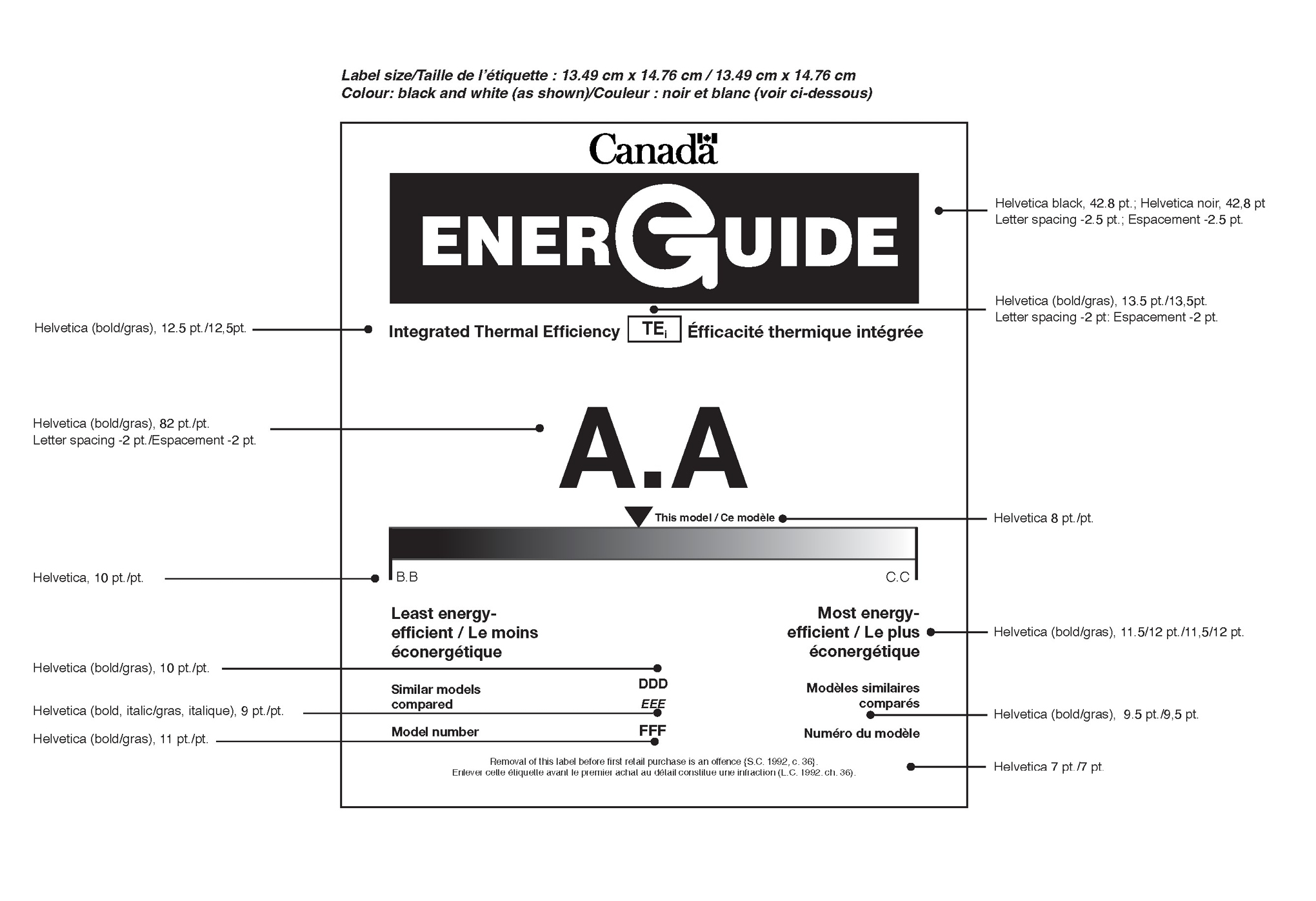
Terms of use and Privacy notice
Terms of use
It is your responsibility to ensure that the comments you provide do not:
- contain personal information
- contain protected or classified information of the Government of Canada
- express or incite discrimination on the basis of race, sex, religion, sexual orientation or against any other group protected under the Canadian Human Rights Act or the Canadian Charter of Rights and Freedoms
- contain hateful, defamatory, or obscene language
- contain threatening, violent, intimidating or harassing language
- contain language contrary to any federal, provincial or territorial laws of Canada
- constitute impersonation, advertising or spam
- encourage or incite any criminal activity
- contain external links
- contain a language other than English or French
- otherwise violate this notice
The federal institution managing the proposed regulatory change retains the right to review and remove personal information, hate speech, or other information deemed inappropriate for public posting as listed above.
Confidential Business Information should only be posted in the specific Confidential Business Information text box. In general, Confidential Business Information includes information that (i) is not publicly available, (ii) is treated in a confidential manner by the person to whose business the information relates, and (iii) has actual or potential economic value to the person or their competitors because it is not publicly available and whose disclosure would result in financial loss to the person or a material gain to their competitors. Comments that you provide in the Confidential Business Information section that satisfy this description will not be made publicly available. The federal institution managing the proposed regulatory change retains the right to post the comment publicly if it is not deemed to be Confidential Business Information.
Your comments will be posted on the Canada Gazette website for public review. However, you have the right to submit your comments anonymously. If you choose to remain anonymous, your comments will be made public and attributed to an anonymous individual. No other information about you will be made publicly available.
Comments will remain posted on the Canada Gazette website for at least 10 years.
Please note that communication by email is not secure, if the attachment you wish to send contains sensitive information, please contact the departmental email to discuss ways in which you can transmit sensitive information.
Privacy notice
The information you provide is collected under the authority of the Financial Administration Act, the Department of Public Works and Government Services Act, the Canada–United States–Mexico Agreement Implementation Act,and applicable regulators’ enabling statutes for the purpose of collecting comments related to the proposed regulatory changes. Your comments and documents are collected for the purpose of increasing transparency in the regulatory process and making Government more accessible to Canadians.
Personal information submitted is collected, used, disclosed, retained, and protected from unauthorized persons and/or agencies pursuant to the provisions of the Privacy Act and the Privacy Regulations. Individual names that are submitted will not be posted online but will be kept for contact if needed. The names of organizations that submit comments will be posted online.
Submitted information, including personal information, will be accessible to Public Services and Procurement Canada, who is responsible for the Canada Gazette webpage, and the federal institution managing the proposed regulatory change.
You have the right of access to and correction of your personal information. To seek access or correction of your personal information, contact the Access to Information and Privacy (ATIP) Office of the federal institution managing the proposed regulatory change.
You have the right to file a complaint to the Privacy Commission of Canada regarding any federal institution’s handling of your personal information.
The personal information provided is included in Personal Information Bank PSU 938 Outreach Activities. Individuals requesting access to their personal information under the Privacy Act should submit their request to the appropriate regulator with sufficient information for that federal institution to retrieve their personal information. For individuals who choose to submit comments anonymously, requests for their information may not be reasonably retrievable by the government institution.